The evolution of U.S. policy toward Greenland: military-strategic and diplomatic aspects (1941—1968)


Abstract
The article examines the formation and evolution of the U.S. policy toward Greenland between 1941 and 1968. The purpose of the study is to identify how Greenland’s place in American foreign policy and defence planning evolved over time, as well as to determine the role of interagency coordination in shaping Washington’s policy toward Greenland. The research is based on declassified archival materials from U.S. foreign policy, intelligence, and military agencies, many of which are introduced into scholarly circulation for the first time. These materials make it possible to trace the relationship between U.S. strategic objectives, the dynamics of bilateral relations with Denmark, and the development of Arctic infrastructure. The study finds that Greenland’s significance for the United States gradually extended beyond the requirements of local defence and became part of a broader strategy of containing the Soviet Union. It demonstrates that, at different stages, Washington combined diplomatic flexibility with a persistent commitment to maintaining a long-term military presence on the island. Particular attention is paid to the changing functions of American military infrastructure in Greenland as nuclear strategy, delivery systems, and early-warning capabilities evolved. The article concludes that U.S. policy toward Greenland was shaped not by a single factor but by a combination of strategic, diplomatic, and institutional interests. It further argues that the crisis surrounding the American military presence in 1968, triggered by the crash of a U.S. bomber carrying nuclear weapons, revealed the limitations of the previous model of bilateral cooperation.
Introduction
Greenland has recently moved to the forefront of the international political agenda. The issue gained prominence following statements by U. S. President Donald Trump, who publicly expressed interest in the United States acquiring the island as early as 2019. After returning to the White House in 2025, he revisited the subject, linking control over Greenland to U. S. national security interests in the Arctic. The President’s rhetoric provoked a negative response both in Denmark and across Europe more broadly, renewing debate over the seriousness of Trump’s intentions and his view of Greenland as one element of a new U. S. missile defense architecture.
Contemporary U. S. interest in Greenland, however, is not a new phenomenon but has deep historical roots. In this context, it is particularly important to examine how U. S. strategy toward Greenland was formulated and transformed during the Cold War, what government agencies shaped its content, how Washington balanced diplomatic considerations against military-strategic priorities, and how Denmark and the United States managed their interaction with regard to Greenland.
Historiography and research methodology
In foreign historiography, U. S. policy toward Greenland during the Cold War has received considerably more extensive treatment than in Russian historical research. The principal point of departure for most studies remains the collective volume Greenland During the Cold War: Danish and American Security Policy, 1945—68, published by the Danish Institute of International Affairs.1 Based on both Danish and American sources, the study sought to provide a comprehensive reconstruction of U. S.-Danish relations regarding Greenland. Nevertheless, although it remains the most comprehensive study, a number of archival collections declassified in subsequent years were unavailable to its authors at the time of writing. This makes it necessary to reassess and update its conclusions in light of newly accessible sources.
Subsequent research developed primarily through increasing thematic specialisation. A substantial body of scholarship has focused on the military and strategic dimensions of U. S. policy toward Greenland. In particular, Petersen’s studies examine the role of the American base at Thule within the broader context of U. S. polar strategy [1; 2]. Fischer likewise addressed the modernization of the American radar installation at Thule Air Base, although his research focused on U. S.-Danish relations during the final phase of the Cold War [3]. The evolution of negotiations between Washington and Copenhagen over the deployment of American military facilities in Greenland has been examined in the works of Clive Archer [4; 5]. Historians have also shown sustained interest in the development of U. S. strategic aviation, including its operations in the northern regions [6—8]. A broad range of studies has addressed the military and scientific development of Greenland by the United States during the Cold War [9; 10]. Olesen’s works focus primarily on Danish sovereignty over Greenland in the context of Copenhagen’s relations with Washington, as well as on the diplomatic dimension of U. S.-Danish interaction concerning the deployment of nuclear weapons on the island [11; 12]. In addition, some studies examine nuclear incidents during the Cold War, including the 1968 crash in Greenland of a U. S. bomber carrying nuclear weapons [13].
In Russian historiography, U. S.-Danish relations regarding Greenland have been examined only fragmentarily. The most extensively studied subject is U. S. military and strategic planning during the Cold War and the role of the American Thule base within a broader military-strategic framework [14]. Several studies have also addressed secret U. S. projects for the exploration and development of Greenland during the Cold War, particularly with regard to the potential military use of the island’s northern territories [15]. These works, however, do not examine the U. S.-Danish relations. It may therefore be argued that the interagency coordination through which Washington formulated its foreign policy and military strategy toward Greenland remains insufficiently studied in both Russian and international historiography.
The present study pursues two principal objectives. First, it seeks to supplement existing knowledge of U. S.-Danish relations concerning Greenland between 1941 and 1968 through the use of newly declassified sources. Second, it shifts the analytical emphasis toward the process of interagency coordination within the United States in the formulation and implementation of foreign policy and military-strategic approaches toward Greenland during this period — an aspect that has received considerably less attention in the historiography.
The study is based on a group of sources produced by U. S. government agencies involved in the implementation of foreign policy. These include analytical reports, internal memoranda, and diplomatic notes of the Department of State, some of which have not previously been introduced into Russian scholarly circulation. Newly declassified CIA documents, likewise little used by researchers, constitute another important part of the source base and provide additional detail for the analysis of the subject. To examine the political-military and strategic dimensions of Washington’s policy toward Greenland, the study also makes use of documents produced by the National Security Council (NSC), as well as primary sources from the Joint Chiefs of Staff (JCS), the Department of Defense, and the Strategic Air Command (SAC).
Taken together, these sources serve two interrelated purposes. First, they make it possible to situate U. S.-Danish relations regarding Greenland within the broader American debate over the island’s strategic significance during the Second World War and the Cold War, up to 1968. Second, documents produced by U. S. diplomatic and military agencies reveal the principal issues and disagreements that arose within Washington during the interagency coordination and formulation of U. S. strategy toward Greenland.
The chronological scope of the study is determined by the internal logic of the problem under examination. The starting point is the signing of the U. S.-Danish agreement of 9 April 1941, which established the legal framework for the American military presence in Greenland. The endpoint is marked by the crash of a U. S. B-52 bomber near the American air base at Thule in 1968. The accident brought an end to the practice of continuous U. S. airborne patrols carrying nuclear weapons over Greenland and, more broadly, worldwide, while also compelling Denmark and the United States to reconsider their secret understandings concerning the presence of American nuclear weapons on the island.
Theoretical framework
The study draws on the two-level game model developed by the American political scientist Robert Putnam [16]. The central premise of this approach is that foreign policy operates simultaneously at two levels. It encompasses not only negotiations, agreements, disagreements, and confrontation between states, but also a complex and nonlinear process of domestic coordination through which foreign policy is formulated. The principal actors at this level include not only public opinion, which may exert considerable pressure on political leaders, but also elite groups, bureaucratic institutions, political parties, and interest groups.
Whereas the interstate dimension, or Level I, is generally more accessible to scholarly analysis, the domestic dimension, or Level II, is considerably more difficult to reconstruct, particularly where interagency and intra-elite coordination is concerned. This difficulty stems from the secrecy, institutional opacity, and informal character of many such processes. In this respect, the full application of the two-level game model depends on access to evidence revealing the positions and interests of actors operating at Level II; where such evidence is unavailable, the explanatory value of the model is necessarily reduced.
For the present study, however, the application of the two-level game framework is well justified. The substantial body of declassified U. S. documents relating to the formulation of policy toward Greenland makes it possible to reconstruct interagency coordination in Washington more comprehensively and, in turn, to trace the broader evolution of U. S.-Danish relations during the period under examination. The State Department, the Department of Defense, the Joint Chiefs of Staff, and the Strategic Air Command did not always agree on the optimal forms of the American presence in Greenland. As a result, negotiations with Denmark cannot be understood solely as an interstate process; they must also be examined at the domestic level. U. S. policy toward Greenland was therefore shaped by internal debates among several centres of decision-making, each of which defined the limits of acceptable compromise differently.
The theory of asymmetric alliances provides an additional analytical framework for the present study. From this perspective, relations between allies are not treated as an interaction between equal partners, but as a system in which the weaker state receives security guarantees and access to resources, while the stronger state gains access to infrastructure, political support, and opportunities to expand its influence. The junior ally, however, is not merely an object of pressure exercised by a great power. It may also rely on its own foreign policy resources to influence or constrain the strategy of its more powerful partner.
This pattern was clearly evident in U. S.-Danish relations concerning Greenland. Although Washington possessed overwhelming military and political superiority, it was nevertheless compelled to take account of Copenhagen’s position as the holder of sovereign rights over the island. The asymmetry of power therefore did not eliminate the need for negotiation, but instead gave it a distinctive form. The United States had to identify politically and institutionally acceptable means of securing its interests that Denmark could present as compatible with its own sovereignty and domestic political requirements.
In this sense, U. S.-Danish relations during the period under examination cannot be reduced either to a model of unilateral American dictate or to one of partnership between equals. Denmark remained militarily and strategically dependent on the United States. At the same time, it retained the ability to restrict certain forms of the American presence. At a minimum, Copenhagen could insist that this presence be framed in ways that were more diplomatically acceptable and easier to defend before Danish public opinion.
Taken together, these theoretical approaches allow for a more precise interpretation of U. S. policy toward Greenland. The arrangements reached between Washington and Copenhagen were shaped not only by the island’s objective strategic importance and by the military superiority of the United States, but also by multilevel bargaining. Foreign policy decisions were closely connected to interagency coordination and to the ability of both governments to secure domestic legitimacy for the international agreements they concluded.
Greenland in U. S. military and strategic planning, the 1940s—early 1950s
Throughout the second half of the nineteenth century and the first half of the twentieth century, the United States repeatedly explored the possibility of acquiring Greenland from Denmark.2 The issue, however, assumed far greater strategic importance following the outbreak of the Second World War, when the defense of Greenland came to be regarded in Washington as an important component of U. S. national security. It should be emphasised, however, that the United States did not immediately respond to the proposal advanced by the Danish Minister to the United States, Henrik Kauffmann, who in April 1940 urged Secretary of State Cordell Hull to establish an American protectorate over Greenland.3 Hull responded cautiously, warning that such a step could establish a precedent for the American occupation of another state’s territory and might subsequently be invoked by other powers to justify aggressive territorial expansion. President Franklin D. Roosevelt shared this cautious approach, maintaining that extending the Monroe Doctrine to Greenland would be premature [17].
Strategic considerations, however, soon outweighed the Secretary of State’s initial reservations. Preventing Nazi Germany from establishing control over Greenland became an increasingly important objective in view of the island’s significance as a key strategic position in the North Atlantic. Control of Greenland would have enabled the Axis powers to exert influence over the region’s maritime and air lines of communication. Against this background, in November 1940 Assistant Secretary of State Adolf A. Berle Jr., during discussions with Henrik de Kauffmann and the Governor of South Greenland, Aksel Svane, cautiously raised the question of “whether some defense measures beyond the resources of the Greenland authorities should not be instituted.”4
In February 1941, Berle articulated Washington’s emerging position on Greenland. The U. S. foreign policy establishment regarded the island as an important component of the inter-American defense system and considered it to fall within the scope of the Monroe Doctrine.5 Under this interpretation, Greenland also came within the framework of the Havana Act, adopted by the foreign ministers of the American republics in late July 1940, which provided for collective measures to safeguard the security of the Western Hemisphere. Berle further emphasised that the United States was prepared to provide the Greenland authorities with financial and technical assistance for the construction of airfields that could be used by the armed forces of the American republics.
As the military and political situation in Europe continued to develop, however, Washington modified its position on defense infrastructure in Greenland. In March 1941, German bombers repeatedly flew over the island’s eastern coast.6 A telegram sent to the U. S. Consul in Greenland, James K. Penfield, on 4 April 1941 stated that all facilities under construction would fall under U. S. jurisdiction and would be protected by American armed forces.7
These developments culminated in the signing of the Agreement Relating to the Defense of Greenland on 9 April 1941. The agreement reaffirmed Danish sovereignty over Greenland while authorising the deployment of U. S. forces to defend the island and prevent its occupation by the Axis powers. Notably, the agreement did not specify a time limit for the American military presence. Instead, Article X stipulated: “This Agreement shall remain in force until it is agreed that the present dangers to the peace and security of the American Continent have passed.”8 This ambiguous provision would later become a source of disagreement between the United States and Denmark in the postwar period. Although the German-occupied Danish government declared on 12 April 1941 that Kauffmann had been recalled and that the agreement he had signed was invalid, Washington regarded the document as providing a legitimate legal basis for the deployment of U. S. armed forces to Greenland.
The end of the Second World War did not bring the 1941 agreement to an end. It was approved by the Danish Parliament on 16 May 1945. Amid continuing uncertainty in Soviet-American relations, the U. S. political and military leadership saw little reason to hasten the withdrawal of American forces from Greenland [18]. In 1946, Secretary of State James F. Byrnes informed Danish Foreign Minister Gustav Rasmussen that Washington was interested in purchasing Greenland and presented him with a memorandum outlining the proposal.9 The initiative, however, was not pursued further, as the Danes, in the aftermath of the Second World War, were particularly determined to preserve their sovereignty over their last remaining dependent territory. By 1947, the increasingly evident division between the Soviet Union and the United States, together with the gradual institutionalisation of the Cold War, had begun to reshape Washington’s strategy toward the Arctic island.
In a January 1947 memorandum to Secretary of State George C. Marshall on U. S. national security interests in the North Atlantic, H. Freeman Matthews, Director of the Office of European Affairs, noted that the Danish government was seeking to revise the 1941 agreement governing the stationing of U. S. forces in Greenland.10 Under these circumstances, the Joint Chiefs of Staff identified two outcomes as most advantageous to Washington: the purchase of Greenland from Denmark or the acquisition of long-term rights to station American forces on the island.11
On 26 May 1947, the Central Intelligence Group (CIG) — the immediate institutional predecessor of the Central Intelligence Agency, established later that year — informed President Harry S. Truman that Danish Prime Minister Knud Kristensen had conveyed through U. S. Ambassador Josiah Marvel that “the Communists intend to introduce a resolution in Parliament calling for action to terminate the US-Greenland defense agreement and restore Denmark’s sovereignty.”12 The prime minister further indicated that the resolution would receive support from other parliamentary groups, thereby compelling his own party to endorse it as well. At the same time, however, the CIG cited reports from the U. S. Military Attaché in Copenhagen, who regarded the prospect of the resolution’s adoption as “extremely remote.”13
During talks held in October 1947 between Secretary of State George C. Marshall, Danish Foreign Minister Gustav Rasmussen, and Ambassador Henrik de Kauffmann, the American side made it clear that the continued U. S. military presence in Greenland was not open to negotiation. Given the island’s importance to the defense of the Western Hemisphere, Washington sought only to devise an arrangement that would be acceptable to both governments.14 The Danish representatives, in turn, emphasised that their government was facing mounting domestic pressure from public opinion demanding the termination of the American military presence on the island.
At the same time, although the Soviet Union did not exert direct pressure on Denmark over the continued stationing of U. S. forces in Greenland, it closely monitored developments in the region. The Soviet representative in Copenhagen, for example, inquired about reports that the United States intended to purchase Greenland. In response, he was referred to Rasmussen’s public statement, made only a few days earlier, that “Greenland is not for sale.”15
By January 1948, however, Benjamin Hulley, Acting Chief of the Division of Northern European Affairs, reported, following a meeting between Under Secretary of State Robert Lovett and Ambassador Kauffmann, that the latter had become particularly concerned about the growing intensity of Soviet propaganda. According to Kauffmann, Soviet propaganda was influencing Danish public opinion and strengthening demands for the withdrawal of American forces from Greenland.16
On 25 November 1947, a top-secret report was prepared for the National Security Council that addressed, among other issues, Greenland’s importance to U. S. defense planning.17 The report stated: “It is difficult to conceive of a war in the next 15 or 20 years in which Greenland, Iceland, and the Azores would not be of extreme importance to our war effort.”18 Against this background, it unequivocally asserted that these territories would have to be occupied in the event of a major war. From a military-strategic perspective, the report identified four reasons why these territories were of particular importance to the United States: first, as bases for offensive military operations; second, as bases forming part of the U. S. defense system; third, as territories that had to be denied to potential adversaries; and fourth, as refuelling bases for aircraft. Greenland was described as one of the few locations from which very heavy bombers could launch direct strikes against the industrial centers of the prospective enemy — the USSR. Military planners further maintained that the deployment of early-warning radar and interceptor missiles in Greenland would significantly complicate any Soviet attempt to launch an air attack against the United States.
Nevertheless, amid growing public opposition in Denmark to the continued American military presence in Greenland, the State Department decided not to press for the immediate conclusion of a comprehensive long-term agreement governing U. S. bases on the island. Although the Joint Chiefs of Staff had prepared a draft agreement, the Department refrained from formally transmitting it to Copenhagen through Ambassador Kauffmann in March 1948, recognising that such a step would place the Danish government in a politically difficult position. Danish Foreign Minister Gustav Rasmussen subsequently expressed his gratitude to the U. S. government for this decision.19
From that point onward, the negotiations effectively entered a prolonged phase of informal and semi-official consultations, during which both governments sought to avoid harsh and poorly considered decisions. Copenhagen urged Washington to refrain from planning major new infrastructure projects on the island, fearing that such initiatives could provide the Soviet Union with grounds to accuse Denmark of entering into a military alliance with the United States.20 The Danish government also sought a number of concessions, including the transfer of certain facilities in Greenland for Danish use, which could be presented to the Danes as evidence of the gradual restoration of Denmark’s full and effective sovereignty over the island.21 In Rasmussen’s view, however, it would be sufficient for these to consist only of minor installations that were of little practical significance to U. S. military planning.22 Overall, the Central Intelligence Agency concluded that Denmark was satisfied with the general course of negotiations with the United States concerning military bases in Greenland.23
Nevertheless, Washington did not abandon its objective of securing long-term access to military facilities in Greenland. In October 1949, the State Department prepared a classified policy paper outlining the principal objectives of U. S. policy toward Denmark.24 One of its principal objectives was the replacement of the 1941 agreement with a long-term bilateral defense agreement that would guarantee the continued American military presence on the island. The Joint Chiefs of Staff had previously advanced the same proposal in an internal memorandum.25
By the end of the 1940s, an interagency consensus had emerged in Washington regarding the need to maintain an American presence in Greenland. Although strategic planners continued to disagree over the considerable financial costs associated with maintaining military installations on the island, strategic imperatives outweighed budgetary considerations. An especially important turning point came with the Soviet Union’s successful test of its first atomic bomb in August 1949, which gave impetus to a reassessment of U. S. strategy toward Greenland. Whereas before 1949 the island had constituted an important component of the American “perimeter strategy,”26 it subsequently became one of the key elements of the United States’ polar strategy [2, p. 90]. This transformation was closely linked to the entry into service of the B-36 intercontinental bomber, which increased the strategic importance of the shortest Arctic air routes while simultaneously turning Greenland into an important intermediate staging point [2, p. 91]. In the autumn of 1950, Secretary of the Air Force Thomas K. Finletter argued that forward American bases with permanently stationed forces, forming part of the perimeter for the containment of the Soviet Union, had become highly vulnerable to both conventional and nuclear Soviet attacks [2, p. 93].
These developments explain the resumption of formal negotiations between Denmark and the United States in October 1949 over an agreement governing the stationing of American forces in Greenland. The establishment of NATO and Denmark’s accession to the Alliance in April 1949 were viewed positively in Copenhagen because they offered an opportunity to move bilateral negotiations with Washington into a multilateral framework, thereby making the issue more acceptable to Danish public opinion27.
For nearly two years, the United States and Denmark negotiated the future of Greenland’s defense arrangements. Washington’s principal objectives were to secure long-term access to existing military facilities while preserving the ability to construct new ones. These priorities partly reflected a broader reassessment of U. S. strategy. Under the earlier perimeter strategy, South Greenland had been valued primarily as a base for air operations against the Soviet Union and as a transit point for military aircraft. By contrast, the polar strategy shifted the focus toward North Greenland, whose location along the shortest transpolar route made it particularly well suited both for long-range bomber operations and for the deployment of early-warning systems.
Within this strategic framework, the construction of a major air base at Thule assumed particular importance. Although Washington informed Copenhagen of its intentions, it presented its demands as part of NATO’s broader program for the development of military infrastructure. In December 1950, a study was conducted under the direction of Colonel George Glover — the so-called Glover Committee. Its authors concluded that the establishment of a military base at Thule would enable B-36 bombers to strike up to 85 per cent of all targets within the Soviet Union [2, p. 93].
For Denmark, the negotiating position was shaped by pragmatic political considerations. Above all, the future agreement had to be presented to the domestic audience as a diplomatic success in the context of the restoration of Denmark’s full sovereignty over Greenland. The termination of the 1941 agreement — which had granted the United States virtually unrestricted rights on the island — the subsequent transfer of American facilities to Danish ownership, and the possibility of appointing a Danish officer as the nominal commander of the joint forces in Greenland were regarded as sufficient conditions to secure a favourable Danish response to the new agreement.28
The U. S.-Danish agreement governing the stationing of American forces in Greenland was signed on 27 April 1951, providing a formal legal foundation for the U. S. military presence. Officially, the agreement was portrayed as a diplomatic success for Denmark because, unlike the 1941 agreement, it granted the United States limited rights to use specified military installations, including the bases at Thule, Søndrestrømfjord, and Narsarsuaq.29 Even before the agreement was signed, the CIA reported that the Danish government was eager to announce its conclusion as quickly as possible to prevent speculation in the press.30 Copenhagen feared accusations that it had acted under American pressure and no longer exercised effective control over the island. From the American perspective, it was particularly important that the agreement was tied to the continued existence of NATO, since this protected it against premature termination due to the influence of domestic political factors, as it had occurred with the 1941 agreement.
The 1951 agreement created legal ambiguity regarding the deployment of nuclear weapons in Greenland. The treaty neither prohibited nor authorised the deployment of U. S. nuclear weapons on the island, effectively placing the issue in a legal grey area. Washington deliberately avoided drawing attention to the possible deployment of nuclear weapons in Greenland. As early as January 1951, the Military Liaison Committee to the Atomic Energy Commission advised that American diplomats should refrain from drawing their Danish counterparts’ attention to the issue, since doing so might result in the suspension of negotiations over the new agreement [19, p. 33]. This unresolved ambiguity would later contribute to a serious deterioration in U. S.-Danish relations following the 1968 nuclear accident.
U. S. interests in Greenland, 1951—1958
The period from 1951 to 1958 was marked by the systematic development and use of the areas and facilities made available to the United States under the 1951 agreement. Accelerated construction of Thule Air Base began in the summer of 1951. The initial phase was largely completed by 1952, although the base did not become fully operational until the middle of the decade. Washington also began to consider acquiring an additional area in northeastern Greenland. These plans, however, encountered opposition from Copenhagen and were ultimately abandoned.31
Following the commissioning of Thule Air Base in 1952, the Strategic Air Command, which had controlled the base since 1957, began using it for military exercises. During this period, American military planners regarded Thule not as a permanent bomber base, but as a forward staging base intended to receive U. S. aircraft — primarily B-36 strategic bombers — for short-term rotational deployments. This approach was partly associated with the Joint Air Defense Board’s 1954 decision to limit the concentration of strategic aircraft at any single military base.32 The broader concept called for the dispersal and continuous rotation of strategic bombers to reduce their vulnerability to a surprise attack and prevent the loss of a substantial proportion of the U. S. nuclear delivery force. Moreover, the development of aerial refuelling capabilities using KC-97 tanker aircraft made it possible to employ B-47 jet bombers.
In November 1952, a CIA intelligence report stated that the establishment of a Soviet military base at Tiksi was intended to counter the newly constructed U. S. base at Thule.33 The report also noted the continued expansion of rail and maritime infrastructure required to support Soviet military installations in the Arctic. Washington feared that the Soviet Union was strengthening its military capabilities in the region and might thereby gain an advantage in launching a first strike. These concerns reinforced the perceived need to integrate Thule Air Base more fully into the U. S. system of nuclear deterrence against the Soviet Union and to develop the necessary supporting infrastructure there.
In 1954, reports began to emerge concerning the construction of “special storage facilities” intended to house nuclear weapons, specifically Mk 6 and Mk 8 atomic bombs. Although there is no official evidence that U. S. nuclear weapons were deployed in Greenland before 1958, the Danish authorities were unofficially aware of the construction of specialised storage hangars at Thule Air Base, which caused considerable concern.34 The only documented use of nuclear technology in Greenland in the mid-1950s involved small nuclear reactors operated by the U. S. military to provide electricity for remote military installations.35
By the winter of 1955, the United States was already conducting exercises that simulated the use of nuclear weapons. The results of Exercise Ballet Dancer, held in February 1955, nevertheless revealed a number of serious obstacles to air operations in Greenland. These included the severe climatic conditions and inadequate heating facilities, which hindered the Strategic Air Command’s ability to achieve its operational objectives [2, p. 101].
In January 1955, Chairman of the Joint Chiefs of Staff Admiral Arthur W. Radford sent a memorandum to Secretary of Defense Charles E. Wilson in which he reiterated Greenland’s military importance in the context of containing the Soviet Union.36 The U. S. military continued to regard the 1951 agreement with Denmark as insufficiently responsive to American strategic requirements, since it did not provide complete freedom of action on the island and required Washington to coordinate its activities with Copenhagen. Under these circumstances, the Joint Chiefs of Staff once again advanced the desirability of purchasing Greenland from Denmark, a position also supported by the Secretary of Defense.37
This position may be attributed in part to the growing concern within the U. S. military and political establishment over the development of Soviet nuclear delivery capabilities. According to a 1955 CIA estimate, by mid-1958 the Soviet Union might possess 350 heavy jet bombers, 250 heavy turboprop bombers, and 450 aerial-refuelling tankers.38 From this perspective, Greenland appeared to be one of the vulnerable regions containing U. S. bases that the Soviet Union might attack to reduce Washington’s capacity to launch a retaliatory strike. Against this background, military planners sought to obtain full control over the island and thereby eliminate the need to coordinate their actions with Copenhagen.
Despite the difficulties involved in coordinating military construction with the Danish authorities, the U. S. Embassy in Copenhagen reported in May 1957 that, apart from the Communists, Danish public opinion was generally not critical of American military bases in Greenland.39 Although the diplomats noted that the preservation of Danish sovereignty over the country’s last remaining overseas territory was a particularly sensitive issue, objections to U. S. activities on the island were only sporadic. The Embassy concluded that negotiations with Denmark and the coordination of flight operations were proceeding satisfactorily and elicited no adverse reaction from Copenhagen. In contrast to the Department of Defense, the State Department, represented by Assistant Secretary of State for European Affairs C. Burke Elbrick, believed that the time for purchasing Greenland had passed. The Danish Constitution of 1953 had made the island an integral part of the country, rendering any negotiations over its acquisition virtually impossible.40
The Soviet Union’s test of its first intercontinental ballistic missile in August 1957, however, prompted significant adjustments in U. S. defense planning and altered Greenland’s role in American military strategy. Washington’s efforts to establish the Distant Early Warning Line (DEW Line) began in the mid-1950s following authorisation by President Dwight D. Eisenhower, and Greenland was incorporated into the system. By the end of the decade, however, the DEW Line had begun to assume a secondary role in the defense of the United States. The system had been designed primarily to provide warning of attacks by strategic bombers and was poorly suited to detecting ballistic-missile launches. Secretary of Defense Robert S. McNamara subsequently observed that “large portions of the existing surveillance, warning and control system constructed during the 1950s are either obsolete or of marginal value to our overall defense.”41
In November 1957, the National Security Council prepared a report for the President on nuclear deterrence that reaffirmed the importance of Thule Air Base.42 The report noted, in particular, that the Arctic offered the most suitable locations for ballistic-missile early-warning systems, thereby increasing Greenland’s significance in U. S. military and strategic planning. By the late 1950s and early 1960s, Thule had become an important component of the new Ballistic Missile Early Warning System (BMEWS), representing a fundamental transformation in the base’s role compared with the preceding period.
Under the terms of a supplementary agreement between Denmark and the United States, Washington obtained the right to expand its military infrastructure into four additional areas, which became operational in 1961.43 In August 1959, Secretary of Defense Neil H. McElroy informed President Eisenhower’s Special Assistant for National Security Affairs, Gordon Gray, that the early-warning installation at Thule was 50 per cent complete and was scheduled to become fully operational in September 1960.44 A 1960 NSC report identified the continued availability of U. S. military bases in Greenland as one of the country’s principal strategic objectives, both because they supported the ability to conduct strikes against the Soviet Union and because they provided sites for missile- and air-defense systems.45
As early as October 1957, during talks between Soviet Foreign Minister Andrei A. Gromyko and U. S. Secretary of State John Foster Dulles, the latter proposed that ground inspections and aerial photography should begin in the Arctic. Dulles argued that the region was the most likely avenue for a surprise attack and, unlike Europe, was politically less contentious as an area in which to introduce such measures.46 He added that Washington maintained an important military base at Thule, while the Soviet Union had conducted nuclear tests in the region, making Arctic inspections reasonable. Gromyko responded humorously that aerial photography would produce only “pictures of ice, snow and polar bears” and rejected Dulles’s proposal. The Soviet position was understandable. Although the United States continued to rotate strategic aircraft through Greenland, it did not maintain nuclear weapons on the island on a permanent basis. This substantially reduced the value of such inspections in the eyes of the Soviet leadership, since the Soviet Union itself maintained permanently based military installations in its Arctic regions.
Deployment of U. S. nuclear weapons in Greenland
To date, no declassified documents have been identified that fully explain the reasoning of the U. S. military command behind the decision to deploy nuclear weapons in Greenland. One plausible explanation is Washington’s broader adherence to the doctrine of “massive retaliation,” which envisaged the delivery of multiple nuclear strikes against Soviet territory. In this context, storing nuclear weapons in Greenland would have enabled bombers returning from an initial strike against the Soviet Union to take on additional warheads for subsequent missions.
The Department of Defense maintained that, under the 1951 agreement, Washington was not required to notify Copenhagen of its intention to deploy nuclear weapons in Greenland. The State Department nevertheless considered it necessary to obtain the opinion of the U. S. Ambassador to Denmark, Val Peterson, and sent him a corresponding request in August 1957.47 Given the negative Danish reaction to the possible deployment of American nuclear weapons on Danish territory, as well as the Danish government’s assurances that no such weapons would be stationed there, Peterson believed that the Danes should not be “informed of something they would not wish to know.”48
In October 1957, however, the State Department instructed the Ambassador to ascertain informally the position of the Danish authorities regarding the possible “nuclearisation” of Greenland.49 In November, Peterson reported to Washington that, following a meeting with Prime Minister H. C. Hansen, the latter had handed him a document stating that he saw no problem with the storage of “supplies of munitions of a special kind” in Greenland. U. S. officials interpreted this statement as tacit consent to the deployment of nuclear weapons.50
Deputy Under Secretary of State Robert Murphy, who oversaw the State Department’s handling of the nuclear negotiations with Denmark, subsequently informed Assistant Secretary of Defense Mansfield Sprague that Copenhagen’s consent had been obtained. Murphy emphasised, however, that it was of the utmost importance to both the United States and Denmark that the understanding remains secret.51 In February 1958, four nuclear weapons were deployed at Thule, although they were removed by October of the same year [2, p. 104].
The highly ambitious U. S. plan to construct an extensive network of tunnels beneath the Greenland ice sheet for the deployment of nuclear weapons must also be taken into account. The initiative became known as Project Iceworm [20]. The planned tunnel system was to extend for approximately 3,000 kilometres and accommodate 600 Iceman ballistic missiles. By 1962, however, it had become clear that the project faced serious technical limitations. Heat generated by the small nuclear reactor supplying power to the underground Camp Century installation, together with the natural movement of the ice sheet, contributed to the rapid deformation of the tunnels. These conditions made the construction and safe operation of a full-scale underground nuclear-missile network impracticable. The project was abandoned in 1966, and no ballistic missiles were ever deployed in Greenland.
As noted above, the role of the U. S. military installation in Greenland had changed by the beginning of the 1960s. The introduction of the intercontinental B-52 bomber and the growing expectation that a Soviet attack on the United States would involve intercontinental ballistic missiles transformed Thule into an important but vulnerable component of the Ballistic Missile Early Warning System. U. S. military and political leaders feared that a surprise attack on the installation in Greenland might deprive the United States of advance warning of an incoming Soviet ICBM strike.
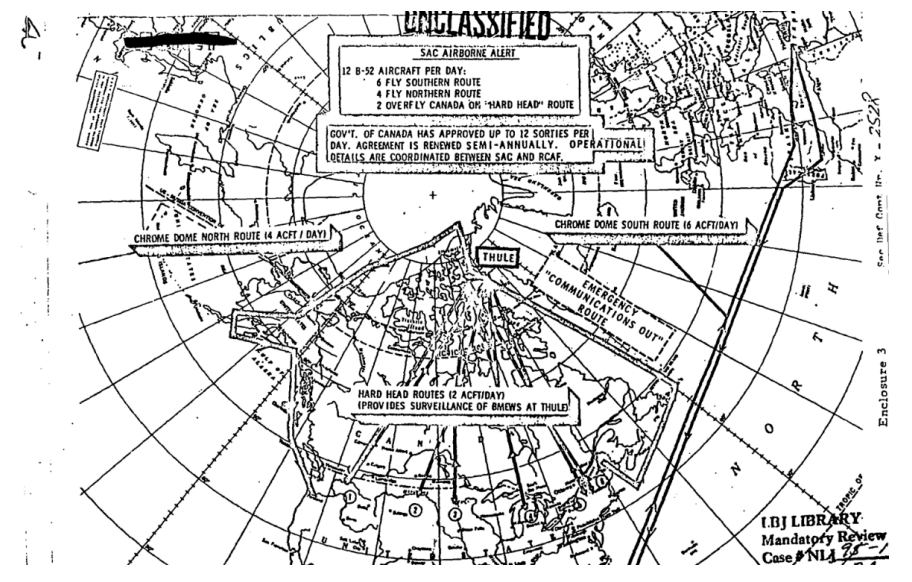
Against this background, General Earle G. Wheeler, then Director of the Joint Staff, sent a memorandum to Secretary of Defense Robert S. McNamara in August 1961 informing him that the Strategic Air Command had modified one of its airborne-alert routes to provide continuous, twenty-four-hour monitoring of the BMEWS installation at Thule.52 Particular concern centred on the submarine communications cable linking Greenland with Newfoundland. American planners believed that the Soviet Union might first disrupt communications with Thule and then launch a missile attack against the United States. In November 1961, for example, the transmission of signals from the Greenland installation abruptly ceased, immediately alarming SAC. Within several minutes, however, the airborne patrol reported that the base remained intact and was operating normally [2, p. 112].
It is important to note that continuous airborne patrols over Greenland formed part of a broader U. S. program introduced in the late 1950s. Known as the Airborne Alert Program, it was intended to keep nuclear-armed strategic bombers continuously in the air so that they could rapidly strike targets in the Soviet Union. Although specific bomber routes were frequently modified, the northern route across Greenland remained one of the principal operational corridors, since it provided the shortest approach to a large number of targets on Soviet territory.
As of May 1964, twelve bombers were maintaining continuous airborne alert each day, four of them operating along the northern routes.53 In addition, two aircraft per day patrolled the Hard Head route, which covered the area containing the strategic communications links between the military installation in Greenland and the United States (Fig.).
Secretary of Defense Robert S. McNamara was sceptical of the Airborne Alert Program and advocated its termination.55 He argued, in particular, that by the mid-1960s intercontinental ballistic missiles had become the principal means of delivering nuclear weapons. He also maintained that improved missile-attack early-warning systems provided sufficient time to launch at least 50 per cent of the strategic bomber force.
Chairman of the Joint Chiefs of Staff General Earle G. Wheeler, however, opposed terminating the Airborne Alert Program. Despite the growing number of ICBMs, he argued that strategic bombers continued to carry the greater share of the total nuclear yield available to the United States.56 In a memorandum submitted on behalf of the Joint Chiefs of Staff in December 1965, Wheeler proposed reducing the number of airborne-alert sorties to six while preserving the program as a whole.57
The crash of a U. S. B-52 strategic bomber near the Spanish village of Palomares in January 1966 prompted major changes to the Airborne Alert Program. The eastern patrol route across the Atlantic was discontinued, and the total number of bombers maintained on airborne alert was reduced to four beginning in July 1966. Significantly, of the four remaining aircraft, one patrolled the northern route, another covered the Alaskan sector, and the other two conducted visual surveillance of the installation at Thule.58
By the end of the decade, the importance of the Airborne Alert Program had declined substantially. The divergence between the Department of Defense and the Joint Chiefs of Staff over the program’s continued utility, together with the nuclear accident in Spain, led to a major reduction in the number of strategic aircraft engaged in continuous airborne patrols. Against this background, the military-strategic value of Thule by the late 1960s derived increasingly from its role as a site for the ballistic-missile early-warning system.
Political-diplomatic and military-strategic dimensions of the B-52 crash in Greenland
On 21 January 1968, a U. S. B-52 strategic bomber conducting a patrol over the military installation at Thule crashed in North Star Bay, Greenland, with four Mk 28 nuclear weapons on board. Although the accident did not result in a nuclear detonation, the weapons’ conventional high explosives exploded, causing plutonium contamination across part of the crash site. The incident prompted both a reassessment of U. S. military strategy and serious political and diplomatic difficulties for Washington.
Although some members of the U. S. military establishment favoured continuing airborne patrols without nuclear weapons following the 1968 accident, the commander of the Strategic Air Command regarded such flights as strategically pointless. Patrols along the northern and western routes were therefore discontinued. Only surveillance flights over the Thule installation continued, now without nuclear weapons on board.
During a meeting with President Lyndon B. Johnson on 22 January, Secretary of Defense Robert S. McNamara stated that, in consultation with Chairman of the Joint Chiefs of Staff General Earle G. Wheeler, a decision had been made to terminate airborne-alert patrols carrying nuclear weapons.59 It is noteworthy, however, that the B-52 crash in Greenland received almost no discussion at the White House meeting. Attention focused primarily on other issues, including the situation in Southeast Asia and North Korea’s seizure of a U. S. intelligence-gathering vessel. McNamara’s brief remarks on the accident at Thule were almost immediately interrupted as the participants returned to the discussion of the ship’s capture in Northeast Asia.
Despite the difficult search conditions caused by extremely low temperatures, prolonged snowfall, and the polar night, the U. S. Atomic Energy Commission reported on 24 January that only “a low level of contamination” had been detected at the crash site60. On 30 January, the Air Force informed the Joint Chiefs of Staff that plutonium penetrating the ice and water could cause contamination severe enough to render the area uninhabitable for approximately 200 families.61 During a joint meeting of the Department of Defense and the Atomic Energy Commission, Assistant Secretary of Defense Carl Walske stated that “38 per cent of the total plutonium had been deposited on the snow and ice in the crash area,” while the contaminated zone covered approximately twenty acres62.
On 23 February, General Edward Giller reported to Washington that “99 per cent of the bomber wreckage had been recovered,” substantially reducing the level of radioactive contamination.63 Assistant Secretary of State for European Affairs John M. Leddy likewise informed Secretary of State Dean Rusk that the effective cooperation between the United States and Denmark, together with the public emphasis placed on the fact that all operations were being conducted by joint Danish-American teams, had helped avert a negative reaction among the Danish public.64 He further maintained that contamination levels remained low and that, under the agreement reached between the two governments, the United States would remove and process up to 50 per cent of the contaminated ice and snow.
The most difficult consequences for Washington arose in the political and diplomatic sphere. Following the B-52 crash, the Danish government was particularly concerned to avoid accusations from the Danes that it had secretly consented to the deployment of American nuclear weapons in Greenland. At a press conference held later that same day, Foreign Minister Hans Tabor stated that Copenhagen remained committed to its policy of prohibiting the stationing of nuclear weapons on Danish territory and that Washington was fully aware of this position.65 In the minister’s account, the crash had resulted from a malfunction aboard the American bomber during operations in the Arctic, after which the aircraft had attempted to make an emergency landing at Thule Air Base.
The Danish statements issued after the accident, however, provoked a negative reaction in Washington. The U. S. foreign policy establishment strongly opposed any public reference to understandings concerning either the deployment or the non-deployment of American nuclear weapons. Secretary of State Dean Rusk informed the U. S. Embassy in Copenhagen that the Danish Ambassador had been reminded of the secret nuclear understandings reached in the late 1950s. Rusk also reiterated the established U. S. formula on nuclear weapons: “Neither confirm nor deny publicly the presence of nuclear weapons aboard aircraft or at military installations anywhere in the world.”66
Washington further maintained that Copenhagen had tacitly consented to the continuation of nuclear-armed flights during a meeting between U. S. Ambassador William McCormick Blair Jr. and Denmark’s Deputy Permanent Under-Secretary responsible for Greenland affairs, Eske Brun, following the crash of a U. S. strategic bomber in Maryland in January 1964.67 From Washington’s perspective, therefore, the United States had not violated any understanding with Denmark. Any statement by Copenhagen concerning Greenland’s nuclear-free status, moreover, was expected to be made without reference to the United States.
During a meeting on 28 January between Danish Ambassador Torben Rønne and Secretary of State Dean Rusk, the latter insisted that the statement being prepared for Prime Minister Jens Otto Krag concerning Greenland should not refer to any consultations with the United States over the absence of nuclear weapons from the island. The statement was to present Denmark’s position alone.68 Washington feared that the creation of such a precedent could undermine the broader system of American nuclear deterrence by bringing questions concerning the deployment of U. S. nuclear weapons into the public domain. Significantly, when Rusk invoked the existing understandings concerning nuclear weapons in Greenland, Rønne replied that several public statements had already been made during the 1960s affirming Denmark’s opposition to the deployment of nuclear weapons on the island. In turn, Rusk stressed that the United States could not accept any interpretation under which it might be accused of violating its understandings with Denmark.
By the end of January, Washington’s principal concern was the potential impact of the incident on U. S. military arrangements along NATO’s northern flank.69 The intelligence community warned that the nuclear accident might provoke a broader investigation in Denmark and ultimately lead to demands for the renegotiation of existing base agreements, including the incorporation of an explicit prohibition on overflights by aircraft carrying nuclear weapons. There were also concerns that Iceland might pursue similar restrictions on U. S. military activities at its bases, thereby limiting Washington’s nuclear-deterrence capabilities in the region. Comparable pressures, although probably less pronounced, could also emerge in Norway.
Denmark nevertheless did not seek to renegotiate the 1951 Defense Agreement, as was made clear during informal contacts at the U. S. Embassy in Copenhagen.70 According to Ambassador Rønne, reopening the agreement “would open up far more serious problems than it would solve.”71 He argued that Greenland had acquired a substantially greater voice in matters affecting the island than it had possessed when the agreement was concluded in 1951. Any attempt to renegotiate the treaty would therefore bring Greenlandic representatives more directly into the process, effectively giving the negotiations a trilateral dimension that both governments preferred to avoid. Copenhagen consequently sought a more flexible formula that would prohibit the deployment of nuclear weapons in Greenland while remaining acceptable to Washington and avoiding any formal revision of the 1951 agreement.
David McKillop, head of the State Department office responsible for Scandinavian affairs, prepared a statement outlining the U. S. position on Greenland for eventual transmission to the Danish government and submitted it to Assistant Secretary of State for European Affairs John M. Leddy for approval. The document stated that the United States could provide confidential assurances that nuclear weapons would not be stored at American military installations in Greenland and that aircraft carrying nuclear weapons would not fly over the island.72 At the same time, it reaffirmed the established U. S. policy of neither confirming nor denying the deployment of American nuclear weapons abroad.
During the interagency review of McKillop’s draft, the Department of Defense stipulated that overflights by nuclear-armed aircraft should take place only with Denmark’s consent. It nevertheless warned that obtaining such consent might prove difficult in an emergency — understood primarily as a Soviet nuclear attack — because of the extremely limited time available for consultations.73 Washington thus sought to preserve a degree of operational flexibility that would allow it, in the event of a sudden Soviet attack, to make use of military facilities and airspace associated with Greenland even when prior consultation with Copenhagen might not be practicable. Ambassador Rønne subsequently reported that Washington’s assurances regarding the non-deployment of nuclear weapons and the prohibition of nuclear-armed overflights had been received favourably in Copenhagen.74
Following the crisis caused by the B-52 crash in Greenland, Washington’s principal objective was to preserve access to the ballistic-missile early-warning radar and to the air corridors required by U. S. strategic aviation in an emergency.75 To secure these interests, the United States was prepared to make concessions to Copenhagen by providing assurances that nuclear weapons would not be deployed in Greenland and that nuclear-armed strategic aircraft would not fly over the island. U. S. officials feared that, without such assurances, the Danish government might demand a comprehensive renegotiation of the 1951 Defense Agreement.
The Danish side, however, increasingly pressed for a legally binding arrangement prohibiting the presence of nuclear weapons in Greenland in any form. Washington opposed this approach and preferred to limit the settlement to a confidential exchange of notes.76 Ambassador Rønne further reported that the Danish Parliament was placing growing pressure on the government to obtain an official and public American assurance that nuclear weapons would not be deployed in Greenland. This demand likewise met with firm opposition in Washington.
The United States ultimately secured Danish acceptance of its preferred approach, avoiding both the conclusion of a separate legally binding agreement and any public statement on the issue. In March 1968, the State Department prepared a draft secret note stating that the United States would neither deploy nuclear weapons in Greenland in any form nor conduct overflights of the island by aircraft carrying such weapons. The draft nevertheless retained a provision concerning the emergency circumstances discussed above.77
After the note was presented to Ambassador Torben Rønne on 1 April, he indicated that the principal difficulty concerned the final paragraph dealing with emergency situations, which he believed could provoke an adverse reaction from the Danish Ministry of Foreign Affairs.78 Rønne argued that the need for an emergency response in such circumstances would be self-evident and did not require explicit mention. John M. Leddy replied that the B-52 crash, together with the fact that most members of the Danish government had been unaware of any previous understandings, had produced serious consequences for the United States that Washington wished to avoid in the future. In a subsequent memorandum to Assistant Secretary of Defense Paul C. Warnke, however, Leddy recommended that the United States should not turn the issue into a major dispute and should accommodate the Danish position.79
The Department of Defense generally accepted the State Department’s approach. Warnke nevertheless emphasized that the importance to the United States of nuclear-armed overflights of Greenland in an emergency should be communicated orally. He further proposed that this clarification be included in the memorandum of conversation, a copy of which would be provided to Ambassador Rønne.80 Secretary of State Dean Rusk81 and President Lyndon B. Johnson both approved this arrangement.82
Although Leddy informed Rønne that the United States would neither endorse nor comment on any Danish statement concerning the prohibition of nuclear weapons in Greenland, and although the wording of the proposed note was modified, the confidential exchange of notes ultimately took place at the end of May 1968.83 From Washington’s perspective, the resulting settlement represented a significant political and diplomatic success.
On the one hand, the United States preserved access to the ballistic-missile early-warning installation at Thule, which had acquired critical importance as ballistic missiles became the Soviet Union’s principal means of nuclear delivery.84 At the same time, the gradual termination of the Airborne Alert Program — because of its declining strategic utility, high costs, and considerable operational risks — had substantially reduced the importance of continuous nuclear-armed bomber patrols in U. S. strategy. Consequently, Washington no longer regarded regular overflights of Greenland by aircraft carrying nuclear weapons, which Denmark opposed, as essential. At the same time, the United States orally indicated that, in the event of a sudden emergency such as a Soviet attack, the limited time available might make prior consultation with Copenhagen impracticable. Denmark, for its part, was able to state publicly that no nuclear weapons were present in Greenland in any form, while the United States refrained from commenting on the Danish declaration. The resulting ambiguity was therefore politically advantageous to both governments.
Contemporary relevance
As great-power competition has become a central trend in contemporary international relations, rivalry in the Arctic has considerably intensified [21]. Unlike during the Cold War, interest in the region is now displayed not only by the Arctic states but also by a number of non-Arctic powers, including China, while competition encompasses both military-strategic and commercial and logistical dimensions [22]. An important indication of the growing significance of the Arctic in U. S. military and political planning was the adoption of the National Strategy for the Arctic Region in October 2022, followed in 2024 by the U. S. Department of Defense’s Arctic Strategy, which identified the region as one of the key areas affecting American national security. Against this background, Washington’s renewed attention to Greenland appears to be a logical development, given the strategic importance of the U. S. defense infrastructure established on the island.
The American military installation at Thule, renamed Pituffik Space Base in 2023, continues to perform many of the strategic functions assigned to it during the Cold War, including missile warning, missile defense, and space surveillance. The substantial modernisation of the radar installation at Thule during the 2000s enabled its deeper integration into the U. S. security architecture. Against the background of the broader deterioration of the arms-control system, growing tensions with Russia and China, and increasing risks of nuclear escalation, maintaining guaranteed U. S. access to the infrastructure at Pituffik remains one of the most important requirements of American national security [23]. Moreover, the military infrastructure established in Greenland is relevant to Washington’s stated intention to implement the Golden Dome project, which is intended to create a qualitatively new defense system against ballistic, hypersonic, and cruise missiles.
Donald Trump, elected once again as President of the United States in 2024, returned to the idea of changing Greenland’s status, which he had already raised during his first term in office. As during the Cold War, this position is largely connected to uncertainty within the U. S. political and military establishment regarding unrestricted access to military infrastructure in the event of a major conflict, as well as to the continuing need to coordinate American actions, to one degree or another, with the Danish and Greenlandic authorities. The emerging crisis of transatlantic solidarity has further intensified these concerns. In this context, the framework established by the 1951 agreement and supplemented by the 2004 agreement appears to the American side to be insufficiently flexible and in need of adaptation to new circumstances. Washington also recognises Greenland’s importance in terms of natural resources and critical minerals [24], although the Canadian scholar Frédéric Lasserre argues that their extraction remains labour-intensive and not entirely economically viable because of climatic conditions [25].
Nevertheless, Trump’s coercive approach to resolving the issue, reflected in threats of economic pressure and his refusal to rule out the use of U. S. armed forces, encountered substantial opposition not only from Denmark and Greenland but also from EU member states. The transactional approach of the incumbent U. S. president differs considerably from the secret negotiations of the Cold War and has substantially weakened Washington’s negotiating position because of the public pressure exerted on Denmark and Greenland [26]. It may nevertheless be assumed that confidential negotiations will continue, given the sensitivity of the issue for the United States.
One of the principal challenges facing the United States is Greenland’s substantially greater degree of autonomy compared with the Cold War period and its more active participation in any negotiations concerning the island’s future status [27]. Following the 1968 crisis, the United States and Denmark already feared that the nuclear incident might necessitate a comprehensive revision of the 1951 agreement, which would probably require the inclusion of Greenlandic representatives in the negotiating process. Even at that time, this prospect was viewed as a factor capable of significantly complicating the conclusion of a final agreement. Sarah Olsvig argues that a change in the negotiating paradigm occurred in 2020, when Washington engaged directly with Nuuk in negotiations concerning the military installation at Pituffik. This represented a substantial departure from the Cold War model, transforming Greenland from an object of negotiations into a significant participant in the process [28]. Today, against the background of Trump’s confrontational statements, any concessions to Washington may provoke an extremely negative reaction from both Danish and Greenlandic societies, requiring all parties to adopt a cautious and balanced approach [29].
Conclusion
The analysis undertaken in this study demonstrates that U. S. policy toward Greenland between 1941 and 1968 was consistent in its fundamental objectives but internally heterogeneous, being shaped by a combination of diplomatic, strategic, and interagency factors. During the Second World War, Washington did not immediately accept the proposal advanced by Danish Minister Henrik Kauffmann for the deployment of an American military contingent on the island. The United States nevertheless subsequently established military bases in Greenland, justifying this action by the need to prevent Germany from gaining control over strategic positions and lines of communication in the North Atlantic. This arrangement was formalised by the agreement of 9 April 1941. In the first postwar years, however, Greenland ceased to be viewed as the subject of a temporary arrangement with Denmark and became an element of long-term American political-military and strategic planning amid growing Soviet-American tensions and the emergence of the Cold War.
Documents produced by the Central Intelligence Agency, the State Department, and the military establishment demonstrate that by the end of the 1940s the American leadership had developed a stable perception of Greenland as a territory of exceptional importance to the defense of the United States and the Western Hemisphere as a whole. Diplomats and military officials nevertheless differed in their assessments of the degree of pressure that could be exerted on Denmark and of the most appropriate means of formalising American rights on the island. At the strategic level, however, the U. S. position remained unchanged: Washington sought to prevent the loss of Greenland as a military-strategic asset and to establish a durable legal foundation for the continued American military presence once it became clear that the purchase of the island was impossible.
The conclusion of the 1951 agreement represented a turning point. It replaced the 1941 agreement and provided a new legal foundation for the continued American presence in Greenland. Unlike during the preceding period, the objective was no longer simply to prevent a potential adversary from establishing control over the island, but to integrate Greenland systematically into the American system of strategic deterrence. The accelerated construction of Thule Air Base, the development of military infrastructure on the island, Greenland’s gradual integration into the U. S. polar strategy, and the transfer of Thule Air Base to the control of the Strategic Air Command in 1957 demonstrated that Greenland had assumed an important position within the American nuclear-deterrence system.
During the first half of the 1950s, Thule Air Base was regarded as an important support facility for strategic aviation and as an intermediate deployment base at which B-36 bombers were deployed on a rotational basis. During the second half of the decade, its importance increased in connection with the development of aerial-refuelling capabilities and continuous airborne-alert programs. The most significant changes, however, resulted from the Soviet Union’s acquisition of intercontinental ballistic missiles. Against this background, the American installation at Thule emerged as an especially suitable location for an early-warning radar capable of detecting ballistic-missile launches. The United States consequently began to construct a new system of nuclear deterrence in which the base in Greenland performed a key role.
Throughout the period under examination, Washington was compelled to take Denmark’s position into account in connection with the military development of Greenland. Seeking to preserve its sovereignty over the island without undermining its alliance with the United States, Copenhagen pursued a policy of pragmatic cooperation with Washington. At the same time, it consistently resisted the establishment of complete de facto American control over Greenland and sought to minimise the domestic political costs of concessions to the United States. Relations between the two countries therefore centred on the search for compromise formulas capable of reconciling American strategic interests with Denmark’s cautious policy. Although U. S. military officials advocated exerting pressure on Copenhagen to obtain maximum freedom of action on the island and repeatedly examined the possibility of purchasing Greenland, the State Department adopted a more nuanced approach that took Danish interests into account.
The question of deploying American nuclear weapons in Greenland acquired particular importance during this period. In the late 1950s, U. S. military officials insisted upon the broadest possible interpretation of the 1951 agreement and maintained that Washington was not required to notify Copenhagen of its intentions concerning the deployment of nuclear weapons. American diplomats nevertheless conducted preliminary secret negotiations that resulted in Copenhagen’s informal consent to the stationing of nuclear weapons in Greenland. At the same time, official Danish discourse repeatedly asserted that no nuclear weapons were present on the island. This created an ambiguous situation in which the Danish authorities were, in one form or another, aware that the United States was using Thule Air Base either to store nuclear weapons or to conduct nuclear-armed overflights. Nevertheless, the two governments succeeded for a considerable period in avoiding open confrontation.
The 1968 crash of an American B-52 bomber carrying nuclear weapons marked the culmination of the crisis in U. S.-Danish relations over the American nuclear presence in Greenland. The crisis demonstrated that the previous model of bilateral relations, based on a combination of secret understandings, limited awareness, and public ambiguity, had reached its limits. An analysis of internal interagency discussions within the United States indicates that the accident itself did not generate major alarm among the American leadership. The interagency coordination of U. S. policy following the incident centred on two principal objectives: preserving access to the early-warning radar installations used to detect ICBM launches and preventing public discussion of the deployment of American nuclear weapons in other countries. In this context, Washington made several concessions to Denmark to secure broader and more enduring strategic objectives.
Greenland during the period under examination was therefore not a peripheral territory but one of the key components of U. S. Arctic policy aimed at deterring the Soviet Union. The transition from the perimeter strategy to a polar strategy, together with the emergence of intercontinental ballistic missiles, transformed the Arctic into one of the central regions required for the protection of U. S. national security.
Reference