Spatial characteristics of economic security for enclave (exclave) territories


Abstract
The article examines the spatial characteristics of economic security in enclave and exclave territories as a distinct type of region characterised by territorial fragmentation, institutional dependence, and constrained economic connectivity. The relevance of this work is driven by increasing geopolitical instability, growing cross-border restrictions, and the increased vulnerability of enclaves to external shocks and crises. A comparative analysis of a sample of enclave (exclave) territories identifies key conditions for their economic security, including financial support from the “mother state”, transportation accessibility, and the specifics of their economic regimes. It is shown that these factors play a compensating role but do not eliminate structural constraints to development. The paper proposes a conceptual framework for understanding the distinctive nature of economic security in enclave and exclave territories through a system of attributes that capture their dual role as both sources of opportunities and sources of constraints. The “enclave effect” is substantiated, manifesting itself in increased vulnerability, dependence on external conditions, and the formation of persistent structural imbalances. Using the Kaliningrad region as an example, the spatial characteristics of economic security are revealed, allowing for consideration of regional specifics when developing sustainable development strategies. The study concludes that it is necessary to assess the spatial characteristics of enclave (exclave) economic security when developing a strategy for ensuring it and substantiating an economic development model. The study’s results expand the theoretical understanding of regional economic security and have practical implications for public policy.
Introduction
Enclave and exclave territories, comprising various types of enclaves and exclaves, have traditionally attracted scholarly interest regarding their classification, the history of their emergence, their potential for conflict, and current political, social and economic processes. However, growing geopolitical tensions worldwide have lent new urgency to research into the economic security of these territories. The effects of economic crises, the COVID-19 pandemic, geopolitical and military conflicts, and the ongoing disruption of the world order have increasingly prompted countries and regions to address issues of economic security, including the protection of economic assets, the maintenance of critical infrastructure and strategic industries, and access to resources such as energy, food and technology.1 In this context, enclaves and exclaves, being territorially separated and located at a distance from the home state [1], appear particularly vulnerable, especially in the face of geopolitical and geoeconomic changes of varying scale and intensity.
Yet, the body of research on the economic security of enclave and exclave territories remains limited. Most scholars focus on general security issues related to territorial integrity and sovereignty, border security, military conflicts and, more broadly, the protection of citizens’ rights and freedoms, examined in the context of individual enclaves and exclaves [2—8]. Against this background, interest in the economic security of the Kaliningrad exclave has grown over the past ten years due to its challenging geopolitical position, which deteriorated with the onset of Russia’s special military operation in Ukraine. In particular, researchers and experts from the Kaliningrad region have addressed general theoretical issues concerning the exclave’s economic security [9—13] and its various types [15—18]. However, contemporary theories of regional economic security tend to overlook the spatial origins of this phenomenon, while the available studies remain few and fragmented [19—24].
Apparently, the absence of a theoretical framework addressing the spatial dimension of economic security in certain types of regions, including enclaves and exclaves, renders attempts to respond to emerging challenges and threats ineffective. Therefore, this study aims to demonstrate the uniqueness of enclave and exclave regions in the context of ensuring their economic security and to identify the spatial features of this dimension of security.
The study is intended to make the following contributions:
— A conceptualisation of the ‘enclave and exclave effect’ as a systemic constraint on economic security, reflecting the impact of spatial isolation on territorial development resilience;
— A novel approach to assessing the economic security of enclave territories, taking into account their spatial specificity through analysis of a combination of institutional, infrastructural and economic factors;
— A conclusion based on a comparative analysis of international cases demonstrating that traditional policy instruments, such as financial support, special regimes and transit arrangements, have limited compensatory capacity;
— A rationale for a shift towards a comprehensive strategy for ensuring economic security, reducing structural vulnerability and enhancing the economic connectivity of enclave territories.
Enclaves and exclaves and their attributes
When defining the category of the enclave, we adhere to a widely accepted approach rooted in international law:2 an enclave is a part of a state’s territory that is surrounded by the territory of another state. The criterion of territorial discontinuity is the presence of a land border with another state, its correlative in the case of non-sovereign island territories being inclusion within the territorial sea of another nation. An exclave, in its turn, is ‘a part of a country that is spatially separated from its mainland and shares a land border with one or more foreign states’ [26, p. 9]. We do not consider the types of enclaves and exclaves here, relying instead on the classifications proposed in earlier publications [27; 28].
The total number of enclaves and exclaves worldwide varies depending on the classification in use and continues to change in response to border delimitation and demarcation, as well as the establishment of physical connection corridors linking such territories to the home state. For example, in the early 2000s, Jan S. Krogh identified 273 enclaves and exclaves,3 Yury M. Zverev 279 [27], and Evgeny Yu. Vinokurov 282 [28].
We have conducted a broad assessment of enclaves and exclaves. As of 2025, only approximately 117 enclave and exclave territories exist worldwide, including 6 enclave states, 106 enclaves (semi-enclaves) and 5 exclaves. The most significant changes occurred within the largest group of enclaves and exclaves between Bangladesh and India, which were exchanged in 2015 under a bilateral land boundary agreement: India transferred approximately 111 enclaves, while Bangladesh transferred 51. Dahagram—Angarpota constitutes the only remaining enclave. In some cases, de-enclavisation has occurred through the establishment of land-based connections between an enclave or exclave and its parent state. Some previously isolated territories may be regarded as quasi-enclaves or quasi-exclaves, including Temburong after the construction of a bridge across Brunei Bay in 2020, across the Adriatic Sea in 2022, and the Republic of Crimea as a result of the construction of the Crimean Bridge across the Kerch Strait between 2018 and 2019. In 2023, the enclave village of Barak was transferred to Uzbekistan, while in 2024, Armenia relinquished control over the villages of Asagi Askipara, Baganis Ayrum, Xeyrimli, and Qizilhacili. The process of border delimitation between Armenia and Azerbaijan, initiated on 1 January 2025, is ongoing.
Regardless of their geographical position, the presence of land and/or maritime borders, the number of surrounding states and similar factors, all enclaves face unique political, economic and social conditions in terms of their functioning and development. Andrey Klemeshev and Yana Vorozheina regard separation and detachment from the home state as the principal attribute of enclaves and exclaves, with these factors exacerbating problems of accessibility and transport. connectivity. The authors also view functional exclavity as deriving from the degree of openness or restrictiveness, which is determined by the respective barrier or contact border regime. However, the economic position of an enclave or exclave is not determined solely by the above-mentioned attributes. Isolation and small size also play a role, generating additional transport costs, lower economies of scale, as well as greater economic vulnerability, among other effects [28, p. 55].
We have aggregated the attributes and main characteristics of enclaves and exclaves as a distinct regional type within a territorial—spatial framework (Table 1). This approach enables enclaves and exclaves to be considered in terms of their characteristic features as both parts of a territory (within the territorial approach) and parts of space (within the spatial approach). From the perspective of the territorial approach, regional characteristics are considered as determined by geographical position, resource potential, economic specialisation, institutional environment and other factors. The spatial approach focuses on the widely recognised properties of economic space, such as attributive, systemic and dynamic characteristics. When identifying the features of an enclave or exclave, we assessed their impact in terms of opportunities and potential, as well as challenges and constraints, which determine the specificity of a region’s economic security.
Basic characteristics | Effect on functioning and development | |
Opportunities and potential | Challenges and constraints | |
Geographical position | ||
Border regime and functions; geopolitical and geoeconomic environment; development disparities and economic performance of neighbouring territories | Opportunities and potential of the enclave / exclave are associated with a contact border in the absence of open geopolitical conflicts and competition | The enclave / exclave position determines the border regime and the economic model, shaping conditions of openness or restrictiveness |
Resource potential | ||
Small size of the economy (actual and potential resources) | Enclave / exclave as a testing ground for technological, social, economic and other solutions, including legal norms and regulatory regimes | High economic vulnerability to crises and shocks, limited regional market for large-scale production |
Economic structure and principal industries | ||
Narrow economic specialisation and low-tech production either oriented towards the regional market (restrictiveness) or the external market (openness) | Development of specialisations in the non-production sector: finance, trade, ICT, tourism and recreation, transport, etc. | Low economic complexity of production and resource limitations on growth, as observed in research-intensive and high-tech industries |
Institutional conditions (regimes) | ||
Special economic regimes, prevalence of informal over formal institutions, state support, and the issue of balancing interests | Institutionalisation of enclave/exclave issues. Special economic regimes within policies aimed at ensuring the openness of exclaves (offshore regimes, VAT exemptions, special economic zones, etc.) | High potential for conflict (may lead to rising separatist tendencies), weak development institutions, dependence on preferential regimes and mechanisms |
Infrastructure (subsystem support) | ||
Critical role of transport, customs and tariff regulation, and the need for independent infrastructure (electricity, gas and other utilities) | Growing service exports (maritime, air and other means of transport, transit, electric power transmission, digital products, among others) | High costs of infrastructure creation and maintenance, and low efficiency within a compact territory |
Political status (administrative-territorial level) | ||
Parts of sovereign territories (detachment), heavy dependence on the home state | Internationalisation of exclave issues is directly linked to international law and politics and requires the alignment of positions between the home state and neighbouring countries | Limited potential for transformation into a regional entity capable of self-organisation and self-development, operating across multiple spatial scales |
Properties and characteristics of the economic space | ||
Peripheral location (remoteness), fractality and multi-level structure (regional, national, global space) | The enclave / exclave is embedded in higher-order international spaces of various types and scales | Difficulties in organising regional space and ensuring connectivity with the national space |
Quality of economic space | ||
Openness as opposed to restrictiveness as a principal condition for the development of the enclave / exclave | Openness encourages cooperation with neighbouring countries in the economy, culture, education, science, and other fields, ensuring access to resources, knowledge, technologies, and other assets | Restrictiveness intensifies separation and remoteness, while integration into the country’s single economic space is maintained through increased state support |
Spatial organisation of the economy | ||
Openness to international trade shapes the nature of economic processes and the allocation of factors of production | Development of spatially distributed forms of economic organisation, such as clusters and networks, within multi-level spatial frameworks | The enclave / exclave becomes oriented towards place-specific functions (geopolitical, contact, transit, etc.), thereby intensifying the polarisation and heterogeneity of regional space |
Spatial determinants of development | ||
Locational, institutional, structural and typological characteristics | Locational: implementation of locational functions and objectives; institutional: normative enshrinement of the special status of the enclave/exclave; structural: transformation of the sectoral and technological structure; typological: economic model based on the principles of economic security | Locational: intensification of detachment and remoteness; institutional: dependence on state decisions and support; structural: persistence of a low-complexity production structure; typological: reinforcement of the adverse effects of enclavity / exclavity |
Materials and methods
The identification of the spatial features of economic security was carried out using a monographic research method grounded in the experience and operational practice of enclaves and exclaves worldwide. This approach entails an in-depth examination of these territories aimed at identifying typical processes, patterns and specific characteristics. A specially constructed sample was employed, comprising a set of 20 enclaves and exclaves that are broadly comparable in terms of administrative level, economic scale and the nature of enclave-related challenges (Table 2). From the overall set of 117 enclaves and exclaves, enclave states, disputed territories, legal enclaves, islands and fragments were excluded. A comparable approach was adopted by Novosseloff [29], who examined 21 enclaves; however, Northern Ireland, the Maktaaral district (Kazakhstan), and French Guiana (France) were excluded, whereas the de facto enclave of Temburong (Brunei) was considered in the study.
Name | Year | ATUi | Type | Sii | Miii |
Alaska | 1867 | U.S. state | Exclave | Canada | United States |
Kaliningrad region | 1991 | Region of the Russian Federation | Exclave | Lithuania, Poland | Russia |
Northern Ireland | 1921 | Сountry of the United Kingdom | Semi-enclave | Ireland | United Kingdom |
Cabinda | 1975 | Province | Exclave | Republic of the Congo, Democratic Republic of the Congo | Angola |
Nakhchivan | 1990 | Autonomous republic | Exclave | Armenia, Iran, Turkey | Azerbaijan |
Maktaaral district | 1991 | District | Semi-enclave | Uzbekistan | Kazakhstan |
Musandam | 1971 | Muhafazah | Semi-enclave | United Arab Emirates | Oman |
Oecusse-Ambeno | 1510 | Municipality | Semi-enclave | Indonesia | Timor-Leste |
Sokh | 1991 | District | Enclave | Kyrgyzstan | Uzbekistan |
French Guiana | 1891 | Overseas department | Exclave | Suriname, Brazil | France |
Vorukh | 1991 | Jamoat | Enclave | Kyrgyzstan | Tajikistan |
Shohimardon | 1991 | Villagae | Enclave | Kyrgyzstan | Uzbekistan |
Baarle-Nassau | 1648 | Municipality | Enclave | Belgium | Netherlands |
Baarle-Hertog | 1648 | Municipality | Enclave | Netherlands | Belgium |
Dahagram—Angarpota | 1974 | Union Parishad | Enclave | India | Bangladesh |
Ceuta | 1668 | Autonomous city | Semi-enclave | Morocco | Spain |
Melilla | 1497 | Autonomous city | Semi-enclave | Morocco | Spain |
Llívia | 1659 | Municipality | Enclave | France | Spain |
Gibraltar | 1713 | Overseas Territory | Semi-enclave | Spain | United Kingdom |
Campione d’Italia | 1935 | Municipality | Enclave | Switzerland | Italy |
Comment: I ATU stands for administrative-territorial unit; ii S denotes the surrounding state; iii M denotes home state; iv 1991 refers to an exclave of the USSR, 1992 to an exclave of the Russian Federation; v UK denotes an administrative-political part of the United Kingdom of Great Britain and Northern Ireland; vi denotes a district of the Turkestan region.
Economic security conditions
Financial support for enclave and exclave territories from the home state is regarded, on the one hand, as a mechanism compensating for their specific circumstances and, on the other, as an instrument for ensuring their economic security. This dimension of support for enclaves and exclaves may take several forms.
First, it is transfers, such as subsidies, to regional budgets. For example, government support accounts for approximately 35—38 % of budget revenues in Alaska (36.1 % in 2025), 4 30—32 % in the Kaliningrad region (30.8 % in 2025), 5
50—57 % in Nakhchivan (56 % in 2025),6 and more than 80 % in the Maktaaral district (81.7 % in 2025).7 In Oecusse-Ambeno, no more than 3—5 % of budget revenues are financed through allocations from Timor-Leste’s total public expenditure (2.6 % in 2025),8 while in Campione d’Italia, budget transfers amounted to 15.3 % in 2025.9 State support is primarily channelled into the development of transport and energy infrastructure, housing, education, healthcare, social welfare, employment promotion and public security.
Second, support is provided through dedicated agencies and structural funds, as is the case in the enclaves and exclaves of European states. For example, French Guiana receives regular financial assistance from the Agence Française de Développement (AFD), which financed over 180 projects with a total value of 819 million euros10 between 2015 and 2025, as well as from EU structural funds, which provided approximately 920 million euros.11 The autonomous cities of Ceuta and Melilla are financed through budget transfers, as well as within Spain’s National Recovery and Resilience Plan, via grants and loans from the EU Recovery and Resilience Facility (RRF), and through regional programmes under the EU cohesion policy. The planned funding amounts for 2021—2027 are approximately 40 million euros for Ceuta and 45 million euros for Melilla. In the budgets of these autonomous cities, current transfers account on average for around 40—60 %: 41.2 % in Ceuta in 2025 and 60.83 % in Melilla.12
Third, home state tend to implement large investment projects in enclaves and exclaves as part of special programmes and plans. A prime example is the province of Cabinda, where several major investment projects are underway, including the construction and commissioning of an oil refinery (Afreximbank, Africa) valued at over USD 500 million,13 a deep-water port with the participation of China (The Export-Import Bank of China), with a total investment exceeding USD 600 million,14 an international airport (UK Export Finance, UK) with an investment volume of over 350 million GBP.15 In Musandam, five-year development plans (2015—2020, 2021—2025, 2026—2030) are being implemented, focusing on transport and logistics, tourism, fisheries, energy, housing, education and healthcare.16
Notably, support from the home state does not fully resolve issues of economic security, as reflected in aggregate indicators such as disposable household income (Fig. 1).
For most enclaves and exclaves, income per household member amounts to approximately 80 % of the average level in the home state. The following patterns of income interdependence in enclaves and exclaves can be identified. First, as expected, a higher level of economic development of the home state translates into higher income in an enclave or exclave (Fig. 2). Second, higher enclave and exclave income is associated with greater openness (Fig. 3). Third, as a consequence of the first two relationships, openness in enclaves and exclaves is linked to the income gap between these territories and their home state. The strength and direction of this relationship are influenced by both the level of development of the home state and the presence of unique resources in the enclave or exclave — including oil, gas, metals and ores. Countries and regions with a high level of economic development, such as the US, France and Spain, or those endowed with unique resources, such as oil-rich Cabinda (Angola) and Musandam (Oman), exhibit higher regional incomes and a stronger increase in openness (R² = 0.988). By contrast, in countries and regions lacking a high level of development or unique resources (for example, the Kaliningrad region), a decline in openness is associated with a contraction in the income gap with the home state (R² = 0.608). Incomes in this group of enclaves and exclaves are largely sustained by the home state in the absence of development prospects and under conditions of low or declining external openness.
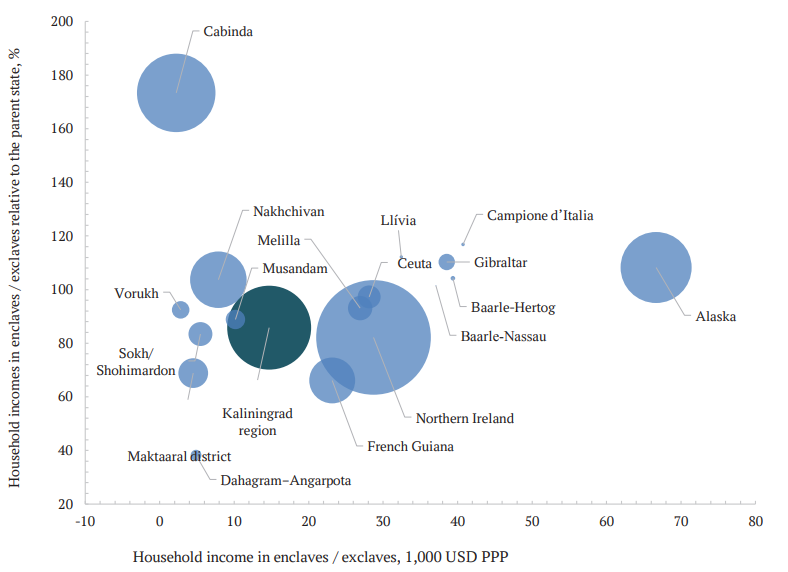
Comment: 1 circle size corresponds to population size; 2 disposable household income (resources) in national statistical offices is represented by the indicator ‘Gross disposable income of households per capita’; 3 disposable household income (resources) was estimated using the World Bank purchasing power parity conversion factor to market exchange rates (1990—2024).17
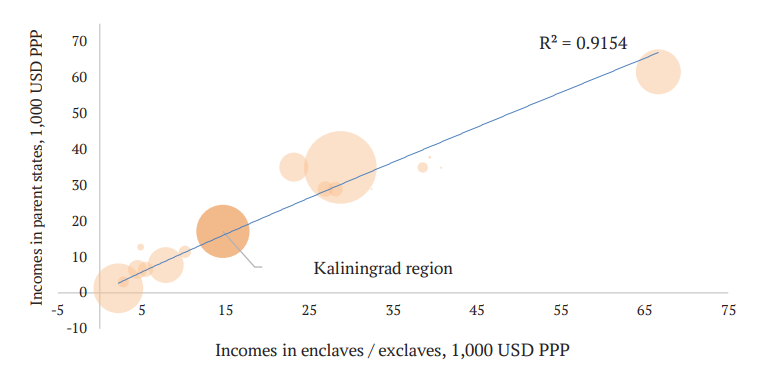
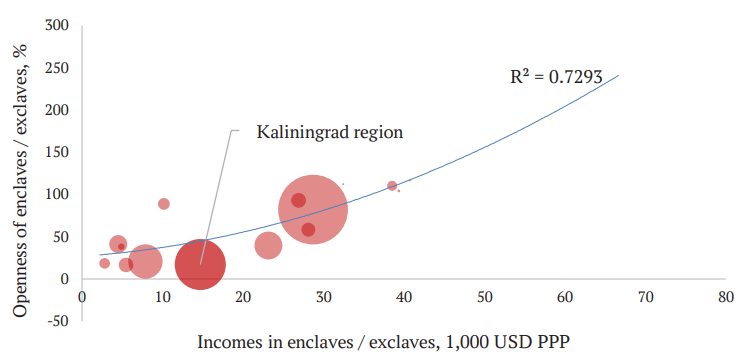
Economic regimes across enclaves and exclaves encompass a wide range of measures, chiefly tax incentives and property tax abatements for businesses and individuals. Yet, from the perspective of economic security, the principal aspect is the role of economic regimes in striking a balance across three dimensions: between the interests of the enclave / exclave population, businesses and the home state; between orientation towards surrounding country(ies) and the home state; and between the development of the territory and the increase in revenues through openness (exports and transit). The effect of economic regimes is illustrated through the cases of the enclave / exclave territories of the Kaliningrad region, Gibraltar and Cabinda (Table 3).
Effect of economic regimes and preferential arrangements | Enclave / exclave territory | ||
Kaliningrad region (Russia) | Gibraltar (UK) | Cabinda | |
Interest prioritisation: business, state, society | Businesses and state | Balanced interests | Businesses and state |
Effect on ES | Constraints on the development of social welfare and human capital | High levels of social welfare and human capital development | Lack of social harmony21 and low levels of human capital development |
Orientation towards the home state or surrounding state(s) | Until 2022: pronounced external openness; after 2022: growing reliance on the home state | Orientation towards surrounding state(s) and the broader international environment (financial services, re-export of crude oil and petroleum products) | Orientation towards surrounding state(s) and the broader international environment (export of crude oil and petroleum products) |
Effect on ES | Under sanctions (after 2022): intensifying forced economic isolationism due to rent-driven economic development | Full openness while challenges and threats persist (cross-border movement of factors of production, access to EU markets [Brexit], financial transparency of offshore jurisdictions, etc.) | Increasing openness in certain sectors (oil extraction, transport, etc.), risk of separatism and threats to territorial integrity |
Prioritisation of the territory’s development or revenue growth through openness | Until 2014: Growth in regional and home state revenues due to openness; after 2014: increasing importance of ES | Growth in territorial revenues; however, following Brexit (2020), economic diversification has become a priority | Growth in export revenues, which exacerbates economic imbalances and wide gaps in living standards across population groups |
Effect on ES | Ensuring ES is viewed as a key issue in regional development; this priority is not formally recognised in regulations | Ensuring ES in terms of economic diversification and (supra)national security issues | Attention to specific aspects of ES: food, manufacturing, environment, social cohesion, etc. |
Economic independence (autonomy) or dependence on the home state | Heavy dependence on the home state, including institutional mechanisms and federal support | Relative autonomy due to overseas territory status | Heavy dependence on the home state: a large share of revenues is transferred to Angola’s state budget |
Effect on ES | Since the 2000s, individual regional initiatives contributing to the strengthening of ES have not been supported by the federal centre | Ensuring ES under Gibraltar’s development programme is linked to economic diversification priorities | Problems of ES are addressed within Angola’s national programmes (e. g., that for agricultural development) |
In the Kaliningrad region, a special economic zone (SEZ) and a special administrative region (SAR) are in place, complemented by social support measures and tax incentives regulated by the federal legislation. Gibraltar is an offshore jurisdiction characterised by a flexible tax regime, tax exemptions and preferential tax arrangements for individuals over 60 and highly skilled professionals. Cabinda, in its turn, has enjoyed a special economic regime since 2022, although levels of social support remain limited outside the oil extraction and refining sector. From the perspective of economic security, the impact of economic regimes and preferential arrangements highlights three factors affecting enclaves and exclaves: (1) political status; (2) the home state’s regional economic policy; and (3) the nature of the economic regime and incentives in place.
First, lacking autonomy, an enclave or exclave territory remains dependent on decisions taken by the home state. Across a wide range of policy areas, it operates within a unified legal framework in which national laws, standards and regulations apply unless otherwise specified. As a result, the specific challenges associated with enclavity and exclavity are not always adequately addressed. These conditions necessitate the formal recognition of a special political, rather than merely economic, status of the territory.
Second, enclaves and exclaves require special consideration on the part of the home state, which follows from the preceding argument concerning the territory’s special status. Of key importance here is the home state’s recognition of the specific challenges of enclavity and exclavity, as reflected in targeted regional policy measures.
Third, of fundamental importance are the design of the economic regime and the preferential arrangements in place. This consideration essentially refers to requirements related to the maturity and specificity of the measures, as well as their alignment with the territory’s development objectives consistent with national interests. Maturity implies the readiness of the regional system to fully utilise the established economic regime. Specificity relates to the configuration of incentives that provide the territory with competitive advantages and compensate for its detachment and remoteness. Finally, alignment of the economic regime with the territory’s objectives as shaped by national interests is directly linked to ensuring economic security and has little bearing on rent-seeking based on a favourable geographical position.
Transport accessibility of enclaves and exclaves is ensured within transit agreements concluded with neighbouring states. Analysis of transit conditions for enclaves and exclaves as a principal element of economic security yielded the following conclusions.
1. Border security, including issues such as illegal migration, hazardous or prohibited goods, and smuggling, is a key concern. For example, the Spanish cities of Ceuta and Melilla have been compelled to strengthen border controls due to an increase in irregular crossings by migrants. An alarming situation is repeatedly reported at the Musandam border, where smuggling activities take place, with goods being transported to and from Iran via the Strait of Hormuz.22 Such trade has intensified under sanctions pressure imposed on Iran. Customs and border controls have been reinforced in the Cabinda province due to the separatist movement. An unstable military-political situation persists in the enclaves of the Fergana Valley, despite significant progress in border delimitation achieved in 2025. Security considerations are also of cardinal importance for a group of European enclaves, particularly with regard to requirements for the labelling or declaration of specific categories of goods such as chemicals, fuel and fish during transit to the territory of the home state.
2. An important policy objective covers the establishment of simplified border-crossing arrangements, customs and border controls, and the reduction of border-crossing times. Thus, among the 20 enclaves and exclaves included in the sample, only three lack simplified border-crossing procedures: the Kaliningrad region, Musandam and Oecusse-Ambeno. Significant changes, however, are expected in the latter case, as a third round of negotiations between Timor-Leste and Indonesia on land and maritime boundaries is scheduled for 2026. In the remaining enclaves, relatively liberal or fully open mobility regimes are implemented. These include European enclaves and exclaves integrated into the Schengen Area, territories where a free-border policy operates between the home state and neighbouring countries such as Oman and the United Arab Emirates, and enclave / exclave territories in Central Asia with a shared historical, cultural and traditional background. In the case of the Kaliningrad region, border conditions have remained a complex issue, particularly following the accession of Lithuania and Poland to the European Union. Since 2022, transit to the Russian exclave by land has been subject to severe restrictions.
3. It is worth noting the expansion of cooperation and the strengthening of good-neighbourly relations between states, including through the implementation of major cross-border projects. Illustrative examples of rapprochement include relations between Morocco and Spain (the autonomous cities of Ceuta and Melilla), Tajikistan and Kyrgyzstan (Vorukh), and Turkey, Armenia and Azerbaijan (Nakhchivan). For instance, rapprochement between Spain and Morocco intensified after 2022 following Spain’s endorsement of Morocco’s autonomy plan for Western Sahara, which paves the way for the de-escalation of a protracted conflict and territorial disputes. Both countries also have significant interests in tackling migration, transport and infrastructure issues, among others. Although negotiations on the delimitation and demarcation of the Tajikistan—Kyrgyzstan border began in 2002, substantial progress was achieved following the armed border clash in 2022. The process was further facilitated by the groundwork laid in 2017 and 2018 through discussions on disputed territories between Kyrgyzstan and Uzbekistan. In the case of Turkey, Armenia and Azerbaijan, rapprochement is driven primarily by economic interests. The joint declaration and peace agreement between Armenia and Azerbaijan, signed with US mediation at the Washington Summit in 2025, envisaged the opening of the Zangezur Corridor, with long-term development rights granted to the US. The project has been designated as the Trump Route for International Peace and Prosperity (TRIPP). The route is to be managed for 49 years by a company in which 74 per cent of the shares are held by the US.23 The TRIPP project offers clear economic benefits to all participating countries, with the US as the primary beneficiary.24
The conditions for ensuring economic security described above point to the idea of the territories’ uniqueness as the core principle underpinning enclave / exclave policies pursued by home state. The distinctiveness of enclave / exclave territories in relation to economic security may be examined with reference to the principal attributives that shape their spatial configuration (Fig. 4). The characteristics of enclaves and exclaves, defined through a set of criteria (identifiers), exhibit a degree of dynamism and are therefore subject to repeated revision, as are the boundaries of economic security, understood as the necessary and sufficient level of protection of an enclave / exclave from challenges and threats.
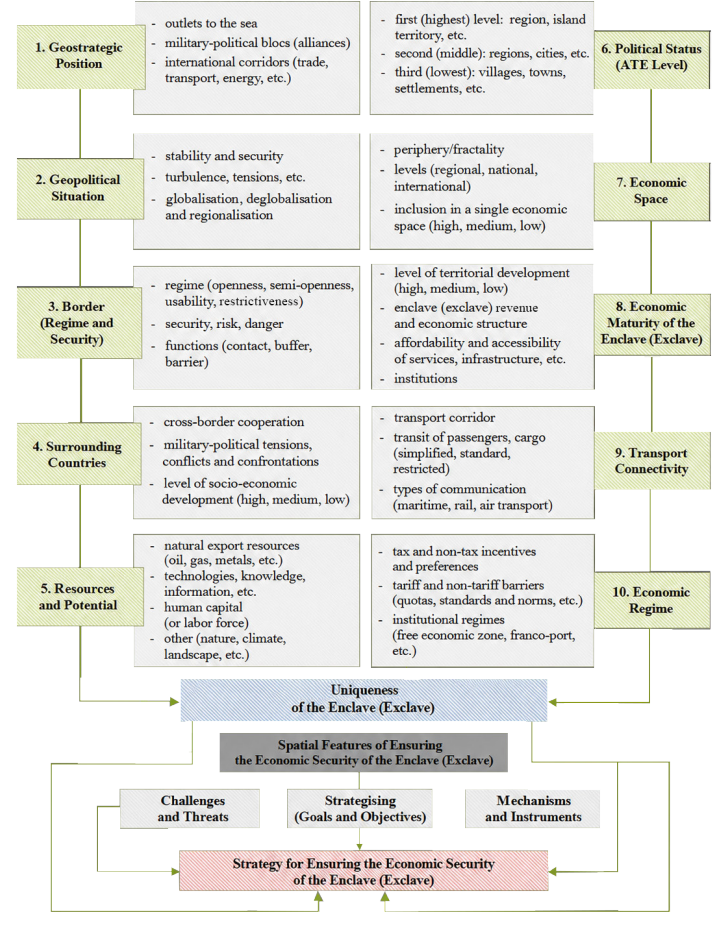
Comment: unique characteristics of the Russian exclave are given in bold.
Spatial aspects of ensuring economic security
The notion of the spatial basis of economic security underpins existing typological differences between regions, which fully applies to enclaves and exclaves [21]. Among these typological differences, the following may be distinguished: (1) variations in regional potentials and specific natural geographical conditions, as well as historical, socio-cultural and economic characteristics of the territory (economic specialisation, the quality of human capital, transport and geographical location, among others); (2) differing degrees of regional integration into spatial configurations and higher-order territorial systems and their entities; (3) differences between regions in terms of their significance and role in ensuring national security.
As a result, the spatial characteristics of regions’ economic security are associated not only with differing capacities and opportunities to ensure economic security, but also with the extent of their need for it. In this context, the spatial features of enclave and exclave economic security are examined with reference to their attributes and the selected criteria (identifiers) used to assess uniqueness, through such dimensions of economic security as: (1) essence and design; (2) category (subject matter); and (3) final state (objective).
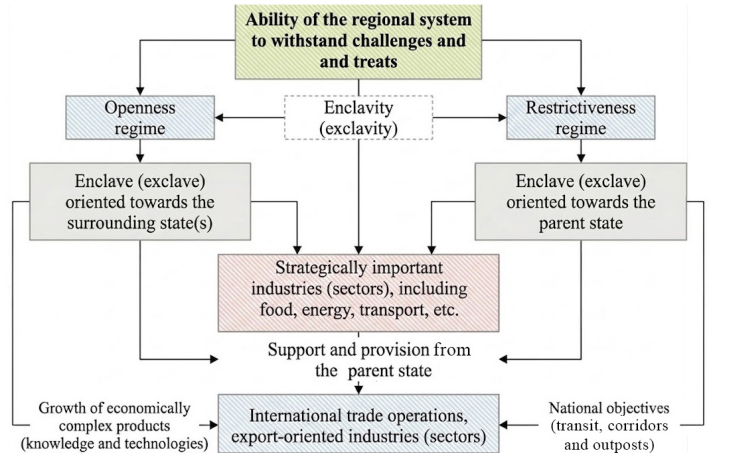
First, the essence and design of economic security are associated with shaping a regional system’s resilience to challenges and threats. In the case of an enclave or exclave, this capacity is determined by the border regime, the territory’s orientation towards surrounding or home state, as well as the home state’s financial support and regional economic policy. An enclave or exclave will inevitably face new challenges and threats that vary in essence, sources, scale, direction and intensity, and which are generated by ongoing geopolitical and geoeconomic transformations. This necessitates continuous qualitative transformation of the regional system, albeit with differentiated approaches applied to individual sectors and industries.
Thus, it is reasonable to identify a group of strategically important industries and sectors whose functioning and development require state support (Fig. 5). This applies both to special incentives and subsidies and to an expanded state presence in the economies of enclaves and exclaves. Other types of economic activity and production, as well as international trade operations, develop depending on the degree of an enclave / exclave’s openness or restrictiveness, provided that the following condition is met: openness should translate into an increase in the production of high value-added goods, whereas restrictiveness should be associated with the servicing of physical corridors (transport, energy, etc.), transit organisation, and, under certain circumstances, the function of an outpost.
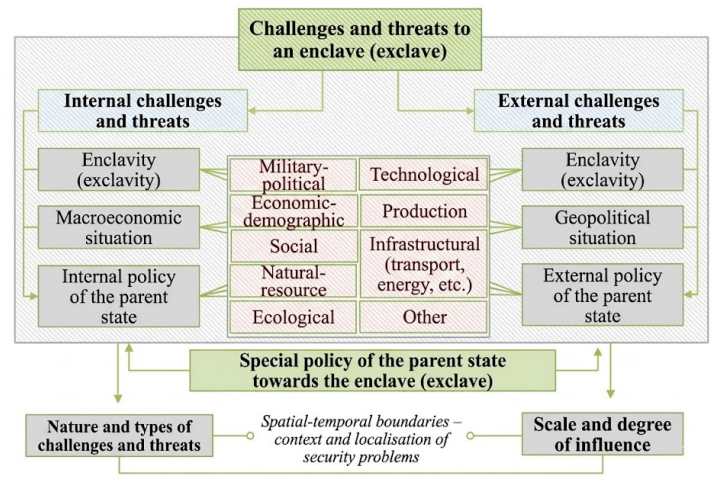
Second, the spatial characteristics of an enclave’s or exclave’s economic security are associated with emerging challenges and threats that define its category (subject matter) (Fig. 6). Internal challenges and threats are determined by the influence of enclavity / exclavity discussed in Table 1 (border regime, small-scale economies, informal institutions, etc.), as well as by the macroeconomic situation of the home state (at least as regards the volume of financial assistance provided) and its policy towards the enclave/exclave. Internal challenges and threats arising from enclave / exclave characteristics are complex and multifaceted, yet relatively predictable. The capacity of an enclave or exclave to withstand them is effectively formed from the moment of the territory’s establishment. External challenges and threats are less predictable and arise both from the features of enclavity / exclavity, such as transit conditions through neighbouring states, and from the home state’s foreign policy, not to mention the broader geopolitical environment. Resilience to such poorly predictable external challenges and threats may be strengthened either through greater integration of an enclave or exclave into the home state’s economic space or through increased autonomy. Another way to enhance robustness is through the development of proactive measures based on stress scenario assessment capable of significantly affecting enclave / exclave security.
Third, resilience, or stability, as the ultimate objective of an enclave or exclave’s economic security, is associated with the attainment of proportionality through the balanced development of the regional system. This is explained by enclavity and exclavity generating a wide range of structural imbalances due to the territory’s remoteness and detachment from the home state, which affects production and consumption, imports and exports, price structures, labour markets, as well as private and public investment, among other dimensions. As a result of such imbalances among its structural and functional elements, a regional system becomes unable to develop a coherent capacity to withstand challenges and threats. Accordingly, a balanced regional system provides the foundation for resilience (stability) and, consequently, for the economic security of an enclave or exclave. In turn, as a continuous process of correcting structural imbalances, the attainment of a balanced regional system requires specific mechanisms, measures, instruments and regulatory regimes tailored to the conditions in which an enclave or exclave functions and develops.
Evidently, the spatial features of economic security outlined above are territory-specific, reflecting the uniqueness of the enclave or exclave under study and its attributes. This consideration should be taken into account in strategies for achieving economic security and in regional governance.
Conclusion
This study identified the key features of ensuring the economic security of enclave and exclave territories amid increasing geo-economic instability and cross-border restrictions. A comparative analysis demonstrated that spatial isolation gives rise to a specific configuration of risks associated with dependence on external transport corridors, institutional conditions and the current economic situation in neighbouring states.
It was established that the state policy instruments in use, such as financial support, special economic regimes and transit agreements, largely perform a compensatory function, although they do not eliminate the structural constraints on the development of enclave territories. This confirms the existence of the enclave/exclave effect, manifested in heightened vulnerability to external shocks and limited economic connectivity.
The findings indicate the need to move from fragmented measures towards an integrated approach to economic security strategy, aimed at reducing vulnerability and enhancing the resilience of enclave territories. Such an approach implies the development of economic connectivity, diversification of the economic structure, the strengthening of the institutional environment and the reduction of the dependece on external transit conditions. The integrative nature of this strategy takes into account the identification of key components and avenues for ensuring the economic security of an enclave or exclave, taking into account its unique features. These avenues may be understood as follows. The first direction is structural change, associated with the full-scale restructuring of the economy and the transformation of its reproductive structure in favour of greater economic connectivity and a qualitative transformation of economic space. The second avenue is convergent change, requiring the strengthening of an enclave’s or exclave’s potential, including in relation to the exercise of its geostrategic role, as well as its absorptive or integrative functions. The third element concerns sectoral change and relates to the structural dimensions of security, including transport, food, infrastructure and international trade, with a view to both safeguarding national interests and achieving balance and stability within the regional system.
From a theoretical perspective, the study contributes to refining the understanding of the role the spatial factor in shaping regional economic security, whereas its practical significance lies in the potential application of the findings to the formulation of public policy towards enclave and exclave territories.
The case of the Kaliningrad region was investigated to demonstrate that ensuring economic security requires an integrative approach that takes into account both exclave-specific features and the geopolitical context of the Baltic region. Therefore, priority should be given to sustainable transport and logistics links, economic diversification, reduced dependence on external transit conditions and a stronger institutional environment.
The findings may be applied in the development of regional and federal policies towards enclave territories. As for its theoretical contribution, the study enhances understanding of the role of the spatial factor in ensuring regional economic security.
The limitations of the study stem from the use of aggregated data and the comparative nature of the analysis, whereas promising avenues for further research include an in-depth analysis of individual enclaves and an assessment of the efficiency of state policy.
Reference