State of automobile transport development of Latvian territories in the context of spatial inequality


Abstract
This study is dedicated to the analysis of the state of automobile transport development of Latvian territories within the broader context of spatial inequality regarding economic productivity and environmental sustainability. The object of analysis comprises 43 Latvian municipalities, examined using statistical and fiscal data from 2022—2023. Given the country’s pronounced monocentric structure and population density asymmetries, correlation analysis and two-step hierarchical cluster analysis were employed to typologise territories based on characteristics of automobile transport infrastructure, economic indicators, and ecological risks. As a result, five stable territorial types were identified, displaying significant differences in levels of automobile transport provision, integration into the national economic space, and environmental load. Central cities generally benefit from concentrated investment and denser transport networks, while peripheral areas are characterised by limited infrastructure access and less favourable environmental conditions. A notable exception is Ventspils, which — despite its peripheral geographical position — was classified as a central-type territory owing to its infrastructure and economic attributes. The study concludes that a differentiated transport policy is essential — one that accounts for the unique characteristics of different territories and seeks to mitigate the effects of the center-periphery divide. The proposed empirical model provides a basis for formulating territorially sensitive strategies to promote the development of automobile transport, while concurrently aligning with sustainable development goals.
Introduction
The key concepts addressed by the authors in this study include the state of transport development within a given territory [1], [2], with particular emphasis on automobile transport development; spatial inequality [3], [4] in relation to economic productivity [5], [6] and ecological sustainability [7]; and broader issues of environmental sustainability [8]. Attempts to conceptualise and empirically interpret these notions were undertaken in previous studies by one of the authors of this article [9], [11], though without focusing on Latvia’s state of transport development in the context of spatial inequality regarding economic productivity and environmental sustainability. Nevertheless, this specific context is especially relevant for Latvia today. For instance, Mauris, an economist at the Bank of Latvia, emphasises that in recent years, several sectors of the Latvian economy have grown rather rapidly, while the transport sector has been one of the slowest. The gradual decline in the transit sector has significantly undermined the role of transport in the Latvian economy.1
Furthermore, the transport sector is considered a major polluter, as it accounts for a significant share of greenhouse gas (GHG) emissions [12], [13]. In Latvia, the agricultural and transport sectors contribute the highest per capita GHG emissions.2 Latvia is among the EU countries with the oldest vehicle fleet,3 a fact often cited as a reason for the high volume of transport-related GHG emissions in the country.4 According to OECD experts, renewing Latvia’s vehicle fleet requires innovative financial solutions to increase the accessibility of new transport vehicles [14]. Paula, an economist at the Bank of Latvia, notes that Latvia is a catching-up economy: income levels are low, the number of vehicles is relatively small, and the overall volume of GHG emissions is not particularly high. In this context, the fact that environmental goals apply to everyone highlights the costs of comparison — when trying to ‘catch up’ with countries with a higher standard of living, the desired prospects for growth often conflict with the levels of physical and material resource consumption. At the same time, Latvia produces less added value per unit of GHG emissions compared to other EU countries, especially in the agricultural and transport sectors.5
When analyzing the state of automobile transport development of Latvian territories in the context of spatial inequality regarding economic productivity and environmental sustainability, it is essential to consider one important characteristic — namely, the monocentric nature of the spatial distribution of population density in Latvia [15; 16], which has a significant impact on the state of automobile transport development of the country’s territory. In Latvia, the population density is very high in the capital and its surroundings (and continues to grow) compared to other regions, especially those located near the national border.6 For the state of automobile transport development of Latvian territories, it is particularly important that practically uninhabited areas (1—3 inhabitants per km2) are located not only near the borders with Russia and Belarus (where the possibilities for cross-border automobile transportation and economic cooperation have been almost entirely eliminated due to current geopolitical conditions), but also along the borders with Lithuania and Estonia (EU countries), as well as along the Baltic Sea coast. Almost the entire Latvian economy (including the transport sector and labour force) is concentrated around the capital, and the distance to Riga becomes the main determinant of Latvia’s transport development, shaping the economic productivity and environmental sustainability of its territories.
The aim of this study is to analyse the state of automobile transport development of Latvian territories within the broader context of spatial inequality regarding economic productivity and environmental sustainability. The research also seeks to examine how the specific spatial distribution of population density in Latvia affects the state of automobile transport development — particularly the pronounced concentration of residents in the capital and its surroundings, and the low population density (in rural areas, near-uninhabited conditions) in territories near the borders with neighboring countries, including EU member states.
Literature review and a brief analysis
The literature review and brief analysis in this study aim to provide a foundation for the further conceptualisation and empirical interpretation of the key concepts used by the authors: the state of transport (specifically automobile transport) development of a territory, spatial inequality regarding economic productivity and environmental sustainability. Furthermore, the literature review focuses on the main task of identifying gaps in the research on the state of automobile transport development in the context of spatial inequality and substantiating the methodology for further empirical investigation.
A significant contribution to the development of the methodology for assessing the state of transport development of a territory was made by the approach [9], in which the state of transport development is presented as a multi-component phenomenon encompassing the level of transportisation,7 the degree of internationalisation of the transport system, the quality of transport infrastructure, and the efficiency of transport services. As part of the study [9], an integrated Territory Transport Development Index (TTDI) was developed and tested using the example of EU countries. Its advantage lies in its ability to combine various quantitative and qualitative indicators — from road and inland waterway density to assessments of port infrastructure quality and the efficiency of rail transport — into a unified comparative scale [9]. Particularly valuable in the context of spatial analysis is the index’s ability to identify not only traditional ‘centres’ of transport activity but also cases of functional mismatch with territorial location, which highlights the relevance of a typological approach based not on geographic proximity but on systemic characteristics.
A study [10] holds particular significance for developing a deeper methodology of spatial analysis of the state of transport development of a territory, as it examines the interrelations between the development of transport infrastructure and the level of territorial production. The authors identify two levels of interpreting the state of transport development — the classical (infrastructure of roads, ports, aviation) and the innovative (logistics and digital services). The results demonstrate the stability of typologies: the most developed EU countries consistently show high values across all indices, while Latvia shows consistently low ones. An important contribution of the study [10] is the identification of a reverse causal relationship: developed infrastructure becomes a determinant of production growth, rather than its consequence. This study also emphasises the need to consider not only economic and logistical, but also environmental and institutional factors when assessing territorial development — a point especially relevant for small and remote regions with limited access to centralised investment and administrative resources.
A significant contribution to the study of the relationship between transport infrastructure and economic development at the subnational level in Latvia was made by analysis [11], which focused on municipal budget expenditures on transport and production in the context of increasing local economic activity. Study [11] disproved the initial hypothesis that funding priorities are determined by the current level of economic development: it turned out that municipal budget priorities depend more on geographic or geoeconomic location than on the internal state of the economy. In Latvia, there is a stable clustering of municipalities based on the dominant type of expenditure, with a growing trend toward “transport-production” restructuring observed in 2022, likely related to the geopolitical situation in Eastern Europe.
Of particular interest to this study is the work dedicated to South Asian countries [17], which demonstrates that population density has a significant impact on the relationship between the state of automobile transport infrastructure, the extent of the road network, the level of energy provision, and quality of life. In conditions of high population density, the growth of automobile transport infrastructure without adequate development of public transport leads to a deterioration of environmental and social conditions, increased pollution, and traffic congestion. Study [17] argues that transport policy planning must take into account not only the availability of roads and energy supply but also the functional integration with the settlement structure, including the development of accessible and environmentally friendly public transport. These conclusions are also relevant to the Latvian context, where a high concentration of population in the capital region is observed, along with the need to shift toward functionally oriented transport development strategies.
Contemporary studies [18], [19] emphasise the dual nature of the impact of the state of automobile transport development on the environmental sustainability of territories. For example, an analysis of ten countries transitioning to green energy [18] found that investments in environmentally friendly road transport contribute to reducing the ecological footprint and, consequently, to lowering the level of environmental degradation. The impact of green automobile transport is evident both in the direct reduction of greenhouse gas emissions and in the increased energy efficiency of urban mobility, while factors such as institutional quality, innovation activity, and domestic investment also help improve the ecological balance. However, urbanisation, on the contrary, increases pressure on the environment, requiring a comprehensive policy to align growth rates with environmental constraints [18]. At the same time, a study based on the Hainan Province in China [19] shows that the impact of transport development depends on the nature of land use changes: improving land use efficiency can mitigate negative effects, whereas intensive development of new areas, on the contrary, leads to increased pollution [19]. Thus, the sustainable effect of transport investments is determined not only by their scale but also by the nature of territorial policy.
Returning to the economic aspects of the state of automobile transport development in the Baltic region, it should be emphasised that virtually all modern studies confirm a direct relationship between the state of transport infrastructure and macroeconomic dynamics. For instance, study [20] argues that investments in Latvian transport infrastructure contribute not only to GDP growth but also to the intensification of foreign trade, including export-import relations with Poland and other EU countries. Analysis [21] shows that the effectiveness of transport policy largely depends on the state’s ability to establish sustainable mechanisms for investment decision-making under conditions of limited budgetary resources. At the same time, high-quality infrastructure promotes entrepreneurial activity, increases employment, and enhances the competitiveness of the economy. Study [22] adds to this picture by modeling the contribution of the transport and logistics sector to Latvia’s economic development: the authors record a significant share of added value (9.2 %) and a strong correlation between freight turnover fluctuations and GDP dynamics, emphasising the role of Latvia as a regional transit hub. Finally, study [23] highlights that the sustainable development of the Lithuanian transport sector has a multiplier effect on the economies of neighbouring countries, including Latvia, confirming the need to consider regional interconnections when formulating national transport strategies. All these studies underline that road transport infrastructure serves not merely as a logistical resource but as a strategic instrument of spatial economic development.
The OECD study on the climate impact of transport investments in Latvia [14] proposes a more differentiated strategy (taking spatial inequality into account) for transitioning from car-based transport to more sustainable forms of public transportation. This includes investments in expanding public transport infrastructure (such as railways) and improving urban transport systems (such as trams and trolleybuses), particularly in the capital region, where road congestion and emissions are significant. For peripheral areas with lower population density, OECD experts recommend focusing on investments that enhance the connectivity and efficiency of existing transport infrastructure [14]. In turn, for territories with the lowest population density, the experts emphasise the need to develop transport policies that reflect local needs (for example, promoting car-sharing services) [14]. These recommendations aim to improve transport development across regions while simultaneously supporting economic growth and environmental sustainability, both in the capital and in Latvian peripheral territories.
In this context, it is appropriate to refer to the theoretical ‘centre—periphery’ model, widely used in academic literature on spatial inequality [24; 25]. It describes a structure in which central regions (in this case, Riga and the surrounding areas) concentrate resources, infrastructure, and economic activity, while peripheral areas are characterised by lagging behind in key indicators. At the same time, uneven territorial development is not a result of backwardness or a lack of resources but is shaped through structural dependency, both in terms of external economic relations and institutional factors [24].
Empirical confirmation of the applicability of the ‘centre—periphery’ model in transport research is provided by an analysis of the connectivity of rural settlements in the Kaliningrad region [25]. The authors note that insufficient transport connectivity contributes to the deepening of peripheral status, reduces access to social and economic services, and limits the development potential of remote areas. Study [25] shows that investments in automobile transport infrastructure aimed at overcoming isolation and restoring connections with the centre serve not only as a transport measure but also as a socio-economic tool for reducing territorial inequality. Thus, the ‘centre—periphery’ concept can serve not only as a theoretical framework but also as an analytical tool for interpreting the differences observed in the road transport development of Latvian territories.
Studies on the transport infrastructure of the Kaliningrad region [26], [27], [28] demonstrate a systemic interrelation between its geopolitical position, economic resilience, and logistical connectivity. The region is considered a unique semi-exclave of Russia, isolated from the country’s main territory while being in close proximity to industrially developed European states, which defines its dual economic-geographical role [26]. Research [27], [28] emphasises that weak transport connectivity and insufficient density of ground infrastructure limit the region’s economic potential and increase its vulnerability under sanction pressure. Significant disparities have been identified among federal, regional, and local roads, which require reconstruction and expansion despite the relatively high proportion of paved roads. Special attention is given to the role of the special economic zone as an institutional mechanism of adaptation: it provides partial compensation for the region’s isolation and stimulates the creation of additional transport and logistics potential in the territory [26].
Summarising the results of the reviewed theoretical and empirical studies, it can be concluded that the state of transport development of territories is a multi-level and multifactorial phenomenon that exerts a complex influence on the economic productivity and environmental sustainability of regions. The monocentric population structure of Latvia, the persistent dominance of the capital region, and the significant disparity in access to transport infrastructure intensify spatial inequality, which necessitates a more nuanced and typologized analysis. The approaches presented in the literature, along with the identified interrelations between transport characteristics, population density, and economic-environmental indicators, provide a foundation for the empirical validation of the systemic model proposed in this study. This model will, in turn, serve as the basis for formalising a methodology for the analysis of the territories of Latvian municipalities.
Conceptual framework and research methodology
Based on the results of the literature review and brief analysis, we propose dividing Latvia into three distinct (unequal) types of territories for further conceptualization and definition of the notion of the state of transport development (separately for each type of territory in Latvia) in the context of spatial inequality regarding economic productivity and environmental sustainability. The object of this study is the territories of Latvian municipalities. The administrative division of Latvia into municipal territories (36 counties and 7 state-level cities not included in the counties) was implemented on July 1, 2021, in accordance with the Law of the Republic of Latvia “On Administrative Territories and Populated Areas”.8 All Latvian municipalities — both counties and state-level cities — are included in the sample of this study, which ultimately consists of 43 entities and coincides with the total population (overall number) of Latvian municipalities. This relatively small number of entities can be analysed using statistical methods [29], though special attention must be paid to the statistical significance of the obtained results.
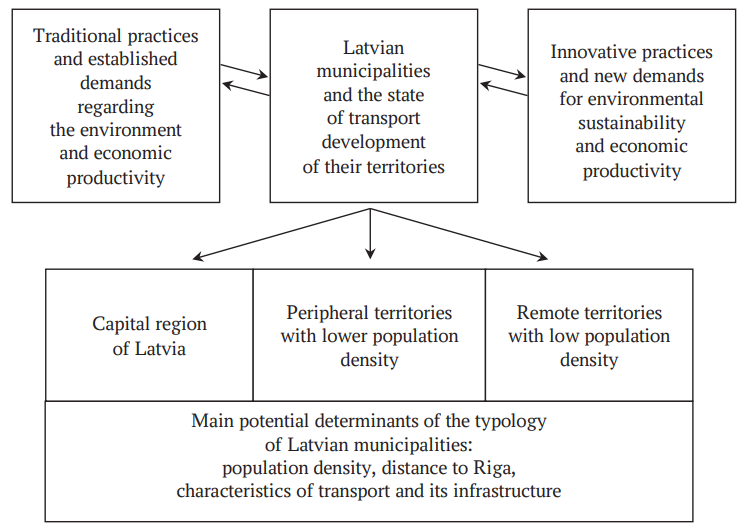
The systemic analysis of the object and subject of the study begins with the forces (processes) that influence Latvian municipalities, and vice versa. These forces include, on one hand, traditional practices and established expectations regarding the environment and economic productivity, and on the other hand, innovative practices and new demands for environmental sustainability and economic performance. As a result of this mutual influence, it is theoretically possible to identify three types of territories in Latvia in the context of spatial inequality: the capital region, peripheral areas with lower population density, and remote areas with very low population density. The main potential determinants of the typology of Latvian municipalities (which must be empirically tested through further quantitative analysis of statistical data) are considered to be population density, distance from Riga, and the characteristics of transport and its infrastructure. The next methodological issue in the empirical verification of the above theoretical systemic analysis is the empirical interpretation of the conceptual constructs used in the study, with the aim of making them practically measurable in the territories of Latvian municipalities.
Table 1 presents both the conceptual constructs used in the systemic analysis of the object and subject of the study, as well as their empirical interpretation, based on ideas drawn from the reviewed scientific literature and data from Latvian statistics.
|
Conceptual constructs |
Empirical interpretation within the study, |
|
Economic productivity |
GDP per capita, euros |
|
Environmental sustainability |
Greenhouse gas (GHG) emissions (CO2, N2O, CH4, HFC, and SF6) per capita, kg in CO2 equivalent |
|
Transport characteristics |
Share of passenger electric vehicles, % of the total number of registered passenger cars |
|
Transport infrastructure characteristics |
Share of asphalt and other bitumen-covered roads, % of the total length of roads |
|
General characteristics |
Population density, number of residents per km2 of territory |
|
Developed based on [1], [2], [9], [11], as well as data from Latvian statistics9 and the State Treasury of Latvia.10 |
|
Since the interaction between Latvian municipalities/the state of transport development of their territory and the practices / demands related to environmental sustainability and economic productivity is a two-way process, Pearson correlation [30] analysis can be used for the quantitative assessment of the above-mentioned interrelationships (Fig. 1). Subsequently, those among the main potential determinants of the typology of Latvian municipalities that show statistically significant correlation with the selected indicators of economic productivity and environmental sustainability will be included in a cluster analysis aimed at identifying empirical types of Latvian territories (Fig. 1, Table 1). Based on the literature review and brief analysis, it can be concluded that the state of transport development for each type of identified Latvian territory has its specific characteristics, determined by the particularities of the economic productivity and environmental sustainability of these types of territories.
Results and discussion
The analysis of the research results begins with the examination of the correlation between the characteristics of transport and its infrastructure in Latvian municipalities, the general characteristics of the municipalities, and the economic productivity / environmental sustainability of their territories (Table 2).
|
Correlated indicators |
Correlation analysis coefficients |
Indicators of economic productivity (in the territory) |
Indicators of environmental sustainability |
||
|
GDP per capita |
Average annual personal income tax per capita |
GHG emissions per capita |
GHG emissions per km2 of territory |
||
|
Share of passenger electric vehicles |
Pearson correlation coefficient |
0.400** |
0.800** |
− 0.505** |
0.134 |
|
Significance (2-tailed) |
0.008 |
< 0.001 |
< 0.001 |
0.392 |
|
|
Share of asphalt and other bitumen-covered roads |
Pearson correlation coefficient |
0.511** |
0.544** |
− 0.705** |
0.679** |
|
Significance (2-tailed) |
< 0.001 |
< 0.001 |
< 0.001 |
< 0.001 |
|
|
Road density |
Pearson correlation coefficient |
0.241 |
0.208 |
− 0.575** |
0.856** |
|
Significance (2-tailed) |
0.119 |
0.180 |
< 0.001 |
< 0.001 |
|
|
Population density |
Pearson correlation coefficient |
0.427** |
0.215 |
− 0.497** |
0.969** |
|
Significance (2-tailed) |
0.004 |
0.167 |
< 0.001 |
< 0.001 |
|
|
Distance to Riga (by road) |
Pearson correlation coefficient |
− 0.494** |
− 0.832** |
0.432** |
0.001 |
|
Significance (2-tailed) |
< 0.001 |
< 0.001 |
0.004 |
0.993 |
|
Developed using IBM SPSS Statistics based on data from Latvian statistics and the State Treasury of Latvia. | |||||
** 2-tailed correlation is significant at the 0.01 level.
The results of the correlation analysis presented in Table 2 highlight the relationship between characteristics of transport / its infrastructure and the economic/environmental indicators of Latvian municipalities. Higher-quality road infrastructure and a greater share of electric vehicles are associated with increased economic productivity (r = 0.400, p = 0.008 for GDP and r = 0.800, p < 0.001 for personal income tax) and reduced GHG emissions per capita (r = − 0.505, p < 0.001). However, an increase in road density and population density leads to higher GHG emissions per unit area (r = 0.856, p < 0.001 and r = 0.969, p < 0.001, respectively), which poses challenges for environmental sustainability. Proximity to Riga plays a crucial role (showing the highest correlation coefficients) in the economic productivity of Latvian municipalities (r = − 0.494, p < 0.001 for GDP and r = − 0.832, p < 0.001 for personal income tax) and correlates with higher per capita GHG emissions as the distance increases (r = 0.432, p = 0.004). In any case, all five correlated indicators demonstrate statistically significant relationships with one or another aspect of economic productivity or environmental sustainability in Latvian municipalities and will be included in the subsequent cluster analysis.
The results of the cluster agglomeration process (the first step in the implementation of hierarchical cluster analysis) showed that the optimal number of clusters, calculated based on identifying the step in the agglomeration process after which the coefficient increases sharply [30] (in our case, from 8.879 at step 39 to 14.064 at step 40), is 4 (calculated using IBM SPSS Statistics software). The main results of the cluster analysis are presented in Table 3.
|
Parameter |
Cluster 1 |
Cluster 2 |
Cluster 3 |
Cluster 4 |
|
Name of the cluster |
The capital of Latvia |
Central cities |
All Latvian counties |
Remote cities |
|
Number of objects |
1 |
3 |
36 |
3 |
|
Names of participants |
Riga |
Ventspils, Yelgava, Yurmala |
Group of 36 county-level municipalities requiring further classification |
Daugavpils, Liepaya, Rezekne |
|
Share of passenger electric vehicles, % |
5.7 |
7.7 |
1.4 |
|
|
Share of asphalt and other bitumen-covered roads, % |
72.3 |
69.5 |
69.9 |
|
|
Road density, km |
3.96 |
3.91 |
4.88 |
|
|
Population density, persons |
2,309 |
724 |
1364 |
|
|
Distance to Riga (by road), km |
0 |
83 |
223 |
|
Developed using IBM SPSS Statistics based on data from Latvian statistics. | ||||
The results of the cluster analysis presented in Table 3 reveal distinct typological groups among Latvian municipalities. Clusters 1, 2, and 4 show a similar level of automobile transport infrastructure development, while remote cities (Cluster 4) face additional challenges such as low adoption of electric vehicles and greater distance from the economic centre, which is reflected in their economic and environmental profiles (Table 4). Remote cities in Latvia exhibit a more “industrial” profile, with relatively higher population density and road density compared to central cities.
|
Economic / environmental indicators |
The capital of Latvia, Riga |
Central cities (Ventspils, Yelgava, Yurmala) |
Remote cities (Daugavpils,
Liepaya, |
|
GDP per capita, euros |
28,943.00 |
12,454.67 |
13,283.67 |
|
Personal income tax per capita, euros |
1,159.68 |
992.17 |
645.66 |
|
GHG emissions per capita, kg |
3,712.09 |
2,630.55 |
3,306.92 |
|
GHG emissions per km2 of territory, ths. t |
7.42 |
1.71 |
4.12 |
Developed using IBM SPSS Statistics based on data from Latvian statistics and the State Treasury of Latvia. | |||
Riga demonstrates the highest economic productivity and income levels, highlighting its central role in the Latvian economy. Central cities benefit from their proximity to Riga, showing moderate economic productivity, while remote cities have a slightly higher GDP per capita but a lower average annual personal income tax per capita (Table 4). Regarding environmental profiles, it is important to note that Riga’s high economic productivity is accompanied by high levels of GHG emissions both per capita and per km2 of territory. In contrast, central cities exhibit the most favourable environmental indicators, with the lowest GHG emissions per capita and per km2, indicating a balance between economic productivity and environmental sustainability in this type of Latvian territory.
Particular attention should be given to the position of the city of Ventspils in the typology. Despite its considerable geographical distance from Riga, it was placed in the cluster of “central cities” alongside Jelgava and Jūrmala. At first glance, this may seem methodologically questionable; however, the sample and the logic of clustering were based not on geographical criteria but on complex socio-economic and infrastructure indicators. Ventspils demonstrates a high share of electric vehicles, a well-developed road network, relatively strong economic performance, and moderate GHG emissions per unit of area. Furthermore, its specialisation as a port city grants it functional proximity to the centre of the national economy. Therefore, its inclusion in this cluster should be interpreted as a reflection of functional rather than purely spatial centrality.
In turn, the remote cities of Latvia, despite having lower economic productivity, exhibit significant GHG emissions per capita, highlighting their environmental unsustainability, even though their overall GHG emission density per km2 is lower compared to Riga (Table 4). The results of this analysis reveal the economic advantages and environmental challenges faced by different groups of Latvian cities. Riga’s economic leadership contrasts with its environmental impact, while the central cities demonstrate a more balanced relationship between economic productivity and environmental sustainability.
As for the 36 Latvian counties, a second stage of cluster analysis was conducted, during which the 7 city municipalities were excluded from the analysis. The results of the agglomeration process (the first step in implementing hierarchical cluster analysis) showed that the optimal number of clusters — calculated by identifying the step in the agglomeration process after which the coefficient increases sharply [30] (in our case, from 16.864 at step 34 to 43.970 at step 35) — is 2 (calculated using IBM SPSS Statistics software). The main results of the cluster analysis are presented in Table 5.
|
Parameter |
Cluster 1 |
Cluster 2 |
|
Name of the cluster |
Central counties |
Remote counties |
|
Number of objects |
17 |
19 |
|
Names of participants |
Adazi, Aizkraukle, Bauska, Cesis, Dobele, Jelgava, Kekava, Limbazi, Marupe, Ogre, Olaine, Ropazi, Salaspils, Saulkrasti, Sigulda, Tukums, and Valmiera counties |
Aluksne, Augšdaugava, Balvi, Dienvidkurzeme, Jekabpils, Gulbene, Krāslava, Kuldīga, Līvāni, Ludza, Madona, Preiļi, Rēzekne, Saldus, Smiltene, Talsi, Valka, Varakļāni, and Ventspils counties |
|
Share of passenger electric vehicles, % |
3.8 |
1.0 |
|
Share of asphalt and other bitumen-covered roads, % |
37.3 |
24.7 |
|
Road density, km |
1.05 |
0.81 |
|
Population density, persons |
53 |
10 |
|
Distance to Riga (by road), km |
52 |
182 |
Developed using IBM SPSS Statistics based on data from Latvian statistics. | ||
As shown by the data presented in Table 5, central counties are characterised by a higher level of electric vehicle adoption, more developed transport infrastructure, relatively high population density, and proximity to Riga. These factors contribute to better economic opportunities, access to services, and environmental technologies, making the central counties more dynamic and integrated into Latvia’s overall economic structure. In contrast, remote counties demonstrate lower levels of electric vehicle adoption, less developed transport infrastructure, low population density, and are located significantly farther from Riga (Table 5). These factors contribute to economic isolation, slower development, and limited access to modern infrastructure and environmental technologies, making remote Latvian counties less competitive and more dependent on traditional transportation methods. Overall, the typological groups of Latvian counties mirror the typology of cities, with central counties also benefiting from proximity to the capital / central cities and better infrastructure, while remote counties face challenges related to distance from Riga, lower quality transport infrastructure, and comparatively low population density.
As shown by the data in Table 6, central counties demonstrate better economic indicators, with higher GDP per capita and personal income tax per capita, reflecting a more developed economy, better access to markets, and higher income levels among the population. Regarding environmental sustainability, these counties have lower GHG emissions per capita but higher GHG emissions per km2 of territory due to concentrated economic activity. On the other hand, remote counties face economic challenges in the form of comparatively low GDP per capita and personal income tax per capita, contributing to their isolation — not only economically, but also socially, politically, etc. [11; 31; 32] — lower economic productivity, and limited access to economic opportunities. Meanwhile, the higher GHG emissions per capita in the remote Latvian counties indicate less efficient energy use, although the overall GHG emissions per km2 are lower due to the relatively large size and low population density of these territories.
|
Economic / environmental indicators |
Central counties, n = 17 |
Remote counties, n = 19 |
|
GDP per capita, euros |
13,499.24 |
10,042.32 |
|
Personal income tax per capita, euros |
925.28 |
586.83 |
|
GHG emissions per capita, kg |
5,106.35 |
6,865.78 |
|
GHG emissions per km2 of territory, ths. t |
0.20 |
0.07 |
Developed using IBM SPSS Statistics based on data from Latvian statistics and the State Treasury of Latvia. | ||
Figure 2 visually presents five types of territories in Latvia identified through the two-level cluster analysis:
(1) Riga, the capital of Latvia and its geographical, transport, economic, and other central hub;
(2) central cities of Latvia (Ventspils, Yelgava, Yurmala), located close or relatively close to Riga (except for Ventspils);
(3) remote cities (Daugavpils, Liepaya, Rezekne), located far from Riga;
(4) central counties (17 municipalities), located close or relatively close to Riga;
(5) remote counties (19 municipalities), located far from Riga.
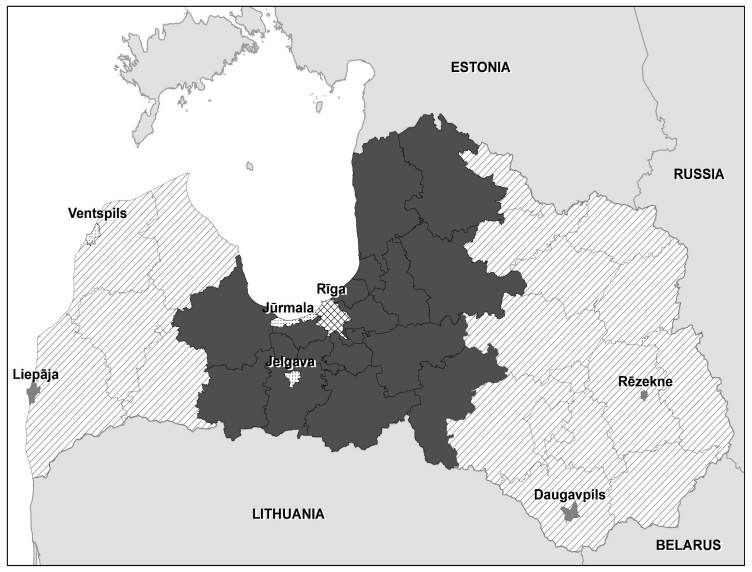
Relatively speaking, economically active and transport-developed Latvia can be outlined on a geographical map (Fig. 2) almost with a compass, placing its point on Riga. As for the rest of the country — if not for the presence of three fairly large industrial cities (Daugavpils, Liepaya, Rezekne) — the Latvian political elite would likely prefer to forget about it altogether, as many remote areas of Latvia have already become nearly inaccessible by land transport, especially under unfavorable weather conditions and during the off-season [33]. Thus, the specifics and essence of the state of automobile transport development in Latvian central and remote territories are determined by monocentric spatial inequality (with elements of polycentrism — some state-level cities may be considered growth poles to some extent) regarding economic productivity and environmental sustainability, as well as by the unique spatial distribution of population density.
Central Latvian territories are characterised by an improved state of automobile transport development due to a well-developed road network, high road density, and better quality of transport infrastructure. The transport development of central territories supports economic productivity in these areas but requires careful management to balance economic growth with environmental sustainability.
In contrast, the state of automobile transport development of remote Latvian territories is lower due to less developed transport infrastructure, low road density, and minimal adoption of electric vehicles. The state of automobile transport development challenges in these territories are further exacerbated by long distances and higher transportation costs, making it difficult to achieve high economic productivity and environmental sustainability.
Conclusions
This study emphasizes the significant differences between central and remote Latvian territories (at both the city and county levels), highlighting the need for a targeted transport policy that takes into account the unique context of spatial inequality regarding economic productivity and environmental sustainability, as well as the specific spatial distribution of population density in Latvia. Central Latvian cities and counties benefit from their proximity to the capital and its infrastructure, while remote cities and counties face economic isolation and environmental inefficiency. In fact, the 100-kilometre zone surrounding the Latvian capital represents a ‘different world’ compared to remote Latvia, located more than 100 kilometres from Riga. It is noteworthy that the current geopolitical situation and sanctions/restrictions against Russia and Belarus are not the determining factors of this condition, as remote Latvian counties near the borders with Estonia and Lithuania share a similar context in terms of economic productivity and environmental sustainability, as well as comparably low population density and limited state of automobile transport development, to those near the borders with Russia and Belarus.
The state of automobile transport development in central and remote Latvian territories largely depends on the economic and environmental characteristics of each of these territory types, as well as on population density and their distance from Riga. To improve the state of automobile transport development in Latvia, targeted strategies are needed separately for the central and remote parts of the country. For central territories, the focus should be on optimising road transport networks, promoting electric vehicles, and implementing sustainable urban transport solutions. In contrast, remote territories require investments in automobile transport infrastructure, such as the modernisation of rural roads and the introduction of innovative, localised transport solutions (e. g., shared vehicle services). These measures can help balance economic productivity with environmental sustainability and tailor development to the specific needs and capabilities of both central and remote Latvian territories.
Thus, the identified differences confirm the existence of a persistent ‘centre — periphery’ structure in Latvia, where Riga and the surrounding areas function as the centre, while remote territories act as the periphery, limited in access to economic and transport resources.
Reference