Migration typology of the world’s coastal exclaves


Abstract
A significant contribution to the study of migration in the exclave region of Kaliningrad, including an analysis of determining factors, was made by Dr. hab. Prof Gennady Fedorov, who conceptualised migration movements as a demographic element within the geo-demographic context. He was the first to highlight the distinctive nature of migration processes in the region, shaped by its historical background and unique economic-geographical position. This article examines how the exclave position, including spatial remoteness from the parent state, affects migration patterns. To this end, migration is examined in thirteen coastal exclaves worldwide, excluding military bases and uninhabited territories. Situated in diverse regions worldwide, these areas are characterised by varying climatic, economic, and institutional conditions, as well as distinct historical and cultural features in societal development, each overcoming the challenges of spatial isolation in a unique way. These differences are reflected in the attractiveness of the exclaves to migrants and, consequently, in the current migration situation. This study is the first attempt to produce a typology of exclaves by examining local migration situations. To this end, exclaves are compared using indicators of population migration, its role in population replacement, transport connectivity with the parent and neighbouring states and the natural and socio-economic conditions of regional development from 2017 to 2022. The comparison produces a typology of coastal exclaves based on the characteristics of migration processes. Exclaves that lack attractiveness to migrants include those developing under harsh climatic conditions such as Alaska; those experiencing extreme temperatures and possessing underdeveloped economies like Oecussi-Ambeno, Temburong and French Guiana; and densely populated exclaves facing a massive refugee influx, such as Ceuta and Melilla. Attractive exclaves are economically prosperous regions that take advantage of their coastal location, such as the Kaliningrad region and Crimea, and specialise in oil and gas production, for example, Cabinda and Musandam. The third type comprises the most densely populated exclave of Gibraltar, along with the highly developed regions of Dubrovnik and Northern Ireland, where migration has minimal impact on population replacement.
Introduction
Ongoing geopolitical and geoeconomic changes are profoundly impacting the attractiveness of Russia’s westernmost region, Kaliningrad, to migrants and, consequently, the migration situation in this coastal exclave. Over the 21st century, the region’s net migration rate was growing, making it a territory attractive for migrants from across Russia and the CIS countries. By 2021, the region ranked among the top five in the country for net migration. In 2022, the migration situation altered, with growth declining by more than half. By 2023, at 6.0 ‰, it had reached its lowest level since 2011.1 This change appears to result from a decline in the region’s attractiveness to migrants, on the one hand, and shifts in the factors influencing the migration of Russian citizens, on the other. Increasing economic and military-political tensions between Russia and neighbouring NATO states — Lithuania and Poland — along with restrictions on passenger and cargo transit through Lithuania, have heightened the risk of a blockade and worsened the socioeconomic situation. Overall, the economic situation deteriorating at the national level in 2022 and societal divisions over political issues have intensified the economic and political factors of migration while diminishing those related to improving quality of life. Consequently, the traditional factors that once attracted migrants to the Kaliningrad exclave — natural and climatic conditions, environmental quality, European travel prospects for migrants from other Russian regions, and employment opportunities sought by most migrants coming from CIS countries — have significantly diminished in relevance. In contrast, economic pressures pushing people out of the exclave have intensified. This shift has led not only to a decrease in the inflow of migrants from CIS countries but, more notably, to a reduction in in-migration from other Russian regions and growing outmigration. Thus, both ‘old’ and ‘new’ migration factors largely reflect the region’s distinctive economic-geographical position (EGP).
The changes occurring in Russia’s exclave of Kaliningrad prompted us to explore the impact of exclave status on migration in other coastal exclaves.
The specific features of coastal exclaves, such as spatial separation from the parent state, borderland status and coastal position, allow us to formulate hypothetical scenarios for migration dynamics within them. Scenario 1: closed-circuit migration, where movements occur predominantly within the confines of the region. Scenario 2: the predominance of international migration over interregional migration due to a focus on international trade relations or other humanitarian factors, such as historical ethnic or cultural proximity of the populations. Scenario 3: interregional migration surpassing international migration, despite territorial separation, to strengthen the spatial connectivity of the exclave with the parent state. Scenario 4: simultaneous involvement in migration interactions with both the parent and neighbouring states, with the region’s attractiveness sustained by the ‘development corridor’ model.
This article aims to identify the specific impact of exclave status on migration processes. To this end, the following objectives are attained: a) the analysis of Russian and international studies on migration processes within the contexts of coastal location, borderland status and exclavity, aimed at identifying the specific impact of exclavity on migration; b) development of a migration typology for coastal exclaves based on the authors’ methodology; c) identification of the typical features of migration development in coastal exclaves.
Theoretical overview
Political geography defines an exclave as a part of a state’s territory surrounded by foreign territories [1]; a coastal exclave that has access to the sea. Island exclaves, however, are not classified as coastal ones, as seen, for example, in Yuri Zverev’s typology [2, p. 21]. The genesis and history of exclaves have been examined in depth, with classifications developed based on the legal status, population size, origin, sea access, distance from the parent state and income levels, relative to the average in both the parent and surrounding states [3].
Comparatively few studies look specifically at the development of coastal exclaves [2], [4]. Zverev defines a coastal exclave as a separately located part of a country’s territory, surrounded by one or more foreign states and having access to the sea’ [2, p. 21]. In one of his works [2], he classifies coastal exclaves based on area, population size, legal status, number of surrounding countries and distance from the parent state. However, migration processes in coastal exclaves have largely remained underexplored.
The main feature of coastal exclaves is their spatial isolation or detachment from the parent territory.2 Despite the development of air transport connections that significantly compress space, distance remains a crucial factor in population migration [5]. The closer an exclave is to the parent territory, the higher the likelihood of closer migration interactions. At the same time, the implementation of policies to mitigate the territorial costs of isolation, such as transport cost subsidies, may create conditions that attract migrants. Furthermore, spatial isolation often determines the exclave’s development strategy, accounting for its special status, often viewed in geostrategic terms. An exclave may evolve according to various models, ranging from a ‘development corridor’ model, characterised by intensive interaction with neighbouring countries and consequently high migration activity, to an ‘outpost’ model, where a special regime restricts migratory movements.
Studies focusing on individual exclaves highlight the influence of exclave status on push and pull factors in migration [6]. For example, IT specialists who have relocated to the Kaliningrad region mention migration factors accounted for by the region’s exclave status: an extensive network of subsidised air connections with Russian cities; costs associated with territorial isolation, such as the need for visas for land transit through neighbouring countries; and the region’s more dynamic development due to federal support [6]. Under sanctions, however, exclusivity-driven reliance on imports and transit poses serious challenges to the region’s social and economic development [7]. This dependency exacerbates Kaliningrad’s vulnerability to crises, as seen during the COVID-19 pandemic and after the start of Russia’s special military operation in Ukraine in 2022, resulting in a sharper decline in living standards compared to other Russian regions. This dynamic diminishes the region’s attractiveness to migrants and creates conditions for population outflow [7].
Another feature of exclaves is their borderland status. In some cases, it may offset an exclave’s peripherality, facilitating regional development and attractiveness to migrants, while in others, it may exacerbate the challenges of peripheral location, prompting local populations to leave [8]. The effect depends on the type of borders and the balance of their contact, barrier and filtering functions. Amid inter-country disparities, contact-dominated borders promote cross-border labour and educational migration and shuttle trade [9], [10], [11], [12], increasing the exclave’s attractiveness to internal migrants [13], [14]. In contrast, underutilisation of the contact function can turn regions into ‘buffer zones’ for transit migration towards economically stronger areas in the parent state or neighbouring countries [15], [16], [17], potentially leading to the substitution of newcomers for the out-migrating local population [15]. In the case of closed borders, often resulting from conflict-prone situations, borderland status is increasingly associated with disintegration, lower socio-economic levels and deepening peripherality. It has been demonstrated, however, for Guyana and Suriname that, despite closed borders, emigration can grow, primarily in the aftermath of political regime changes [18].
Spatial isolation and borderland position affect the self-image of an exclave’s residents, shaping their socio-cultural and territorial identity where self-identification as part of the region blends with that of the parent state and surrounding countries,3 accounting for the population’s migration mobility [19].
The coastal position of an exclave impacts migration processes through the maritime orientation of economic development, which attracts specialists in the relevant fields from beyond the region, creating additional socio-economic opportunities and making exclaves more attractive to migrants [20]. An outlet to the sea prompts the development of additional transport corridors thus enhancing the territory’s transport accessibility for migrants. Fishing contributes to the population’s food security, while the coastalisation factor prompts lifestyle migration [21], [22], [23]. At the same time, in unfavourable climatic conditions, coastal locations may be linked to flood risks, generating migration push factors [24].
Thus, these features of the coastal exclaves’ EGP indirectly impact migration by shaping conditions for socio-economic development and altering population structure. Consequently, assessing how these characteristics influence migration in coastal exclaves is complicated by this indirect nature, as well as by the sensitivity of migration to other factors. Among these factors, as suggested by the literature, are the natural and social environment of individuals, including geographical, environmental and socio-economic conditions, as well as structural factors influencing the composition of populations involved in migration, such as demographic, ethnic, historical, professional and educational characteristics [25, p. 54—55]. These factors can both push and pull migrants.
The identification of migration factors in diverse territorial units is often preceded by the provision of a relevant typology, as typologising enables the division of territories into distinct homogeneous groups and facilitates a qualitative analysis within each type [26]. Typologies characterising territories by migration processes typically rely on absolute and relative indicators of net and gross migration, the number of arrivals and departures, and migration efficiency4 [26], [27], [28], [29]. If the focus is on migration activity rates and population adaptation, a typology may use measures such as the proportion of migrants within the population5 [30] and the structure of migrants by length of stay in the settlement region [31]. Of particular interest is the typology of regional capitals in Russia, which categorises these cities based on the ratio between natural and migratory population change, highlighting migration’s role in population dynamics [32].
Typologies that consider the conditions shaping migration processes also use indicators reflecting the overall demographic situation, labour market conditions and employment rates, education systems, individuals’ socio-economic status, standards of living, and level of regional public security [28]. For the specifics of the EGP to be fully taken into account, it is essential to consider characteristics of the border functions, such as the number of bordering countries and the number of border crossing points [33]; natural and climatic conditions, for instance, January temperature averages [28]; and population distribution, including the level of urbanisation [28] and proximity to major cities.6
Although existing typological methodologies fail to capture the migration-related specifics of coastal exclaves and are thus not entirely suited to the objectives of this study, net migration rate, the share of migrants in the population, average air temperature and urbanisation level have proven to be reliable and effective indicators for use in migration typologies. Additionally, it is prudent to apply widely used indicators of exclave development conditions, such as territory size, distance from the parent state and a comparison of average personal incomes between the exclave, the parent state and neighbouring countries. Given this, we propose developing a customised methodology for this study that, on the one hand, leverages the accumulated expertise in exclave typology and, on the other, accommodates the availability of statistical data across territories in different countries.
Methods and materials
As of the beginning of 2022, there were 18 coastal exclaves in the world [2]. Six of them are situated in areas with unfavourable climatic conditions. Brunei’s Temburong district and East Timor’s Oecusse-Ambeno district are located in an equatorial climate zone, while French Guiana, an overseas region of France, lies in a subequatorial zone. These areas are characterised by high average annual temperatures, over 26 °C, and abundant rainfall. In Oman’s Musandam governorate and Angola’s Cabinda province, situated in the arid tropics, air temperatures also exceed 26 °C. Most of Alaska, a US state, lies in a subarctic climate zone, with some areas classified as arctic. This directly impacts both the economic development of these territories, including their maritime economic activities, and the population’s migration mobility. Additionally, some exclaves, such as the British Overseas Territories of Akrotiri and Dhekelia, are sovereign military bases, which precludes civilian migration.
Coastal exclaves range from extensive territories like Alaska (1,718,000 km²) to very compact and highly urbanised areas, such as Gibraltar (a British Overseas Territory) and Spain’s sovereign territories of Ceuta and Melilla. These differences impose limitations on the migration capacity of such areas, and in some cases, result in the absence of civilian populations altogether, as is the case in Turkey’s Kokkina enclave. The distances between the coastal exclaves and their parent territories exhibit significant variation. While two-thirds are located within 150 km of their parent state, two exclaves, Russia’s Kaliningrad region and Alaska, are situated 300 to 900 km away, while four are over 1,000 km from the metropole.
Twelve coastal exclaves are located in countries in the Global North, distinguished by high economic development levels, while others are located in the Global South, placing them in proximity to less economically developed states, such as French Guiana.
This study draws on the conceptual foundations of the theories of exclavity, borderlands and coastalisation, employing methods commonly used in migration studies. Statistical methods were applied during the data collection and calculation stages to derive the necessary indicators. The subsequent stage involved a comparison of the study territories and their typologisation. The criteria and indicators presented in Fig. 1 were employed to describe the effect of EGP on migration patterns. Additionally, factors such as environmental and climatic conditions, the regions’ socio-economic development levels, population distribution, special regimes promoting economic activities, and the exclaves’ transport connectivity with the parent states were considered in developing the typology. The exclusion of certain factors from the analysis, such as state migration policies and the age and gender structure of the population, can be explained by the inability to account for all possible influences, including the lack of publicly available data.
The migration typology of the world’s coastal exclaves was developed for 13 territories, using data from 2017 to 2022. Military bases — Akrotiri, Dhekelia, Peñón de Vélez de la Gomera, — the Dhekelia power station and Kokkina, all bereft of civilian population, were excluded from the analysis. However, the Russian exclave of the Republic of Crimea was included in the typology, as it was considered an exclave throughout nearly the entire study period before no longer being regarded as such in 2022 due to the integration of new regions into the Russian Federation,7 which provided direct land connectivity to the parent territory. The inclusion of Crimea in the typology is justified by its exclave status during the majority of the study period.
The study used data from the exclave’s national and regional statistical services. Data from the Rome2Rio travel planning portal and the Flightradar24 flight tracking portal were utilised to evaluate the transport connectivity of the exclaves with the parent state and surrounding countries. The sources of demographic data included the World Bank database, the UN Population Division data portal, the Statista data platform, the Worldometer Reference Web Portal and the Thomas Brinkhoff: City Population Geodata Portal.
Data from government portals of parent states and exclaves, as well as thematic reports from specialised organisations on economic and sectoral development, such as the World Bank, were employed to analyse the economic specialisation of exclaves, transport accessibility and regimes implemented to promote economic activities. The Subnational Human Development Index (SHDI) was utilised to compare the social development levels of the exclaves. For Russia’s Kaliningrad region, average values for the Northwestern Federal District (NWFD) were used, while for Crimea, those for the Southern Federal District (SFD), as federal district figures more accurately reflect regional conditions than national averages do. Notably, NWFD figures surpass the national average at 101 %, whereas SFD figures are below it at 97 %.
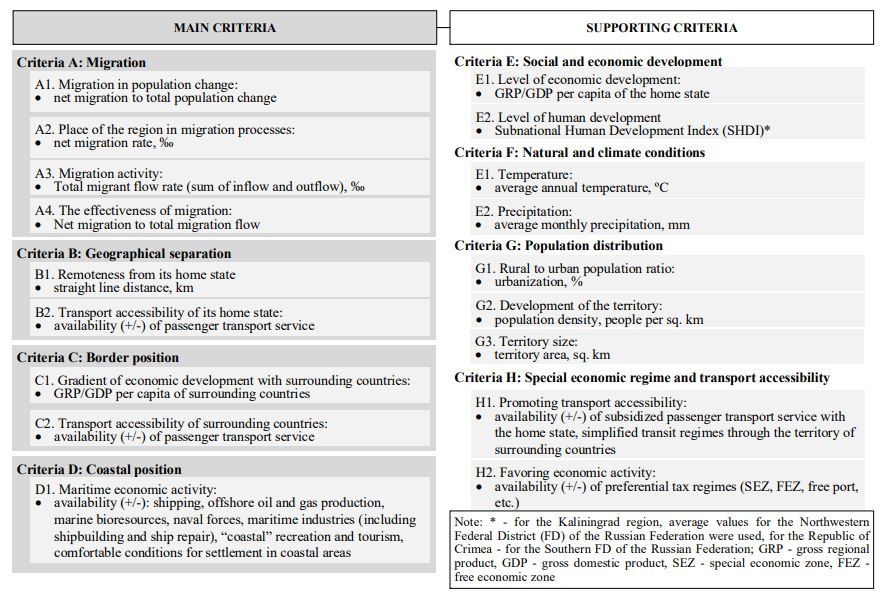
The data on average annual temperature and precipitation were obtained from the Weather and Climate: The Global Historical Weather and Climate Data search engine. The identified types and subtypes of coastal exclaves are described in terms of how migration patterns are shaped by spatial isolation, coastal location and borderland status. Some data are only partially comparable. For instance, migration statistics in the United Kingdom and the United States are typically collected mid-year, while in other regions, they are reported at the start of the year. Moreover, since migration indicators for some exclaves, such as Musandam, Cabinda and Oecusse-Ambeno, are not available in the public domain, some estimates were calculated based on natural population change. It is also important to note that the methodology for calculating migration indicators is not standardised,8 and in some countries, migration data collection is not entirely reliable, as in the cases of Angola and East Timor.
Results
The distribution of coastal exclaves by the contribution of migration to population dynamics — defined as the ratio between net migration and natural increase or decline — as well as by distance from the parent state, area, environmental conditions and economic performance revealed several distinctive features. Firstly, migration has a prominent role in population dynamics in only three coastal exclaves. In the Kaliningrad region it is responsible for population growth, being many times the natural decrease rate, while in Temburong and Ceuta, it accounts for population decline (Fig. 2). In two other exclaves, Alaska and Musandam, net migration is slightly above the natural increase rate. Secondly, exclaves located in regions with severe climatic conditions typically exhibit unfavourable migration trends. The only exceptions are Musandam and Cabinda. Thirdly, migration-related population decrease is registered in smaller exclaves, whose territories naturally have a limited capacity for migration. Fourthly, among exclaves with negative net migration are three territories lying at the greatest distance from the parent state: French Guiana, Gibraltar and Alaska. Fifthly, population decrease due to migration is accompanied in exclaves by higher economic growth rates, three times exceeding those in areas with migration-related growth. This leads one to the conclusion that the influence of this factor on migration processes is secondary.
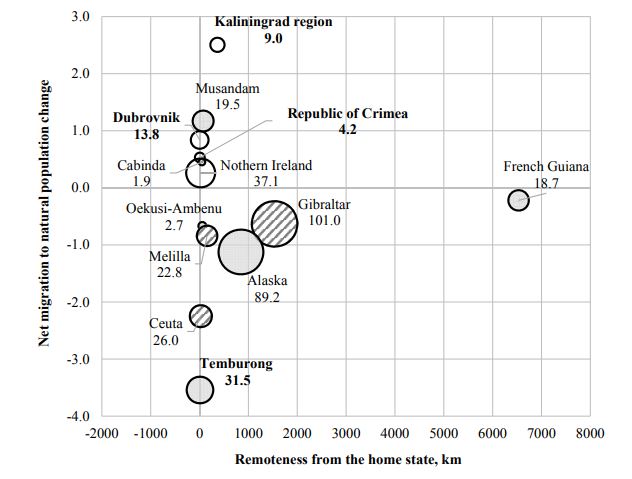
Comment: The size of each circle and its caption represent the GDP (current prices, PPP), in 1,000 USD per capita. For Temburong, Oecusse-Ambeno, and Musandam, average national values are used. Exclaves with an area of no more than 20 km² are hatched. Those located in unfavourable natural and climatic conditions — equatorial, sub-equatorial, tropical, and subarctic climates as classified by Boris Alisov — are shaded. Exclaves experiencing natural population decrease are indicated in bold .
Migration typology of the world’s coastal exclaves
According to migration characteristics, coastal exclaves can be classified into three types: territories attractive to migrants (Type A), unattractive to migrants (Type B) and peripheral to migration processes (Type C) (Table 1).
Type A includes exclaves with overall positive net migration over the study period. Subtypes A1 and A2 can be distinguished based on the significance of migration for population dynamics. Exclaves where migration plays a primary role in population dynamics form subtype A1. Among them is the Kaliningrad region, where migration offsets natural population decrease, and Musandam, where migration complements natural population growth. Subtype A2 comprises Crimea and Cabinda, where migration plays a secondary role, with population dynamics largely driven by natural increase (Cabinda) or decrease (Crimea).
Larger than many other study exclaves in terms of area, both the Kaliningrad region and the Republic of Crimea have a mild climate and favourable environmental conditions. They boast well-developed maritime economy sectors and robust transport connectivity, both national and international. Home to international airports and seaports, these regions are linked to surrounding states by an extensive road network. Between 2018 and 2022, Crimea was only linked by road to other Russian regions via Kerch Bridge. Yet, in economic terms, the two regions perform below the averages for both the country and the surrounding states. This may indicate that these regions are chosen by residents from less economically developed regions of Russia and other countries (not the neighbouring ones). Moreover, migration to these areas for non-economic reasons, such as environmental, climatic, historical, or cultural ones, is also widespread. Currently, a number of measures aimed at subsidising transport connections and stimulating socio-economic development are focused on reducing the costs associated with the spatial isolation of the Russian exclaves.
Musandam and Cabinda differ from other Type A exclaves in that they exhibit high natural population growth. In these regions, the influence the unfavourable environmental and climatic conditions have on migration dynamics is overshadowed by economic factors, primarily, the oil and gas extraction capability. Both exclaves are located relatively close to their parent territories, at distances ranging from 50 to 75 km, and maintain strong connectivity with the metropole through all modes of transport. These regions are also engaged in the maritime economy, including the development of port infrastructure and logistics, fisheries and ‘coastal’ industries.
Indicator | Type A | Type B | Type C | ||||||||||
A1 | A2 | B1 | B2 | ||||||||||
RU-KGD | OM-MU | RU-CRI | AO-CAB | ES-CE | US-AK | BN-TE | TL-OE | FR-GF | ES-ML | GIB-292 | HR-19 | GB-NIR | |
Criteria А: migration situation | |||||||||||||
A1 | 2.51 | 1.17 | 0.53 | 0.45 | – 2.25 | – 1.1 | – 3.54 | – 0.67 | – 0.2 | – 0.84 | – 0.63 | 0.84 | 0.26 |
A2 | 10.75 | 15.93 | 3.63 | 8.46 | – 6.99 | – 7.12 | – 12.37 | – 12.54 | – 3.92 | – 5.71 | – 1.82 | 1.35 | 0.81 |
A3 | 45.8 | N/A | 48.1 | N/A | 56.3 | 112.6 | N/A | N/A | N/A | 73.6 | N/A | 31.6 | 24.8 |
A4 | 0.23 | N/A | 0.08 | N/A | 0.17 | – 0.07 | N/A | N/A | N/A | – 0.15 | N/A | 0.04 | 0.03 |
Criteria B: spatial isolation | |||||||||||||
B1 | 365 | 73 | 5 | 49 | 25 | 847 | 9 | 57 | 6530 | 153 | 1535 | 2 | 22 |
B2 | + / + / + | + / + / + | + / + / + | + / + / + | – / + / + | – / + / + | + / – / + | + / + / + | – / + / – | – / + / + | – / + / – | + / + / + | – / + / + |
Criteria C: borderland status | |||||||||||||
C1 | 0.38—0.50 | N/A | 0.86 | N/A | 4.97 | 1.7 | N/A | N/A | 3.71 | 4.37 | 3.3 | 1.47 — 1.91 | 0.3 |
C2 | + / – / – | + / – / – | + / + / + | + / – / + | + / – / – | + / + / + | + / – / – | + / – / – | + / + / + | + / – / – | + / + / – | + / – / – | + / – / + |
Criteria D: coastal position | |||||||||||||
D1 | + | + | + | + | + | + | + | + | + | + | + | + | + |
D2 | + | + | + | + | – | + | – | – | – | – | – | – | – |
D3 | + | + | + | + | + | + | – | + | + | + | – | + | + |
D4 | + | + | + | + | + | + | + | + | + | + | + | + | + |
D5 | + | + | + | – | + | + | – | – | + | – | + | + | + |
D6 | + | + | + | – | + | + | – | – | + | + | + | + | + |
D7 | + | + | + | + | + | + | – | – | + | – | – | – | + |
D8 | + | – | + | – | – | – | – | – | – | – | + | + | + |
Criteria E: socio-economic development | |||||||||||||
E1 | 0.7 | N/A | 0.3 | N/A | 0.7 | 1.3 | N/A | N/A | 0.5 | 0.6 | 2.2 | 0.8 | 0.8 |
E2 | 0.85 | 0.83 | 0.81 | 0.69 | 0.85 | 0.93 | 0.83 | 0.54 | 0.79 | 0.85 | 0.93 | 0.87 | 0.9 |
Criteria F: climate and environment | |||||||||||||
F1 | 9.4 | 28.2 | 15.0 | 26.0 | 18.6 | – 2.0 | 28.4 | 27.7 | 27.5 | 19.6 | 18.0 | 16.0 | 9.9 |
F2 | 67 | 13 | 42 | 68 | 51 | 32 | 126 | 136 | 109 | 30 | 64 | 86 | 72 |
Criteria G: settlement patterns | |||||||||||||
G1 | 77 | 72* | 51 | 87 | 100 | 80 | 6 | 21 | 90 | 100 | 100 | 100 | 65 |
G2 | 67 | 27 | 73 | 115 | 4556 | 0 | 7 | 89 | 3 | 6437 | 5025 | 68 | 137 |
G3 | 15 125 | 1800 | 26 081 | 7273 | 19 | 1 717 856 | 1306 | 817 | 83 846 | 13 | 7 | 1781 | 13 843 |
Criteria H: special economic regime and transport accessibility | |||||||||||||
H1 | + | – | + | – | + | + | – | – | – | + | – | + | + |
H2 | + | + | + | + | + | – | – | + | – | + | + | – | + |
Comment: * — evaluation; the codes of the regions are in accordance with ISO 3166; the code of the Republic of Crimea was assigned by the authors within the logic of GOST 7.67.
Although transport links with the parent state are not subsidised for these exclaves, special tax regimes have been implemented in Cabinda, the Cabinda VAT Special Regime — albeit not applicable to the oil extraction sector — has been introduced to enhance the competitiveness of locally produced goods and maintain affordable import prices. This regime includes various tax benefits, such as a reduced value-added tax (VAT) rate of 1—2 % on certain goods and services, instead of the standard 14 %.
Type B subtypes, representing exclaves unattractive to migrants, are categorised following the same logic. Subtype B1 encompasses exclaves where migration serves as the primary driver of population dynamics, while subtype B2 includes those where migration plays a secondary role. Subtype B1 comprises Ceuta and Alaska, where population outflows offset natural population growth, and Temburong, where migration exacerbates natural population decline, a trend uncharacteristic of the country as a whole. This phenomenon is attributed to a high proportion of older individuals and a low percentage of those in reproductive age, resulting in reduced fertility rates and increased mortality. Subtype B2 consists of Oecusse-Ambeno, French Guiana and Melilla — exclaves where migratory outflows partially decrease natural population growth.
The largest exclave by area, Alaska, lies one-third beyond the Arctic Circle. Harsh environmental and climatic conditions continue to shape its migration dynamics. At the same time, the region’s economic focus — resource extraction, with a significant share of the public sector [34] — and its strong transport connectivity to other territories, supplemented by subsidised domestic air travel, contribute to substantial migration turnover. Although Alaska outperforms neighbouring Canada and many US states in terms of socio-economic development, the region continues to experience a net migration decrease.
Densely populated Melilla and Ceuta benefit from favourable climate and environmental conditions. Migration processes in these regions take place within the confines of a small territory, characterised by limited migration capacity and economic potential. Migration dynamics in these exclaves are marked by the outflow of permanent residents to mainland Spain, driven by the region’s lower living standards and the influx of African refugees seeking to enter the European Union, which diminishes the regions’ appeal to interregional migrants [35]. A modest migration gain in exchange with neighbouring Morocco is accompanied by high-intensity short-term migration of Moroccans into the exclaves. This situation results from a higher standard of living in the exclaves, which is four times greater than in Morocco, and the opportunity for Moroccans to make short-term, visa-free visits to Spanish cities, as Spanish exclaves are excluded from the Schengen Agreement.
Temburong, Oecusse-Ambeno and French Guiana are located in the equatorial and sub-equatorial regions, respectively, both associated with adverse natural and climatic conditions. The economies of these exclaves are underdeveloped, with their coastal locations largely untapped and dependence on state subsidies remaining high. In Temburong and Oecusse-Ambeno, the principal industry is agriculture, with the former also specialising in ecotourism. In French Guiana, the most developed sectors are fishing, seafood extraction and timber harvesting. The transport accessibility of French Guiana, the most distant exclave, is the lowest among all the study regions, with air transport being largely unaffordable due to its below-average economic development relative to the parent country. Connectivity with neighbouring countries is more intensive due to multiple road, sea, and air transport options, as well as greater affordability resulting from higher levels of economic development compared to adjacent states. Oecusse-Ambeno and Temburong have relatively closer transport links with their parent states by road, sea and air, with the last option not applicable to Temburong. However, none of the exclaves in this subtype receive subsidies for the transport corridor connecting them with their parent states.
Type C encompasses exclaves located outside major migration routes, with a low net migration rate — Dubrovnik, Gibraltar, and Northern Ireland — where mobility has a modest impact on population change. This situation can be explained by various factors, with the main ones being population ageing, the increase in homeownership, cultural entrenchment, and the widespread development of remote employment [36]. In Northern Ireland, negative societal attitudes towards migrants are also significant, as the region has only recently emerged as a destination for immigration [37]. Although Northern Ireland’s economy is highly diversified, with a well-developed maritime sector, the region lags behind both the parent country and its neighbour, reducing its appeal to migrants from other parts of the UK and Ireland. Migration capacity is an additional factor contributing to the low intensity of migration in Gibraltar and Dubrovnik. In the former, it is largely the result of its small area, which is slightly above 7 km², while in the latter, it is influenced by the heavy volume of tourists9 and the restrictions associated with the status of the UNESCO World Heritage Site for the old town.
Territories exhibiting typical characteristics of migration processes in coastal exclaves were selected for a more in-depth analysis. These include the Kaliningrad region and Alaska, where interregional migration plays a leading role; Northern Ireland, characterised by localisation of migration within the exclave; Oecusse-Ambeno, primarily oriented towards migration interactions with neighbouring countries; and the Republic of Crimea, engaged in migration exchanges simultaneously with both neighbouring countries and the parent state.
Migration specifics of some typical coastal exclaves
Kaliningrad exclave: a centre of attraction for internal migrants
Populated by Soviet settlers after the territory became part of the RSFSR in 1946, the Kaliningrad region experienced a migration gain throughout the post-Soviet period. A new phase of increase in the exclave’s net migration rate began after 2016, as Russia overcame the crisis caused by the sanctions standoff between the country and the West, following the integration of Crimea and Sevastopol in 2014. Another factor was the growing popularity of the region as a destination for Russian tourists. The influx of visitors led to greater recognition of the region and stimulated investment, which transformed its appearance and improved its transport connectivity with other Russian regions. Consequently, migrant inflows from other parts of Russia increased [28].
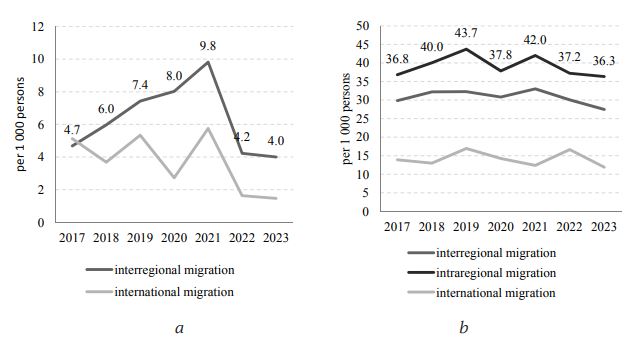
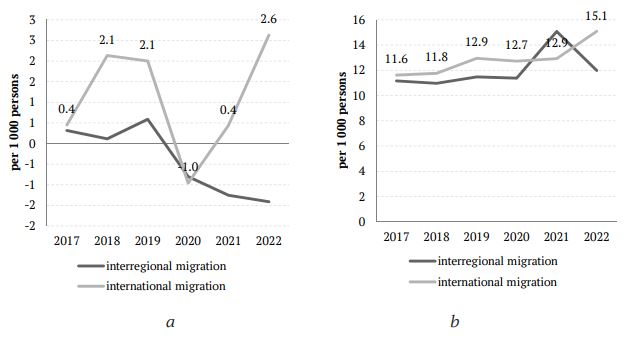
Interregional migration accounts for over 60 % of the region’s migration gain and about 36 % of gross migration (Fig. 3). The primary reasons settlers from Russia choose the exclave are its favourable natural and climatic conditions, clean environment, historical and cultural uniqueness and affordable housing costs [28]. It is therefore unsurprising that most migrants come from the northern regions, Siberia, and the Russian Far East [28]. The geography of destinations chosen by migrants from the Kaliningrad region indirectly reflects the push factors of economic and educational migration, influenced by the exclave nature and small size of the region, i. e., its limited economic capacity. As a result, residents of the region more frequently head towards the capitals, Moscow and St. Petersburg, as well as their surrounding regions [38].
Measures aimed at overcoming transport costs include subsidising passenger air links with the parent territory and, since 2022, maritime freight transport. A simplified procedure for land transit through Lithuania is available for residents of the region. Projects aimed at enhancing the region’s economic security are being implemented, including major energy initiatives such as the construction of an LNG reception terminal, a floating regasification unit and an underground gas storage facility. Moreover, a Special Economic Zone (SEZ) regime has been established to sustain the competitiveness of local products.
Alaska: a donor of internal migrants for other US states
Migration in Alaska has traditionally been either forced or economically motivated. A large proportion consisted of military personnel being assigned to new postings and migrants seeking higher wages in the fishing industry and mining enterprises.10 Currently, 28 % of workers in the production sector are employed in mining, and 20 % in the fishing industry.11 Military personnel account for 7 % of the local population.12 As of 2018, 42 % of the exclave’s population were locally born, while 46 % were born in other US states and around 12 % abroad, with 3 % originating from the Philippines.13
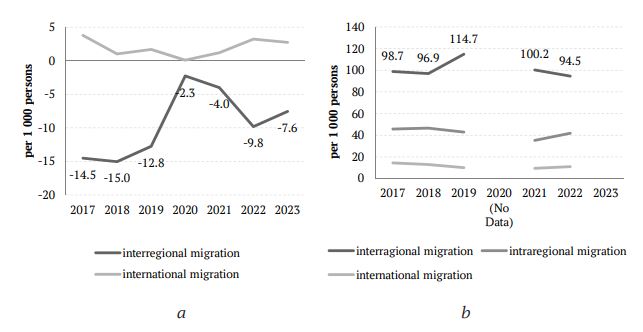
The migration experience of Alaska’s residents, their lack of rootedness, and the adverse natural and climatic conditions drive the local population to other US states, diminishing the significance of the advantages provided by the region’s buoyant economy. The outflow is further intensified by subsidised air travel within the state, which improves access to central airports — key points of connection with the mainland — for residents of remote areas. In total, between 2017 and 2023, the exclave lost nearly 50,000 people, or 6.6 % of its population, with only one-fifth of this loss compensated by inflows from other countries, primarily the Philippines (Fig. 4).
The mobility of the population within the state, facilitated by subsidised air travel, remains high — around 40 ‰ — which exceeds the values observed in other exclaves. However, it is still less intense than external migration, accounting for 28 % of gross migration in Alaska.14
Oecusse-Ambeno: migration decline of rural population due to emigration and urbanisation
According to the 2022 census, locally born residents account for over 90 % of the population of Oecusse-Ambeno.15 A significant migration decline in the population of this agricultural exclave is primarily linked to emigration. This trend is due to the region’s remoteness and the low affordability of transport links with the mainland, as well as the lack of strong social ties with the peoples of the eastern part of the country: ethnic proximity to the peoples of the western part hinders intensive migration interaction with other regions of East Timor. Experts highlight two main directions in international migration: a) towards the culturally and economically close neighbouring region of Indonesia — East Nusa Tenggara; b) towards economically developed countries — Australia, Portugal and the UK — much in line with national trends.16 The less pronounced interregional migration loss is linked to urbanisation and the relocation of the exclave’s rural population to the capital region of Dili. According to the 2022 census, the area had the highest proportion of exclave natives who had ever left their birthplace to migrate within the country (76 %). Among the measures to address Oecusse-Ambeno’s spatial isolation is a special tax regime implemented within the Special Administrative Region framework to promote international tourism [39].
Northern Ireland: localisation of migration flows with a focus on international migration exchange
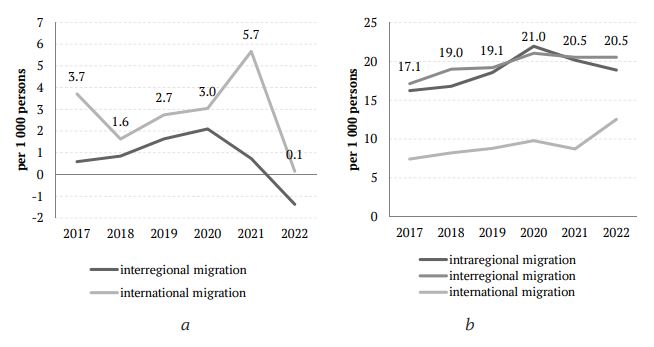
Migration in Northern Ireland is dominated by movements over distances of 10 to 50 km [40]. Over 80 % of residents who changed their place of residence in 2020 did not leave the exclave, and the vast majority remained within their district.17 This local migration focus is attributed to the region’s uneven living standards and quality of life, its lag behind the average levels of the parent state and the neighbouring country, as well as insufficient subsidies for transport connectivity with the mainland.18 The religious composition of the population also influences migration patterns: protestants, who make up 44 % of the population, exhibit greater mobility over distances of up to 50 km [40].
The primary driver of changes in Northern Ireland’s migration dynamics, largely oriented towards internal movements, is international migration — specifically, exchanges with neighbouring Ireland (Fig. 5). International mobility is primarily facilitated by close social, often familial, ties among residents on both sides of the border. The primary driver of changes in Northern Ireland’s migration dynamics, which are predominantly focused on internal movements, is international migration, particularly exchanges with neighbouring Ireland. Another significant factor is transport connectivity and the Common Travel Area regime,19 which allows Irish citizens to live and work in the UK (and UK citizens in Ireland) without restrictions.
Close migration ties also underpin immigration from India and China, which in 2022 was facilitated by the liberalisation of the visa regime for highly skilled professionals and healthcare workers [37]. Moreover, the exclave attracts labour migrants from countries with lower living standards and higher unemployment rates, such as Romania, Bulgaria, Poland and Lithuania.20 Finally, another migration channel to the exclave is the spontaneous movement of refugees from conflict zones, including Ukraine and Syria.
The Republic of Crimea: an exclave with a developed migration exchange with the parent and neighbouring states
After 2014, a decisive role in the migration dynamics in Crimea was played by two processes: a growing migration exchange with other Russian regions, stimulated by the territory’s integration into Russia and the increasing influx of migrants from Ukraine. Yet, migration exchange with Russian regions has low efficiency, whereas the less intensive exchange with foreign states, primarily Ukraine, accounts for 73 % of migration gain. The driver of increased interregional migration was the active integration of the region into Russia’s political, legal and socio-economic environment, as well as the establishment of the region’s security system, which required the involvement of specialists with appropriate qualifications [41]. Another contributing factor is the subsidised railway link and the preferential tax regime (Crimea SEZ). The influx of migrants from Ukraine is accounted for by the relocation of part of the Russophone population to Russia as a result of discrimination in the country of origin.
Conclusion
The study showed that exclavity rarely determines the specific nature of migration processes in coastal exclaves. It can play a pivotal role in only three circumstances: when the exclave is geographically distant from the parent state, when it lags behind socio-economically, leading to limited affordability of transport links with the parent state, or when both conditions occur simultaneously. In all other cases, exclavity is secondary to other factors influencing migration dynamics, including natural and climatic conditions, sectoral economic specialisation, such as oil and gas extraction and the maritime economy; the level of socio-economic development relative to the parent and neighbouring countries; historical and cultural determinants of migration ties; territorial capacity; and the presence of special regimes designed to mitigate territorial isolation costs. An example of the first case is French Guiana, which has a relatively low net migration rate. Remoteness, coupled with adverse natural and climatic conditions, not only results in spatial isolation and low transport connectivity but also defines the peripheral nature of the exclave, which in turn diminishes the affordability of transport links with the parent state and its migration attractiveness to neighbouring countries. The low level of socio-economic development associated with exclavity drives the migration outflow from the underdeveloped agricultural exclave of Oecusse-Ambeno, primarily towards neighbouring Indonesia.
The study also showed that such diverse coastal exclaves can be typologised according to the nature of the migration processes occurring within them. Only four coastal exclaves are experiencing migration growth: the Kaliningrad region, Crimea, Cabinda and Musandam. A significant factor in this increase is the implementation of policies aimed at mitigating the costs of exclavity, with such measures most successfully applied in the Kaliningrad region and Cabinda. However, in all other exclaves, the measures taken do not appear to be sufficiently effective and fail to create conditions conducive to migration growth. Six of the 13 exclaves are classified as unattractive to migrants, while in three, migration processes are minimal.
The study confirmed the hypotheses tested. Despite the wide range of measures aimed at overcoming the costs of exclavity and promoting migration exchange with neighbouring Ireland, Northern Ireland experiences a localisation of migration processes. Due to its low socio-economic development and historical factors, the agricultural exclave of Oecusse-Ambeno exhibits a stronger orientation towards migration exchanges with neighbouring Indonesia compared to interregional migration. Interregional migration predominates in the Kaliningrad region and Alaska, albeit for different reasons. The attractiveness of the Russian exclave stems from the forced concentration of migration processes within the country’s borders, due to sanctions (after 2022) and the COVID-19 pandemic, as well as an improvement in living standards, supported by active policies to overcome the costs of exclavity. In Alaska, natural, climatic and economic conditions push the population out of the region. An intensive migration exchange with both the parent and neighbouring states was characteristic of Crimea as a result of the region’s integration into the Russian environment alongside close social ties with Ukraine.
The prospects of the research are tied to a more detailed examination of the push and pull factors influencing migrants within the typological groups of coastal exclaves. An analysis of migration dynamics over a longer time span is also of interest, with the aim of verifying changes in migration patterns within the context of economic and political shocks, particularly regarding the ‘parent state — surrounding state’ relationship [42, p. 301].
This study was supported by grant № 23-77-01102 from the Russian Science Foundation, https://rscf.ru/project/23-77-01102/.
Reference