Adaptation of the territorial organisation of agriculture in a peripheral region to the operations of agricultural holdings


Abstract
Agricultural holdings are often cited as the main beneficiaries, on the one hand, of organisational and structural changes in Russian agriculture during the post-Soviet period, and on the other, of the transformation of state policy in response to contemporary geopolitical challenges. This paper examines the adaptation of the territorial and sectoral structure of agriculture in a socioeconomically peripheral region in response to the expansion of agricultural holdings. This study draws on official statistical data, the SPARK database, resources from the VetIS Federal State Information System, the Unified Federal Information System on Agricultural Land, and the authors’ extensive field research. The study demonstrated that the operations of agricultural holdings can completely transform the agricultural profile of a non-Chernozem region with a declining population in terms of specialisation and organisational structure, leading to economic recovery in agriculture. The example of the Pskov region illustrates how the expansion of agroholding assets is swiftly extending into peripheral areas with abundant land and low rural population density. The interviews confirmed that livestock agricultural holdings, primarily those specialising in pork production, benefit from the social desertification of rural areas. This is accompanied by a further weakening of rural community economies, as livestock and poultry have completely disappeared from private and subsistence farms. The new pork production specialisation in the Pskov region has, as expected, led to other changes in agriculture, including an increase in grain farming. While production volumes have risen, new territorial centres have not emerged.
Introduction and problem statement
The policy of many countries with regard to the development of agriculture and food production is frequently expressed in terms of the application of general incentives. In terms of geography, these policies tend to be most effective in areas with favourable conditions for agriculture or in proximity to large urban agglomerations. From an organisational perspective, incentives have the greatest positive impact on the development of major players in the food market. Consequently, the scope of their expansion extends beyond the boundaries of the most appealing regions for agriculture and food production, frequently precipitating a notable transformation of peripheral areas [1].
The resurgence of agricultural production in Russia during the 2000s was accompanied by a gradual shift toward the south. Conversely, in numerous areas of the non-chernozem region, the decline persisted, accompanied by significant demographic losses [2]. This was largely due to agricultural holdings, which, according to Barsukova [3], constituted an “unexpected result” of the Russian agrarian reform of the 1990s. They were the principal beneficiaries of the shifts in the external and internal trajectories of the country’s development. The sharp devaluation of the rouble, which occurred after the 1998 crisis and was subsequently repeated in 2008, 2014—2016, and 2022—2024, created an opportunity for profitable investment in production oriented both towards the export market and the domestic market with the aim of replacing expensive imports. The close ties between agricultural enterprises, regional and even federal authorities enabled them to amass a considerable portion of state support for agricultural production.
It is estimated that Russia’s accession to the WTO in 2012 resulted in a significant reduction in state support for agricultural production. This was associated with several reductions, such as a reduction in tariffs and tariff quotas, a reduction in opportunities to manipulate phytosanitary restrictions, and a reduction in direct financial support to producers and exporters.1 It was anticipated that the animal husbandry sector would encounter the most significant challenges, prompting the government to prioritize supporting its various branches [4].
The geopolitical crisis of 2014, in conjunction with Western sanctions and the Russian response to them, created conditions conducive to circumventing WTO rules and regulations. Imports of agricultural products from the EU and several other countries were subject to restrictions, while financial and organisational support for domestic agriculture was increased. The establishment of agroholdings played a pivotal role in expediting import substitution and fostering the growth of export capabilities. However, their operations have also given rise to concerns regarding the potential risks they pose to farmers and citizens’ personal assets, as well as to rural communities in general according to some estimates [2].
It is important to note that the development of economic sectors in border regions has consistently been approached in the context of the functions of these regions. It is not merely an outpost; it is also a zone of contact and transit, a locale where export flows are formed, and a ‘showcase’ that exemplifies the success [5] of the state. However, in border regions such as the Pskov region, the negative trends in agriculture and rural population decreases were more pronounced than in other regions of the non-chernozem region. The factors of peripherality, intense competition from neighbouring regions whose agriculture was subsidized by national and, in the case of the Baltic countries, supranational authorities and the rapid decline in rural populations all had an impact.
Since the mid-point of the 2000s, and particularly following 2014, agroholdings have assumed an increasingly prominent role in numerous border regions. They have facilitated the emergence of new specializations, the development of new interregional links and the creation of new industrial enterprises, including those oriented towards export. Prior research in other border regions has demonstrated the varied impact of such developments on the sustainability of local communities, food security challenges [6], and cross-border practices of the local population [7].
The objective of this study is to evaluate the impact of sanctions and restrictions on agricultural production in the Pskov region and to examine the relationship between the expansion of agricultural holdings over the past decade as well as the evolving structure of the regional agricultural sector.
Literature review
An agroholding can be defined as a group of agricultural organisations whose controlling shares are held by a holding (management) company [8]. In this instance, the management company exercises control over several agricultural, processing and other enterprises, each of which is a distinct legal entity with a unique legal form. Agroholdings are a distinctive form of a business entity that is confined to a limited number of geographical regions worldwide. This form of agribusiness organisation is most prevalent in Eastern Europe, Latin America (Brazil, Argentina), Australia, China, as well as in the post-Soviet countries (where it is of particular significance in Russia, Ukraine and Kazakhstan) [9], [10]. The concept of agroholding is open to a number of different interpretations in the academic literature. It is important to note that the legal concept of agroholding does not exist.
The term agroholding is used to describe a specific form of farm organisation as defined by numerous economists [11], [12]. The enterprise is constructed according to the specific type of holding, which represents a set of management organisations and subsidiaries. A further defining feature is the concentration of land rights. There is no consensus among researchers regarding the minimum size of agricultural holdings. Some researchers are guided by relative parameters [13], while others propose specific criteria. Accordingly, in the work of Hermans and colleagues, the typical size of agroholdings is 500,000 hectares [9]. Grulier posits that the typical agroholding exceeds 27 thousand hectares in size [14]. In contrast to the prevailing approach, Shagaida and Uzun determine the size of an agroholding not by the area of the controlled land, but by the income of the enterprises [15], [16], [17]. In accordance with the regulatory legal acts on small and medium-sized enterprises, the authors put forth a lower limit for the total revenue of the agroholding [16], [18], which is set at approximately 20 million USD. It is not always the case that academic economists refer to agroholdings as vertically integrated units. Some authors posit that the presence of assets in the agricultural sector is the sole criterion for identifying agroholdings. In the literature on international agricultural economics, agroholdings are regarded as both horizontally and vertically integrated enterprises [9], [13], [19]. It is also noteworthy that the majority of authors highlight the unfeasibility of contractual relations within this organisational structure.
Some geographers adopt an approach similar to that of economists, viewing agroholdings as a distinct form of business organisation [20], [21], [22]. However, this perspective is not widely embraced within the field. In contrast, a more common approach is to consider vertical integration and the coverage of several economic sectors, including farming, processing and trade as the primary factors of interest [23], [24], [25].
In general, two distinct approaches to the definition of agroholdings can be identified. The first approach is economic, wherein the agroholding is conceptualized as an ‘umbrella system’ delineating between the integrator enterprise and the subsidiary organisations. In this approach, the structure and size of the enterprise (which is not clearly defined, with the definition based on the total turnover of the groups of enterprises and the area of land owned by the enterprise) are of greater importance than the profile of the enterprise’s activities (an agroholding can either be involved only in agricultural activities or integrate the entire production chain). The second approach is economic-geographical. The distinguishing feature of an agroholding is the composition of its assets, which should encompass the entire production chain from field to consumer.
In light of the pivotal role that such enterprises play in shaping the territorial organisation of agricultural production, this article adopts a comprehensive definition of agroholdings. In addition to encompassing traditional holding-type organisations with assets in agriculture, the term is also used to refer to large, corporate, vertically integrated structures with a complete food production chain.
The evolution of agricultural holdings and the reinforcement of their contribution to agricultural production have resulted in a notable transformation in the territorial organisation of agricultural production. The existing literature on the main territorial shifts in agricultural production only partially examines the role of agricultural holdings in these transformations. They are predominantly presented in the form of individual case studies of the largest farms at the national or regional level. In general, the agricultural assets of agricultural holdings, irrespective of the type of integrator enterprise, are situated in close proximity to major markets and regions with a concentration of labour and natural resources [24], [26], [27]. Furthermore, the agricultural assets of agricultural enterprises are frequently developed in the vicinity of the most profitable farms in the southern region of the country [28]. At the regional level, the availability of developed infrastructure has become a significant factor influencing the proliferation of farms. As a consequence of the limited number of territories that meet the aforementioned conditions, the concentration of agricultural activities of farms occurs in a restricted number of regions. This is particularly significant with regard to the production of high-margin products, including pig meat, poultry and plant products [29]. Moreover, agricultural holdings disrupt the production process, with the production of animal products concentrated near major markets and the harvesting of fodder occurring in areas with optimal agroclimatic conditions [26], [27].
It is important to note that the activity of agricultural holdings at the regional level does not undergo radical changes; however, it does result in a notable alteration to the territorial organisation of agricultural production, thereby accelerating the processes of polarization [27]. Furthermore, the influence of agricultural holdings on the organisational structure of production and sectoral specialisation is considerable. Consequently, with the advent of agricultural enterprises in the region, a growing proportion of agricultural output is concentrated in the hands of agricultural organisations [23]. Simultaneously, the number of small farms is in decline [30] with those that remain diversifying their activities to encompass a greater range of sectors [27]. The activity of large farms results in the displacement of traditional specializations both at the level of individual districts and across entire regions [30].
The majority of studies on foreign farms concentrate on the efficiency of agricultural production in such formations [31], [32]. A further area of investigation concerns the relationship between agricultural production and land use conflicts as well as the question of food security [33].
The question of the relationship between sanctions policy trends in agricultural production and the expansion of agroholdings has yet to be adequately addressed in academic literature. The relative closure of the main players in the agricultural market has an impact on this relationship. Nevertheless, some studies suggest that following 2014, the support of agroholdings became a de facto priority for the authorities, with these entities exhibiting a high degree of dependence on this support [13]. Some studies characterize agroholdings primarily as beneficiaries of the sanctions policy, which enabled them to occupy the vacated niches, significantly expand production and even export their products to other countries [3]. Other studies, especially those published after 2022, concentrate on the potential issues facing agricultural holdings and the wider domestic agro-industrial complex, including dependence on supplies of Western machinery, breeding and genetics, pesticides and other inputs. It is emphasized that agricultural enterprises are particularly dependent on international cooperation, and thus their regions of presence will be particularly susceptible to the effects of sanctions. Conversely, this form of agriculture displays considerable potential for adaptation driven by preferential loans and a range of state-sponsored support programmes [34].
A paucity of studies has been dedicated to the examination of alterations in the territorial configuration of agricultural production, particularly within the Pskov region. Kleimenov conducted a historical analysis of the post-Soviet transformation of the region’s agro-industrial complex. He demonstrated that the reduction in the population’s income during the 1990s and the first half of the 2000s, which resulted in a decline in consumption of milk and meat products, prompted a reorientation of food production towards the larger markets of Moscow and St. Petersburg. During this same period, there was a notable shift towards the utilization of imported raw materials, including milk powder and frozen meat. In the 2010s, the growth of household incomes, an increase in demand for dairy and meat products among the residents of the Pskov region, as well as the reduction of domestic production of raw milk and meat, led to the necessity for large combines to form their own raw material base. This was exemplified by the formation of the Velikoluksky Dairy Plant, the Velikoluksky Meat Processing Plant and the Pskov Meat Plant [35].
It is often the case that the activities of agroholdings in peripheral areas are related to the objective of achieving food self-sufficiency [36]. Nevertheless, it is more frequently the case that the support of local farming is regarded as a means of peripheral development, particularly in European countries. In any case, an examination of peripheral areas as a setting for the activities of diverse actors in the agrifood sector is a topic of significant interest [37], [38].
Data and methods
The work is based on an analysis of official data from the Federal State Statistics Service of Russia and its territorial division for the Pskov region, data from the North-West Customs Department of Russia, and reports from the company “Agroexport” on the export of agricultural products. Furthermore, as Russia does not maintain statistical records on agricultural holdings, we devised our own methodology for data collection on the territorial distribution of assets of agricultural holdings which was then tested on the materials of the Pskov region. In the initial phase, a register of agroholdings was compiled using the SPARK database of companies as a reference point. Subsequently, a list of agricultural assets was determined for each company using data from the FGIS VetIS, and their location and activity profile were established. Subsequently, data from additional sources, including the Unified Federal Information System on Agricultural Land and Google Earth, were employed to ascertain the construction dates of the requisite agricultural assets for the purpose of analyzing the territorial expansion of the holding company.
The interpretation of the data was informed by the authors’ long-term field research in the Pskov region, which included expert interviews with government officials, agricultural producers and processors conducted in 2016—2017, 2021 and 2024 in Pskov, Velikiye Luki, Porhov, Pechory, Nevel, Sebezh, Gdov, Pushkinskiye Gory and surrounding areas.
Results and discussion
______________________________
Dynamics of agricultural development
The crisis of agricultural production observed in the Pskov region after 1991 was particularly pronounced when compared to other regions of the non-chernozem region. By the end of the Soviet era, the region had developed a specialization in dairy and meat cattle breeding and flax farming. Before flax, grain legumes, potatoes and forage crops (such as lucerne and clover) were included in crop rotation to add nitrogen to the soil. These crops were also valuable lactogenic fodder for dairy herds. In the 1990s, dairy cattle breeding and flax farming encountered significant financial challenges struggling to compete with similar industries in neighbouring Belarus, where agricultural enterprises, the food and light industries were subject to active state subsidies. By 1995, agricultural output had fallen to a level that was approximately 50 % of the 1991 figure. In 2000, agricultural output reached a mere 42 % of the 1991 level. The decline in output slowed, but did not halt.
The initial indications of a stabilization in the sector emerged during the 2007—2009 period. However, the overall decline in agricultural production persisted (Fig. 1). The 2010s marked a turning point with the trend finally shifting from negative to positive. It is noteworthy that the total agricultural production in 2022 was approximately double that of 2014, yet remained 65 % of the level recorded in 1991.
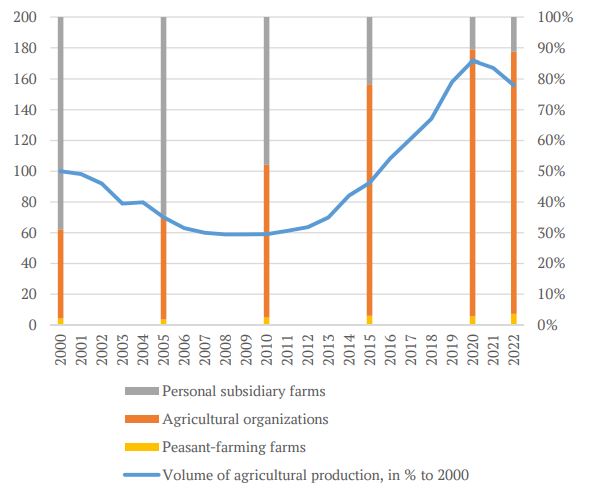
The changes were associated with a radical restructuring of the organisational structure of the industry. In 1995, agricultural organisations reduced production by 65 %, while household farms saw a 35 % reduction. The only sector to demonstrate growth was nascent peasant-farming farms (PFF), which increased production by a factor of three. This was largely attributable to the deterioration of the collective farm system. In the 2000s, personal subsidiary farms (PSF) owned by private citizens accounted for 69 % of agricultural output, while agricultural organisations were responsible for no more than 30 %.
The unfavourable demographic situation in the region has contributed to a significant degradation of rural settlements, which has led to a rapid decline in production in household farms with a reduction of 8—10 % annually. In 2010, PFF accounted for approximately 3 % of production, with the remainder produced by agricultural organisations and household farms in roughly equal proportions.
Following the 2010 period, the majority of production growth was driven by agricultural organisations. The average growth rate for the period 2010—2013 was approximately 4.5 %, while the subsequent period (2014—2020) saw a notable increase to just under 14 %. This equates to a rate of slightly less than 14 %. By 2016, agricultural organisations had already surpassed their 1991 production volumes, and by 2020, they are expected to have doubled those figures. During the post-Soviet period, there was a 6.7-fold increase in production by farms, a 1.9-fold increase by agricultural organisations, and a more than 10-fold decrease in production by household farms. Consequently, in 2022, 85 % of production was attributable to agricultural organisations, 11.3 % to household farms and only 3.6 % to private farms.
The substantial alterations in the configuration of agricultural production across categories of farms were accompanied by notable shifts in the ratio and magnitude of output within the principal branches of the agricultural sector.
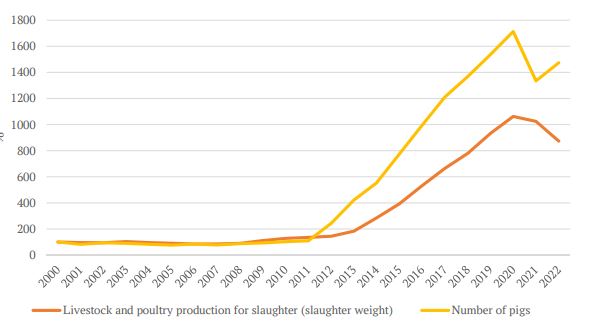
In the 2000s, the primary driver of growth was pig breeding. Since 2000, the number of pigs has increased by 14.7 times, with the majority of this growth occurring after 2011 (Fig. 2). Since the year 2000, the production of livestock and poultry for slaughter has increased by a factor of eight and a half, with a notable acceleration in the growth rate occurring after 2014.
In contrast, the number of cattle was observed to decline rapidly (Fig. 3). Since the year 2000, the number of cattle has decreased by a factor of three, with a 27 % reduction observed by the year 2014. A comparable pattern was observed in the dairy herd. However, the impact of the neighbouring St. Petersburg and Leningrad region business sector on the structure of the agro-industrial complex, coupled with a favourable situation in the dairy sector due to the food embargo in 2014, manifested itself in the establishment of new dairy farms. Consequently, there was a notable increase in efficiency, particularly in light of the significant growth in milk yields since 2000 (4.4 times). The total volume of milk produced was 8 % higher than in 2014, representing 65 % of the level recorded in 2000.
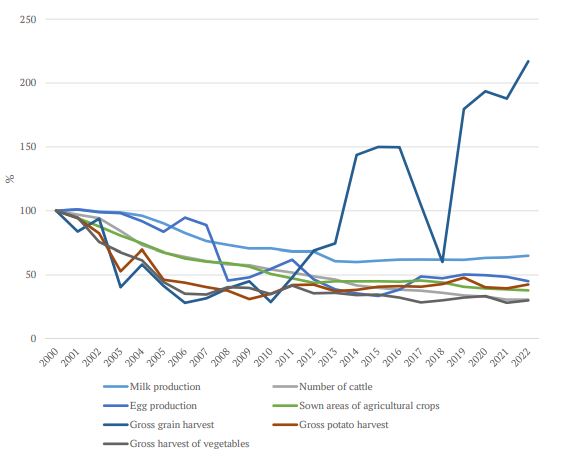
The region was experiencing a decline in egg production. The period of slight growth that commenced in 2017 was primarily attributable to the production of hatching eggs at the breeding farm “Naziya” (see Fig. 3).
A challenging scenario was observed in crop production, with the size of sown areas decreasing by a factor of 4.3 since 1990, including a 16 % reduction in the period since 2014. Concurrently, their structure has undergone minimal alteration since the early 1990s. As was the case previously, the dominant crops are fodder crops (65 % in 2020) and cereals (23 %, predominantly wheat). Approximately 10 % of the total area is devoted to potato cultivation. The proportion of land devoted to technical crops remains at 7 %, although the cultivation of rapeseed has replaced that of flax.
Notable positive developments occurred in the grain sector following 2010. There has been a substantial increase in production volumes. Concurrently, there has been a notable increase in yields, with a 2.6-fold rise since 2010 and a 3.7- fold rise since 2000.
In one of the historically significant agricultural sectors in the region, namely potato cultivation, the proportion of private subsidiary farms has consistently been high (93 % in 2000). However, despite this, production volumes between 2000 and 2022 exhibited a decline of 2.3 times the initial figure. Nevertheless, following 2014 there were periods of growth. In 2022, the proportion of household farms fell below 50 %. Crop yield has increased by 1.4 times since 2014 (1.9 times since 2000).
The gross harvest of vegetables remained virtually unchanged; however, the proportion of the population engaged in their production declined from over 90 % in 2000 to 56 % in 2022. Concurrently, the proportion of agricultural organisations increased from 9 % to 30 %, yet this had no impact on yields.
The changes that have occurred in the agro-industrial complex sector have had a discernible impact on the structure of the region’s foreign trade. The Pskov region has historically demonstrated a relatively limited export potential with its share in the total volume of Russian exports declining from 0.16 % in 2005 to 0.05 % in 2021. However, since 2010, there have been notable changes within the region in both the volume and structure of exports. The analysis of export supplies from the Pskov region revealed a notable increase in the value of food groups of goods and agricultural raw materials, timber and wood products from 2010 to 2021. The export of food products exhibited a particularly pronounced growth rate, increasing by a factor of 6.8. There was a notable shift in the ratio of key export commodities between 2010 and 2021. The proportion of wood processing in the region’s exports has increased by 1.5 times since 2010 (from 18.3 % in 2010 to 27.3 % in 2021), while the proportion of food and agricultural raw materials has increased by 1.6 times (from 12.9 % in 2010 to 21.2 % in 2021). In contrast, the proportion of machinery and equipment has decreased by 4.2 times (from 51.3 % in 2010 to 12.2 % in 2021). Therefore, the export of food and agricultural raw materials from the Pskov region demonstrated the most favourable growth dynamics in comparison to other categories of goods exported.
During the period between 2010 and 2014, dairy products constituted a substantial proportion of the export structure. From 2012 to 2018, a considerable proportion of the products exported from the Pskov region were fish products, specifically fresh fish fillets and canned fish. On average, these products accounted for approximately 50 % of the total exports during this period. Since 2016, the proportion of meat products (fresh, chilled, frozen pork, sausages) in exports has been increasing annually. From 2019, this category has accounted for the majority of exports (43 %, or $ 18.7 million). Furthermore, fish products are not only losing ground in terms of their relative importance in the export structure, but are also declining in absolute terms. The data for 2021 indicate that the share of the meat sector (production of chilled, frozen and fresh pork) represents 55 % (USD 31 million) of the total export structure of the Pskov region.
Such shifts have prompted a reorientation in the foreign supply of agricultural products, moving away from close ties and toward more distant ones. Consequently, while the share of European countries’ food exports (in particular the Baltic states) exceeded 80 % during the period 2010—2013, this figure will fall below 20 % on average over the 2019—2022 period. In recent years, Vietnam, China and Kazakhstan have emerged as pivotal countries in the context of foreign food exports.
The alteration in the composition of exports serves to illustrate the shift in the agricultural profile of the region. The production of export foodstuffs (pork products) is based on local raw materials, with the number of pigs on the farmstead increasing in line with the growth of this raw material base.
Consequently, the key factors influencing the transformation of the agricultural profile of the Pskov region since the 2010s have been large-scale depopulation, changes in external and internal market conditions, the transformation of the volume and principles of state support of the agro-industrial complex and demand factors, including from St. Petersburg. These factors have resulted in the region becoming one with a pronounced pork specialization accompanied by a moderate growth in the gross harvest of grain crops.
The geographical distribution of agroholdings in the Pskov region
The radical restructuring of the organisational structure of agricultural production in the 2000s and 2010s, which saw the ascendance of agricultural organisations, was primarily due to the activities of agricultural holdings. The experts interviewed highlighted that the success of agricultural holdings is largely attributable to the fact that these organisations, given their scale, possess superior knowledge about the types and modalities of state support, which they leverage to develop well-informed strategies for their own growth and development. For instance, the support structure for pork, beef, and poultry meat underwent significant shifts between 2010 and 2020, aligning with the evolving availability of these commodities.
As evidenced by the data for 2024, there are nine agricultural holdings operating within the Pskov region (Table 1). These structures are predominantly vertically integrated. Only two holdings adhere to the principle of horizontal integration of assets. These are the group of companies “Nortagra” (crop production) and the group of companies “Idavang Agro” (pig breeding). Among the agricultural holdings, there are both regional ones whose assets are concentrated solely within the Pskov region (the Velikoluksky Meat Processing Plant group of companies, the Kabosh group of companies, and the PskovAgroInvest group of companies) and interregional ones, some of which span multiple regions within the European part of Russia.
Agroholding | Location of assets |
Velikoluksky Meat Processing Plant | Pskov region |
Naziya | Leningrad and Pskov regions |
Kabosh | Pskov region |
PskovAgroInvest | Pskov region |
Idavang Agro | Pskov and Leningrad regions |
A-1 first genetic company | Vologda region, Krasnodarsky krai, Ryazan region, Pskov region |
Terra Nova | Saint Petersburg; Leningrad, Samara and Pskov regions |
Nortagra | Kaliningrad and Pskov region |
Laktika | Saint Petersburg; Leningrad, Novgorod and Pskov regions |
The specific areas of specialization among agricultural holdings exhibit considerable diversity. The majority of these agricultural holdings operate within the dairy sector. Three holdings are involved in pork production, while one each is involved in poultry and crop production. The majority of agroholdings possess their own land assets, which are primarily utilized for the cultivation of fodder crops.
The distribution areas of the agroholdings are located in 18 out of the 24 districts of the Pskov region (Table 2). Two regional agroholdings are distinguished by their extensive territorial coverage. The Velikoluksky Meat Processing Plant is represented in eight municipalities of the Pskov region, while the Kabosh Group of Companies has a presence in six municipalities. The agricultural assets of these holdings are situated in a relatively concentrated manner, particularly in the southern, western, and eastern regions of the region.
District | Agroholding | Type of assets |
Bezhanicy district | Kabosh | Land plots, dairy farms, elevator |
Velikiye Luki district | Velikoluksky Meat Processing Plant | Pig farms |
Kabosh | Land plots, dairy farms | |
Gdov district | A-1 first genetic company | Land plots, dairy farm |
Dedovichi district | Terra Nova | Land plots, dairy farm |
Krasnogorodsk district | Velikoluksky Meat Processing Plant | Land plots, pig farms |
Kunja district | Velikoluksky Meat Processing Plant | Pig farms |
Kabosh | Land plots, dairy farms | |
Loknja district | Kabosh | Land plots |
Nevel district | Velikoluksky Meat Processing Plant | Land plots, pig farms, feed mill |
Novosokolniki district | Velikoluksky Meat Processing Plant | Land plots |
Kabosh | Land plots, dairy farms | |
Opochka district | Velikoluksky Meat Processing Plant | Pig farms |
Idavang Agro | Land plots | |
Ostrov district | Idavang Agro | Land plots, pig farms |
Nortagra | Land plots | |
Laktika | Land plots, dairy farms | |
Palkino district | Idavang Agro | Land plots, pig farms |
PskovAgroInvest | Dairy plant | |
Terra Nova | Land plots, dairy farms | |
Porhov district | Laktika | Land plots, dairy farms |
PskovAgroInvest | Pig farms, meat processing plant, elevator | |
Pskov district | Idavang Agro | Land plots |
Naziya | Land plots, poultry farm | |
PskovAgroInvest | Land plots, dairy farms, pig farms, meat processing plant | |
Pytalovo district | PskovAgroInvest | Land plots, dairy farms |
Usvjaty district | Velikoluksky Meat Processing Plant | Pig farms |
Velikiye Luki | Velikoluksky Meat Processing Plant | Meat processing plant |
Kabosh | Land plots, dairy plant | |
Pskov | Naziya | Land plots |
PskovAgroInvest | Elevator |
The assets of the PskovAgroInvest Group are situated in four municipalities, with agricultural assets confined to three districts in the vicinity of Pskov (namely, Pskov, Porhov, and Pytalovo districts).
Both the agroholdings whose enterprises are located in the North-Western Federal Local and the federal agroholdings, endeavour to concentrate their assets within a single municipality of the Pskov region. Consequently, the spatial organisation of agroholdings’ activities is characterized by a high degree of concentration. With the exception of Idavang, the majority of “non-regional” agroholdings are situated within a single municipality. The specificities of their geographical positioning result in minimal spatial overlap between the activities of the agroholdings.
In terms of both revenue and the number of assets, the largest agricultural holding in the Pskov region is the Velikoluksky Meat Processing Plant (Table 3). Its revenue is 13 times greater than that of its nearest competitor.
Agroholding | Total revenue, ths. USD | Revenue of companies with assets in the Pskov region, ths. USD |
Velikoluksky Meat Processing Plant | 1 044 706 | 1 044 706 |
Kabosh | 79 270 | 79 270 |
Naziya | 41 377 | 41 377 |
PskovAgroInvest | 27 689 | 27 689 |
Idavang Agro | 54 974 | 16 824 |
Terra Nova | 28 777 | 6398 |
A-1 first genetic company | 20 874 | 4805 |
Laktika | 76 050 | 1416 |
Nortagra | 4514 | 381 |
The analysis of the open data of the Ministry of Agriculture of Russia on the provision of subsidies to borrowers applying for soft loans over a number of years demonstrates that subsidies under this measure of support in the Pskov region are distributed among legal entities that are part of the Velikoluksky Meat Processing Plant, with a subsidy rate of 30 % or more. We will now undertake a more detailed analysis of the asset allocation of this holding and its impact on the territorial and sectoral structure of agricultural production.
Impact of asset allocation of Velikoluksky Meat Processing Plant Group
on the territorial and sectoral organisation of agricultural production
The Velikoluksky Meat Processing Plant Group was established in the 2000s, although its principal period of expansion occurred during the 2010s. The group’s core business is pig farming, but its activities also encompass the cultivation of grain crops and the production of mixed fodder. Furthermore, the holding encompasses its own trading network and a transport and logistics complex. The organisational structure is represented by two principal companies. The OJSC Velikoluksky Meat Processing Plant and interrelated entities LLC VSGC and LLC Velikoluksky Pig Breeding Complex, OJSC, are engaged in agricultural activities and the production of mixed fodder.
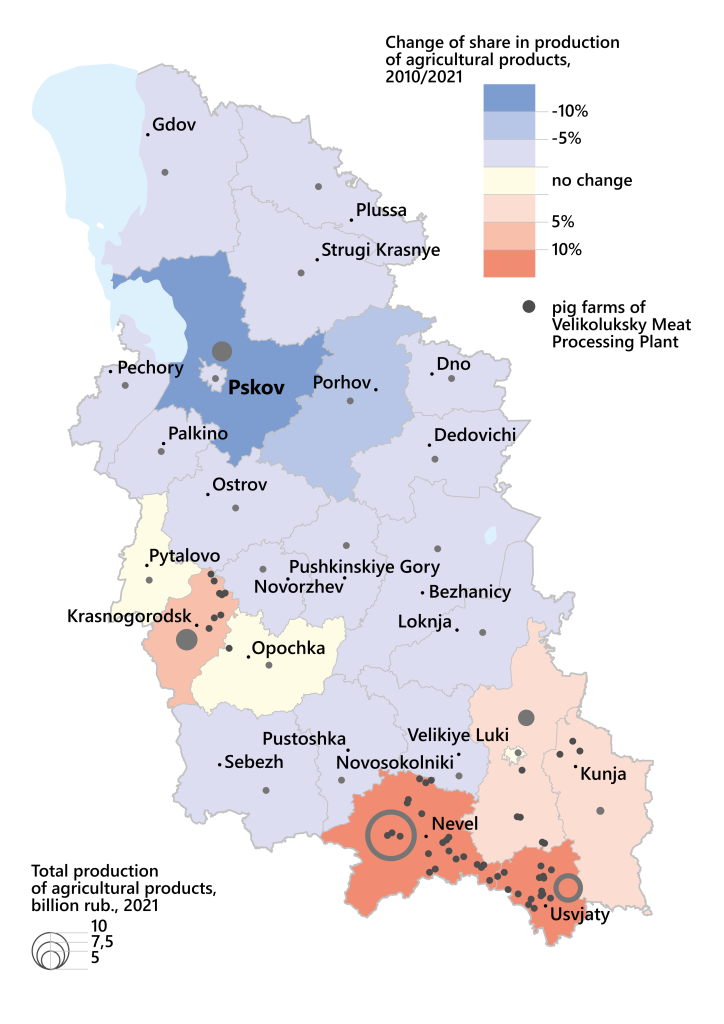
The company’s assets include 56 pig farms situated in six districts of the Pskov region: Velikiye Luki, Krasnogorodsk, Kunja, Nevel, Opochka and Usvjaty districts. The construction of agroholdings commenced in 2012 in the Nevel district, subsequently relocating to the Usvjaty and Velikiye Luki districts in the mid-2010s. This relocation occurred gradually in a south-eastern direction. In 2019, the agroholding expanded its operations to the west of the region, establishing assets in Krasnogorodsk and Opochka districts. Concurrently, the agroholding persists in its endeavours to expand its operations in the southern reaches of the region (Fig. 4).
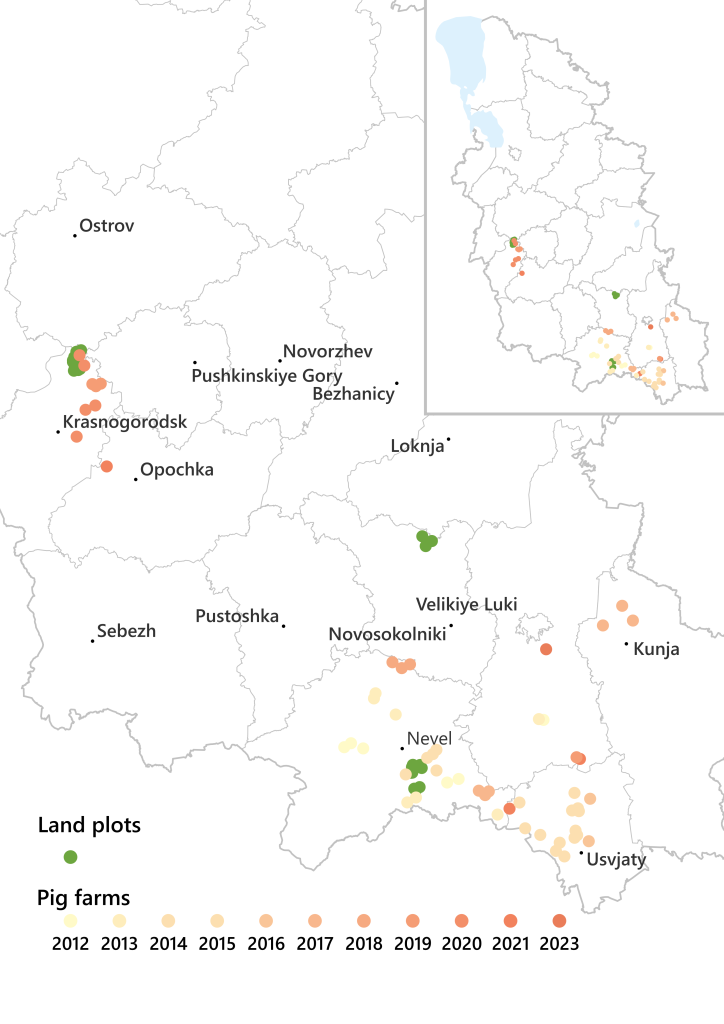
Furthermore, the holding company possesses 31 land plots, with a collective area of over 3,500 hectares, which are designated for the cultivation of grain crops. This indicates that, in addition to its own fodder production, the company procures either finished fodder from other producers or grain for the manufacture of its own mixed fodder. The company’s acreage is situated in three districts of the Pskov region in close proximity to pig farms: Krasnogorodsk district (in the vicinity of the villages of Dyatlovo and Kotyaty), Novosokolniki district (in the vicinity of the village of Gorozhane) and Nevel district (in the vicinity of the villages of Dubishche and Tychkino). The total area sown in each district is approximately equal, amounting to more than 1,000 hectares in total.
The results of our expert interviews have repeatedly confirmed that one of the key problems facing agriculture in peripheral areas is the lack of available labour. Furthermore, in existing small agricultural organisations, wages are often low and uncompetitive in comparison to other sectors, such as trade. The situation in agriculture in areas where agroholdings seek to expand has been characterized by a number of experts as the “extinction of traditional farming”. The majority of employees on farms that are part of a holding company receive a satisfactory remuneration package.
The location of transport routes in relation to the settlement centres is also a factor, as agroholdings frequently utilize personnel transport from nearby urban centres. This is due to the rapid depopulation of rural areas and the frequent absence of personnel who are both able and willing to work. A comparison of the Velikoluksky Meat Processing Plant Group’s asset location map with the transport framework of the territory also indicates that the company is focused on convenient logistics. To illustrate, in the Nevel district, a considerable proportion of the workforce at pig farms is sourced from outside the district, with personnel arriving daily from Velikiye Luki, for instance. As indicated by the experts consulted, both qualified personnel and some rank-and-file staff are also recruited from Belarus.
The Pskov region is a territory characterized by notable disparities in the level of agricultural development across its constituent districts. The discrepancy in production volumes between the leading and lagging districts is more than one hundredfold. The process of territorial contraction of agricultural production in the Pskov region was accompanied by the formation of two isolated growth poles of the industry, one centred on Pskov and the other on Velikiye Luki. This coincides with the concentration of assets of the largest market players, the main of which is the Velikoluksky Meat Processing Plant.
The primary territorial shift in agricultural production in the Pskov region is clearly correlated with the aforementioned replenishment of assets of the Velikoluksky Meat Processing Plant (see Fig. 4, 5). In 2010 this district was one of the most underdeveloped. By the end of the decade, Nevel and Usvjaty districts had become the leading districts in terms of agricultural production in the region. Furthermore, the Krasnogorodsk, Kunja and Velikiye Luki districts also demonstrated a notable increase in the volume of agricultural production. It can therefore be concluded that the principal alterations to the territorial configuration are attributable to shifts in the livestock sector.
Additionally, the Pskov region has shown a trend of increased production, although this has been accompanied by a significant decline in its contribution to the overall dynamics of the region’s total agricultural output. The PskovAgroInvest agroholding, situated in this region, is not comparable in terms of scale and pace of development with the Velikoluksky Meat Processing Plant.
The situation with regard to crop production is somewhat distinct (Fig. 6). The districts of Ostrov, Palkino and Pytalovo demonstrate the most pronounced rates of growth. These districts account for approximately 15 % of the total crop production in the region. In the districts where the grain and fodder crops of the Velikoluksky Meat Processing Plant are situated, no notable alterations have been discerned given that the extent of the company’s cultivated land is not particularly extensive.
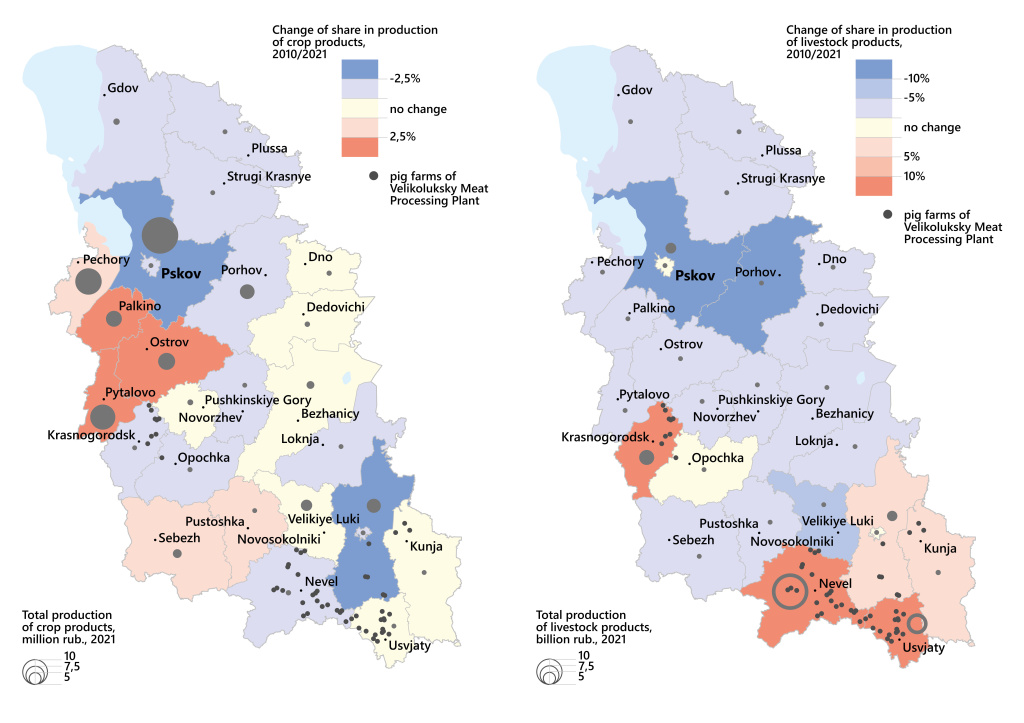
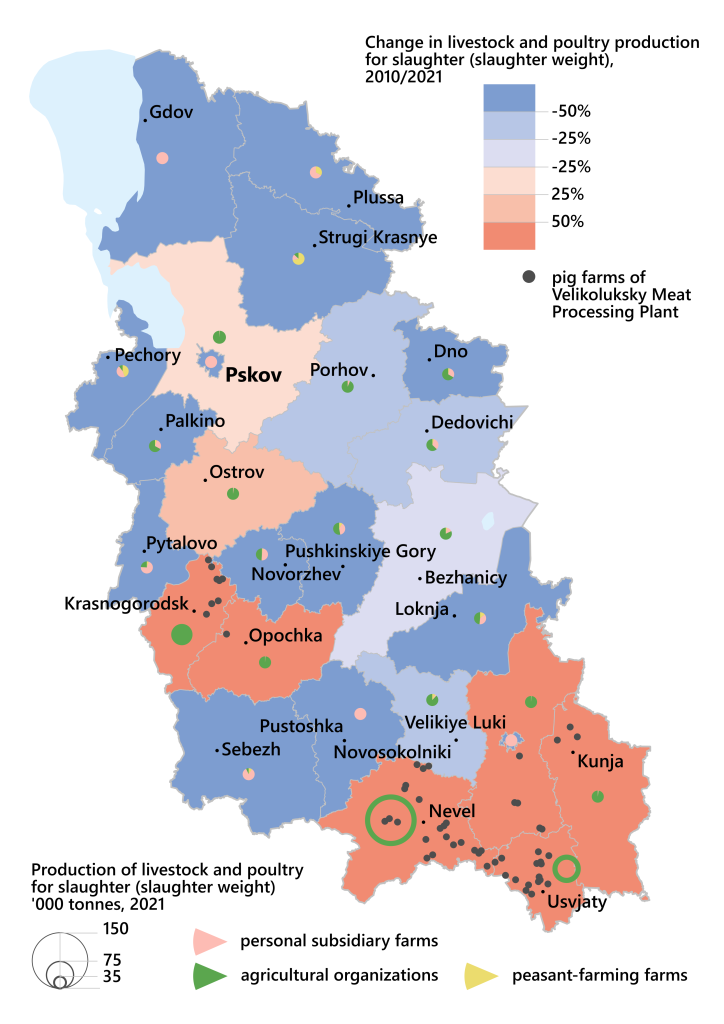
Notable alterations were observed in the production of livestock and poultry intended for slaughter (Fig. 7), particularly in the Krasnogorodsk, Opochka, Nevel, Velikiye Luki, Kunja and Usvjaty districts, which serve as focal points for the concentration of pig-breeding facilities associated with the Velikoluksky Meat Processing Plant. The establishment of such a significant agricultural enterprise has resulted in substantial alterations to the organisational structure of the sector with livestock and poultry production being entirely displaced from peasant farms and private subsidiary farms. Furthermore, a reduction in the proportion of production on private subsidiary farms is evident in districts in close proximity to the agroholding assets, namely Novosokolniki, Ostrov and Novorzhev districts.
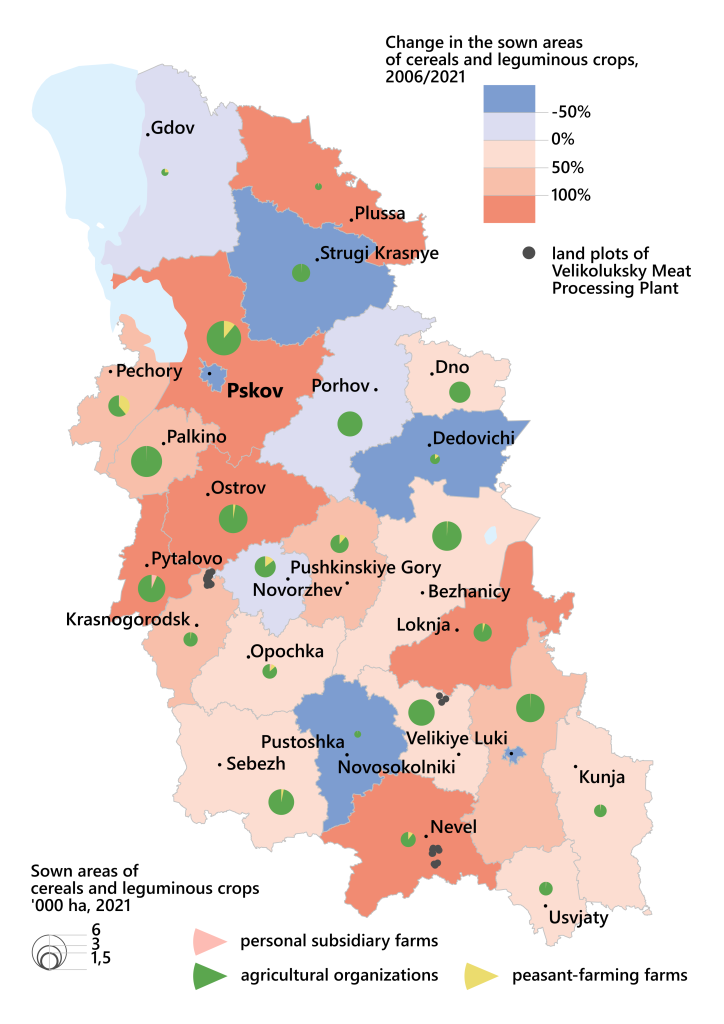
Additionally, there was a notable shift in the size of sown areas for cereals and leguminous crops (Fig. 8). The reduction in the sown area of grain and leguminous crops was most pronounced in the northern districts of the region, specifically the Strugi Krasnye and Dedovichi districts where the decline exceeded 50 %. In contrast, the districts situated in close proximity to Pskov and the Pskov district exhibit a contrasting trend, with a notable expansion in the cultivated acreage of cereals and leguminous crops. A similar trend is evident in the vicinity of Velikiye Luki. The activities of the Velikiye Luki meat processing plant had a negligible impact on the territorial organisation of grain and leguminous crops production. The Nevel district is the only one where there has been a notable expansion in the acreage devoted to crops, which can be attributed to the influence of a low baseline.
The research conducted on the materials of the Pskov region indicates that large agricultural holdings represent a significant driving force behind territorial, sectoral, and organisational transformations within the agricultural sector. The development of agricultural holdings occurs concurrently with the process of radical restructuring of the organisational structure of production of specific types of agricultural products. This phenomenon can be seen to have two distinct yet interrelated effects: firstly, it is a causal factor in the decline of small-scale farming, and secondly, it is a consequence of this decline. The proliferation of agricultural holdings has resulted in a resurgence of agricultural growth and a significant transformation of the regional agricultural profile. Subsequently, following 2010, the region became distinguished for its pronounced specialization in pig breeding. In the majority of sectors, with the exception of grain farming, which provides the fodder base for pigs, even the indicators recorded in 2000, let alone those from 1991, have not been reached.
Conclusions
The crisis phenomena in the agriculture of the Pskov region in the 1990s were more severe than in other parts of the country for a number of reasons including the depth of depopulation processes, the particular characteristics of specialization in the region, and the geographical location of the region. The proximity to Belarus, where the state provided significant support to the agricultural sector, rendered the erstwhile regional specializations (flax farming, dairy and meat cattle breeding) uncompetitive. As a consequence of the economic crisis, the rural population was drawn to the nearest agglomerations of St. Petersburg and Moscow at an accelerated rate. Consequently, personal subsidiary plots and farms constituted the primary means of agricultural production during the initial post-Soviet decade given the prevailing context of a deteriorated collective farm system. However, in the 2000s, and particularly after 2010, agricultural holdings began to assume a dominant role across most sectors. Such trends appear to be typical of peripheral border regions characterized by a significant outmigration of the population, pronounced institutional disparities in economic development in comparison to neighbouring countries and convenient logistical access to markets.
The influence of agricultural holdings results in a gradual shift from the initial spatial compression of agriculture and agglomeration in near-central areas to expansion in peripheral areas with easy access to free land and low rural population density. This is particularly pertinent to the development of the pig sector. This is exemplified by the case of the Pskov region.
The cross-border situation has a differential impact on large holdings and small and medium-sized farms. The competitive landscape for producers in this region is shaped by the presence of neighbouring countries with the potential for market failure and operational disruption. Additionally, external markets employ protectionist measures that influence the viability of small agricultural organisations. Concurrently, the market capacity of the surrounding territory and the solvency of the population are of paramount importance for large holdings. Therefore, the market of the EU countries prior to the implementation of sanctions and restrictions constituted a significant factor influencing the development of agricultural holdings in the Pskov region. The capacity for adaptation of large agricultural holdings is considerable. The growth of state support for the agro-industrial complex in the new conditions was employed by agroholdings for the successful development of the domestic market, while foreign exports were reoriented towards long-distance relations with countries in East and South-East Asia.
A comparative analysis of the dynamics of production of certain types of agricultural products and the spread of agroholding assets within the region has revealed a number of significant trends. The relocation of the Velikoluksky Meat Processing Plant to the south-west of the Pskov region exemplifies the typical ramifications for rural communities in peripheral regions. To illustrate, in the south-west of the region livestock and poultry farming has all but disappeared from peasant-farming and private subsidiary farms. This has a detrimental impact on the economy of rural communities and contributes to further depopulation. Despite the competitive wages offered by agroholding enterprises, their sufficiently high labour productivity means that they do not require a large number of hired workers. Some enterprises have been observed to recruit workers from nearby urban centers and even neighbouring Belarus. Furthermore, the reduction in rural population density mitigates the potential for conflict when expanding agricultural operations and establishing related sanitary protection zones. Based on interviews with experts, it can be argued that livestock agroholdings in general and the Velikoluksky Meat Processing Plant in particular, are often the beneficiaries of the social desertification of rural areas. It can be observed that the activities of agricultural holdings do not result in any particularly significant territorial or sectoral changes in crop production. The areas devoted to the cultivation of different crops have remained relatively stable in recent years, and the correlation between these trends and the activities of pig farming complexes is evident, particularly in the context of grain farming and the associated production volumes.
The research was carried out with the financial support of the project RSF № 24-27-00400 “Adaptation of functions and territorial structures of border regions of Russia in the conditions of restrictions”.
Reference