Dynamics of differentiation of rural North-West of Russia: main trends and features


Abstract
Excessive differentiation and polarisation in rural development lead to spatial compression, fragmentation, and social desertification, increasingly evident across many regions. This study aims to identify the trends, features and patterns of rural population differentiation in Russia’s North-West at interregional and intraregional levels. Methodologically, it adopted an approach that views rural space differentiation as a product of the combined influence of the agro-industrial complex system and the ‘urban–rural’ system. The changes of interest were studied from the industrial, demographic and settlement perspectives, with a focus on indicators such as changes in acreage and livestock between 1989, 2007 and 2023, and the size of the rural population and the number of residents per rural settlement between 2002, 2010 and 2020. The trends are investigated at the levels of regions — Leningrad, Novgorod and Pskov — and their municipalities. Hypotheses regarding the impact of the rental mechanism and core-periphery relations on the development differentiation of district territories were tested and largely confirmed. In the study regions, areas with varying rates of increase and decrease in acreage and livestock, including zones of compression and fragmentation, were identified, along with areas where the rural population grew or declined. Spatial differentiation in terms of resident per settlement ratio is shown to largely coincide with areas experiencing the most dynamic rural population change. The study concludes that, under the baseline scenario, the development of rural spaces in the Novgorod and Pskov regions will likely intensify their polarisation with the Leningrad region and lead to socio-demographic desertification of non-urbanised areas. The findings highlight the need for significant organisational and economic measures, engaging both public and private investments from outside these regions.
Introduction
Numerous scientific works both in Russia and abroad are devoted to the study of spatial differentiation of rural areas. At the same time, the issues of differentiation, including polarisation, compression and fragmentation of rural space, are considered mainly in relation to the central regions of European Russia [1], [2] and the regions of the European North [3], [4]. For the North-West there are publications on some aspects of this problem: Manakov on the population dynamics and depopulation processes in the Pskov region [5], Romanova and co-authors — on the effect of compression of socio-economic space in the Pskov Region [6], Sobolev — on the structural and socio-functional aspects of the problem. Sobolev — on the structural and functional features of spatial development of urban and rural settlements [7], Dementiev — on the typology of districts by the level of development of the settlement system [8], Krasnov and Bizyukov — on the dynamics of the population of the Pskov region in the post-Soviet period in the context of rural settlements [9].
These publications show that the territories of the regions of North-West Russia are highly differentiated. However, comprehensive works covering the process of spatial differentiation of rural areas, such as the study for the Kaliningrad region by Gennady Fedorov, including “territorial and branch production system, settlement system and economic and demographic situation” [10], are not available for the North-West of Russia as a whole [10]. The articles were published mainly in 2015—2016 and do not take into account the latest trends in this process.
In this context, the aim of this research was to identify the features, trends, and patterns of rural spatial differentiation in the North-West at both interregional and intra-regional levels. The focus of observation is the rural areas within the North-West Economic Region (North-West), specifically in the Leningrad, Novgorod, and Pskov regions. The study examines the phenomena and processes that have occurred in the rural spaces of the Russia’s north-west during the post-Soviet period. The subject of the research is the characteristics, trends, and patterns of rural spatial differentiation in the North-West.
Theoretical background of the study
The key concept in this article — “rural space” — is defined based on Tkachenko’s interpretation of the term “rural area”, which, in his opinion, is “geographically specific, necessarily implies a spatial component” and can be considered in different hypostasis, including “as a socio-geographical space formed in the process of life activity of the population”. At the same time, as Tkachenko notes, “unpopulated spaces are not rural areas”, and rural areas are “non-urban spaces with a permanent population” [11, p. 4]. Consequently, rural space is a non-urban space both with and without a permanent population. The space where human activity ceased began to be actively formed due to the changes that took place in rural areas after 1990. The last two decades saw a sharp increase in the number of rural settlements of a new type — “settlements without population” [12, p. 42].
In relation to rural space, transformational changes such as “economic polarisation of space”, socio-economic polarisation”, “polarisation of rural space”, “social desertification”, and “compression of developed space” are considered.
In one of his recent publications, Gennady Fedorov rightly noted that “the development of economy and settlement of rural areas around the world is largely conditioned by the regularities of centre-periphery relations, the polarization of the territory” [10, p. 118]. When using the concept of ‘centre-periphery’ in the studies of rural areas, there are different approaches to the differentiation of space: “near suburban zone, far suburban zone and periphery” are distinguished [10], “near, middle and far periphery” [13], “suburbs, suburbs, far suburban zone and periphery” [13], “suburb, semi-suburb, semi-periphery, semi-periphery, periphery, far periphery” [14], and “inner periphery” [15].
Despite the different terminology, the essence of considering the differentiation of rural space from the perspective of the concept of ‘centre-periphery’ in the publications is clear from their context. Regardless of the variant of spatial area allocation, there is a growing gap between central-urban areas and peripheral-rural territories due to low density, loss and ageing of rural population in the periphery, differences in technological achievements and economic development [16]. At the same time, the difficulties faced by peri-urban areas are inevitably linked to those of declining rural peripheral areas [17].
The concept of “internal periphery” is introduced to describe rural areas that are not geographically peripheral but have limited access to essential services such as education, healthcare, and transport. Over time, this lack of accessibility leads to the accumulation of problems, rendering these areas increasingly unattractive for investment [15]. Some authors distinguish intermediate rural and isolated areas. The common features of such areas are low accessibility, negative migration balance, low level of education, and lack of potential for endogenous development [17].
Regarding the development prospects of central and peripheral areas, there are different points of view: a) the traditional one, based on the centre-periphery theory, where the polarized development process produces, on the one hand, a tendency to concentrate growth in the centres and, on the other hand, a downward spiral of underdevelopment in the periphery [18]; b) the modern one, based on the prospects of digitalization, which argues that geographical remoteness does not lead to marginalization and that a central location does not promise prosperity [19].
When studying spatial differentiation, the concept of polarisation is used, i. e. the presence of two differently directed vectors of development of this process, acting simultaneously, when “in some places, there is growth and development, in other places there is loss and decline” [20, p. 55].
The main causes of differentiation include differences in the size and natural conditions of the territories, a sparse network of large cities, incompleteness of the urbanization process, historical legacy of the past, specificity of Russian institutions, and social inequality [1]. Uskova considers the historical legacy of the past to include the consequences of market reforms of the 1990s, which had a significant impact on the transformation of Russia’s production and settlement framework [3]. Novosibirsk scientists attribute the differentiation of rural space to factors such as disparities in the volume of investment in fixed capital and variations in the policies implemented by the authorities [21]. Foreign publications note that investments aimed at creating innovations are more effective in the central areas compared to the peripheral territories [16]. Confirmation of this is also found in articles by Russian authors: “Investments under the influence of market mechanisms are concentrated in the territories near the centres of regions or municipal districts that are distinguished by a more advantageous location” [4, р. 9].
Publications have drawn attention to the differences in urban and rural development [22], [23], [24], [25]. It is noted that while most large cities are growing, many rural areas and small towns are facing economic stagnation or decline [23], and the differences between urban areas and rural areas are increasing [22], [27]. It is indicated that “the gap between rural and urban areas is more noticeable today than ever before, and rural life is still not so attractive for people, especially for young people” [25, p. 1]. Rural residents are inferior to the urban population in terms of income, living conditions, and social infrastructure [22]. The most important problem of the village is associated with depopulation and ageing of the population in rural areas, the depopulation of villages [25].
The processes of spatial differentiation have formed a special segment — depressed territories, which in Europe are called marginal areas. They usually include remote and less prosperous rural areas with socio-economic and cultural decline, characterized by unemployment, population outflow, ageing and depopulation, rural poverty and social isolation, loss of infrastructure and services, biodiversity depletion, and land abandonment [25], [26], [27], [28].
The presence of such a negative phenomenon as ‘social desertification’ is pointed out by Nefedova, linking it “with the outflow of rural population to cities and with the abandonment of developed agricultural land”, which “is stimulated by continuing urbanization and polarisation of socio-economic space” [29, p. 69—70]. Academician Petrikov writes in the same vein: “The rural population is gradually concentrating in suburban areas, which leads to social desertification of rural areas, creating geopolitical risks” [30, p. 461].
Differentiation of rural space with Russia’s entry into the era of market relations has sharply increased, and polarisation of agrarian production and rural areas has occurred. Against the background of areas with intensively developing agrarian production and growth in the number of rural residents, the territories with depopulation and general depressiveness stood out [13].
The problem of space compression was raised by Harvey, who distinguished “absolute space” in the traditional concept and “relative space”, the compression of which occurs under the influence of the development of communication and transport [31, p. 266]. In this case, the compression of “relative space” is considered a positive phenomenon, leading to “the growth of accessibility of places due to communications”, and the compression of “absolute space” (locational, physically visible) — as a negative phenomenon, predetermining “the loss of inhabited, developed, economically active land” [2, p. 33]. The compression of rural space and social polarisation, as Gennady Fedorov noted, “occurs in the directions from north to south, from east to west, from the periphery to the centre, along the axes north-south, west-east and suburb-periphery” [32, p. 6].
Closely related to the compression of space is the concept of its spatial fragmentation, one of the first to write about it was Harvey. He saw the reason for its emergence in the presence of a paradox: “The less important spatial barriers are, the more sensitive capital is to changes in location in space and the more incentives for differentiation of places attractive for capital” [31, p. 265—266]. Regarding the Russian reality fragmentation is understood as a process of “formation of islands of active economic life in the ocean of demo-economic depression” [14, p. 71]. The compression and fragmentation of space violate the general provisions of the concept of ‘centre — periphery’, as in the territories remote from the centres, separate areas of active economic life emerge, usually due to the emergence of agricultural holdings. Therefore, the analysis of the processes of differentiation of rural space in the North-West will consider their consequences: polarisation, compression, fragmentation, and social ‘desertification’.
Methodology, methods and materials
Following Gennady Fedorov [10], the system approach is taken as a methodology of the study, based on the fact that rural space, which includes demographic, production and settlement components, is differentiated as a result of the interrelation of two systems: the system of agro-industrial complex (AIC) and the system of interaction ‘centre-periphery’ (Fig. 1).
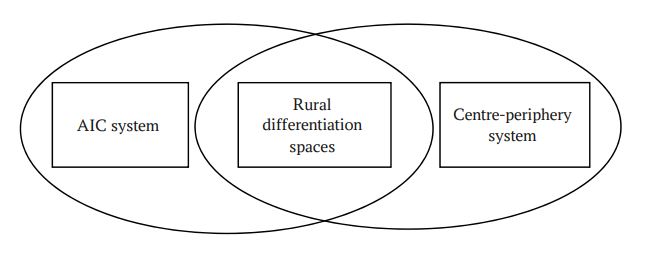
In the system of agro-industrial complex differentiation occurs under the influence of the rent mechanism, and in the system ‘urban-rural’ — under the influence of regularities of centre-periphery relations. All this determines the differentiation of rural space and affects the transformation of rural settlement.
The rent mechanism acts as a chain of interrelations between the dynamics of demand for agricultural products, the dynamics of cultivated areas and the competitiveness of agribusiness in the regions depending on their rent potential. When demand for food grows, the expansion of cultivated areas takes place first of all in areas with higher land rent, then in areas with medium and, finally, low levels of land rent. When the demand decreases, the area under crops decreases to a greater extent in the regions with low and to a lesser extent with high land rent potential [32, p. 126]. As a consequence, rural space with developing agricultural production and positive population dynamics is formed in the territories with high rent potential. The districts with low rent potential are characterized by the focal intensity of agricultural production, fragmentation and compression of rural space.
The effect of the rent mechanism has been repeatedly tested in the European part of Russia with 53 subjects of the Federation, where natural and socio-economic conditions of agricultural production in spatial terms are highly differentiated [33]. On the scale of the regions of the North-West, the level of spatial differentiation is much lower than between the regions of European Russia. Therefore, without stating in advance that the rent mechanism affects the differentiation of rural space, we define this position as a scientific hypothesis that is tested in the course of the study. With regard to the North-West, we also consider the hypothesis of rural space differentiation under the influence of centre-periphery relations. Special attention is paid to those districts that do not fit into the hypotheses put forward. They are tested for compression and fragmentation of rural space separately.
It is proposed to determine the rent potential through indicators of the cadastral value of 1 hectare of agricultural land occupied by agricultural land, based on the following formula
C = (RD + RA) / KR, (1)
where C — cadastral value of 1 ha; (RD + RA) — potential rent income from 1 ha; RD — differential rent; RA — absolute rent; KR — rent capitalization coefficient equal to 0.0303, based on the capitalization term (33 years) adopted for agricultural land. In this case
RD =C · KR – R. A (2)
Information on cadastral land value indicators (C) is taken from resolutions of the executive bodies of the Leningrad, Novgorod and Pskov regions.1 The absolute rent indicator (RA) is unified throughout the Russian Federation — 26 RUB/ha.
In each region, groups of municipal districts (okrugs) (hereinafter generalised as districts) with high, medium and low rent potential were identified. The differentiation of districts between the above groups was determined by dividing the ordered rank scales using tertiles Q1 and Q2, on the basis of which the trends and regularities of spatial dynamics in the production and demographic spheres were studied.
Trends in changes in the level of spatial heterogeneity were identified using the well-known Gini coefficients (indices) (KG), reflecting differentiation, and coefficients of funds (KF), characterizing polarisations. We used an ordinal scale with its division using quartiles Q1, Q2 and Q3.
In the production sphere, the indicators of agricultural production, sown areas, livestock and poultry population in conventional units are taken as indicators at the rate of: 1.0 — cows; 0.6 — other cattle; 0.3 — pigs; 0.1 — sheep; 0.02 — poultry of all kinds.
In the study of centre-periphery patterns , the rural space was divided according to the principle of the remoteness of districts from the centres of the regions: 1 — central districts (up to 100 km); 2 — intermediate districts (100—200 km); 3 — peripheral districts (over 200 km).2
Given the roughly similar quality of modern roads in the single-level taxa of the regions, this division was universally accepted.
The key dates in the study of the agricultural sector are 1989 — the last year of the planned economy, when there were no signs of its collapse, 2007 — the year before the beginning of the programme approach to agricultural development, and 2023 — the last year for which official statistics are available. The information base for the study of agricultural production for 1989 was statistical collections of the Leningrad, Novgorod and Pskov statistical offices,3 and from 2007 to 2023 — databases of municipalities of Rosstat.4
To assess spatial differentiation in the demographic sphere, we limited ourselves to the dynamics of the rural population as the most informative indicator reflecting in the long-term retrospective the effects of fertility, mortality, and natural and migration growth. In the study of the settlement system, we used indicators of the average inhabitancy of rural settlements (RSCs) and their groupings by population size. Data from the 1989, 2002, 2010 and 2020 population censuses were used as information.
Spatial differentiation of the agrarian production development process
______________________________
Interregional differentiation
Sown areas in the regions of the North-West from 1989 to 2023 decreased at a faster rate than in Russia as a whole, where after 2007 a tendency of their growth was formed due to the significantly higher rent potential of the lands of the southern territories in the conditions of the emerging growth of demand for agricultural products. In the Leningrad region, with its more favourable conditions for the formation of differential rent, sown areas decreased to a lesser extent than in the Novgorod and Pskov regions (Fig. 2).
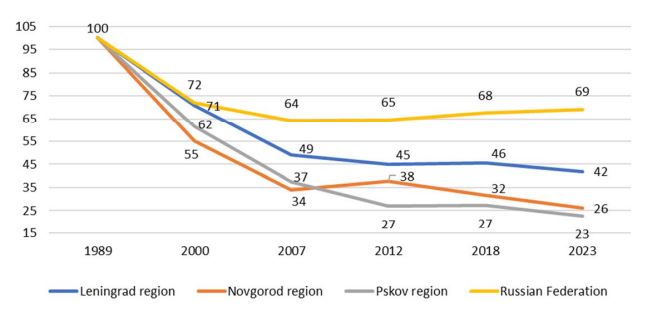
The current dynamics of the sown areas have increased spatial differentiation between the regions. This is especially true for the Pskov region, which in 2000 had a gap with the Leningrad region of 9.2, in 2012 — 18, in 2023 — already 19.3 percentage points (p. p.). — 18, in 2023 — already 19.3 percentage points (p. p.).
The second important indicator of spatial differentiation of the agricultural sector is the indicator of livestock and poultry population. Calculations revealed that the dynamics of this indicator were complicated due to the fragmentation of space associated with poultry and pork holdings (Fig. 3).
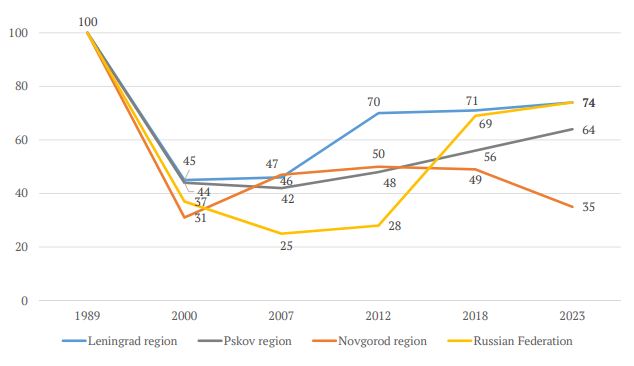
The Leningrad region is home to Russia’s largest poultry farms, Severnaya, Roskar and Sinyavinskaya; the Pskov region is home to the pig farms of Velikoluksky Meat Processing Plant; and the Novgorod region is home to Belgrankorm Veliky Novgorod. Due to the fact that pork and poultry complexes of the North-West are among the largest agroholdings in the country, the growth rates of livestock and poultry in the Leningrad region since 2000, and in the Pskov region since 2018, have exceeded the dynamics in Russia as a whole. Before 2000, differentiation in the North-Western regions, like in the country, occurred naturally along a downward trend reflecting the free market situation of the 1990s. In the Pskov region, this trend continued until the mid-2000s. The emergence of agricultural holdings changed the situation. The Novgorod region has experienced a sharp decline in livestock and poultry population in the last five years due to the epidemic of swine fever, which also had a high share in the livestock structure here.
It should be noted that large pig and poultry complexes have an ambiguous impact on the development of rural areas, polluting the environment and having a positive socio-economic impact only locally, as they hardly involve the local population as the labour force and use imported concentrates for fodder production. Large holdings, becoming monopolists, oust from the market the relevant products of small, medium and even large farms, and with a high concentration of livestock there are risks of mass mortality due to periodic epidemics. The preservation of rural areas is to a greater extent connected with cattle and small ruminants, which require coarse and succulent fodder produced locally and, consequently, areas for their crops. The differentiation of the North-West regions in terms of the number of cattle and small ruminants has a steady trend associated with its widespread reduction, which intensifies the interregional gap (Fig. 4).
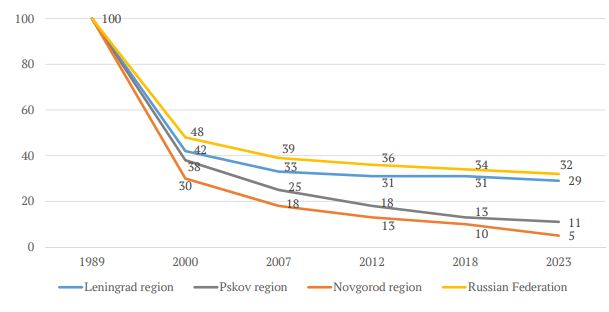
At the same time, the trend line for the decrease in the number of cattle and small ruminants in the Leningrad region by 2023 is as close as possible to the indicators for the Russian Federation.
Intra-regional differentiation. Testing hypotheses about the influence
of the rent mechanism and centre-periphery relations on differentiation
The grouping of the districts of the North-West regions by the growth rate of sown areas showed that the Novgorod and Pskov regions accounted for the largest number of districts with the highest rates of reduction of sown areas in 2007—2023 (less than 50 % growth) (Table 1).
Group of neighbourhoods | Leningrad region | Novgorod region | Pskov region* | North-West, total | ||||
Number of districts | Share, % | Number of districts | Share, % | Number of districts | Share, % | Number of | Share, % | |
Up to + 20 | 2 | 11.8 | 3 | 14.3 | ... | ... | 5 | 8.0 |
Over + 20 | 1 | 5.9 | 4 | 19.0 | 1 | 4.2 | 6 | 9.7 |
Up to – 50 | 13 | 76.5 | 9 | 42.9 | 16 | 66.7 | 38 | 61.3 |
Below – 50 | 1 | 5.9 | 5 | 23.8 | 7 | 29.1 | 13 | 21.0 |
Total | 17 | 100.0 | 21 | 100.0 | 24 | 1000 | 62 | 100.0 |
| Calculated based on the database of municipalities, Rosstat, URL: https://rosstat.gov.ru/storage/mediabank/munst.htm (accessed 18.08.2024). | ||||||||
* The analysis of the differentiation of sown areas over time is limited to the period from 2007 to 2023. This is due to the absence of data for the Pskov region for 1989 and the need to ensure comparability with other regions.
The map scheme (Fig. 5) clearly shows an area with a positive growth of sown areas covering a chain of districts with an area of 15.6 thousand km2, including Luzhsky (Leningrad region), Batetsky, Shimsky, Volotovsky, Poddorsky and Kholmsky (Novgorod region), stretching for more than 200 km along the border with Pskov region.
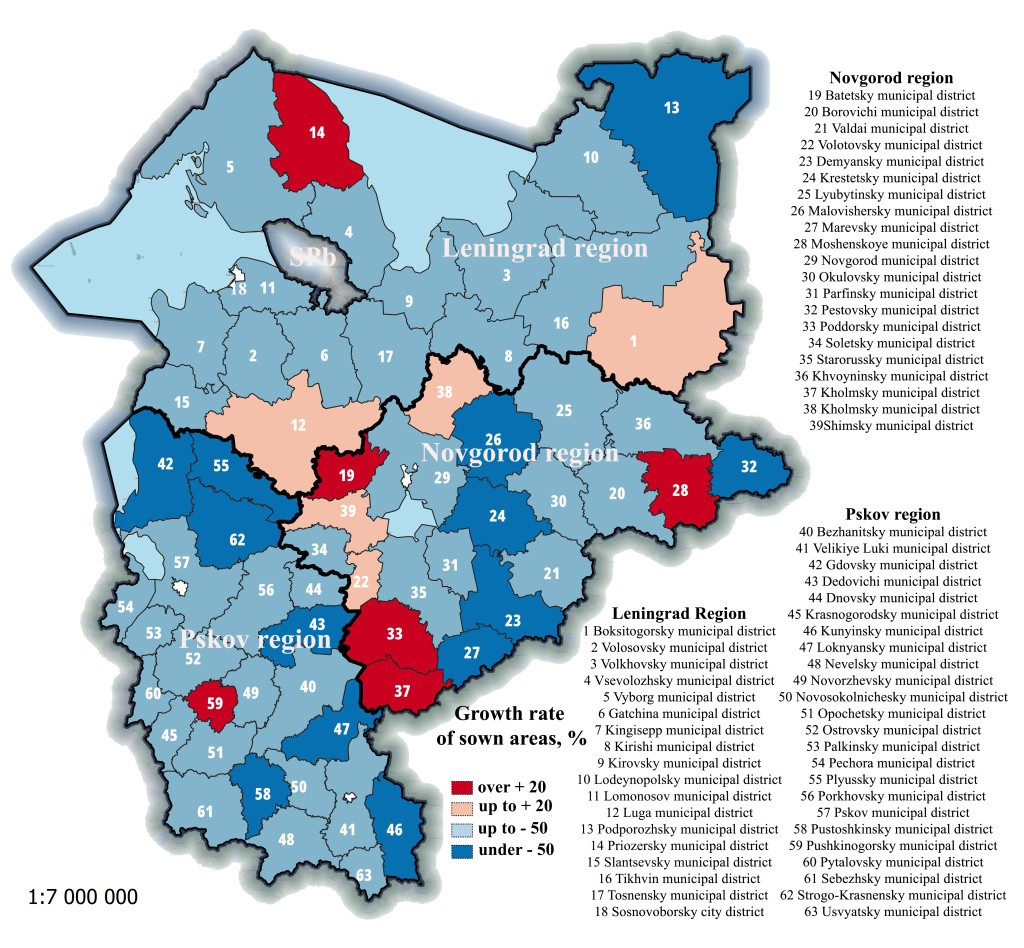
However, the growth of sown areas in the Poddorsky and Kholmsky Districts is not of a systemic nature, but is related to the low comparative base of 2007 — indicators close to zero.
Attention is drawn to the fragmentedly located Pervomaysky and Boksitogorsky districts of the Leningrad Region, Moshensky district of the Novgorod region, Pushkinogorsky district of the Pskov region with positive growth rates of sown areas, which is somewhat illogical from the point of view of their location and requires additional verification of the factors that determined these dynamics.
In parallel with the above-mentioned area in the centre of the Novgorod region from north to south, a chain of bordering districts with the largest reduction of cultivated areas (growth below – 50 %) was formed, including Malovishersky, Krestetsky, Demyansky and Marevsky districts with a total area of 11.1 thousand km2. The same indicators were formed in the north of the Pskov region, including Gdovsky, Plusky and Strugo-Krasnensky districts.
The test of hypotheses about the influence of rent potential and location of districts on the dynamics of sown areas from the position ‘centre — periphery’ showed that these hypotheses were mostly confirmed (Table 2).
Indicator | Leningrad region | Novgorod region | Pskov region | |||||
1989 | 2007 | 2023 | 1989 | 2007 | 2023 | 2007 | 2023 | |
Group of districts by rent potential, % | ||||||||
High | 51.1 | 56.8 | 59.2 | 32.6 | 40.8 | 38.4 | 47.5 | 47.4 |
Medium | 21.4 | 16.2 | 14.7 | 34.2 | 39.1 | 38.4 | 28.1 | 31.3 |
Low | 27.5 | 27.0 | 26.0 | 33.2 | 20.1 | 23.2 | 24.4 | 21.3 |
Total | 100.0 | 100.0 | 100.0 | 100.0 | 100.0 | 100.0 | 100.0 | 100.0 |
Group of districts by remoteness, km | ||||||||
Up to 100 | 46.0 | 45.5 | 50.4 | 49.5 | 56.4 | 60.7 | 32.7 | 34.8 |
101—200 | 40.7 | 41.0 | 43.4 | 28.3 | 25.8 | 23.6 | 44.5 | 45.0 |
Over 200 | 13.3 | 13.5 | 6.2 | 22.2 | 17.8 | 15.8 | 22.8 | 20.2 |
Total | 100.0 | 100.0 | 100.0 | 100.0 | 100.0 | 100.0 | 100.0 | 100,0 |
Calculated based on the database of municipalities, Rosstat, URL: https://rosstat.gov.ru/storage/mediabank/munst.htm (accessed 18.08.2024). | ||||||||
With the general reduction of cultivated areas, there is a tendency for the share of cultivated area to decrease in the group of districts with low rent potential and to increase in the territories whose lands allow to receive higher differential income. This pattern is perfectly traceable in the Leningrad region and as a trend in other regions of the North-West, especially if we take into account extreme periods.
The trends in the change in the structure of sown areas of the districts of these regions of the North-West from the position ‘centre — periphery’ became even clearer. In all peripheral districts their shares consistently decreased, while in the central districts there was an increase. In the Leningrad and Pskov regions, the share of intermediate districts also increased.
Due to the fact that in the conditions of the North-West livestock breeding is a system-forming branch of agricultural production, the main sphere of employment and source of income of the rural population, the rate of its development predetermines the fragmentation of rural space. Calculations of livestock and poultry population growth rates in conventional units showed positive results only in seven districts (11.3 %) of the macro-region under study (Table 3).
Neighbourhood groups | Leningrad region | Novgorod region | Pskov region | North-West, total | ||||
Number of districts | Share, % | Number of districts | Share, % | Number of districts | Share, % | Number of districts | Share, % | |
Up to + 50 | 1 | 5.9 | 1 | 4.8 | 1 | 4.2 | 3 | 4.8 |
Over + 50 | 1 | 5.9 | 1 | 4.8 | 2 | 8.3 | 4 | 6.5 |
Up to – 50 | 3 | 17.6 | — | — | 2 | 8.3 | 5 | 8.1 |
Below – 50 | 12 | 70.6 | 19 | 90.4 | 19 | 79.2 | 50 | 80.6 |
Total | 17 | 100.0 | 21 | 100,0 | 24 | 100.0 | 62 | 100.0 |
Calculated based on the database of municipalities, Rosstat, URL: https://rosstat.gov.ru/storage/mediabank/munst.htm (accessed 18.08.2024). | ||||||||
In most districts in these regions of the North-West, the number of livestock and poultry decreased by more than 50 %, which significantly narrowed the socio-economic space for employment of the rural population. Only pig breeding (Kunyinsky, Nevelsky, Usvyatsky districts of the Pskov region) and poultry farming (Vyborgsky and Kirovsky districts of the Leningrad region; Krestetsky and Valdai districts in the Novgorod region) saw an increase in the number of livestock.
The test of the hypothesis about the influence of the rent potential on the dynamics of the process of differentiation of districts by the number of livestock and poultry showed the following:
1. When considering the entire population, including pigs and poultry, the hypothesis was partially confirmed.
2. The hypothesis was fully confirmed when considering the process of differentiation of the dynamics of the number of livestock, when only those cattle and small ruminants, whose breeding is based on the use of local fodder base, were taken into account in the calculations (Table 4).
Rent potential and remoteness of districts from centers | Leningrad region | Novgorod region | Pskov region | ||||||
1989 | 2007 | 2023 | 1989 | 2007 | 2023 | 1989 | 2007 | 2023 | |
Groups of districts by rent potential including all types of livestock and poultry, % | |||||||||
High | 49.4 | 43.1 | 20.4 | 33.6 | 63.4 | 89.7 | 60.3 | 70.4 | 24.7 |
Medium | 14.4 | 4.5 | 7.1 | 50.3 | 21.7 | 6.7 | 5.9 | 3.2 | 44.2 |
Low | 36.2 | 52.4 | 72.4 | 16.1 | 14.9 | 3.7 | 33.8 | 26.5 | 31.1 |
Total | 100.0 | 100.0 | 100.0 | 100.0 | 100.0 | 100.0 | 100.0 | 100.0 | 100.0 |
Groups of districts by rent potential excluding pigs and poultry, % | |||||||||
High | 46.2 | 51.7 | 50.2 | 38.2 | 41.9 | 41.4 | 40.2 | 46.3 | 51.5 |
Medium | 22.1 | 15.6 | 15.1 | 33.6 | 34.8 | 38.3 | 33.2 | 30.5 | 25.6 |
Low | 31.7 | 32.7 | 34.7 | 28.3 | 23.2 | 20.3 | 26.6 | 23.2 | 22.9 |
Total | 100.0 | 100.0 | 100.0 | 100.0 | 100.0 | 100.0 | 100.0 | 100.0 | 100.0 |
Groups of districts by remoteness, km | |||||||||
Up to 100 | 64.1 | 69.8 | 71.9 | 40.0 | 68.1 | 82.8 | 37.2 | 41.2 | 16.3 |
101-200 | 28.9 | 28.2 | 27.1 | 49.0 | 20.6 | 14.3 | 42.8 | 34.4 | 5.4 |
Over 200 | 7.0 | 2.0 | 1.0 | 11.0 | 11.4 | 2.9 | 20.0 | 24.4 | 78.3 |
Total | 100.0 | 100.0 | 100.0 | 100.0 | 100.0 | 100.0 | 100.0 | 100.0 | 100.0 |
Calculated on the basis of the database of municipalities, Rosstat, URL: https://rosstat.gov.ru/storage/mediabank/munst.htm (accessed 18.08.2024). | |||||||||
Checking the influence of centre-periphery relations on the dynamics of structural changes in the distribution of livestock showed that in the Leningrad and Novgorod regions the hypothesis was fully confirmed: the share of livestock and poultry in the central areas from 1989 to 2023 had a steady tendency of growth, and in the intermediate and especially peripheral areas — of reduction. In the Pskov region, due to the fragmentation of space under the influence of agricultural holding Velikoluksky Meat Processing Plant, which placed the number of pigs in the most remote areas of the region, a situation opposite to the hypothesis was formed.
Quantitative assessment of the dynamics of the process of intra-regional differentiation of agrarian production
Significant differences in the rates of change of sown areas and livestock population have intensified the intra-regional differentiation of agricultural production. To the greatest extent this applies to the agricultural production of the
Pskov region, where the indicators of the Gini index and fund coefficients in 2022 reached the maximum value among other regions of the North-West
(Table 5).
Year | Leningrad region | Novgorod region | Pskov region |
Gini index score (K)G | |||
Agricultural products | |||
1989 | 0.354 | 0.354 | ... |
2007 | 0.412 | 0.393 | 0.368 |
2022 | 0.472 | 0.524 | 0.647 |
Planted areas | |||
1989 | 0.243 | 0.234 | ... |
2007 | 0.327 | 0.404 | 0.294 |
2023 | 0.377 | 0.392 | 0.326 |
Livestock and poultry | |||
1989 | 0.389 | 0.403 | 0.219 |
2007 | 0.572 | 0.397 | 0.401 |
2023 | 0.630 | 0.609 | 0.687 |
Funds ratio indicator (K)F | |||
Agricultural products | |||
1989 | 15.51 | 14.08 | ... |
2007 | 22.28 | 19.05 | 10.97 |
2022 | 46.41 | 89.12 | 190.97 |
Planted areas | |||
1989 | 6.37 | 4.84 | ... |
2007 | 14.79 | 35.57 | 7.36 |
2023 | 33.60 | 79.42 | 29.37 |
Livestock and poultry | |||
1989 | 16.65 | 19.50 | 5.47 |
2007 | 93.64 | 24.02 | 6.61 |
2023 | 332.70 | 277.69 | 14 351,24 |
Calculated based on the database of municipalities, Rosstat, URL: https://rosstat.gov.ru/storage/mediabank/munst.htm (accessed 18.08.2024). | |||
This situation was formed due to livestock breeding, which can be traced by the indicators of the dynamics of livestock and poultry population.
The Novgorod region has an increased level of differentiation and polarisation of districts in terms of agricultural production due to changes in crop production, which are reflected in the dynamics of sown areas (the indicators KG and KF in 2023 here were the highest in the North-West). The Leningrad region is characterized by indicators of increased differentiation and polarisations of districts by livestock population.
Thus, it is obvious that the differentiation of districts took place against the background of the interregional gap in the indicators of the dynamics of changes in sown areas and livestock between the Leningrad region, on the one hand, and the Novgorod and Pskov regions, on the other.
Spatial differentiation of rural population dynamics
The data of the All-Union population censuses show that in all regions of the North-West in the period from 1939 to 1989 downward trends in the number of rural population were formed: in the Leningrad region from 904.2 to 564 thousand people (by 37.4 %), in the Novgorod region from 909.8 to 230.2 thousand people (4 times), in the Pskov region from 1349.7 to 314.8 thousand people (4.3 times). The differences in the rate of decline in the rural population in the Novgorod and Pskov regions from the Leningrad region increased year by year.
After 1989, this gap increased even more against the background of the formation of an upward trend of rural population growth in the Leningrad region (Fig. 6).
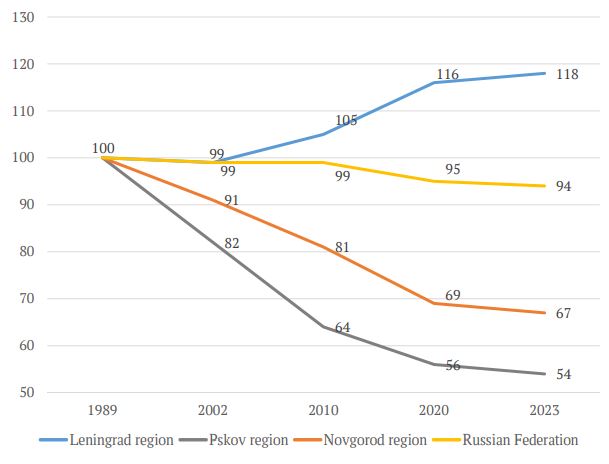
In the period between the censuses of 2002 and 2010, interregional differentiation moved to the stage of polarisation, and by the beginning of 2023 the gap in the growth rates of the rural population between the Leningrad region and the Russian Federation, the Novgorod region and the Pskov region amounted to 24.1, 51 and 63.8 p. p. respectively.
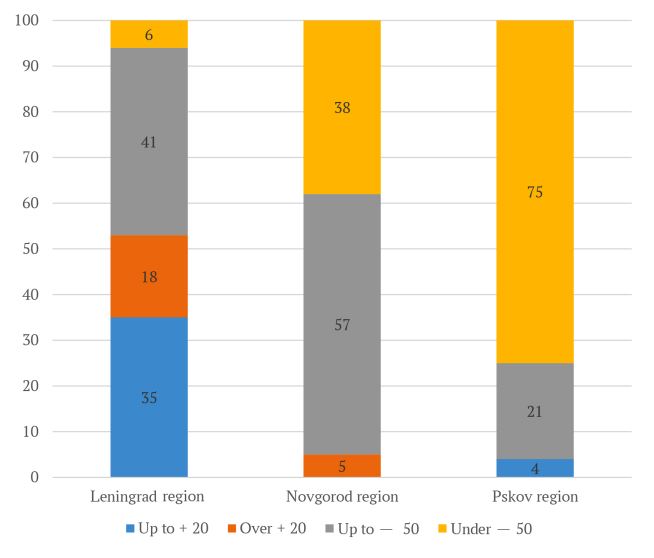
The grouping of districts in the regions of the North-West by the rate of rural population growth from 1989 to 2023 reflected positive growth in the Leningrad Region in nine districts (totalling about 53 % for the two groups), and in the Novgorod and Pskov regions in only one district each, respectively 4.8 and 4.2 % of their population (Fig. 7, 8).
 |
| 7 |
The share of groups of districts in the regions of the North-West with different rural population growth rate from 1989 to 2023, % to 1989 |
An area with a rural population growth of over 20 % was formed, which united the territories of the Vsevolozhsk, Gatchina and Tosno districts of the Leningrad Region, located compactly near St. Petersburg, and the territory of the adjacent Novgorod district (Fig. 8).
This area in the Leningrad region borders the territories of six districts with rural population growth rates of up to 20 %. The rest of the rural areas had a negative growth rate (up to – 50 %), except for the peripheral Podporozhsky district with a growth rate below – 50 %. In the Novgorod region, the majority of peripheral districts (Marevsky, Kholmsky, Poddorsky, Pestovsky and Lyubytinsky) also belong to the group of districts with rural population growth below – 50 %.
Only the central Pskov region with the adjoining Pechora, Palkinsky and Strugo-Krasnensky districts had positive growth rates in the Pskov region, while the rural population decreased by less than 50 %. This group still includes Velikoluksky district, the centre of which is the Region’s second most populous city, as well as Sebezhsky district with its unique nature and national park. The remaining 18 (75 %) districts were included in the group with negative rural population growth below – 50 %.
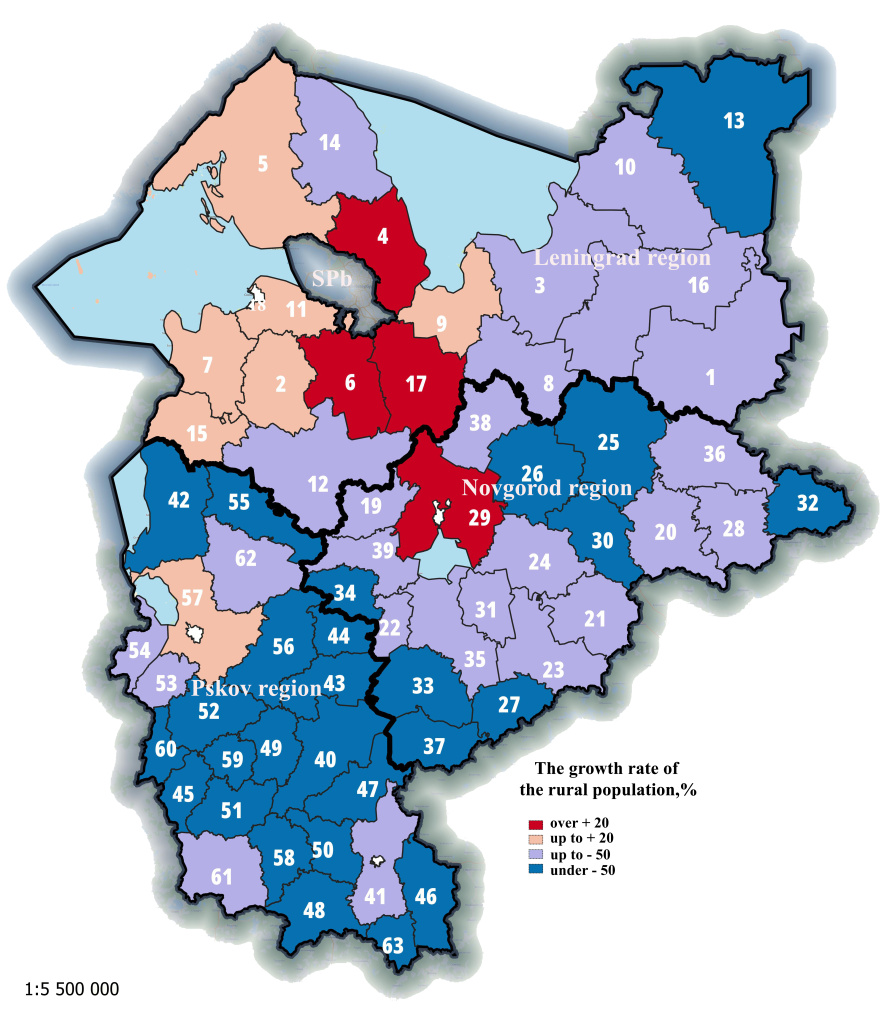
Differences in the growth rates of the rural population by districts and regions of the North-West have increased the differentiation of rural space. This is especially true for the Leningrad Region, where the process of spatial polarisation is clearly manifested: nine districts have formed upward and the rest — downward trends in the number of rural population. This is indicated by the higher than in other regions indicators KG and KF, the value of which is consistently increasing (Table 6).
Indicator | Leningrad region | Novgorod region | Pskov region |
Gini index (K )G | |||
1989 | 0.335 | 0.228 | 0.244 |
2002 | 0.370 | 0.250 | 0.263 |
2010 | 0.415 | 0.277 | 0.290 |
2020 | 0.439 | 0.339 | 0.334 |
Funds ratio (K )F | |||
1989 | 8.84 | 5.30 | 6.45 |
2002 | 11.93 | 6.76 | 7.36 |
2010 | 18.97 | 8.92 | 9.26 |
2020 | 26.08 | 14.02 | 12.14 |
Calculated on the basis of the all-Russian population censuses. | |||
In the Novgorod and Pskov regions the distribution of rural population by districts is less differentiated than in the Leningrad region. The KG indicators in them in 2020 were at the level of 1989 in the Leningrad region. However, even here there is a tendency of growth in the level of spatial differentiation and KF indicators. This process is mainly due to the different rates of decline in the rural population.
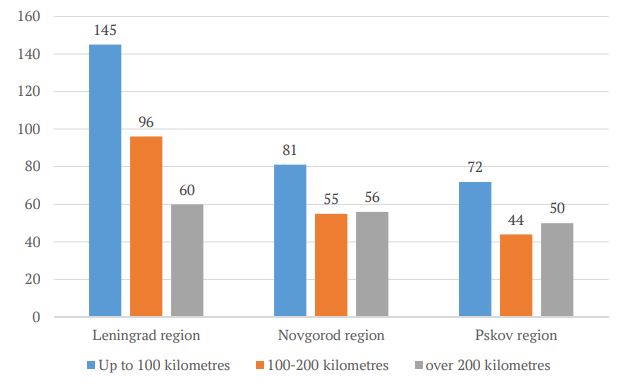
Spatial differentiation of rural population dynamics depending on the remoteness of districts relative to the centres of the North-West regions is clearly visible only in the Leningrad region (Fig. 9).
 |
| 9 |
Rural population growth rates from 1989 to 2023 in groups of districts with different remoteness from the centres of the North-West regions, % |
In the Novgorod and Pskov regions, even in the central districts, the rural population decreased, although to a lesser extent than in more remote areas. At the same time, in the peripheral areas the reduction was less than in the intermediate areas.
Nevertheless, the trends in the change in the structure of rural population in the districts of the regions of the North-West from the positions ‘centre — periphery’ can be traced quite clearly. In all regions, the share of population in the central districts steadily increased at the expense of its decrease in the rest of the territories (Table 7).
Distance | 1989 | 2002 | 2010 | 2020 | 2023 | Structural shift 2023 / 1989, p. p. |
Leningrad region | ||||||
Up to 100 kilometres | 52.2 | 54.6 | 58.0 | 63.3 | 64.3 | 12.1 |
100—200 | 37.7 | 37.3 | 35.5 | 31.4 | 30.6 | – 7.1 |
Over 200 | 10.1 | 8.2 | 6.5 | 5.3 | 5.1 | – 5.0 |
Total | 100.0 | 100.0 | 100.0 | 100.0 | 100.0 | 0 |
Novgorod region | ||||||
Up to 100 kilometres | 47.9 | 49.4 | 53.4 | 57.0 | 57.5 | 9.6 |
100—200 | 34.6 | 33.0 | 30.9 | 28.2 | 28.0 | – 6.6 |
Over 200 | 17.5 | 17.6 | 15.7 | 14.8 | 14.5 | – 3.0 |
Total | 100.0 | 100.0 | 100.0 | 100.0 | 100.0 | 0 |
Pskov region | ||||||
Up to 100 kilometres | 34.0 | 35.1 | 38.1 | 43.6 | 44.4 | 10.4 |
100—200 | 41.4 | 42.4 | 37.6 | 34.0 | 33.4 | – 8.0 |
Over 200 | 24.6 | 22.5 | 24.3 | 22.4 | 22.2 | – 2.4 |
Total | 100.0 | 100.0 | 100.0 | 100.0 | 100.0 | 0 |
Calculated on the basis of the All-Union and All-Russia population censuses. The data as of 1 January 2023 are taken from the current statistics of Rosstat. | ||||||
Growth has been driven more by the intermediate districts, which have experienced greater structural shifts than the peripheral districts with their lower rates of rural population decline.
Spatial differentiation of rural settlement
The analysis has shown that rural settlement is spatially more stable than the demographic or, even more so, the production sphere. The number of rural settlements (SNP) decreased at a lower rate than the indicators of agricultural production and rural population: by 2020 compared to 1989 in the Leningrad region — by 4 %, in the Novgorod region — by 20 %, in the Pskov region — by 31 %, while the area under crops from 1989 to 2023 in the Leningrad region decreased by 2.4 times, and the number of livestock — by 1.3 times, while the population grew by 18 %. In the Novgorod region, the area under crops decreased 3.8 times, livestock — 3.6 times, and the population — only 1.5 times. As a result, the gap in the rate of reduction of the number of SNPs in the Novgorod and Pskov regions from the Leningrad region by 2020 reached 16 and 27 p. p., respectively (Fig. 10).
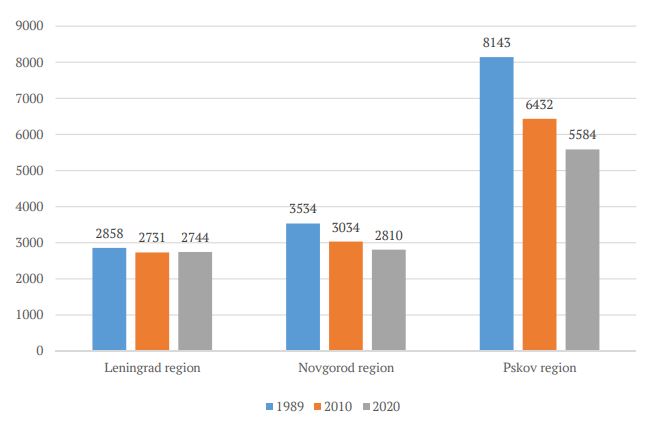
There is a strong polarisation in the dynamics of the indicator of the average SNP crowdedness, which grew by 21.3 % in the Leningrad region over this period, which is 8 p. p. higher than in the Russian Federation as a whole, by 35.2 p. p. in the Novgorod region and by 41.8 p. p. in the Pskov region (Table 8).
Territory | 1989 | 2002 | 2010 | 2020 | 2020 to 1989, % |
Russian Federation | 255 | 272 | 288 | 289 | 113.3 |
Leningrad region | 197 | 202 | 216 | 239 | 121.3 |
Novgorod region | 65 | 63 | 61 | 56 | 86.1 |
Pskov region | 39 | 35 | 31 | 31 | 79.5 |
Intra-regional spatial differentiation in the context of ‘centre-periphery’ is also visible in rural settlements. The expected regularities are most clearly seen in the Leningrad and Novgorod regions: as the districts move away from the centres of the regions, the share of SNPs without population increases and their inhabitancy decreases (Table 9).
In the Pskov region, these patterns are not clearly visible, as the Velikoluksky region with an average population of 56 people, with a share of 23 % of SNPs without population and an increased share (13.2 %) of larger SNPs is again fragmented among the remote areas.
Remoteness from the centres of the regions | Number of SNPs | Average inhabitancy, persons | Share | Share of SNPs in groups | ||
Total, units | Of which without population, % | Up to 100 people | More than 100 people | |||
Leningrad region | ||||||
Up to 100 kilometres | 915 | 1.3 | 459 | 31.9 | 54.7 | 45.3 |
100—200 kilometres | 1.315 | 4.8 | 164 | 45.8 | 76.1 | 23.9 |
Over 200 kilometres | 642 | 8.3 | 59 | 22.4 | 82.6 | 17.4 |
Total | 2.872 | 4.5 | 239 | 100.0 | 70.8 | 29.2 |
Novgorod region | ||||||
Up to 100 kilometres | 1.391 | 16.0 | 65 | 37.7 | 88.5 | 11.5 |
100—200 kilometres | 1.474 | 27.7 | 30 | 39.8 | 94.2 | 5.8 |
Over 200 kilometres | 834 | 30.8 | 28 | 22.5 | 94.0 | 6.0 |
Total | 3.699 | 24.0 | 56 | 100.0 | 89.5 | 10.5 |
Pskov region | ||||||
Up to 100 kilometres | 2.577 | 32.6 | 44 | 32.9 | 93.3 | 6.7 |
100—200 kilometres | 3.673 | 34.2 | 25 | 46.9 | 93.7 | 6.3 |
Over 200 kilometres | 1.582 | 28.4 | 34 | 20.2 | 92.0 | 8.0 |
Total | 7.832 | 32.5 | 31 | 100.0 | 93.5 | 6.5 |
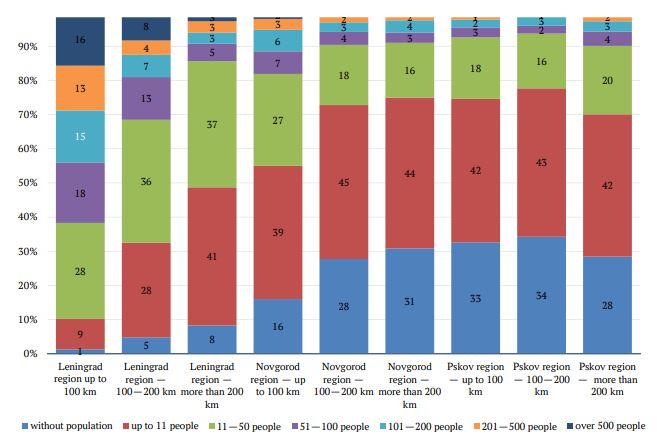
A detailed analysis of the SNP structure in the North-West regions revealed significant spatial differences, both between the central, intermediate, and peripheral districts within each region and across the districts of the Novgorod and Pskov regions. Notably, as these districts extend farther from St. Petersburg, the proportion of unpopulated settlements and those with low population density (up to 11 people) increases, while the share of all other groups, particularly those with a population density of 51 or more, declines (Fig. 11).
The exception is again the group of districts of the Pskov region, distant from its centre at a distance of more than 200 km, due to the above-mentioned peculiarity of rural settlement in the Velikoluksky district.
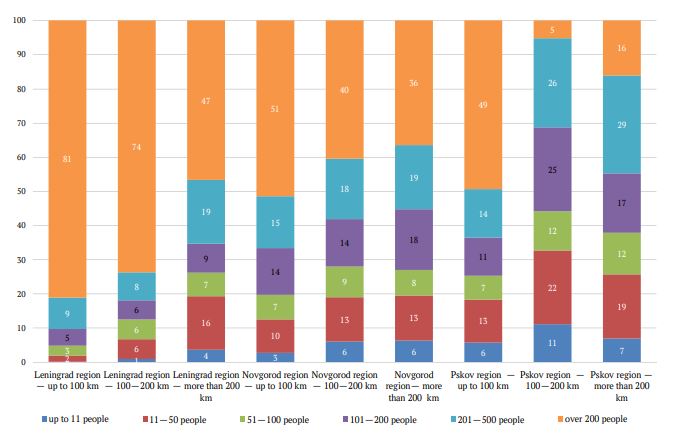
The distribution of the rural population by groups of average SNP inhabitancy depending on the remoteness of districts from the centres of the regions shows almost the opposite pattern. The central districts of all three regions have the maximum number of the rural population: from 49.3 in the Pskov region to 81.2 % in the Leningrad region (Fig. 12).
The spatial differentiation of the districts of the North-West regions in terms of the SNP population (Fig. 13) is largely similar to their differentiation in terms of the rural population growth rate in the period from 1989 to 2023. The area of districts with SNP population of more than 100 people covers those where the growth rate was positive over the period in question, with some expansion of its boundaries in the south of the Leningrad region.
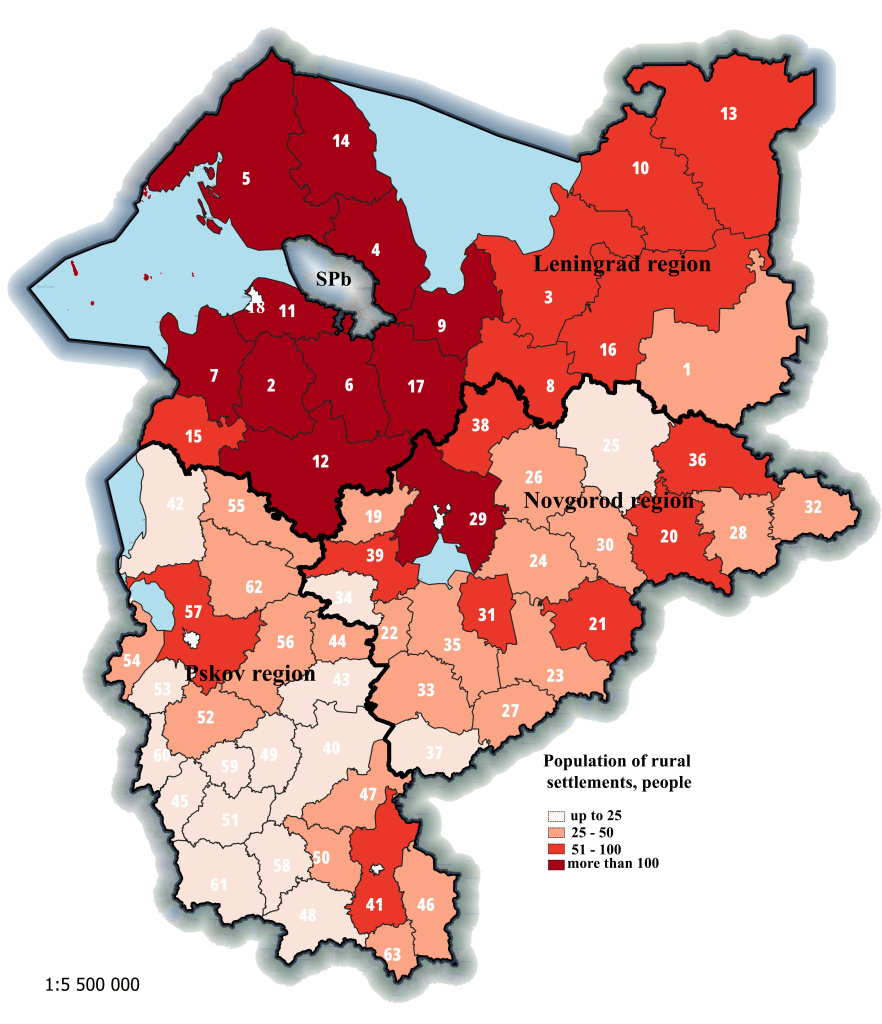
The area of the districts of the Pskov and Novgorod regions with the SNP population of up to 20 people includes those where the rates of rural population decline in 1989—2022 were the highest in the North-West. This also applies to the Gdovskiy (Pskov region), Soletskiy, Kholmskiy, and Lyubytinskiy districts (Novgorod region), which are not included in this area. There are coincidences in other districts as well, which allows us to conclude that the long-term dynamics of rural population and SNP inhabitancy are interdependent.
This conclusion suggests that the population decline will accelerate in districts with a population of up to 50 people, as the share of persons older than working age reaches 45 per cent, while the share of persons younger than working age barely reaches 10 per cent (Soletsky district, Novgorod region).
Conclusion
The study confirmed the hypotheses about the impact on the differentiation of rural space of differences in the rent potential of district territories and their place in the system of relations ‘centre-periphery’ both at the interregional and intraregional levels.
The Leningrad region, being adjacent to St. Petersburg—the largest economic and scientific centre in the country—and possessing one of the highest rent potentials for agricultural land in Russia (ranked 3rd), has created conditions that have shaped the polarised socio-economic development of rural areas within the North-West.
The Novgorod and, especially, Pskov regions without population growth dynamics even in the regional centres, with low population density and decreasing number of residents in the remaining cities, with low rent potential of the land (the Pskov region — 43rd, the Novgorod region — 45th place out of 53 regions of the European part of Russia) objectively occupy a subordinate place in the system of rural space differentiation at the interregional level.
Further inertial development of rural space in the Novgorod and Pskov regions, as the current trends show, will further increase the outflow of rural residents and lead to its socio-demographic “desertification”. It is necessary to take special organisational and economic measures based on the intensification of large-scale investment attraction in these regions.
The current programme and organisational measures cannot even slow down the downward trends, let alone change the current negative trends into positive ones. The State Programme for Integrated Development of Rural Areas, which has been implemented since 2020. The State Programme for Integrated Development of Rural Areas, which is being implemented from 2020, assumes cofinancing from regional and municipal budgets, which are extremely limited in the Novgorod and Pskov regions.
Formal actions on the adoption of legal acts on the transformation of municipal districts into municipal districts, the creation of rural agglomerations and anchor settlements without the implementation of a system of comprehensive measures supported by financial and other resources will not yield any positive results.
The combination of socio-economic problems of rural development in the Novgorod and Pskov regions, which cannot be solved by conventional methods, requires the adoption of separate state programmes for each of them, implemented on the basis of public-private partnership, mainly with financing from the federal budget and involvement of federal ministries and agencies in their implementation. The programmes should provide for the secondary settlement of rural areas by the population from other regions, including under the programme of voluntary resettlement of compatriots from abroad, and the implementation of large investment projects with the introduction of special taxation and lending regimes for entrepreneurs. Investment should be focused “on the mobilisation of local resource, human, social and entrepreneurial potential in order to overcome the depressive state in agricultural production and development of rural areas in these regions” [13, p. 165].
Most of the territories within the districts of the Novgorod and Pskov regions should be prioritised as targets for specific programme initiatives. At the same time, the current dynamics of rural spatial differentiation, including its fragmentation, tendencies towards contraction, and social ‘desertification’, as identified in this study, must be considered.
The research was carried out within the framework of the state assignment № FFZF-2022-18.
Reference