Spatial characteristics of ethnic group localisation in St. Petersburg


Abstract
Amid ongoing globalisation, large cities are becoming increasingly attractive to migrants, resulting in a more multiethnic population composition, which underscores the growing importance of studying interethnic relations in metropolises. This work aims to explore the spatial localisation of ten ethnic groups residing in St. Petersburg: Ukrainians, Belarusians, Tatars, Jews, Georgians, Armenians, Azerbaijanis, Uzbeks, Tajiks and Moldovans. Using the ethnic concentration coefficient, the study examines the territorial heterogeneity of settlement among the city’s largest ethnic diasporas to identify patterns in residential choice. The data on national composition are derived from all-Russian population censuses. Most national minorities are distributed rather evenly across the city, but the Jewish and Georgian communities are notably concentrated in the central district of St. Petersburg. At the same time, the migration restrictions imposed due to the COVID-19 pandemic not only decreased the size of the Uzbek and Tajik diasporas, thereby normalising their gender and age distribution but also led to a more even dispersion of these ethnic groups across the city. Currently, there is no evident correlation between the spatial concentration of most ethnic groups in St. Petersburg and their level of social well-being.
Introduction and problem-setting
Despite ongoing and accelerating globalisation, the issues of interethnic relations remain highly relevant and are gaining increasing prominence. Interactions among representatives of different nationalities are coming to the forefront in large cities, which, due to their diverse ethnic composition, serve as meeting points for different cultural traditions. In multiethnic Russia, the question of the peaceful coexistence of various ethnic groups has historically been central to domestic policy, providing the foundation for successful state-building.
Today, similarly to many other cities around the globe, Russia’s metropolises are marked by a diverse ethnic composition, with polyethnicity growing due to ongoing migration. A diversified labour market, high living standards and greater social mobility opportunities make large cities attractive to internal and external migrants. Yet, the appeal of major urban agglomerations to migrants leads to the inevitable spatial segregation, manifesting along ethnic, religious and racial lines. This phenomenon is vividly illustrated by the ‘ghettoisation’ observed in the largest metropolises across Europe and North America.
Although the interaction of various ethnic groups has been recognised for millennia, fewer studies look at the specifics of their coexistence in urban environments than one might expect. Several factors contribute to this issue being ignored.
Firstly, there is no single approach to defining the concepts of ‘ethnos’ and ‘ethnicity’. Constructivist approaches, prevalent in both Western and Russian scholarship, either replace the essence of the ethnos phenomenon with geographical ethnonyms or treat it as a simulacrum.
Secondly, in many countries of the world, censuses do not include questions on ethnic self-identification, with most European nations avoiding it deliberately. Neither Germany, Italy, the UK, nor other major European states keep official records of ethnic composition since such practices are considered intolerant and xenophobic. Moreover, the French Law on Data Processing, Data Files and Individual Liberties of 6 January 1978 explicitly prohibits the collection and processing of information on citizens’ race and ethnicity. Most Western European publications on ethnic issues focus on immigrants, categorising them according to their place of origin.
In this context, a publication of note is Aleksandr Kapralov’s doctoral thesis dedicated to the patterns of immigrant settlement in Europe’s leading urban agglomerations. He examines the factors and models of immigrants’ spatial behaviour along with the general consequences of immigration to the Paris, London, Madrid and Rome agglomerations and ensuing socioeconomic problems [1]. But, similarly to many other studies on ethnic issues in European countries [2], [3], this research concentrates on immigrant communities, which do not always align with the ethnic groups within the population.
Thirdly, even in countries where ethnic self-identification is officially recognised, relevant data are only collected during censuses, which are typically taken once every decade. Although the multinational Russian Federation falls into this category of states, its vital and resident registration records, including marriages, births and deaths, have not included nationality entries since the mid-1990s.
These circumstances hinder the study of interethnic interactions, limiting most research in the field to interpreting data obtained through sample surveys.
State of research
Most of the recent international studies on ethnic issues use materials collected by statistical agencies in countries exploring the immigration origin of their nations. The works by Dr. Joe T. Darden of Michigan State University, who examines the spatial segregation of various ethnic and racial groups in urban agglomerations in the US and Canada, are a case in point [4], [5], [6].
The contribution by Stephen Matthews, Chad Farrell et al. [7] explores the operation of ethnogeographic methods in urban studies. The use of cartographic and statistical techniques in studying interactions among different racial groups has been discussed by Joanna Pinto-Coelho and Tukufu Zuberi [8], as well as Michael Reibel and Moira Regelson [9]. A comparative analysis of immigrant ethnic enclaves in New York and Los Angeles has been the focus of research by a group of scholars from the University at Albany [10].
As for Russian works on ethnic issues in the US, a notable contribution is the doctoral dissertation by Yulia Kelman, which explores the ethnic and cultural variety of American cities’ population [11]. Other studies by Russian authors have examined the assimilation of various ethnogeographic groups within the US [12] and their socio-spatial inequality [13].
The North American approach to studying ethnic diversity has been adopted by other countries pursuing ‘soft’ immigration policies. For example, an article co-authored by Australian and British scholars examines the settlement patterns of Asians and Muslims in Australia’s 11 major cities from the perspective of spatial segregation [14]. Much in line with the American tradition, the authors of the contribution substitute ethnic characteristics with ethnogeographic and denominational ones, interpreting the assimilation of immigrant descendants as a change in their country of origin [15]. Analogous studies on ethnic segregation processes have been conducted in Auckland, New Zealand’s largest city [16], [17].
Noteworthy Russian studies on the settlement patterns of various nationalities include works by Andrei Manakov, Aleksandr Orlov and Sergey Sushchy, which view the transformation of the ethnic space of Russia, its regions, and neighbouring countries from a historical perspective [18], [19], [20], [21]. Most studies on interactions among different national groups in Russian cities are essentially localised sociological research and thus do not examine spatial patterns of ethnic segregation. Among geographical studies on interethnic contacts in major cities, it is worth mentioning the research conducted by Olga Vendina, Alexander Panin and Vladimir Tikunov into Moscow’s social space [22]. Using census data, they consider the ethnic aspects of social segregation, employing, in particular, the ethnic patchiness index.
Most recent works on ethnic issues are sociological, typically relying on an analysis of local surveys and expert interviews [23], [24], [25], with authors seldom relying on statistical data, particularly that collected at the local level. A rare exception is Vendina’s contribution, which tracks the concentration of selected ethnic groups across Moscow municipalities, based on vital records and a survey of 3,500 respondents. It monitors the ‘embeddedness’ of ethnic diasporas in the Moscow landscape at the beginning of the 2000s [26]. Relevant research on the ethnic geography of Russia at regional and federal levels is, however, lacking, as are studies on issues related to interethnic relations in urban environments.
The recent decades of upsurge in migration to Russia’s major cities has brought about changes in their ethnosocial structure and settlement patterns. Lately, similar processes taking place in urban agglomerations in Europe and North America have led to the development of segregated ethnic areas, which are often socioeconomically disadvantaged and viewed as negative outcomes of segregation.
The question this study will strive to answer is whether the intra-city isolation of national communities is an inevitable consequence of ongoing migratory and assimilation processes, and to what extent this phenomenon is characteristic of Russian cities. To achieve this, the study will examine the case of St. Petersburg to identify spatial patterns in the settlement of different nationalities residing in the city at the beginning of the 21st century. This research aims to analyse these patterns and determine whether they reveal selectivity in the residential choices of the largest ethnic diasporas in St. Petersburg.
Materials and methods
Unfortunately, as is the case with most Russian research in ethnic geography, the spatial analysis of the study phenomenon is complicated by several factors. Firstly, this is the incompleteness and discrete nature of available statistical information, particularly at the lowest territorial level. As mentioned earlier, data on ethnic composition, based on respondents’ self-identification, is collected in Russia only during national censuses. The smallest territorial taxon that can be matched to open-access ethnic composition data is level 1 rural settlements and urban districts. In this context, the hundredfold variation in the municipalities’ population size — from a few hundred people to tens of thousands of individuals — is not the sole problem. The historical ephemerality of the existing level 1 municipal entities, which were only established in the early 2000s, prevents the examination of ethnic composition changes over an extended period.
Another important factor complicating the analysis of ethnic composition data for territorial entities is the incompleteness of census information. For instance, during the 2010 census, 3.9 % of Russians did not provide their ethnicity, and this figure rose to 11.6 % in 20211. A similar percentage of Russians not responding to questions about education level, field of employment, place of birth or sources of livelihood in 2021 indicates that these people did not participate in the census. In St. Petersburg, this ‘census absenteeism’ is even more pronounced: 15.8 % of residents did not indicate their nationality in 20212.
Currently, no reliable data indicates that the census provided more accurate information for some ethnic groups compared to others. One may assume that migrants are less likely to participate in such nationwide events as censuses, leading to a higher proportion of non-participants than the ‘native’ Russian population. But one should bear in mind that a significant proportion of labour migrants are citizens of other countries with permanent residence outside Russia, and are not counted in the country’s total population by definition. Moreover, immigrants who have obtained Russian citizenship or permanent residence permits generally do not avoid participating in censuses, viewing it as an important step towards intended integration into society. Thus, there is currently no general agreement as to the extent to which members of various ethnic groups in Russia, and specifically in St. Petersburg, participate in censuses. For this study, however, data on the spatial distribution of national groups holds greater value than their overall numbers. Therefore, it can be assumed that the completeness of census data for a particular ethnic group does not affect their spatial distribution within the city.
Since its foundation in the 18th century, St. Petersburg has been a multinational city with the sheer prevalence of Russians. Despite the influx of migrants, including those from outside the country, the proportion of Russians in the city’s population has not diminished but, on the contrary, slightly increased. At the same time, both the number and proportion of major ethnic minorities in St. Petersburg have considerably changed during the post-Soviet period (see Table 1).
Ethnic group | 1897 | 1926 | 1939 | 1959 | 1970 | 1979 | 1989 | 2002 | 2010 | 2021 |
Population, thousand people | ||||||||||
Total | 1264.9 | 1609.8 | 3191.3 | 3321.2 | 3949.5 | 4568.5 | 4990.7 | 4661.2 | 4879.6 | 5601.9 |
including those who indicated their nationality, of which: | 1264.8 | 1609.8 | 3190.6 | 3321.2 | 3947.6 | 4568.5 | 4986.9 | 4293.2 | 4226.7 | 4717.2 |
Russians | 1094.0 | 1386.9 | 2776.0 | 2951.3 | 3514.3 | 4097.6 | 4448.9 | 3949.6 | 3908.8 | 4275.1 |
Ukrainians | 5.2 | 10.8 | 54.7 | 68.3 | 97.1 | 117.4 | 151.0 | 87.1 | 64.4 | 29.4 |
Belarusians | 2.9 | 14.6 | 32.4 | 47.0 | 63.8 | 81.6 | 93.6 | 54.5 | 38.1 | 15.5 |
Tatars | 4.9 | 9.8 | 31.5 | 27.2 | 32.9 | 39.4 | 44.0 | 35.6 | 30.9 | 20.3 |
Jews | 16.9 | 84.5 | 201.5 | 168.6 | 162.5 | 142.7 | 106.1 | 36.6 | 24.1 | 9.2 |
Moldovans | 0.1 | 0.2 | 0.6 | 1.0 | 2.5 | 2.9 | 5.4 | 3.4 | 7.2 | 2.9 |
Georgians | 0.2 | 0.6 | 1.6 | 1.9 | 3.8 | 4.4 | 7.8 | 10.1 | 8.3 | 6.5 |
Armenians | 0.8 | 1.7 | 4.6 | 4.9 | 6.6 | 8.0 | 12.1 | 19.2 | 20.0 | 14.7 |
Azerbaijanis | 0.1 | 0.1 | 0.4 | 0.9 | 1.6 | 3.2 | 11.8 | 16.6 | 17.7 | 16.4 |
Uzbeks | — | 0.1 | 0.2 | — | 1.7 | 1.9 | 7.9 | 3.0 | 20.3 | 12.2 |
Tajiks | — | 0.0 | 0.1 | — | 0.4 | 0.5 | 1.9 | 2.4 | 12.1 | 9.6 |
Share of the city’s population, % | ||||||||||
Total | 100 | 100 | 100 | 100 | 100 | 100 | 100 | 100 | 100 | 100 |
including those who indicated their nationality, of which: | 100 | 100 | 100 | 100 | 100 | 100 | 99.9 | 92.1 | 86.6 | 84.2 |
Russians | 86.5 | 86.2 | 87.0 | 88.9 | 89.0 | 89.7 | 89.2 | 92.0 | 92.5 | 90.6 |
Ukrainians | 0.4 | 0.7 | 1.7 | 2.1 | 2.5 | 2.6 | 3.0 | 2.0 | 1.5 | 0.6 |
Belarusians | 0.2 | 0.9 | 1.0 | 1.4 | 1.6 | 1.8 | 1.9 | 1.3 | 0.9 | 0.3 |
Tatars | 0.4 | 0.6 | 1.0 | 0.8 | 0.8 | 0.9 | 0.9 | 0.8 | 0.7 | 0.4 |
Jews | 1.3 | 5.3 | 6.3 | 5.1 | 4.1 | 3.1 | 2.1 | 0.9 | 0.6 | 0.2 |
Moldovans | 0.0 | 0.0 | 0.0 | 0.0 | 0.1 | 0.1 | 0.1 | 0.1 | 0.2 | 0.1 |
Georgians | 0.0 | 0.0 | 0.1 | 0.1 | 0.1 | 0.1 | 0.2 | 0.2 | 0.2 | 0.1 |
Armenians | 0.1 | 0.1 | 0.1 | 0.2 | 0.2 | 0.2 | 0.2 | 0.5 | 0.5 | 0.3 |
Azerbaijanis | 0.0 | 0.0 | 0.0 | 0.0 | 0.0 | 0.1 | 0.2 | 0.4 | 0.4 | 0.4 |
Uzbeks | — | 0.0 | 0.0 | — | 0.0 | 0.0 | 0.2 | 0.1 | 0.5 | 0.3 |
Tajiks | — | 0.0 | 0.0 | — | 0.0 | 0.0 | 0.0 | 0.1 | 0.3 | 0.2 |
| Source: compiled on the basis of data from Demoscope3 and Rosstat4. | ||||||||||
Let us now turn to the spatial features of national minority settlement in St. Petersburg. The basic unit considered in this study is a municipality. Out of the city’s 111 administrative units, three — the villages of Serovo, Ushkovo and Smolchyakovo, all located in the Kurortny district — have populations of fewer than 1,000; they were, therefore, excluded from the examination.
Currently, alongside Russians, St. Petersburg’s largest ethnic groups include Ukrainians, Tatars, Azerbaijanis, Belarusians, Armenians, Uzbeks, Tajiks, Jews and Georgians. This study will examine the spatial settlement patterns of these nationalities. Additionally, it will address the settlement patterns of the Moldovan diaspora, the tenth-largest ethnic community in the city according to the 2010 census.
The ethnic concentration coefficient (Ecc) will be used to assess the territorial heterogeneity of settlement for a given nationality, as it has been done in earlier works [27]. This coefficient is calculated as a ratio between a given ethnicity in the population of an administrative unit and the share of this ethnicity in the city’s total population:
Ecci = (Pi / Ni) / (P / N),
where Pi is the number of the study nationality in the ith municipality; Ni is the number of all residents in the ith municipality who have reported their nationality; P is the total number of members of the study nationality in St. Petersburg; N is the number of the city’s residents who have reported their nationality.
When Ecc = 1, the proportion of the ethnic group in the given municipality equals the city average. Ecc = 0 means that the ethnic group does not reside in the area. A value greater than 1 signifies that the concentration of the ethnic group in the territory exceeds the city average by a factor equal to the coefficient value.
Given the possibility of random ethnic settlement combinations, Ecc ranging from 0.5 to 2.0 indicates the absence of territorial settlement preferences among the ethnic group. Values outside this range — more than twice the average concentration across the city — suggest selectivity in the choice of residence. Based on this assumption, the study will examine changes in the concentration of the largest ethnic diasporas in St. Petersburg and how their settlement patterns have shifted over the last intercensal period, from 2010 to 2021.
Results and discussion
Ukrainians. Since the late 1930s, Ukrainians have been the third-largest ethnic group in St. Petersburg, surpassed only by Russians and Jews. By 1989, the number of the Ukrainian diaspora had reached its peak at 151,000 people; this ethnic group became the city’s most populous national minority, comprising 3.0 % of the total population. As was the case with most ethnic groups in Russia’s ‘northern capital,’ the growth of the Ukrainian diaspora was driven by migratory influx occurring at a rate exceeding that of assimilation. Yet, in the post-Soviet period, the number and proportion of Ukrainian residents of St. Petersburg started to diminish, with the 2021 census reporting fewer than 30,000 Ukrainians or 0.6 % of the Petersburgians. Out of the 108 study municipalities, only seven have a proportion of Ukrainians twice or more than the city average (Table 2), and only in the village of Shushary, the relative amount of this ethnic group was greater than the St. Petersburg average by a factor of more than two. The fact that the standard deviation of the ethnic concentration coefficient (Ecc) for Ukrainians across the city’s municipalities in 2021 (0.39) was the lowest among similar measures for the study ethnic groups (Table 2) clearly points to the lack of selectivity in Ukrainian settlement across St. Petersburg.
Ethnic group | Year | Number of St. Petersburg municipalities | Standard deviation of the ethnic concentration coefficient (ECC) | ||||
Less than 0.2 | 0.2—0.5 | 0.5—2.0 | 2.0—5.0 | Over 5.0 | |||
Ukrainians | 2010 | 0 | 2 | 103 | 3 | 0 | 0.42 |
2021 | 1 | 5 | 101 | 1 | 0 | 0.39 | |
Belarusians | 2010 | 0 | 2 | 105 | 1 | 0 | 0.36 |
2021 | 0 | 4 | 104 | 0 | 0 | 0.48 | |
Tatars | 2010 | 0 | 1 | 104 | 3 | 0 | 0.33 |
2021 | 0 | 2 | 103 | 3 | 0 | 0.43 | |
Jews | 2010 | 10 | 19 | 70 | 9 | 0 | 1.74 |
2021 | 6 | 14 | 75 | 12 | 1 | 1.24 | |
Uzbeks | 2010 | 6 | 26 | 61 | 9 | 6 | 3.01 |
2021 | 2 | 14 | 88 | 4 | 0 | 0.74 | |
Tajiks | 2010 | 12 | 35 | 49 | 7 | 5 | 2.72 |
2021 | 6 | 15 | 81 | 5 | 1 | 1.13 | |
Armenians | 2010 | 0 | 4 | 97 | 6 | 1 | 0.75 |
2021 | 1 | 3 | 100 | 1 | 3 | 1.19 | |
Azerbaijanis | 2010 | 3 | 10 | 92 | 3 | 0 | 0.98 |
2021 | 5 | 21 | 75 | 7 | 0 | 1.35 | |
Georgians | 2010 | 2 | 15 | 77 | 14 | 0 | 0.64 |
2021 | 8 | 11 | 78 | 11 | 0 | 1.45 | |
Moldovans | 2010 | 2 | 22 | 70 | 9 | 5 | 1.39 |
2021 | 7 | 9 | 87 | 4 | 1 | 1.31 | |
| Source: calculated based on Rosstat data.5 | |||||||
Belarusians. The history of the city’s Belarusian diaspora is very similar to that of the Ukrainian one: a rapid growth during the Soviet period followed by an even faster decline in the post-Soviet era. Between 1989 and 2021, the number of Belarusians in St. Petersburg reduced sixfold, compared to a fivefold decrease for Ukrainians. Like Ukrainians, Belarusians settlement is distributed very evenly: only in four municipalities, the ethnic concentration coefficient (Ecc) falls outside the central range (0.5 ≤ Ecc ≤ 2), with values being less than 0.5 in all of them. The degree of spatial concentration of Belarusians in the northern capital changed only slightly during the last intercensal period, with the standard deviation of Ecc values increasing from 0.36 in 2010 to 0.48 in 2021.
Tatars. The Tatar community in St. Petersburg is considered ‘long-established,’ with its presence dating back to the beginning of the 18th century — the early period of the city’s development. For the first two centuries, it was a small and insular diaspora due to its denominational distinctiveness, as most of the Petersburgian Tatars were Muslim. During this period, the Petrograd Side district was the main residential area for the Tatars. Many of them were employed in the carpet trade, leather and bread sales, inexpensive food services, and transport, working as coachmen and stable hands. After 1917, the community rapidly integrated into the broader city society, while an influx of fellow Tatars from the Volga regions continued. Throughout most of the Soviet period, Tatars comprised one of the largest ethnic groups in St. Petersburg, surpassed only by Russians, Ukrainians, Belarusians and Jews. Although the Tatar population gradually declined from 44,000 in 1989 to 20,300 in 2021, it is the second-largest ethnic minority in the city to this day, second only to Ukrainians. Similarly to Ukrainians and Belarusians, Tatars are distributed evenly across St. Petersburg: only in five out of the 108 municipalities, their ethnic concentration coefficient is twice the city average. Over the last intercensal period, the standard deviation of Ecc for Tatars has slightly increased, from 0.33 to 0.43, remaining relatively small.
With few exceptions, these ethnic groups have small populations in areas where the Ecc deviates significantly from 1. Typically, these are industrial or suburban municipalities on the outskirts of St. Petersburg, such as Petro-Slavyanka, Saperny, Ust-Izhora (Kolpino district), Levashovo (Vyborg district), Solnechnoe, Komarovo (Kurortny district), Lisiy Nos (Primorsky district) and Tyarlevo (Pushkin district). Overall, Ecc deviation from the central range tends to grow as the population of the municipality decreases.
Jews. Although the Jewish community emerged in St. Petersburg in the late 18th century, its numbers in the capital did not surpass a few hundred until the mid-19th century, as Jewish residence in the Russian Empire was largely restricted to the so-called Pale of Settlement. Only after Alexander II’s reforms did the Jewish population in St. Petersburg start to increase: there were 6,600 Jews in 1869, 14,200 in 1881 and 16,900 in 1897. An even faster growth in the Jewish community occurred after 1917, when the influx of settlers from today’s Belarus and Ukraine replaced the noble and bureaucratic population of central Petrograd, which had diminished amid the revolutionary repressions. For most of the 20th century, Jews were the largest ethnic group in Leningrad after Russians. The Jewish community reached its peak before the Great Patriotic War, with 202,000 individuals, or 6.3 % of Leningrad’s population, according to the 1939 census. In the post-war period, both the number and proportion of Jews declined, with the rate of decrease accelerating from the late 1980s onwards. Between 1989 and 2021, the city’s Jewish population decreased almost twelvefold, and today only 9,200 individuals of this ethnicity reside in St. Petersburg. The age structure of the city’s Jewish community is skewed: over 42 % of this ethnic group are over 65 years old, while only 5.6 % are children aged from 0 to 14. The median age of St. Petersburg ‘s Jewish community is the highest of any ethnic group in the city, exceeding 60 years6.
Unlike that of Eastern Slavic ethnic groups and Tatars, the pattern of Jewish settlement in St. Petersburg shows a marked spatial heterogeneity: in 13 municipalities, the Ecc is over twice the average concentration, with the value reaching 8.4 in the village of Solnechnoe (Kurortny district). Just as in previous historical periods, a higher proportion of the Jewish population is recorded in the city’s central municipalities — the Admiralteysky, Petrogradsky and Central districts (see Fig. 1). In 2021, the Ecc for Jews was below 0.5 in 20 municipalities, including six where it did not exceed 0.2. The lowest concentration of Jews in the overall population is found in municipalities located in the city’s peripheral southern parts — Kolpino, Krasnoselsky, Petrodvorets, Pushkin and Kronstadt. The standard deviation of the Ecc for Jews across St. Petersburg ‘s municipalities is considerably higher than that for the ethnic groups discussed above, standing at 1.24 in 2021. Compared to 2010, there has been a slight decrease in the level of spatial unevenness in the settlement of the city’s Jewish community. The main area of Jewish settlement in St. Petersburg (Leningrad) appears to have taken shape before the mass housing construction that took place between the 1960s and 1980s. This circumstance explains the higher concentration of the Jewish population in the central districts of the city, compared to the residential areas of the late Soviet period.
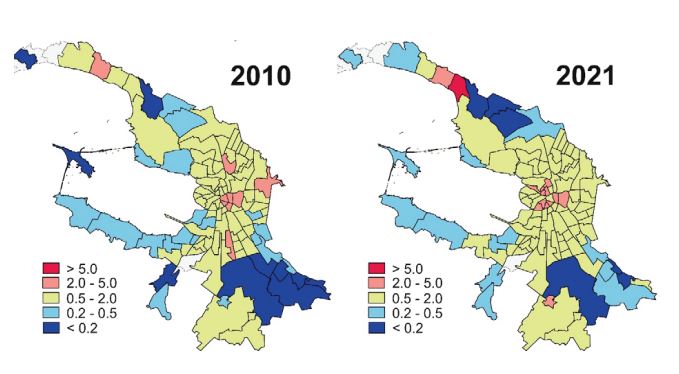
Georgians. Historically, the city’s Georgian community was not populous, only gaining prominence between the 1960s and 1980s. The highest number of Georgians in the northern capital, 10,100 people, was recorded in the 2002 census. This peak was a result of the migratory influx of the 1990s driven by the economic crisis in Georgia and the armed conflicts in Abkhazia and Southern Ossetia. Similar to St. Petersburg’s Jewish community, the Georgians’ settlement pattern shows a high degree of unevenness. In 30 out of the 108 study municipalities, the Ecc for Georgians falls outside the central range; in 11, the value is over twice the city average (Fig. 2). All municipalities with a high level of ethnic concentration of Georgians are located in the historical centre of St. Petersburg, largely mirroring the settlement pattern of the city’s Jewish community. In terms of negative selectivity, the settlement patterns of the Georgian and Jewish communities exhibit less overlap: among 19 municipalities with minimal Ecc values for Georgians, only nine show low Ecc values for Jews as well. The spatial structure of the Georgian community’s settlement in the city is exceptionally stable: the correlation coefficient between the Ecc values for Georgians in St. Petersburg municipalities in 2010 and 2021 was 0.65, despite a 22 % decrease in this ethnic group between the censuses.
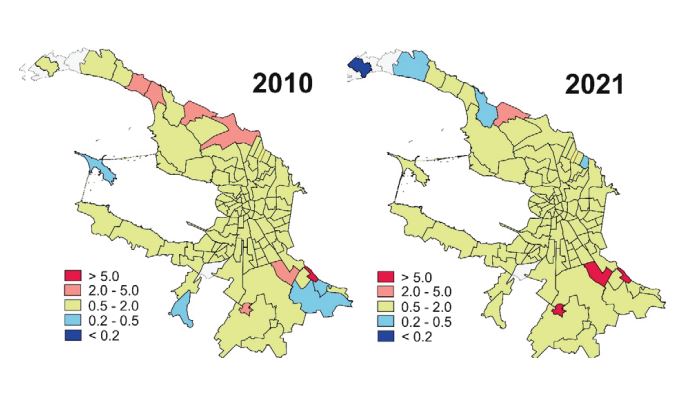
Armenians. The Armenian community is the most established and, until recently, the largest among the Caucasian diasporas in St. Petersburg. In 2010, the number of Armenians permanently residing in the city reached its historical peak of 20,000 individuals, although it has since decreased to 14,700. Unlike the Georgians, the Armenians are distributed fairly evenly across the city: only in eight peripheral municipalities does the concentration of Armenians fall outside the central range. In four less populous municipalities, the Ecc for this ethnic group exceeds 2, whereas in four other municipalities, it is below 0.5. Remarkably, all the city’s municipalities where both positive and negative selectivity in Armenian settlement are observed are situated on the outskirts. Among all the prominent ethnic groups in St. Petersburg, the spatial distribution of Armenians has experienced the fewest changes over the past decade, with the Ecc across the city’s municipalities remaining unchanged at 0.88 in 2010 and 2021 (see Fig. 3).
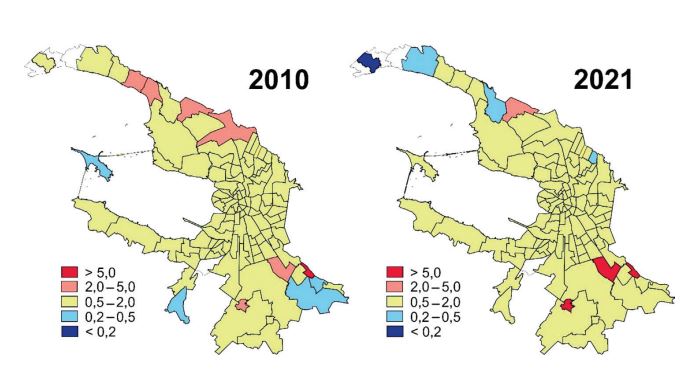
Azerbaijanis. Until the 1980s, the Azerbaijani community in St. Petersburg was small, only starting to grow towards the end of the Soviet era. Over the past 20 years, the number of this ethnic group has remained virtually unchanged, ranging from 16,000 to 18,000 individuals. Today, Azerbaijanis are distributed very unevenly across St. Petersburg: in one-third of the city’s municipalities, the Ecc for this ethnic group lies beyond the central range. Positive selectivity (Ecc ≥ 2) in Azerbaijani settlement is observed in seven municipalities, while negative selectivity (Ecc ≤ 0.5) is noted in 26 municipalities. Areas with a high concentration of the Azerbaijani diaspora are mainly found in late Soviet-built residential districts in the Nevsky and Frunzensky districts and at the interface of the Kirovsky and Admiralteysky districts (the Narvsky and Ekateringofsky municipalities, respectively). The geography of negative selectivity in Azerbaijani settlement in St. Petersburg is more extensive. The Ecc values below 0.5 are observed in most municipalities of the Kurortny, Primorsky, and Petrodvortsovy districts, as well as in Kronstadt. Compared to 2010, the settlement of Azerbaijanis across the city has become more polarised, which distinguishes this diaspora from most of the other study ethnic groups (Fig. 4).
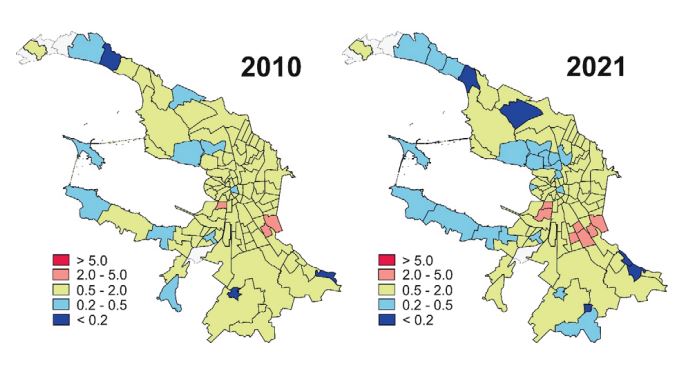
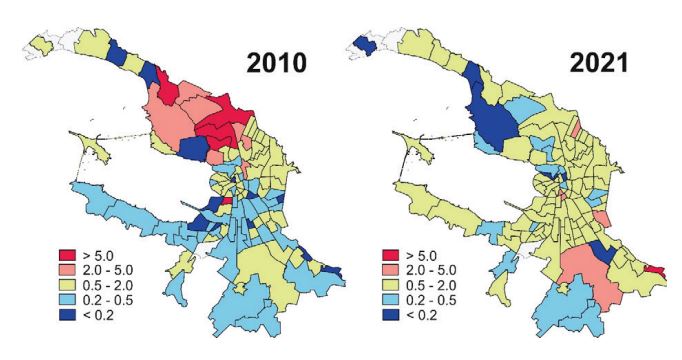
Uzbeks. The most significant increase in St. Petersburg’s Uzbek diaspora occurred during the first decade of the 2000s when a massive wave of foreign labour headed for Russia’s major cities to support the rapid economic growth. However, hundreds of thousands of labour migrants from Uzbekistan and other former Soviet republics are not counted in the census as permanent residents11, unlike the foreigners who have obtained residency permits12. This explains why, despite tens of thousands of guest workers from Uzbekistan residing in St. Petersburg, the official total number of Uzbeks in 2021 was only 12,200, including both Russian citizens and foreign nationals with residency permits13. Yet, compared to 2010, the number of Uzbeks permanently residing in St. Petersburg has decreased by 40 % (see Table 1), and their distribution across the city has become more even. While at the beginning of the last decade, the Ecc for Uzbeks fell outside the central range in nearly half (47) of all the city’s municipalities, by 2021 this number had further decreased to 20 (see Table 2). Today, the highest Ecc values for Uzbeks in St. Petersburg are observed in four municipalities across different parts of the city, with only one municipality, Narodny in the Nevsky district, exhibiting a value exceeding 3. Municipalities with low concentrations of Uzbeks are found throughout the city, with no distinct spatial pattern. This sharply contrasts with the situation in 2010, when there was a pronounced concentration of the Uzbek population in the north-western districts of St. Petersburg, and a negative selectivity regarding the southern parts of the city was noticeable (see Fig. 5). The decrease in the concentration of Uzbeks, particularly in the north-western part of the city, seems to be not so much the result of a reduction in the overall number of Central Asian guest workers caused by the pandemic-related migration restrictions of 2020 and 2021, as the consequence of the distinctly localised construction boom of the early 2000s shifting to the suburban areas of the Leningrad region beyond the city’s administrative boundaries.
It is worth noting that, during the last intercensal period, from 2010 to 2021, the demographic profile of the city’s Uzbek diaspora changed dramatically. In 2010, the proportion of children under 15 among the Uzbeks in St. Petersburg was a mere 6.6 %, and of those over 65 years old only 1.1 %. By 2021, the number of these age groups had increased to 13.9 % and 5.5 %, respectively. The share of women in the city’s Uzbek diaspora grew from 26 % to 40 % during this period. Of course, these figures differ significantly from the St. Petersburg averages, where children under 15 comprise 13.1 % of the population, those over 65, 17.1 %, and women, 55 %. It is undeniable that alongside spatial deconcentration, there is a trend towards the ‘normalisation’ of age and sex distribution within the city’s Uzbek community.
Tajiks. The dynamics of the size and spatial distribution of the Tajik diaspora in St. Petersburg largely mirror those of the Uzbek community. Like the Uzbeks, the Tajiks became a prominent ethnic group in the northern capital only in the early 2000s. Again, as with the Uzbek population, the number of the city’s permanent residents of Tajik origin is significantly smaller than the number of temporary labour migrants representing this nationality. The COVID migration restrictions in place in 2020 and 2021 led to a reduction in the number of all categories of foreign nationals living in the city. In 2010, the census recorded 69,600 foreign nationals, including 15,200 from Uzbekistan and 8,300 from Tajikistan. By October 2021, the number of foreigners living permanently in the city had decreased to 25,500, with 3,100 originating from Uzbekistan and 1,800 from Tajikistan. St. Petersburg’s census-registered Tajik diaspora declined as a result by 20 % — from 12,100 to 9,600 between 2010 and 2021. Just as with the Uzbek community, this has led to a partial ‘normalisation’ of the Tajik diaspora’s age and sex structure, which previously had a notably low proportion of children and older persons compared to the city’s overall population. The number of municipalities where the Ecc for the Tajiks falls outside the central range (2 ≥ Ecc ≥ 0.5) has more than halved: from 59 in 2010 to 27 (see Fig. 6). Today, more than twice the average concentration of the Tajik population is observed in six of the city’s municipalities, with only one — Saperny in the Kolpinsky district — surpassing the average by a factor of five. Areas with high concentrations of the Tajik population do not form a unified settlement area, being spread across different districts. Interestingly, an Ecc for the Tajiks of above 2 is observed in two out of five municipalities (Semyonovsky and Sennoy) in the historical Admiralteysky district. In contrast, the historical Petrogradsky and the coastal Kurortny districts, the latter bordering on the Gulf of Finland, have the lowest concentration of the Tajiks.
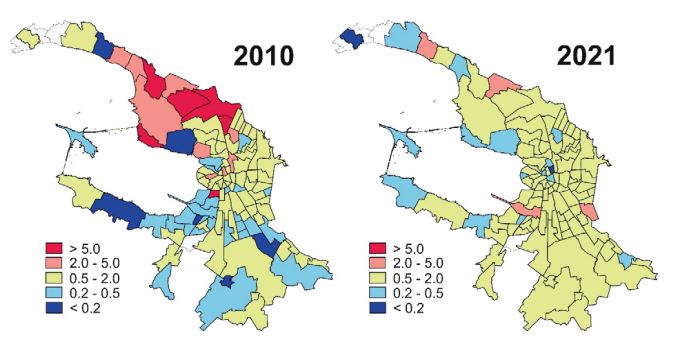
Since 2010, the number of municipalities with similar levels of ethnic concentration of the Uzbeks and the Tajiks has decreased in the city. While 15 years ago, the correlation coefficient between Uzbek and Tajik settlements across St. Petersburg was 0.89, in 2021, it did not exceed 0.44. A spatial analysis of settlement patterns and the age and sex distribution indicates that the Tajik diaspora is integrated into the city’s society to a lesser degree than the Uzbek community.
Moldovans. Today, St. Petersburg’s Moldovan community is the smallest among the ethnic groups examined in this study. It emerged between the 1950s and 1970s when migration within the USSR led to significant population
mixing, particularly in metropolises. However, the most rapid growth in the city’s Moldovan community occurred in the early 2000s, during the peak of labour migration from Moldova to Russia. The 2010 census recorded 7,200 members of this ethnic group living in the northern capital, most of whom were Moldovan citizens. The reduction in the number of foreign nationals in Russia during the COVID-19 pandemic led to a decrease in the Moldovan community to 500 individuals in 2021, down from 4,500 in 2010, with the total number of the diaspora members falling to 2,900. Today, the settlement pattern of Moldovans in St. Petersburg is characterised by high spatial unevenness, which, although reduced compared to 2010, remains among the highest of all the study nationalities.
For example, in 21 of the city’s municipalities, the Ecc for the Moldovans lies beyond the central range (compared to 38 municipalities in 2010), with a standard deviation of 1.31, only surpassed by the Ecc for the Georgians and the Azerbaijanis.
A comparison of the spatial concentration of national diaspora members in St. Petersburg with the local municipalities’ social well-being rankings [28] shows no clear correlation between these indicators. The correlation analysis suggests that for most of the ethnic groups considered, the relationship between the Ecc and measures such as housing prices, paid property tax, education level and the proportion of entrepreneurs and rentiers is insignificant, not exceeding 0.3 (see Table 3). Only the Jewish and, to some extent, Georgian communities in St. Petersburg show a noticeable correlation between their percentage in municipal populations and social well-being indicators.
Currently, the city’s Uzbek and Tajik diasporas, formed primarily by post-Soviet migration, show no signs of social segregation at the spatial level: in most cases, both high and low Ecc values for these communities are observed outside either the affluent or most impoverished city areas. This phenomenon may be explained by this study examining spatial distribution at the level of municipal districts, whereas the city’s municipalities are internally highly polarised, with wealth and poverty coexisting within the same residential quarters. This situation is characteristic of the city’s central districts, such as Admiralteysky, Petrogradsky and Central, where 20 to 30 % of the households still live in communal flats.16 In addition, a relatively small number of Uzbeks and Tajiks recorded in the 2021 census indicates that our calculations pertain to the most integrated and socially advantaged segments of these ethnic communities.
Indicator | Ethnic concentration coefficient (ECC), 2021 | |||||||||
Ukrainians | Belarusians | Tatars | Jews | Uzbeks | Tajiks | Armenians | Azerbaijanis | Georgians | Moldovans | |
Housing cost, April 2020, CIAN, m2 | – 0.10 | – 0.27 | – 0.04 | 0.59 | – 0.15 | – 0.24 | – 0.02 | – 0.05 | 0.56 | – 0.03 |
Share of persons with academic degrees (among residents over 25 years old), 2021, % | 0.02 | – 0.23 | 0.04 | 0.42 | – 0.08 | – 0.13 | 0.09 | – 0.19 | 0.24 | 0.29 |
Share of persons with main income from entrepreneurship (among residents over 20 years old), 2021, % | 0.05 | – 0.18 | 0.18 | 0.44 | 0.00 | – 0.06 | 0.52 | – 0.14 | 0.15 | 0.70 |
Average amount of personal property tax paid, in 2016 | – 0.12 | – 0.04 | 0.36 | 0.56 | – 0.23 | – 0.26 | 0.00 | – 0.15 | 0.31 | 0.00 |
Index of social well-being of the territory, 2020 | – 0.08 | – 0.30 | 0.19 | 0.55 | – 0.16 | – 0.28 | 0.03 | – 0.27 | 0.47 | 0.02 |
Source: calculated based on Rosstat data17 and [28]. | ||||||||||
With few exceptions, the other diasporas considered in this study also exhibit a low correlation between spatial concentration and the social well-being of the corresponding residential areas. The exceptions include the strong correlation between the Ecc for the Moldovans and the Armenians and the proportion of the municipality’s residents deriving their primary income from entrepreneurial activities, dividends from financial investments, patents, copyrights and interest.18 This specific case is explained by the appreciable proportion of individual entrepreneurs among the city’s Armenian and Moldovan communities. According to the 2021 census data, in the Armenian community, the proportion of individuals earning from entrepreneurial activities was four times the city average.
When examining the stability of the spatial concentration of national diasporas in St. Petersburg from 2010 to 2021, it is important to emphasise that only some ethnic groups show consistent Ecc values. For example, the correlation coefficient between the 2010 and 2021 Ecc values across the city’s municipalities was 0.59 for Azerbaijanis, 0.65 for Georgians and 0.88 for Armenians (Table 4). Meanwhile, the areas of maximum and minimum concentration for the Uzbek and Tajik diasporas in the city radically changed over the last intercensal period.
Ethnic group | Ukrainians | Belarusians | Tatars | Jews | Uzbeks | Tajiks | Armenians | Azerbaijanis | Georgians | Moldovans | Correlation coefficient of ethnic group settlement in 2010 and 2021 |
Ukrainians | 0.57 | – 0.12 | – 0.21 | 0.11 | 0.32 | – 0.12 | 0.16 | 0.20 | 0.27 | 0.32 | |
Belarusians | – 0.07 | – 0.35 | 0.00 | 0.30 | – 0.21 | 0.05 | – 0.16 | 0.03 | 0.27 | ||
Tatars | 0.55 | 0.05 | 0.15 | 0.13 | – 0.06 | 0.09 | 0.06 | 0.43 | |||
Jews | – 0.07 | – 0.11 | 0.14 | – 0.04 | 0.40 | 0.23 | 0.38 | ||||
Uzbeks | 0.44 | 0.15 | 0.30 | 0.08 | 0.10 | 0.03 | |||||
Tajiks | 0.00 | 0.25 | 0.02 | 0.14 | 0.01 | ||||||
Armenians | – 0.10 | – 0.05 | 0.47 | 0.88 | |||||||
Azerbaijanis | 0.22 | 0.07 | 0.59 | ||||||||
Georgians | – 0.07 | 0.65 | |||||||||
Moldovans | 0.43 | ||||||||||
Source: calculated based on Rosstat data.19 | |||||||||||
Conclusions
The following conclusions can be drawn from the present study:
1. Despite the continuing predominance of the Russian ethnic group, St. Petersburg’s population has seen considerable changes in its ethnic composition over recent decades. The number of Moldovans, Tatars and some other Volga peoples diminished by two to four times, Ukrainians five times, Belarusians six times and Jews 11 times from 1989 to 2021.20 In contrast, the representation of various Caucasian and Central Asian peoples rose by 1.5 to 2 times, with the number of Tajiks increasing fivefold. Although Ekkel’s ethnic patchiness index for St. Petersburg slightly declined between 1989 and 2021 — from 0.202 to 0.179 — the cultural and historical distance between the city’s dominant ethnic group and its largest national diasporas has markedly grown.
2. The ethnic concentration of St. Petersburg’s most populous national communities remains limited in scope, and it seems premature to speak of the formation of ethnic districts within the city. While at the beginning of the last decade, the large-scale migration from Uzbekistan, Tajikistan and Moldova led to high concentrations of members of these ethnic groups in several St. Petersburg municipalities, the pandemic-induced changes in migration patterns and intensity not only reduced the absolute numbers of Uzbeks, Tajiks, Armenians and Moldovans among the city’s permanent residents but also contributed to a more spatially uniform distribution of their settlement.
3. Some of the ten ethnic communities covered in this research exhibit positive complementarity in their settlement patterns across St. Petersburg. For example, the correlation coefficient between the Ecc values across the city’s municipalities is 0.40 for Georgians and Jews, 0.44 for Uzbeks and Tajiks, 0.47 for Armenians and Moldovans, 0.55 for Tatars and Jews and 0.57 for Ukrainians and Belarusians (see Table 4). Avoidance of co-settlement, or negative complementarity, has not been found among the examined ethnic groups: the negative values of the Pearson correlation coefficient for these measures are defined on the Chaddock scale as extremely weak.
4. For the majority of St. Petersburg ‘s ethnic groups, there is no spatial dependence between ethnic concentration and the level of the area’s social well-being. The municipal level shows no concentration of migrant communities from Central Asia and the Caucasus in socially disadvantaged areas. However, for several ‘old’ city diasporas, particularly the Jewish and Georgian communities, there is a significant dependence of spatial localisation on social characteristics: the highest concentration of these ethnic groups is observed in St. Petersburg ‘s prosperous central districts.
This analysis of the settlement patterns of the city’s largest national diasporas is not comprehensive. As migration persists, the significance of interethnic relations will continue to increase, thereby enhancing the relevance of research into this question.
Reference
Kapralov, A. V. 2007, Immigration in Western Europe in the second half of the 20th century — the beginning of the 21st century: the main directions and trends, Issues of economic and political geography of foreign countries, iss. 17, Smolensk, Oikumena, p. 185—204 (in Russ.).
Catney, G., Wright, R., Ellis, M. 2020, The evolution and stability of multi-ethnic residential neighbourhoods in England, Transactions of the Institute of British Geographers, vol. 46, № 2, https://doi.org/10.1111/tran.12416
Catney, G., Lloyd, C. D., Ellis, M., Wright, R., Finney, N., Jivraj, S., Manley, D. 2023, Ethnic diversification and neighbourhood mixing: A rapid response analysis of the 2021 Census of England and Wales, The Geographical Journal, vol. 189, № 1, p. 63—77, https://doi.org/10.1111/geoj.12507
Darden, D. T., Kamel, S. M. 2002, The Spatial and Socioeconomic Analysis of First Nation People in Toronto CMA, The Canadian Journal of Native Studies, XXII, № 2, p. 239—267.
Darden, D., Rahbar, M., Jezierski, L., Li, M. 2010, The Measurement of Neighborhood Socioeconomic Characteristics and Black and White Residential Segregation in Metropolitan Detroit: Implications for the Study of Social Disparities in Health, Annals of the American Association of Geographers, vol. 100, № 1, p. 137—158, https://doi.org/10.1080/00045600903379042
Darden, D., Malega, R., Stallings, R. 2019, Social and economic consequences of black residential segregation by neighbourhood socioeconomic characteristics: The case of Metropolitan Detroit, Urban Studies, vol. 56, № 1, https://doi.org/10.1177/0042098018779493
Matthews, S. A., Chad, R. Farrell, Reardon, S. F., O’Sullivan, D., Lee, B. A., Firebaugh, G., Bischoff, K. 2008, The Geographic Scale of Metropolitan Racial Segregation, Demography, vol. 45, № 3, p. 489—514, https://doi.org/10.1353/dem.0.0019
Pinto-Coelho, J. M., Zuberi, T. 2015, Segregated Diversity, Sociology of Race and Ethnicity, vol. 1, № 4, p. 475—489, https://doi.org/10.1177/2332649215581057
Reibel, M., Regelson, M. 2011, Neighborhood Racial and Ethnic Change: The Time Dimension in Segregation, Urban Geography, vol. 32, № 3, p. 360—382, https://doi.org/10.2747/0272-3638.32.3.360
Logan, J. R., Alba, R. D., Zhang, W. 2002, Immigrant Enclaves and Ethnic Communities in New York and Los Angeles, American Sociological Review, vol. 67, № 2, p. 299—322, https://doi.org/10.2307/3088897
Kelman, Yu. F. 2014, Geographical analysis of the ethno-cultural diversity of the US population, Bulletin of the Moscow University, Series 5: Geography, № 5, p. 22—30. EDN: TFLQDF (in Russ.).
Zhitin, D. V., Prokofiev, A. D. 2019, Spatial features of charging ethnic self-identification of US residents of European origin, Izvestiia Russkogo geograficheskogo obshchestva, vol. 151, № 3, p. 18—40, https://doi.org/10.31857/S0869-6071151318-40 (in Russ.).
Zhitin, D. V., Prokofiev, A. D. 2021, Ethno-territorial features of social inequality in the USA, Vestnik of Saint Petersburg University. Earth Sciences, vol. 67, № 2, p. 333— 359, https://doi.org/10.21638/spbu07.2022.207 (in Russ.).
Forrest, J., Johnston, R., Siciliano, F., Manley, D., Jones, K. 2017, Are Australia’s suburbs swamped by Asians and Muslims? Countering political claims with data, Australian Geographer, vol. 48, № 4, p. 457—472, https://doi.org/10.1080/00049182.2017.1329383
Forrest, J., Johnston, R., Siciliano, F. 2022, Australian Ethnic residential segregation and identificational assimilation: An intergenerational analysis of those claiming single (heritage) and dual (with Australian) ancestries, Ethnicities, vol. 20, № 6, https://doi.org/10.1177/1468796819877572
Manley, D., Johnston, R., Jones, K., Owen, D. 2015, Macro-, Meso- and Microscale Segregation: Modeling Changing Ethnic Residential Patterns in Auckland, New Zealand, 2001—2013, Annals of the Association of American Geographers, vol. 105, № 5, p. 951—967, https://doi.org/10.1080/00045608.2015.1066739
Manley, D., Johnston, R., Jones, K. 2018, Decomposing Multi-Level Ethnic Segregation in Auckland, New Zealand, 2001—2013: Segregation Intensity for Multiple Groups at Multiple Scales, Tijdschrift voor Economische en Sociale Geografie, vol. 10, № 3, p. 319—338, https://doi.org/10.1111/tesg.12314
Manakov, A. G. 2020, Main trends in transformation of Central Asian macroregion ethnic space from 1897 to 2017, Regional Studies, № 1, p. 53—64. EDN: XAAXCB (in Russ.).
Manakov, A. G., Grigorieva, O. A. 2023, Changing the ethnic structure of the population of the republics of the Ural-Volga region: identifying trends from 1926 to 2010, Vestnik Pskovskogo gosudarstvennogo universiteta. Seriya: Estestvennye i fiziko-matematicheskie nauki, vol. 16, № 1, p. 13—30. EDN: RBSHYL (in Russ.).
Orlov, A. Y. 2013, Historical and geographical aspects of the transformation of the ethnic structure of the Russian Federation’s population, Regional Studies, № 2, p. 120— 124. EDN: RBQHMB (in Russ.).
Suschiy, S. Ya. 2020, Settlement strategies of Caucasian expatriate communities in Volgograd region: final third of the 20th century — early 21st century, Regional Studies, vol. 8, № 2, p. 131—147. EDN: PQVYCY (in Russ.).
Vendina, O. I., Panin, A. N., Tikunov, V. S. 2019, Social space of Moscow: peculiarities and patterns, Izvestiya RAN. Seriya geograficheskaya, № 6, p. 3—17, https://doi.org/10.31857/S2587-5566201963-17 (in Russ.).
Albakova, F. Y. 2015, Cultural-anthropological aspects of national policy of the metropolis, Bulletin of Russian nation, № 6, p. 126—136. EDN: VVSTBJ (in Russ.).
Bedrina, Ye. B. 2019, The features of resettlement of labour migrants from foreign countries in Russian metropolises, Economy of region, vol. 15, № 2, p. 451—464, https://doi.org/10.17059/2019-2-11 (in Russ.).
Dobykina, A. A. 2015, New ghettos in the old way. Issues of adaptation and segregation of migrants in a modern city, The Scientific Opinion, № 12-2, p. 69—76. EDN: VJXWVD (in Russ.).
Vendina, O. I. 2004, Can ethnic neighborhoods arise in Moscow?, Vestnik obshchestvennogo mneniya. Dannye. Analiz. Diskussii, № 3, p. 52—64 (in Russ.).
Zhitin, D. V., Krasnov, A. I. 2015, Territorial concentration of ethnic groups in Saint Petersburg, Izvestiya Russkogo geograficheskogo obshchestva, vol. 147, № 2, p. 56—72. EDN: TNZIVN (in Russ.).
Zhitin, D. V., Sechi, G., Krisjane, Z., Berzins, M. 2020, Socio-spatial differentiation in transition: a preliminary comparative analysis of post-soviet Saint Petersburg and Riga, Baltic Region, vol. 12, № 1, p. 85—114, https://doi.org/10.5922/2079-8555-2020-1-6