The Baltic Agenda in the Strategies of Russia’s Baltic Regions and Municipalities


Abstract
Quantitative content analysis was employed to examine 63 strategies for the socioeconomic development of regions and municipalities within Russian Baltic territories. The aim was to assess the extent to which the ‘Baltic agenda’ – themes specific to this area – manifest themselves in the documents. Strategies developed between 2010 and 2023 and in force as of February 2024 were analysed. Indices of manifestation (IM) were calculated based on the number of mentions of 77 marker words. The formula for IM calculation includes the absolute number of mentions of words, adjusted for their significance, which was determined by their frequency of use and location within the text of the strategy. The IM was computed for three interrelated directions: Baltic, European and global. The maximum values of IM are characteristic of the strategy of the Kaliningrad region, which, in addition to objective factors, is due to the unusual voluminosity of the document. At the municipal level, the most impressive performances on this measure are seen in municipalities of the Kaliningrad region (Kaliningrad, Zelenogradsk, Gusev, Slavsk, Baltiysk and Bagrationovsk), Vyborg in the Leningrad region and Pskov. For Kaliningrad and Vyborg, two strategy versions were examined, making it possible to observe changes in the volume and focus on Baltic issues: the strategies are becoming shorter, with diminishing attention given to the Baltic agenda. A map diagram was drawn to illustrate the division of municipal strategies into five groups for each direction. Spatial differentiation is evident: the average IM value for the documents of the inner band of the Russian Baltic area is 2.7 times that for strategies of the outer band.
Introduction
The Baltic vector (like any other vector in territorial development) can evolve relatively spontaneously or be shaped under the influence of governance bodies. The question of the relationship between objective and subjective factors, the alignment of strategic regional policy planning, and actual socio-economic development constantly attracts scholarly attention. For example, research by Druzhinin and Kuznetsova on the impact of the “sea factor” on regional policy in the Baltic region addresses this topic [1], [2]. The authors discuss the relevance of including an assessment of the potential for forming maritime economic activity formats in coastal regions in the Spatial Development Strategy of the Russian Federation for the period until 2025 [1, p. 14], thus highlighting the issue of the interconnectedness of planning, management, and development.
The premise of our study stems from this question in the following reframing: to what extent is the territorially-specific economic profile, influenced by proximity to the Baltic Sea, the result of targeted interventions from regional and municipal levels of governance? Is the role of these levels of governance significant, or does development primarily occur under the influence of business decisions and the federal centre? Answering this question is challenging as it breaks down into many sub-questions. We attempt to address one of these in this article: do regional and municipal authorities recognize the specific opportunities and limitations associated with proximity to the Baltic Sea, and are these aspects reflected in the socio-economic development strategies of federal subjects and municipalities (hereinafter referred to as strategies)?
Given the above, the specific research objective is formulated as follows: to identify the extent of the Baltic vector’s presence in the strategies of regions and municipalities in the Russian Baltic. In this study, the presence of the Baltic vector in a strategy is understood as the degree to which the strategy text reflects issues and development directions determined by the location in the Baltic region. The presence of the Baltic vector is studied in conjunction with the presence of European and global vectors.
In addition to this primary objective, there is an accompanying goal — to test additions to the author’s content analysis methodology, which allows for a more adequate assessment of the reflection of specific issues in the strategy.
The article presents the results of the following research tasks (stages):
1. Based on an examination of approaches to delineating the boundaries of the Baltic region, to establish a list of Russian objects (federal subjects and municipalities) included in the Baltic region (or part of it);
2. Determine the research period and conduct a systematic search for official strategy texts for these objects adopted during this period;
3. Modify the content analysis methodology for strategy texts to obtain quantitative assessments of the presence of Baltic, European, and global vectors (specifically, to compile a list of marker words, establish a counting scheme, and develop an integral presence index);
4. Analyze and evaluate the texts, obtaining quantitative characteristics of the vectors’ presence;
5. Study and describe the specific features of the presence of Baltic, European, and global vectors in regional and municipal strategies, depending on geographical and other factors.
Our research is embedded in the context of related works and relies on their results. The following aspects are significant for the study: the boundaries and essence of the Baltic region [3, p. 18], and coastal and border positions as factors in the development of regions and municipalities [1], [2], [4], [5], [6], [7]. The study of strategy texts, including content analysis, is directly related to our research, as is the underexplored question of reflecting local specificity in planning documents [8].
The study of planning documents, primarily regional strategies, emerged as a scientific direction simultaneously with the appearance of the strategies themselves. Among the pioneers are Klimanov and colleagues [9], who used structural-content analysis. Later, works relying on content analysis appeared [8], [10], [11], [12], [13]. For the Baltic region, content analysis of regional strategy texts was applied by Stepanova in the study of tourism and recreational development issues in the border subjects of northwest Russia [14]. Glukhikh examined the strategies of the Northwestern Federal District (NWFD) of the Russian Federation using qualitative and quantitative content analysis to determine the compliance of regional target development indicators of non-commodity and non-energy exports with federal ones [15].
Among foreign research works where content analysis is used to study socio-economic planning in the Baltic region, one can mention Marciszewska’s research aimed at studying the prevalence of public-private partnership themes for tourism development in the strategic documents of Northern Poland’s voivodeships [16]. Rinkinen, Oikarinen, and Melkas use qualitative content analysis to study Finland’s regional strategies for considering social business themes as an innovation and a source of economic growth [17]. Ahvenniemi and Huovila explore how the themes of ‘smart city’ and ‘sustainable city’ are implemented in Finland’s urban strategies. The authors studied the strategies of six major cities in Finland and concluded that the implementation of these two themes in urban strategies often does not coincide but correlates more with economic and social sustainability themes [18].
The method of strategy study we chose — content analysis — has become widely popular among representatives of social and humanitarian sciences, including geographers and economists [19, p. 4], [20] worldwide (for example, in the works of Iranian scholars [21], [22]). In recent years, extensive literature has appeared on the limitations and possibilities of content analysis as a research tool in various fields of knowledge [23], [24], [25], [26]. Baden and colleagues suggest a transition to hybrid content analysis with the possibility of automatic classification of objects under the researcher’s control [27]. Specialized software such as CiteSpace [28], MAXQDA [21], or ATLAS.ti [29] is increasingly being used for content analysis.
Materials and methods
To form the set of materials studied, it was necessary to rely on one of the existing approaches to defining the composition of countries and their territories included in the Baltic region. A thorough systematic consideration of this issue is provided in the article [3]. In determining the list of studied federal subjects and municipalities (for brevity, we will call them “Baltic objects”), it was decided to base the definition of the Baltic region designated in this article as “Extended A (VASAB)” [3, p. 18]. Based on this definition, the Russian part of the Baltic region (sometimes referred to as the “Russian Baltic”) includes seven federal subjects: Saint Petersburg, Leningrad, Kaliningrad, Novgorod, Pskov, Murmansk regions, and the Republic of Karelia.
From this list, we excluded the Novgorod region, leaving only six regions that have direct access to the Baltic Sea or border foreign countries in the Baltic region (these are eight countries: Denmark, Sweden, Finland, Estonia, Latvia, Lithuania, Poland, and Germany). In this article, we will use the term “Russian Baltic” for these six regions (it would be more accurate to use “Russian Baltic without the Novgorod region” each time).
As a result, the studied Baltic objects included six federal subjects, all municipalities (MPs) of the Leningrad and Kaliningrad regions, and border MPs of the Pskov and Murmansk regions and the Republic of Karelia. For further comparisons and to identify the impact of the spatial factor, the inner and outer circles of the Russian Baltic are highlighted:
• The inner circle of the Russian Baltic objects includes regions with a maritime border (Leningrad and Kaliningrad regions, Saint Petersburg), all municipal districts, and urban districts (UDs) of the Kaliningrad region, and municipal districts and UDs of the Leningrad region adjacent to the maritime or land border of Russia;
• The outer circle of the Russian Baltic objects includes regions that have only land borders with foreign countries of the Baltic region (Pskov, Murmansk regions, and the Republic of Karelia) and their border municipal districts and UDs, as well as municipal districts and UDs of the Leningrad region not adjacent to the Russian border.
Thus, the full list of Russian Baltic objects for which strategies were searched included 70 objects:
• 6 federal subjects: Saint Petersburg, Leningrad, Kaliningrad, Pskov, Murmansk regions, and the Republic of Karelia;
• 18 MPs of the Leningrad region: 17 municipal districts (Boksitogorsky, Volosovsky, Volkhovsky, Vsevolozhsky, Vyborgsky, Gatchinsky, Kingiseppsky, Kirishsky, Kirovsky, Lodeynopolsky, Lomonosovsky, Luzhsky, Podporozhsky, Priozersky, Slantsovsky, Tikhvinsky, Tosnensky) and Sosnovoborsky urban district;
• 22 MPs in the Kaliningrad region: 12 municipal districts (Bagrationovsky, Gvardeisky, Guryevsky, Zelenogradsky, Krasnoznamensky, Neman,1 Nesterovsky, Ozersky, Polessky, Pravdinsky, Slavsky, Chernyakhovsky) and 10 UDs (Baltiysk, Gusev, Ladushkin, Mamonovo, Pionersky, Svetly, Svetlogorsk, Sovetsk, Yantarny, and the urban district “City of Kaliningrad”);
• 9 MPs in the Pskov region: the city of Pskov, 3 municipal districts (Pechorsky, Pytalovsky, Krasnogorodsky), and 5 districts (Gdovsky, Plyussky, Pskovsky, Palkinsky, Sebezhsky);
• 4 MPs in the Murmansk region: 2 municipal districts (Pechengsky, Kandalakshsky); 2 districts (Kovdorsky, Kolskiy);
• 11 MPs in the Republic of Karelia: 10 municipal districts (Loukhsky, Kalevalsky, Muyezersky, Suoyarvsky, Sortavalsky, Lahdenpokhsky, Pitkyarantsky, Olonetsky, Pryazhinsky, Prionezhsky) and Kostomuksha urban district.
The search and selection of strategies for the listed objects were conducted in February 2024 using the State Automated Information System “Management” (hereinafter referred to as GASI) and MP websites.2 The search focused on official socio-economic development strategies approved by the relevant ministries or MP economic development departments. The year the strategy was developed was recorded based on the date of its approval or adoption by the relevant authorities.
The search was complicated by several factors typical of the existing practice of presenting municipal information: discrepancies in data on MP websites and GASI; the low quality of websites of small MPs; the lack of a system for storing previous documents and document editions. Despite this, after careful work, up-to-date strategies were found for the vast majority of objects (64 out of 70). No strategies meeting the search criteria were found for 6 MPs (3 in the Kaliningrad region and 3 in the Murmansk region). The reasons for the absence of strategies in these MPs were not specifically studied.
For analysis, primarily the original editions of strategies without subsequent corrections were selected. Content analysis was conducted according to the scheme described in our work [30], which included: a) forming a list of marker words relevant to the studied topic; b) recording one of three counting options for each word (considering or not considering synonyms and forms); c) counting the number of mentions. In this study, the methodology was significantly supplemented: weights were introduced for marker words depending on the place of mention in the strategy text and the rarity of word usage; relative indicators (calculated per 1,000 words of text) were determined.
The set of marker words was compiled considering the main objective — identifying the level of the Baltic vector’s presence understood as the level of reflection in the strategy text of opportunities and development constraints determined by inclusion in the Baltic region. Proximity to the Baltic Sea and Baltic countries serves as a premise for including in development plans such topics as cross-border cooperation, solving common environmental issues with neighbouring countries, and exchanging experiences in solving similar problems due to geographical proximity. Coastal and border positions also offer more global opportunities to access world markets through the sea and neighbours. This is clearly stated in the article: “Thus, the main function of the Baltic Sea as the basis of the Baltic region is the ability to connect any coastal state or city with any other coastal state or city without crossing transit territories” [6, p. 148]. Therefore, the Baltic vector is inseparably connected with European and global vectors, embedded within them. Accordingly, the list of marker words includes not only the names of countries in the Baltic region and their coastal areas but also terms such as “globalization,” “European integration,” etc.
A total of 77 words were selected. The search for marker words in strategy texts was conducted semi-automatically using the built-in search tools of Microsoft Word and Adobe Acrobat. The texts were reviewed twice to identify synonyms and related marker words. The results were recorded in an Excel spreadsheet format.
Based on the identified frequency of marker word occurrences in the entire array of texts, it turned out that out of 77, only 51 words were found. Marker words within each vector were divided into three groups according to their significance, and a significance coefficient was assigned to each group: highly significant (1.5), significant (1), and less significant (0.5). More significant were considered words that are rarer and more specific. Highly significant words were defined as those found in less than 10 % of the strategies; there were 24 of them. Significant were words found in 10—20 % of the strategies (13 of them). Less significant were common words found in more than 20 % of the strategies (14 of them, such as “Baltic,” “Baltic Sea,” “Europe / European,” and “foreign”). To differentiate strategies by vector presence, their value is lower than that of rarely occurring words (Table 1).
Counting Option | Marker Words |
Baltic Vector (47 Marker Words) | |
All forms | Baltic (0.5), Baltics (0.5), Hanseatic (1.5), Denmark (1.5), Sweden (0.5), Finland (0.5), Estonia (0.5), Latvia (1), Lithuania (0.5), Poland (0.5), Germany (0.5), Hamburg (1.5), Wismar, Rostock (1.5), Lübeck, Kiel, Szczecin, Gdańsk (1), Gdynia (1.5), Klaipeda (1.5), Ventspils (1.5), Riga (1), Visby, Paldiski, Tallinn (1), Hamina-Kotka, Helsinki (1), Turku, Naantali, Mariehamn, Kapellskär, Stockholm (1.5), Nynäshamn, Malmö, Copenhagen (1.5) |
Unique Form | Baltic region (1), Baltic macroregion (1), Baltic Sea (0.5), Gulf of Finland (1), Fennoscandia (1.5), Baltic Pomerania, Vision and Strategies Around the Baltic Sea (VASAB)/Models and Strategies Around the Baltic Sea, Trans-European Cooperation for Balanced Development in the Baltic Sea Region (INTERREG) (1.5), Union of Baltic Cities (UBC), Council of the Baltic Sea States (CBSS) (1.5), “Baltic Sea” — Baltic Sea project (BSP) |
With Synonyms | Cross-border cooperation (0.5) |
European Vector (13 Marker Words) | |
All forms | Europe/European (0.5) |
Unique Form | European Commission (1.5), European Union (EU) (0.5), Council of Europe, European Parliament (Euro parliament), Northern Dimension (ND) (1.5), North Atlantic Treaty Organization (NATO) (1.5), Technical Assistance Program of the European Union to the CIS and Mongolia (TACIS) |
With Synonyms | Brussels, Euroregion (1), Schengen Area, Eurozone (1.5), European integration |
Global Vector (17 Marker Words) | |
All forms | Foreign/Overseas (0.5), Globalization (0.5), Global Market (1.5), World Trade (1), World Financial Market (1.5) |
Unique Form | Westernization, Developed/Developing Countries (1), World Trade Organization (WTO) (1), World Bank (1.5), World Health Organization (WHO), World Heritage (UNESCO) (1), International Monetary Fund (IMF) (1.5), BRICS (1.5), UN (1.5) |
With Synonyms | Transnational Companies/TNCs (1.5), Transboundary Cooperation (1.5), G20 |
Note. Words that did not appear in the studied texts are given in italics; the significance coefficient is indicated in parentheses; the features of the counting options are explained in [30, p. 42].
The frequency count was conducted both across the entire text of the strategy and separately for the main standard sections, of which five were identified: analysis of socio-economic development (current state); goals and objectives, strategic priorities; expected results, target indicators; activities, projects, initiatives (implementation mechanisms); external and interregional relations. In practice, strategies differ significantly in structure, so aligning text fragments with a standard section was imprecise.
A weighting factor of 1.25 was introduced for words occurring outside the “Analysis” section, which contains the analysis of socio-economic development (description of the current state). This means that mentions of marker words in sections related to priorities, goals, objectives, projects, and target indicators are considered more significant than when stating the current situation and geographical position.
To assess the prominence of the vector in a particular strategy, the Vector Prominence Indicator (VPI) was calculated as a weighted sum of the number of marker word mentions. The formula for the calculation is:
VPI = (1,5 · Nhswa + Nsa + 0,5 · Nlswa) + 1.25 ⋅ (1.5 ⋅ Nhw + Ns + 0.5 ⋅ Nls),
where:
Nhswa is the number of mentions of highly significant words in the “Analysis” section;
Nsa is the number of mentions of significant words in the “Analysis” section;
Nlswa is the number of mentions of less significant words in the “Analysis” section;
Nhw is the number of mentions of highly significant words in all sections except “Analysis”;
Ns is the number of mentions of significant words in all sections except “Analysis”;
Nls is the number of mentions of less significant words in all sections except “Analysis.”
The significance of mentions of marker words also depends on the text volume. Therefore, in cases where texts with significantly different lengths are compared, it is useful to use the relative (per 1,000 words of text) number of mentions in addition to the absolute number of marker word mentions. Accordingly, we will refer to the absolute VPI as the VPI calculated according to the given formula, and the relative VPI as the value of the absolute VPI divided by the number of words in the text and multiplied by 1,000.
In the further analysis, the absolute VPI was primarily used; therefore, unless otherwise specified, the term VPI refers to the absolute VPI. Cases where the text volume could significantly affect the vector prominence assessment when using the absolute VPI were considered separately.
Results and discussion
Text corpus
Using the described methodology, absolute and relative Vector Prominence Indicators (VPIs) were calculated for 63 (6 regional and 57 municipal) of the 64 strategies of Baltic objects found in February 2024.3
Most of the studied strategies were adopted in the five-year period from 2017 to 2021. Five were adopted before 2017, and six after 2021.
The strategies vary significantly in length. Among the federal subjects, the longest strategy belongs to the Kaliningrad region — 111,720 words, while the shortest is the Leningrad region’s — 13,638 (an eightfold difference). The remaining regions show less variation: Republic of Karelia — 54,767, Pskov region — 46,573, Saint Petersburg — 44,256, Murmansk region — 31,493.
Among the municipalities, the variation is even higher (elevenfold), with the longest (Pskov strategy — 83,653 words) and the shortest strategy (Krasnogorodsky district strategy — 7,391 words) both found in the Pskov region (Table 2). The average size of a municipal strategy varies by region: shorter in the Kaliningrad and Pskov regions, and longer in the Leningrad region and the Republic of Karelia. There is no correlation between the length of a regional strategy and the average length of the region’s municipal strategies.
Region | Number | Text Length (words) | ||
Average | Maximum | Minimum | ||
Murmansk region | 1 | 15 235 | 15 235 | 15 235 |
Kaliningrad region | 19 | 19 544 | 38 724 | 9917 |
Pskov region | 8 | 27 252 | 83 653 | 7391 |
Leningrad region | 18 | 36 833 | 59 984 | 10 538 |
Republic of Karelia | 11 | 41 651 | 79 500 | 18 379 |
The observed variation in the strategies’ text lengths prompted a hypothesis check on the substantial influence of text length on the absolute VPIs. The Pearson correlation coefficient between VPI values (in points) and text length (number of words) for the municipal strategy sample varies from 0.20 (for the European vector VPI) to 0.28 (for the cumulative VPI), indicating a weak relationship between strategy length and VPI values. Additionally, the coefficient of determination for the same sample based on cumulative VPI values and strategy length was calculated. The R² value equals 0.07, meaning that the strategy length is not an explanatory characteristic for VPI values. In further analysis, both absolute and relative VPIs are used.
Strategies of the federal subjects
Let us consider the results of the VPI calculations for the federal subjects. The absolute leader in the presence of Baltic, European, and global themes in the socio-economic development strategy is the Kaliningrad region (Table 3). The sum of the VPIs for the three vectors in the Kaliningrad region’s strategy exceeds the corresponding indicator of the next highest strategy, that of Saint Petersburg, by more than six times, and the indicator of the Leningrad region by more than 80 times.
Federal Subject | Share of Marker Words (% of all marker words) | VPI (points) | Sum of VPIs | Relative VPI (points per 1,000 words of strategy) | Relative VPI (sum of VPIs) | ||||
Baltic | European | Global | Baltic | European | Global | ||||
Kaliningrad region | 53 | 254.8 | 125.1 | 186.4 | 566.3 | 2.27 | 1.12 | 1.66 | 5.06 |
Saint Petersburg | 29 | 34.9 | 15.1 | 43.0 | 93.0 | 0.79 | 0.34 | 0.97 | 2.10 |
Pskov region | 12 | 23.6 | 0.5 | 22.1 | 46.3 | 0.51 | 0.01 | 0.48 | 0.99 |
Murmansk region | 10 | 1.0 | 10.0 | 12.9 | 23.9 | 0.03 | 0.32 | 0.41 | 0.76 |
Republic of Karelia | 10 | 16.9 | 1.9 | 3.9 | 22.6 | 0.31 | 0.03 | 0.07 | 0.41 |
Leningrad region | 9 | 3.5 | 1.0 | 2.5 | 7.0 | 0.25 | 0.07 | 0.18 | 0.51 |
Difference between the maximum and minimum VPI values, points | 251.3 | 124.1 | 183.9 | 559.3 | 2.24 | 1.11 | 1.59 | 4.65 | |
Difference between the maximum and minimum VPI values (without Kaliningrad region), points | 31.4 | 14.1 | 40.5 | 86 | 0.76 | 0.33 | 0.90 | 1.69 | |
The greatest difference between the maximum and minimum VPI values is observed for the Baltic vector if the Kaliningrad region is considered; without it, the greatest difference is observed for the global vector’s VPI.
It should be noted that at the federal subject level, the expected pattern is revealed — the Baltic vector presence in two out of the three strategies from the inner circle of Baltic objects is higher than in the three strategies from the outer circle. The strategy of the Leningrad region, however, is an anomaly.
The leader in the cumulative absolute VPI — the Kaliningrad region’s strategy — also demonstrated the best results in relative VPIs, surpassing other strategies in each of the three vectors and cumulatively (Table 3). The shortest strategy in the sample, the Leningrad region’s strategy, showed better relative VPI values than the Republic of Karelia’s strategy but lags behind the Murmansk region’s strategy in terms of European and global vectors as well as cumulatively. Overall, the ranking of regional strategies by absolute and relative VPI values almost completely coincides.
The authors do not overestimate the epistemological value of the quantitative comparisons made. However, at a minimum, such analysis allows for identifying the most interesting cases for describing best practices and studying the reasons for counterintuitive results.
Let us consider two extreme examples among the studied regional strategies: the expectedly leading (but surprisingly with a significant margin) strategy of the Kaliningrad region and the unexpectedly lagging strategy of the Leningrad region.
For interpretation, it is important to remember that we are studying not regions and municipalities but the texts of their strategies. These texts are shaped under the influence of several factors: a) the objective situation; b) the degree of its recognition by the authors of the text; c) the readiness and ability of the developers and the client to adequately express this situation in the text; d) the general political context and federal narratives of the period when the strategy was adopted.
In the Kaliningrad region, the document studied was “The Strategy for the Socio-Economic Development of the Kaliningrad Region for the Long-Term Perspective,” adopted by the Kaliningrad Regional Government’s Decree № 583 of August 2, 2012.4 This is the second oldest document in the sample (only the strategy of the Bagrationovsky district, from 2010, is older). Amendments were made in 2019 and 2022, but they mostly concerned technical matters — target indicators were updated, and the names of official documents were added and clarified.
The region’s objective specificity influenced the structure of the strategy. A lengthy section is devoted to international and interregional cooperation issues, with mentions of Baltic partner regions and Baltic cooperation organizations. There is a large section on export (in fact, a separate export strategy integrated into the strategy as the section “Strategy for Ensuring Favourable Conditions for Export Activity Development,” adopted by the Kaliningrad Regional Government on April 13, 2022). The entire post-Soviet history of the region is thoroughly presented in connection with the Russian and international context, broken down by stages (the 1990s, 2005—2008, 2008—2010), and EU documents are analyzed, including the “Europe 2020” programme. The thoroughness of these topics and the text as a whole was laid down in previous strategies created with the involvement of consultants funded by international grants and supported by a strong local scientific potential. One of the previous strategies, adopted in 2003, referred to international cooperation even in its title — “The Strategy for the Socio-Economic Development of the Kaliningrad Region as a Cooperation Region for the Period until 2010” [31].
The Kaliningrad region’s strategy is the most extensive in the sample — it contains 111,720 words, so the absolute number of marker word mentions is large — 832. Among the most frequently mentioned are “foreign/overseas” (186 mentions), “Europe/European” (110), “Lithuania” (78), “Poland” (57), “Baltic” (50), “Germany” (50), and “Baltic Sea” (46), “WTO” (46).
Thus, in addition to the obvious objective factors, the presence of Baltic, European, and global themes in the Kaliningrad region’s strategy was influenced by its volume and scientific style, due to the ability to involve highly qualified scholars and the abundance of scientific and analytical materials dedicated to this unique region.
The opposite situation is observed in the Leningrad region. The “Strategy for the Socio-Economic Development of the Leningrad Region until 2030” was initially approved by the regional law on August 8, 2016, and amended on December 3, 2019.5 This strategy is radically different from standard regional strategies, primarily in its minimalism — it contains 13,638 words (55 pages), eight times fewer than the Kaliningrad region’s strategy and four times fewer than standard strategies, which usually have around 200 pages. Additionally, seven pages are formatted as annexes, so the strategy itself occupies 48 pages. If the topic of export is allocated 54 pages in the Kaliningrad region’s strategy, in the Leningrad region’s strategy, it occupies just over one page. A brief economic-geographical note is placed in the annex and occupies two pages.
It is clear that with such brevity, one cannot expect a large number of marker words: there are only 12 of them, with the words “Baltic,” “Finland,” “Estonia,” “EU,” and “foreign/overseas” each appearing twice.
In such a short text, the significance of each phrase increases. It is noteworthy that among the six factors named as important for the development of the Leningrad region, four are related to the studied vectors:
1. Border location (border with two EU countries);
2. Favorable coastal position (shore of the Baltic Sea), the presence of large active and under-construction seaports;
3. Transport hub located in the alignment of the Pan-European transport corridor and the North-South international transport corridor;
4. Multimodal transportation: the intersection of sea, river, rail, road, air, pipeline, and telecommunications routes.
In this case, it could be grounds for classifying the Leningrad region’s strategy as one with a high presence of the Baltic, European, and global vectors.
The examples considered show the limitations of the formal marker word counting method but also confirm its ability to identify important situations for in-depth research.
Municipal Strategies
Now let us turn to municipal strategies. Their grouping by five levels of vector presence is shown in the figure. For the Baltic and global vectors, the range of VPI values is roughly the same, and the scale boundaries coincide. For the European vector, the scale differs.
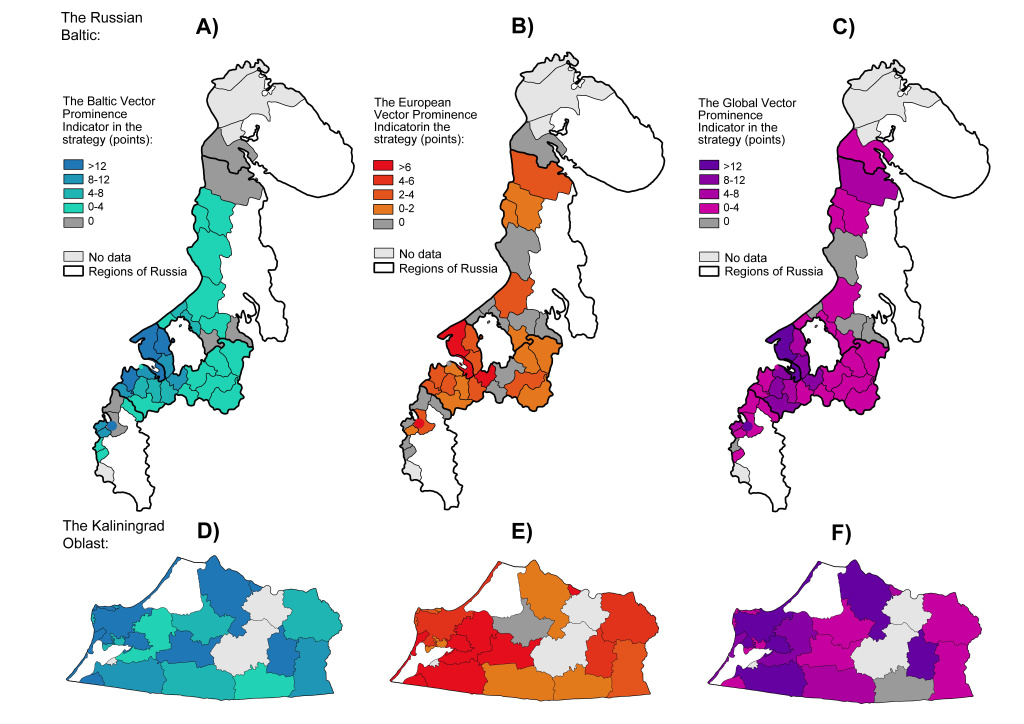
Note: The map scheme shows only the municipalities and regions included in the study. For the map pairs a—d, b—e, c—f, the same symbols are used.
The cumulative VPI values turned out to be extremely differentiated, ranging from 0 points for the Prionezhsky municipal district to 983 points for Pskov. At the same time, 26 municipal strategies (46 % of all those studied) have a cumulative VPI for the three vectors below 10.
A similar differentiation is observed for each vector. The Baltic vector VPI values range from 0 to 696, the European vector — from 0 to 234, and the global vector — from 0 to 20.
Zero VPI values deserve special attention. The global vector did not manifest in the strategies of 6 MPs, 4 of them in the Republic of Karelia, 1 each in the Pskov and Kaliningrad regions. For the Baltic vector, 6 strategies also showed zero VPI — all municipalities with such strategies belong to the outer circle of the Russian Baltic. The European vector did not manifest in the strategies of 16 municipalities: in the Pskov region, five out of eight strategies studied, and in Karelia — six out of eleven. One strategy, that of the Prionezhsky district in the Republic of Karelia, received zero points for the cumulative VPI.
To some extent, this situation has objective prerequisites — many districts in Karelia and the Pskov region are peripheral and poorly connected to the outside world. It is also possible that the subjective factor of insufficient developer qualification played a role — the budgets of Pskov districts likely do not allow for hiring professional consultants. Detailed study of this phenomenon could be the subject of separate research.
Geographical patterns are fully revealed only for the Baltic vector: VPI values decrease in the direction of the north, east, and south relative to the coast of the Gulf of Finland (Fig., a). Among the leaders are the Vyborg district, Saint Petersburg, and the Kingisepp district. The VPI values of municipalities in the Leningrad region are generally higher than in the Pskov region, the Republic of Karelia, and the Murmansk region.
However, there are exceptions. The strategy of Pskov ranks second in the entire sample in terms of the Baltic vector VPI. In the Pskov region, the VPI values for the Pechorsky and Palkinsky districts are higher than for the more northerly located Gdovsky, Pskovsky, and Plyussky districts.
The municipalities of the Kaliningrad region generally demonstrated a high level of the Baltic vector presence in their strategies. The leaders are Kaliningrad and the Zelenogradsky urban district.
For the European and global vectors, similar geographical patterns are less pronounced: VPI values do not consistently decrease with increasing distance from the Baltic Sea coast. For example, in the Leningrad region, the Kirovsky district is one of the leaders in the European vector VPI, while in the Republic of Karelia, the most northern Loisky district and the Suoyarvsky district stand out (Fig., b). In the latter case, the result can be explained by the border factor or the “neighbour effect,” but in the case of the Leningrad region, these factors do not provide a sufficient explanation.
In the Kaliningrad region, the distribution of VPI values for the European and global vectors is again uneven, with no apparent patterns like “west-east,” “north-south,” or “centre-periphery” (Fig., d, e). The absence of such clear geographical patterns can be explained by a complex of non-spatial factors, such as the specifics of the consultants involved in development and the political culture of local communities.
Only the expected differentiation between the inner and outer circles of Baltic objects is clearly expressed: the Baltic and European vectors in the inner circle’s strategies are 2.7 times stronger than in the outer circle’s strategies (Table 4). It is also logical that the differentiation in the global vector presence is somewhat lower (1.9 times).
Circles of Baltic Objects | Number of Strategies (units) | Average VPI Value (points) | |||
Baltic vector | European vector | Global vector | Total VPI | ||
Inner Circle | 24 | 14.79 | 4.78 | 6.56 | 26.13 |
Outer Circle | 33 | 5.48 | 1.73 | 3.52 | 10.73 |
Difference between average VPI values (times) | 2.70 | 2.76 | 1.86 | 2.43 | |
Let us take a look at the municipal strategies with the highest VPI values (Table 5). The maximum VPI values were obtained for the Baltic vector, which is explained, on the one hand, by the research methodology (more marker words were considered for the Baltic vector), and on the other hand, by the objective significance of the theme for the studied municipalities and regions. Thus, the weight of VPI values for the Baltic vector dominates in the cumulative assessment; however, the ranking results by the Baltic vector VPI and the cumulative VPI differ.
Baltic vector | European vector | Global vector | Total | ||||||||
Municipality | VPI | Relative VPI | Municipality | VPI | Relative VPI | Municipality | VPI | Relative VPI | Municipality | VPI | Relative VPI |
Pskov | 69.6 | 0.83 | Kaliningrad | 23.4 | 1.35 | Bagrationovsk | 20.0 | 0.91 | Pskov | 98.3 | 1.17 |
Vyborgsky District | 54.6 | 0.98 | Pskov | 15.8 | 0.19 | Kaliningrad | 17.8 | 1.03 | Vyborgsky District | 77.4 | 1.39 |
Kaliningrad | 35.9 | 2.08 | Bagrationovsk | 9.9 | 0.45 | Slavsk | 14.8 | 0.86 | Kaliningrad | 77.0 | 4.46 |
Zelenogradsk | 31.5 | 1.97 | Baltyisk | 9.8 | 0.25 | Vyborgsky District | 13.5 | 0.24 | Zelenogradsk | 50.4 | 3.15 |
Kingisepp | 29.5 | 1.43 | Kirovsk | 9.5 | 0.17 | Zelenogradsk | 13.3 | 0.83 | Baltyisk | 46.0 | 1.19 |
Baltyisk | 27.9 | 0.72 | Vyborgsky District | 9.3 | 0.17 | Pskov | 12.9 | 0.15 | Bagrationovsk | 39.1 | 1.79 |
Gusev | 21.0 | 0.93 | Gvardeysk | 7.0 | 0.40 | Gusev | 12.5 | 0.55 | Gusev | 37.8 | 1.67 |
Priozersky District | 18.4 | 0.33 | Mamonovo | 6.9 | 0.29 | Kirovsky District | 12.0 | 0.21 | Kingisepp | 35.5 | 1.72 |
Svetlogorsk | 16.9 | 0.51 | Sovetsk | 6.1 | 0.29 | Luga District | 10.9 | 0.23 | Kirovsky District | 32.5 | 0.58 |
Sovetsk | 16.8 | 0.79 | Gurievsk | 6.1 | 0.37 | Vsevolzhsky District | 10.0 | 0.17 | Slavsk | 29.4 | 1.71 |
For municipal strategies (unlike regional ones), the transition from analyzing absolute VPI to relative VPI makes noticeable adjustments to the results. The Kaliningrad strategy, which holds the third position in cumulative absolute VPI, ranks first in relative VPI, with a significant margin from other strategies. The Pskov strategy, which ranked first in absolute VPI for the Baltic vector, drops to eighth place. The Krasnoznamensk municipal strategy, which does not rank in the top ten in absolute VPI for the European vector, ranks third in relative VPI. However, the overall ranking results are similar: the lists of the top ten leaders in absolute and relative VPI for the Baltic and European vectors match by 70 %, for the global vector — by 50 %, and cumulatively — by 80 %.
If the presence of Kaliningrad and the Vyborgsky district in the top three leaders is not surprising, the high position of Pskov is at first glance unexpected. Let us take a closer look at the strategies of these municipalities.
Pskov’s Baltic orientation is natural. It is determined by its location and is clearly reflected on the city’s website: the historical note states that “the development of the region was facilitated by the connection of the river system of Lake Peipus with the Varangian (Baltic) Sea.”6 The Pskov strategy is one of the most recent and extensive. The document, titled “Pskov City Development Strategy until 2030,” was approved by the Pskov City Duma on December 25, 2020, and contains 83,653 words (about 300 pages).7 In the document’s structure, the analysis section is disproportionately highlighted, occupying two-thirds of the total volume — 200 pages. The high VPI values (9.83) were influenced by the frequent use of words such as “foreign” (21), “Europe / European” (19), “cross-border” (18), “Hanseatic / Hanseatic” (13), “Estonia” (10), “Latvia” (8), “EU” (8). A total of 122 mentions, and if it weren’t for the lowering coefficient for words appearing in the analysis section, Pskov’s strategy would have been even more dominant.
A significant portion of the marker words appear in the context of tourism development, which is given considerable attention in Pskov. Traditionally, Pskov participated in international cooperation programmes, and in 2018, the Committee for the Implementation of Cross-Border Cooperation Programmes and Tourism was established, with a dedicated department for cross-border cooperation programme implementation. In 2020, at least ten projects were operating under six bilateral and multilateral cross-border and transboundary cooperation programmes. In the strategy’s target sections, there are significantly fewer marker words, mostly concentrated in a special section dedicated to developing and strengthening cross-border and transboundary cooperation. Thus, the high VPI values of the Pskov strategy are due both to the objective factors of its border location and the use of this for cooperation programme implementation, as well as the increased volume of the strategy text.
Historically and geographically, the Vyborgsky district of the Leningrad region, once part of Finland and having a long maritime border, is most predisposed to the manifestation of the Baltic vector in development. This is reflected in its strategy. The studied document, “The Strategy for Socio-Economic Development of the Vyborgsky District of the Leningrad Region until 2025,” is stored on the district’s website as a draft prepared by the company Enko.8 It can be assumed that it was adopted in this form in December 2015. In the text, 111 marker words were found (cumulative VPI — 768). The most frequently mentioned words are “Finland” (25), “Gulf of Finland” (19), “foreign/overseas” (16), “EU” (13), “Helsinki” (9).
The strategy text occupies nearly 200 pages (55,496 words), with part of the text (30 pages) formatted as annexes. The document was prepared by professional geographers and planners. Accordingly, there is a thorough section describing and analyzing the current situation and an adequate assessment of geographical position features. The border location with the EU, the presence of a maritime outlet and three ports, and the importance of the Saimaa Canal are noted. Among the important development factors is the favourable transport-geographical location, which led to the passage of international transport corridors through the district (“Pan-European Transport Corridor № 9,” “Eurasian International Transport Corridor ‘North-South,’ “Eurasian International Transport Corridor ‘Trans-Siberian’“). Strengthening the transport and logistics function is recognized as an important development direction.
These same topics are preserved in the “Strategy for the Socio-Economic Development of the Vyborgsky District of the Leningrad Region until 2035,” adopted on May 21, 2024.9 This strategy conceptually maintains continuity with the 2015 strategy but has become four times shorter (56 pages). The Baltic orientation is already evident in the first section, where the presence of international checkpoints is noted. It mentions the port complex in Primorsk, which became the largest specialized port for oil and oil product exports in Russia, and the LNG terminals in Vysotsk and Portovaya Bay. The Vysotsk port is nearing the completion of a terminal for grain cargo transshipment, with recipients potentially being countries in Northwest and Western Africa. The paragraph from the previous strategy listing international transport corridors is repeated almost verbatim.
The reduction in text volume and the radical change in the geopolitical situation have led to marker words appearing much less frequently and in a different context. Derivatives of the word “Europe” appear only three times, characterizing Vyborg as a monument of medieval European architecture and in the name of the “Window to Europe” film festival. Similarly, derivatives of the word “Finland” are mentioned only three times, two of which refer to railway checkpoints — the Finland Station and the St. Petersburg-Finland station. The Gulf of Finland is mentioned three times. “Baltic Sea” is mentioned twice, with a total of ten derivatives from the word “Baltic.” The “EU” is mentioned once in the context of assessing the weaknesses of the geographical location — “The cessation of cross-border cooperation with EU countries.” The border status remains in the description of one of the three key strategic directions: “The Vyborgsky District of the Leningrad Region is a strategic border territory with a developed transport and logistics complex and a competitive economy based on the use of advanced technologies in industry and agriculture.” Curiously, in the 2015 strategy, this phrase did not include the second part about a competitive economy.
A substantive study of both Vyborgsky district strategies allows us to assert that the Baltic vector is adequately reflected in them, which would be insufficiently manifested in a formal marker word count in the 2024 strategy.
Kaliningrad was one of the first in Russia to embrace strategic planning — the first strategy appeared almost immediately after the Strategic Plan of St. Petersburg (1997) and was very similar to it. The current “Strategy for Socio-Economic Development of the Urban District ‘City of Kaliningrad’ until 2035” was adopted in 2013, with changes made annually to certain sections from 2016 to 2020, and in October 2023, the text was completely replaced.10
Quantitative analysis was conducted for the initial 2013 edition. The strategy is relatively short — 17,261 words, 81 pages. Nevertheless, in terms of the absolute number of marker words (123), this text surpasses significantly more extensive strategies like Pskov (122) and Vyborg district (111). However, considering the weighting used in the calculation formula for absolute VPI, Kaliningrad’s strategy ranks third in cumulative VPI, being first in the European vector VPI, second in the global vector VPI, and third in the Baltic vector VPI. The transition to relative VPI places Kaliningrad’s strategy first in all parameters (see Table 5). The most frequently encountered words are “Europe/European” (35), “Baltic” (18), “foreign/overseas” (15), “Germany” (10), “Poland” (8), “Baltic macroregion” (7), “EU” (7), “WTO” (5).
One of the city’s development scenarios is titled “Communicative (Risky).” It is based on the idea of turning Kaliningrad into an international trade fair and exhibition centre for the Baltic macroregion, a centre of cultural and business communication between Russia and Europe. Elements of this scenario are reflected in the city’s mission: “Kaliningrad — a city for comfortable living and working, a platform for communication and interaction between Russia and European countries in the fields of business, innovative economy, education, and culture.”
After the update in late 2023, Kaliningrad’s strategy became almost three times shorter, fitting into 32 pages (of which 8 pages are an annex with descriptions of individual territory transformation projects). The number of themes related to external functions has sharply decreased, with more attention given to internal aspects — the concept of a compact city, spatial development, a comfortable environment, creative industries, healthcare, transitioning to a knowledge economy, tourism, etc. The connection to the Baltic region is only visible in a few phrases — it is mentioned that a strong side of the city is its ice-free port in the Baltic with developed port infrastructure. The updated city mission no longer mentions communications between Russia and Europe, but it does include a reference to the Baltic: “Kaliningrad — a city with 15-minute accessibility, an innovation-educational creative tourist centre on the Baltic.” Marker words have practically disappeared.
The examined metamorphosis of Kaliningrad’s strategy vividly illustrates how the significance and direction of a particular vector change following shifts in the global context.
Conclusion
Reflecting on the results of the study leads to several conclusions that can be grouped into several directions.
1. Studying strategies
Ideally, a strategy accumulates the ideas prevailing in a given territory within the “authority — business — society” triangle and influences actual socio-economic development. Therefore, it is not accidental that the study of strategies has become a special scientific direction, allowing, in particular, judgments about the target orientations of certain territorial communities. However, in reality, a strategy may turn out to be created “for the sake of form,” without the interested participation of the community, and in this case, it will only reflect stamp-like non-specific provisions introduced by an uninterested consultant or copied from the Internet by a local specialist. Moreover, development does not always follow the strategy. These circumstances should always be kept in mind.
If we assume that the strategy was ideally developed, then the absence of signs of the Baltic vector in it corresponds to the objective situation. But this fact may also be caused by the low qualification and insufficient diligence of the developer.
2. The influence of strategies on development
Referring to the overarching task stated at the beginning of the article — to contribute to the problem of identifying the influence of municipal and regional planning on territorial development — we can assert that a small step in this direction has been made. We have identified those municipalities in the Russian Baltic where strategies are significantly oriented towards the Baltic vector. But this is only the first step. To find out to what extent the objectively observed Baltic vector is man-made and which level of authority had more weight in forming this vector, a historical-economic analysis of each case is necessary. When selecting cases, one can orient oneself to municipalities with a higher presence of the Baltic vector. The history of individual cities and regions is well known. For example, Saint Petersburg has always positioned itself as a window to Europe, and the activities of its first mayor, Anatoly Sobchak, were undoubtedly an important factor in strengthening the Baltic and European vectors, which were recorded in the first Strategic Plan of Saint Petersburg in 1997. Similarly, the significant contribution of the first head of the Kaliningrad region administration, Yuri Matochkin, is clear. He achieved the status of a special economic zone for the region, relying on local expert potential. The significant role of the regional and city authorities of Pskov in initiating Baltic cooperation projects is also evident. We can assert that at least there are regions and MPs where strategies supported the objective opportunities for development in the direction of the Baltic vector.
3. The Russian Baltic
Studying the Russian Baltic through the strategies of its constituent regions and MPs provides new knowledge about the state of the territorial management system. The obvious fact of the heterogeneity of such a large macro-region as the Russian Baltic has manifested itself in the degree of attention given by the authorities in strategies to the opportunities and limitations caused by inclusion in this macro-region. And this is not always related to geographical proximity to the sea or external borders. The presence of transport connectivity and the subjective factor — the presence in the administration team of specialists oriented towards international cooperation and ready for it — also plays a role.
It turned out that if one considers the Russian Baltic as a set of MPs and looks at the “gravitational force” towards the Baltic Sea and Baltic opportunities manifested in the strategies, gaps and mosaicism will be revealed: MPs where the Baltic vector is absent or very weakly expressed. This allows the map scheme presented in the article to be used as a basis for further reflections on the composition of the Russian Baltic.
4. Practical significance
In light of the beginning of a new stage of strategic planning in 2024, associated with the establishment of updated national development goals, as well as changes in the situation in the Baltic Sea basin, a comparative assessment of existing strategies may be very useful. Identified examples of best practices in reflecting the Baltic vector of development in strategies can be used by strategy developers. Regional authorities may pay increased attention to the development of strategies for MPs where the Baltic vector is insufficiently taken into account and provide them with assistance.
5. Strategies to study
Strategic planning at the municipal level in Russia has been around for more than 25 years. In many MPs, several strategies have already been adopted, each of which has been corrected. This opens up opportunities for studying strategies in dynamics, allowing tracking changes in goals and development priorities of an individual MP or a group of MPs. For example, including new versions of strategies for Kaliningrad and the Vyborg district in the research orbit made it possible to see how the scale and modality of the vectors under consideration change under the influence of a radical change in the geopolitical situation. However, realizing these opportunities is not easy — if past strategy versions can be found in GASI, then it can be impossible to find previous versions of strategies not accounted for in GASI. When specifying the conditions for each new study over a certain period, it is necessary to clearly fix the task of the search — whether we will take corrections into account, study the initial or final versions, or both. In our study, we were unable to compare VPIs of several versions for one region or MP, although this thought did arise.
Another nuance is the appearance in the planning document system of master plans for cities and agglomerations, which in significant part overlap with strategies in content. Whether to include them in the analysis and how to use content analysis considering the large amount of non-textual information (illustrations, map schemes) in master plans are questions to consider. For example, in our study, the oldest strategy is that of the Bagrationovsky district. At the same time, a master plan for Bagrationovsk was recently created, which was not included in the list of studied documents.
6. Studying strategies: content analysis
In our view, content analysis of strategy texts yields useful results not on its own but in combination with other methods. Most often, content analysis can serve as a preliminary stage, allowing the identification of cases deserving attention, which are then subjected to expert review. For example, the study of VPI differentiation revealed both expected patterns (the predominance of VPI in the inner circle of Russian Baltic objects over VPI in the outer circle) and some anomalies (the disproportionately large gap in the VPI of the Kaliningrad region’s strategy from all others and the strong lag in the VPI of the Leningrad region). These anomalies were studied and explained by differences in the volume and style of strategy texts.
Content analysis should not be an end in itself but should be embedded in the context of a specific research task. The modification we used involves forming a list of marker words relevant to the research question and analyzing the frequency of these words. This approach is more productive than, for example, that applied in [10], where a “word cloud” is created and patterns are searched for within it.
During the study, a valuable methodological result was obtained — additions to the author’s method were tested, allowing intuitive differences in word significance to be taken into account in the context of the research task. A scheme was proposed to objectively divide the set of marker words by significance based on their actual occurrence in the studied text corpus. Additionally, significance was differentiated depending on the section of the strategy in which the word is found. This is already an element of combining content analysis with expert analysis. In the future, it will be useful to work out an algorithm for transitioning from content analysis to expert structural content analysis or incorporating content analysis into expert analysis.
An important aspect was the use of relative word occurrence values (calculated per word count in the text). It turned out that in this case, there is no significant correlation between the strategy volume and VPI values. Small strategies with high VPI values are encountered, as are large strategies with low VPI values. Comparing the results of strategy rankings by absolute and relative VPI values did not show significant differences. In the future, we plan to use relative values.
7. Deepening the research
The subject of continuing this research could be a comparison of the objective expression of the Baltic vector and the presence of this vector in the strategy. To do this, it will be necessary to find a way to assess the objective expression of the vector in the economy (through the analysis of transport links, commodity flows, and tourist visits), in the public sector (using similar management methods with Baltic countries, the presence of cooperation projects), in urban environments and behavioural stereotypes of residents (toponymy, types of public catering establishments, public spaces, etc.).
The study was carried out in accordance with the state assignment of the Institute of Economic Forecasting of the Russian Academy of Sciences under the theme “Development of Theoretical and Methodological Foundations of Scientific and Technological Development of the Economy Based on Innovation Dynamics and the Formation of Mechanisms for Its Implementation in the Regions” (code FMGS-2024-0001).
Reference