Development stages of ethnic contact zones in Estonia, Latvia and Lithuania since the end of the 19th century


Abstract
The analysis of changes in the ethnic structure of the population is one of the most central topics in the study of the development of Estonia, Latvia and Lithuania. This work aims to identify stages in the evolution of ethno-contact zones in the Baltic States, using ethnic statistics from the end of the 19th century to the present. This study employs, for the first time, a methodology for identifying stages of ethnic contact zone development. This methodology simultaneously considers the direction of change in the ethnic mosaic index used to determine the phases of growth and dissolution of ethnic contact zones and the positive or negative dynamics of the proportion of titular ethnic groups. The ethnic mosaic index helped identify five prominent ethnic contact zones: the capitals of the Baltic countries, Ida-Viru County in Estonia and the Latgale region in Latvia. Over the past century and a half, these ethnic contact zones have exhibited three different types of dynamics. The first is characteristic of Tallinn, Riga and the Latgale region, where phases of ethnic contact zone growth and dissolution alternate as the proportion of titular ethnic groups changes in response to the vicissitudes of history. The second is peculiar to the Estonian county of Ida-Virumaa, which has experienced phases of ethnic contact zone development and an increase in the non-titular population. The third, exemplified by Vilnius, combines phases of ethnic contact zone growth and dissolution with a rise in the proportion of the titular ethnic group. The proposed methodology can be extended to the analysis of ethnic contact zone development in other territories as well.
Introduction
Changes in the national composition of the population are among the most pressing topics in the study of the modern development of the Baltic countries (Estonia, Latvia, and Lithuania). At the same time, there is interest in studying ethno-demographic processes on their territory over a long time interval. The most significant factor leading to changes in the ethnic structure of the populations of Estonia, Latvia, and Lithuania in the 20th-early 21st centuries was migration. The direction of migration processes has been determined by the political status of the republics. The periods of first and second independence (1920—1940 and since 1991 onwards) were characterized by an increase in the proportion of the titular population of the republics and the Soviet period — by an increase in the share of the non-titular population.
At the same time, the development of ethno-demographic processes exhibited significant territorial differences. On one hand, parts of the republics’ territories remained mono-ethnic and were unaffected by migration. On the other hand, zones of intense contact between indigenous and immigrant populations were formed. The formation and development of these ethno-contact zones span a considerable period, often longer than a century. However, statistical analysis of the development of ethnic contact zones has a more limited time interval, since it can only be based on the results of population counts and censuses. This study presents the experience of conducting such an analysis, for which the authors, based on ethnic statistics from 1881 to the present, have developed a methodology for identifying the stages of the development of ethnic contact zones located on the modern territory of Estonia, Latvia, and Lithuania.
It should be noted that the concept of the ‘ethnic contact zone’ in the study is based on the geospatial approach developed in Russian cultural geography. Ethnic contact zones are considered elements of the territorial structure of the ethnic layer of geocultural space (ethnic space). These zones result from the overlap of two or more ethnic territorial systems. Following this approach, it is possible to identify ethnic contact zones of different hierarchical levels — from civilizational (macro level) to local (micro level).
This article focuses on ethnic contact zones at the regional scale (meso level). The aim is to identify the stages of development of the most pronounced ethnic contact zones in Estonia, Latvia, and Lithuania, using ethnic statistics from the late 19th century to the present.
Degree of knowledge of the problem
The traditional method for studying the development of the national composition of the Baltic population in the 19th century, along with the ethnic structure dynamics of Estonia, Latvia, and Lithuania in the 20th century, involves analyzing fluctuations in the size and proportion of major ethnic groups across census years and population records. Notably, comprehensive ethno-demographic analyses based on this approach were conducted by Kazmina [1], [2] and Kabuzan [3]. Since the 1960s, Russian science has increasingly developed indicators to assess the diversity of ethnic structures within populations. Presently, the ethnic mosaic index proposed by Eckel in 1976 [4] is commonly used for this purpose. It is worth noting that the term ‘ethnic mosaic index’ was previously introduced by Pokshishevsky in 1969 [5]. Initially, various formulas were suggested for calculating the ethnic mosaic of cities and regions, but it was the index introduced by Eckel that made it possible to compare the national composition mosaic of populations across comparable territories [6].
The ethnic mosaic index (EMI) is calculated using the formula
EMI = 1 - Σ ni=1 (ni)2 ,
where N is the number of nationalities represented in the region and ni is the share of the i-th nationality in the population of a region.
It should be noted that this indicator was first proposed 20 years before Ekkel by Greenberg [7] for studying the linguistic diversity of populations and it was named the ‘index of ethnolinguistic fractionalization’. Subsequently, Greenberg had many followers, and this indicator became widely known in international science as the ‘ethnic fractionalization index’ ([8], [9], [10], [11], etc.). This index is most commonly used to explore the relationship between the ethnic diversity of countries and regions and their economic development ([12], [13], [14], etc.). Russian economists have also embraced this research topic and use the same terminology for the index as proposed in international science ([15], [16], [17], etc.).
This index is now frequently employed in ethnic geography and ethno-demography to analyse the dynamics and complexity of the ethnic structure within populations of countries and regions. A graphical method of displaying changes in an indicator is often used for this. For example, Drazhanova [18] presents the results of calculating the index for 162 countries for a period spanning 1945—2013. Nemeth [19], [20] calculated the value of the index for Latvia from 1897 to 2011. Among domestic studies, one can note, for example, the EMI calculation of Dorofeeva and Savoskul [6] for several regions of Russia based on the results of population censuses between 1959 and 2002. The authors of this article also have experience in calculating EMI for long-time intervals (since the 1897 census) for regions of Central Asia [21] and Crimea [22].
Attempts have also been made to display the dynamics of the index by region of the country using the cartographic research method, for example in the works [20], [23], [24]. The disadvantage of this technique is associated with the need for developing cartographic material for each time interval. Yet there is also an advantage associated with the ability to identify spatial patterns and features of changes in EMI on the territory of the country.
Materials and methods
The information base for the study is data from censuses and population records in the territories of Estonia, Latvia and Lithuania, posted on the website Population Statistics of Eastern Europe and former USSR.1
Based on these statistical data, the Ethnic Mosaic Index (EMI) was calculated for all counties of Estonia, Lithuania, and statistical regions in Latvia for 2021. Additionally, the EMI was computed for five selected regions that represent ethnic contact zones which have existed for over a century: the three capitals of the Baltic states, as well as Latgale in Latvia and Ida-Virumaa in Estonia. These calculations were based on census and population records spanning from 1881 to 2022.
Gorokhov [25] draws attention to two shortcomings of the EMI: 1) the vagueness of the range of values accepted by the indicator; 2) the implicit dependence of the indicator values on the number of nationalities registered in the region. The set of EMI values belongs to the interval from 0 to 1 – 1/N, where N is the number of nationalities registered in the region. Gorokhov proposes to normalize the EMI by the number of nationalities and thereby bring the set of indicator values to the range from 0 to 1. The author proposed to call such an indicator the ‘modified mosaic index’ (MMI).
It is calculated as follows: MMI=EMI/(1 – 1 / N).
Due to its unique range of accepted values, the Modified Mosaic Index (MMI) is convenient for comparative analysis. However, its practical application presents challenges that are less common when assessing religious mosaics, where Gorokhov originally proposed the use of MMI. To begin with, it should be noted that in states and their larger regions, representatives of up to a hundred or more nationalities are usually included, resulting in minimal differences between the Ethnic Mosaic Index (EMI) and the Modified Mosaic Index (MMI). At the microregional level, there are challenges due to limited ethnic statistics and the arbitrary selection of nationalities. The limited number of nationalities taken into account has a minor impact on the EMI calculation since larger ethnic groups are always prioritized. However, their number significantly affects the value of the MMI, resulting in ‘jumps’ when comparing MMI across different years solely due to the number of ethnic groups considered. Therefore, due to the specifics of ethnic statistics at the microregional level, our study uses the EMI instead of the MMI.
Garipov [26] notes that a significant drawback of B. M. Ekkel’s methodology is that it does not consider the ratio of indigenous to non-indigenous populations within national autonomies. For instance, the IEM (Index of Ethnic Maturity) can have equal values in national regions where the titular population clearly prevails or where the non-titular population numerically predominates. Taking this remark into account, we have proposed a methodology based on the simultaneous analysis of the positive or negative dynamics of the IEM and the proportion of titular ethnic groups in the territories.
The map, which presents the EMI value for the regions of Estonia, Latvia, and Lithuania for 2021, uses the EMI scale, which is most often employed in ethno-geographical studies. The primary thresholds for this gradation are EMI values 0.2 and 0.4. This EMI scale was used, for example, in works [27], [28], [29], [30] and others. Formally, territories where the EMI is less than 0.2 can be classified as monoethnic, and those over 0.2 as ethnic contact zones (ECZs). However, due to the considerable number of counties in Estonia and Lithuania with an EMI value of less than 0.2, we proposed introducing an intermediate limit at EMI=0.1. This allows us to distinguish between truly monoethnic territories and counties with a slightly more complex ethnic structure (weakly pronounced ethnic contact zone).
In our study of the dynamics of the Ethnic Mosaic Index (EMI) in long-standing two-component ethnic contact zones (ECZ), we observed a cyclical pattern in their development. This pattern enabled us to identify two primary phases in ECZ evolution, driven by changes in both EMI and the proportions of titular and non-titular populations in national territories. These phases are the growth phase (marked by an increase in EMI) and the dissolution phase (marked by a decrease in EMI). Since ECZ growth can result from increases in either titular or non-titular populations, we proposed distinguishing between ‘waves’ of titularization (growth in the share of titular ethnic groups) and detitularization (growth in the share of non-titular populations). This identification of phases and ‘waves’ in ECZ development enabled us to pinpoint the main stages of development for the five ethnic contact zones previously outlined, using a graph of EMI dynamics. As an additional characteristic, the graphs show changes in the proportion of titular peoples to facilitate the task of distinguishing between the waves of titularization and detitularization (before the establishment of republics — waves of indigenization and deindigenization).
Research results and discussion
Figure 1 shows the EMI value for the regions of Estonia, Latvia, and Lithuania according to the results of the 2021 population census. The most ethnically diverse regions in Estonia are Ida-Viru County and the capital of the country Tallinn (EMI over 0.4), in Latvia — the Latgale region (Russian name — Latgalia) and the capital of the country Riga (in these two cases EMI exceeds 0.6), in Lithuania — Vilnius and the capital district (EMI over 0.4). These territories represent the most pronounced ethnic contact zones in the three Baltic states, each with a long history of development. Consequently, they were selected for the analysis of the Ethnic Mosaic Index (EMI) dynamics, specifically to highlight the stages of EMI development over a period exceeding a century. Only the capital county of Lithuania was excluded from this analysis due to the instability of the administrative boundaries of this region. Therefore, only the city of Vilnius was selected from Lithuania for the study.
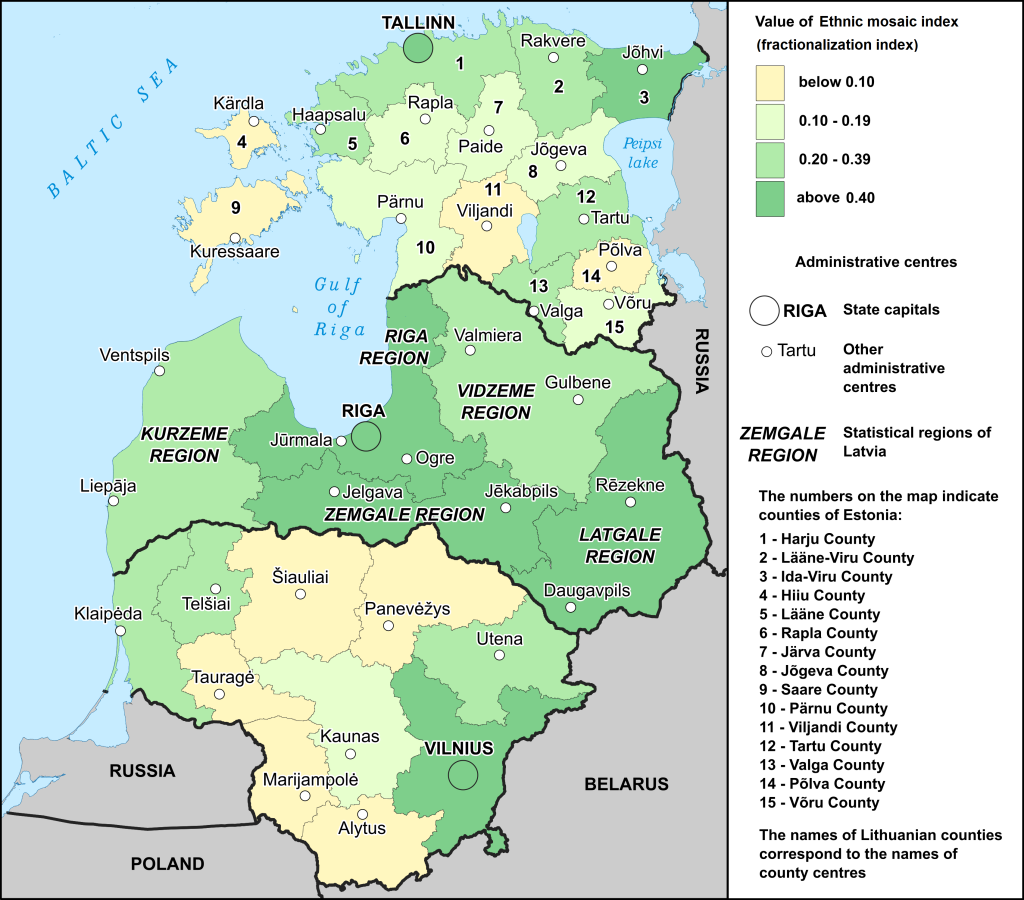
Figure 2 shows the dynamics of the EMI from 1881 to 2022 for the five identified ethnic contact zones, broken down by the stage of development of the ECZ and with an additional characteristic — a change in the share of titular ethnic groups. The most obvious waves of development of ECZ are observed in two ethnic contact zones of Estonia — Tallinn and Ida-Viru County.
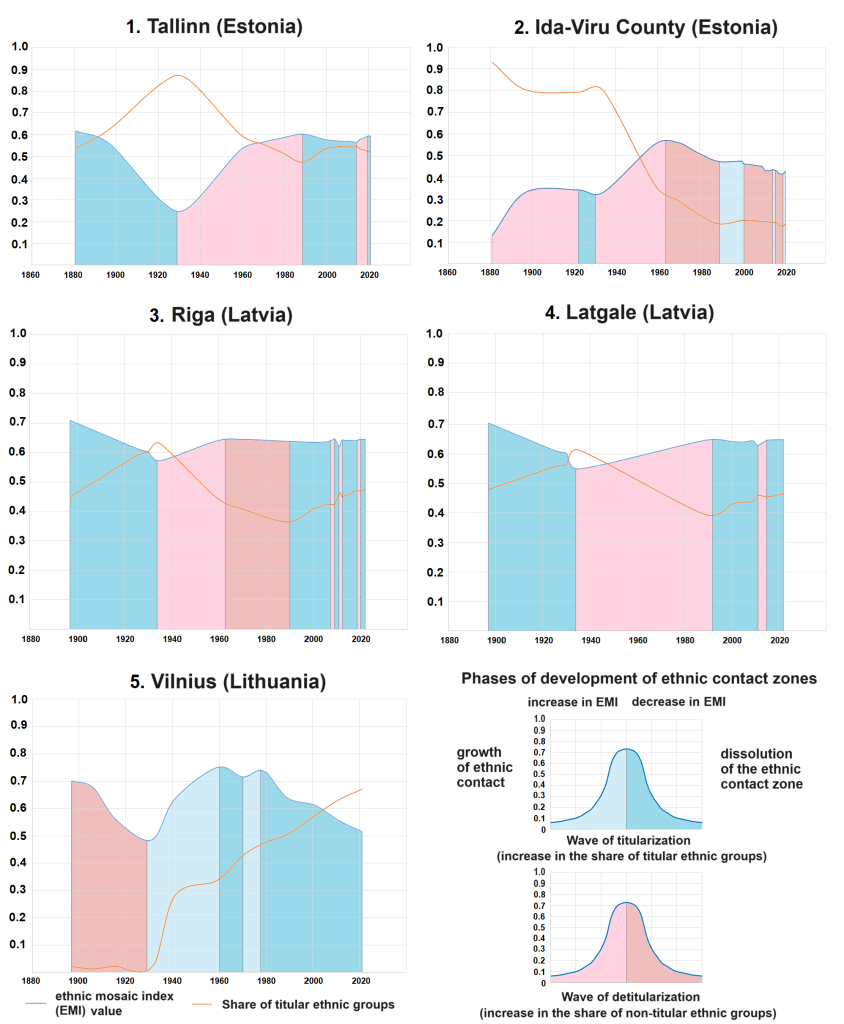
In Tallinn, up until Estonia’s inclusion in the USSR, the share of the titular ethnic group increased, leading to a decrease in the EMI. This period of Tallinn’s ethnic history can be characterized as a phase of dissolution of ethnic contact zones during a wave of titularization of the population. Subsequently, up until Estonia regained independence, there was a decrease in the proportion of the Estonian population in Tallinn, leading to an increase in the EMI. This period can be seen as a phase of growth of ethnic contact zones during a wave of detitularization of the population. In the post-Soviet period, the capital’s ethnic contact zones once again entered a phase of dissolution during a wave of titularization. However, this phase was interrupted for a short period (from 2014 to 2020), when the share of Estonians in the capital temporarily decreased. This corresponds to the growth phase of the ECZ during a wave of detitularization of the population. After 2020, Tallinn returned to its usual post-Soviet dynamics of ethnic mosaic.
Ida-Viru County is currently the most Russian-speaking county in Estonia. According to the 2021 population census, Russians accounted for 73.2 % of the population, while Estonians were only 18.4 %. However, in the pre-war period, the proportion of Estonians here exceeded half of the population, albeit with slight growth occurring only during Estonia’s first independence period. As a result, until the 1960s, there was predominantly growth of ethnic contact zones during waves of detitularization of the population, with a brief interruption in the 1920s—1930s when a temporary dissolution of ethnic contact zones occurred during a wave of titularization. But since the 1960s, the dissolution of ethnic contact zones has resumed during waves of detitularization. Despite efforts to increase the share of the titular ethnic group in the 1990s and certain years of the 21st century, the dynamics of ethnic contact zones largely persisted in the post-Soviet period, maintaining a trend of titularization-driven growth.
Two ethnic contact zones selected for analysis in Latvia, Riga and Latgale, despite their distinct geographical locations and diverse ethnic compositions, exhibit remarkably similar dynamics. This parallelism is attributed to Riga and Latgale following common trends in Latvia’s ethnic mosaic changes, albeit in a moderated manner without abrupt shifts, as noted in Nemeth’s research [20]. Prior to Latvia’s integration into the Soviet Union, both zones experienced dissolution phases during waves of population titularization. Subsequently, there was a period of growth in these zones during waves of detitularization. They approached the dissolution stage during this phase, but after the demise of the USSR, a wave of titularization reemerged. Currently, the dissolution of these zones is progressing, albeit hesitantly, with brief periods of detitularization observed in the early 21st century. This developmental characteristic during this period can be described as ‘phase instability’.
A different dynamic of EMI and the share of the titular population characterizes the capital of Lithuania. In Vilnius, until it received the status of the capital of Lithuania in 1939, the proportion of Lithuanians was extremely low. In the 1920—1930s, the titular population of Vilnius was Poles, and the dissolution of the ECZ during this period was in their favour. It should be noted that some inconsistency between the key dates of political history and the stages of development of the ECZ on the graph is due to the lack of data on the ethnic composition of the population at these moments and with the forced binding of the EMI to the years of population censuses. But it is obvious that already in the pre-war period in Vilnius, a rapid increase in the proportion of Lithuanians began, and the ECZ entered a growth phase on the wave of titularization, and in the second half of the 20th century it began to dissolve on the same wave.
Thus, based on the analysis of the five examined ECZs, three main types of ECZ dynamics can be distinguished. The first type is typical of the capitals of Estonia and Latvia, as well as the Latvian region of Latgale. In this type, periods of growth and dissolution of the ECZ alternate on the ‘waves’ of titularization and detitularization of the population, depending on the political history of Estonia and Latvia. The second type of ECZ dynamics is exemplified by Estonia’s Ida-Viru County, which experienced both phases of ECZ development during the ‘wave’ of detitularization of the population. The short-term ‘waves’ of titularization during periods of Estonian independence did not bring about significant changes. The third type, which includes both phases of ECZ development during waves of titularization of the population, is demonstrated by the capital of Lithuania.
The presented methodology also contains unsolved problems that arose due to the complex nature of the development of multicomponent ECZ. The technique was originally developed for two-component ethnic systems, where the dynamics of the EMI is directly related to changes in the ratio of the relative weight of two ethnic groups. In multicomponent ECZ, a change in the proportion of one of the ethnic groups, even if it is the most numerous, is not the only factor in the dynamics of the EMI, since it is also influenced by a change in the ratio of other ethnic groups. Therefore, the maximum and minimum values of the EMI are not always associated with critical moments in the dynamics of the share of the titular ethnic group (the beginning of an increase or decrease in the share, crossing the line of 50 % of the total population). This scientific problem remains to be solved in subsequent studies. In general, the combination of the proposed methodology of the dynamics of EMI and changes in the proportion of titular peoples provides a new look at ethnic processes in multinational territories, namely, through the prism of the staged development of ethnic contact zones.
Conclusions
During the study using the Ethnic Mosaic Index, five of the most pronounced ethnic contact zones in Estonia, Latvia, and Lithuania were identified, including all Baltic capital cities, as well as Ida-Viru County in Estonia and the Latgale region in Latvia. The prolonged existence of these ethnic contact zones allowed for the identification of development stages spanning over a century. The methodology for identifying these stages of ethnic contact zone development is based on simultaneous consideration of changes in the Ethnic Mosaic Index (phases of growth and dissolution of ECZ) and the positive or negative dynamics of the proportion of titular ethnic groups (waves of titularization and detitularization of the population).
As a result of the analysis, three main types of dynamics of ethnic contact zones were identified. The first type is represented by Tallinn, Riga, and the Latvian region of Latgale. In this type, there are alternating periods of growth and dissolution of ECZ, driven by waves of titularization and detitularization of the population, depending on the political history of the countries. The second type of dynamics was demonstrated by Ida-Viru County in Estonia, which has experienced both phases of development of the ECZ during the wave of detitulisation of the population, which was not reversed by the short-term waves of titulisation during periods of Estonia’s independence. The third type of dynamics, represented by Vilnius, includes both phases of ECZ development (growth and dissolution) on a wave of titularization of the population.
The study was supported by the Russian Science Foundation within project № 23-17-00005 “Ethnic contact zones in the post-Soviet space: genesis, typology, conflict potential”.
Reference
Kazmina, O. E. 1991, Dynamics of the number of Estonian national groups in the 20th century, Rasy` i narody` [Races and peoples], № 21, p. 79—99 (in Russ.).
Kazmina, O. E. 1991, Dynamics of the ethnic structure of the population of Latvia in the XX century, Nacional`ny`e processy` v SSSR [National processes in the USSR], p. 187—216 (in Russ.).
Kabuzan, V. M. 2009, Formirovanie mnogonacional`nogo naseleniya Pribaltiki (E`stonii, Latvii, Litvy`, Kaliningradskoj oblasti Rossii) v XIX—XX vv. (1795—2000 gg.) [Formation of the multinational population of the Baltic states (Estonia, Latvia, Lithuania, the Kaliningrad region of Russia) in the 19th—20th centuries (1795—2000)], M., 152 p. (in Russ.).
Ekkel, B. M. 1976, Determination of the mosaic index of the national composition of the republics, territories and regions of the USSR, Sovetskaya etnografiya [Soviet ethnography], № 2, p. 33—39 (in Russ.).
Pokshishevsky, V. V. 1969, Ethnic processes in the cities of the USSR and some problems of their study, Sovetskaya etnografiya [Soviet ethnography], № 5, p. 3—15 (in Russ.).
Dorofeeva, D. Yu., Savoskul, M. S. 2010, Changing the ethnic mosaic of Russian regions, In: Danilova, I. A., Kharaeva, O. A. (eds.), Jetnicheskaja demografija. Sbornik statej [Ethnic demography. Collection. Ser. Demographic Research], M., MAKS Press, p. 72—93. EDN: VLSNND (in Russ.)
Greenberg, J. H. 1956, The Measurement of Linguistic Diversity, Language, vol. 32, № 1, р. 109—115, https://doi.org/10.2307/410659
Montalvo, J. G., Reynal-Querol, M. 2005, Ethnic Diversity and Economic Development, Journal of Development Economics, vol. 76, № 2, p. 293—323, https://doi.org/10.1016/j.jdeveco.2004.01.002
Casey, G., Owen, A. 2014, Inequality and fractionalization, World Development, vol. 56, p. 32—50, https://doi.org/10.1016/j.worlddev.2013.10.007
Fedderke, J., Luiz, J., de Kadt, R. 2008, Using fractionalization indexes: Deriving methodological principles for growth studies from time series evidence, Social Indicators Research, vol. 85, p. 257—278, https://doi.org/10.1007/s11205-007-9090-x
Awaworyi Churchill, S., Okai, D., Posso, A. 2016, Internet Use and Ethnic Heterogeneity in a Cross-Section of Countries, Economic Papers: A journal of applied economics and policy, vol. 35, № 1, p. 59—72, https://doi.org/10.1111/1759-3441.12125
Alesina, A., La Ferrara, E. 2005, Ethnic Diversity and Economic Performance, Journal of Economic Literature, vol. 43, № 3, p. 762—800, https://doi.org/10.1257/002205105774431243
Campos, N., Saleh, A., Kuzeyev, V. 2011, Dynamic Ethnic Fractionalization and Economic Growth, Journal of International Trade and Economic, vol. 20, № 2, p. 129— 152, https://doi.org/10.1080/09638199.2011.538218
Papyrakis, E., Mo, P. Н. 2014, Fractionalization, polarization, and economic growth: identifying the transmission channels, Economic Inquiry, vol. 52, p. 1204—1218, https://doi.org/10.1111/ecin.12070
Bufetova, A. N., Khrzhanovskaya, A. A., Kolomak, E. A. 2020, Cultural heterogeneity and economic development in Russia, Journal of Siberian Federal University. Humanities & Social Sciences, vol. 13, № 4, р. 453—463, https://doi.org/10.17516/1997-1370-0582
Manakov, A. G. 2020, Main Trends in the Transformation of the Ethnic Space of the Central Asian Macroregion from 1897 to 2017, Regional Research of Russia, vol. 10, p. 574—582, https://doi.org/10.1134/S2079970520040176
Manakov, A. G., Vampilova, L. B. 2023, Assessment of the degree of heterogeneity of the ethnic structure of the population of the Crimea from 1897 to 2014, Pskov
Journal of Regional Studies, vol. 19, № 1, p. 113—128, https://doi.org/10.37490/S221979310023933-9 (in Russ.).
Manakov, A. G. 2019, Evaluation of сhanges in the ethnic mosaic of regions of European Russia in periods between the 1897, 1959 and 2010 censuses, Izvestiya Rossiiskoi akademii nauk. Seriya geograficheskaya, № 2, p. 117—128, https://doi.org/10.31857/S2587-556620192117-128 (in Russ.).
Terenina, N. K. 2022, Ethnic contact index as a tool for studying territories with a mixed national composition of the population, Pskov Journal of Regional Studies, vol. 18, № 1, p. 101—116, https://doi.org/10.37490/S221979310018427-2 (in Russ.).
Gorokhov, S. A. 2014, Religious fractionalization as a factor of regional economic development in the modern world, Vestnik Moskovskogo universiteta. Seriya 5, Geografiya, № 4, p. 56—61 (in Russ.).
Garipov, Yu. Z. 2015, About a technique of quantitative measurement of level of interethnic communication, Review of Economy, the Law and Sociology, 2015, № 3, p. 194—197. EDN: ULQZDT (in Russ.).
Lysenko, A. V., Vodopyanova, D. S., Azanov, D. S2011, Ethnic-contact zones of the North Caucasus, Vestnik Stavropolskogo gosudarstvennogo universiteta, 2011, № 3, р. 165—170. EDN: NYEPIP (in Russ.).
Lysenko, A. V., Azanov, D. S., Vodopyanova, D. S. 2013, Ethnocontact zones in system of ethnocultural division into districts of the North Caucasus, Science. Innovation. Technologies, № 1, p. 130—137. EDN: RTNOIX (in Russ.).
Orlov, А. Yu. 2013, Historical and geographical aspects of the transformation of ethnic structure of the Russian Federation’s population, Regional Studies, № 2 (40), p. 120—124. EDN: RBQHMB (in Russ.).
Shitikov, F. V. 2015, Geographic specifics of ethno-confessional situation in the republic of Buryatia, The Bulletin of Irkutsk State University. Series Earth Sciences, vol. 11, p. 141—148. EDN: TJBBWH (in Russ.).