Population replacement in Latvia: current state and prospects


Abstract
This article analyses fertility rate trends in Latvia over a medium-term period of 53 years, from 1970 to 2022, aiming to predict the immediate prospects for population replacement. The novelty of this interdisciplinary research, which encompasses demography, mathematics, economics and sociology, lies in applying mathematical analysis to the study of socio-demographic processes, which has not been attempted before by Latvian or international researchers. Moreover, this study is the first to draw on the theory of economic cycles to identify demographic cycles and their phases in Latvia and predict the near-term birth rate in Latvia. Furthermore, analysing comparative data from 2004 and 2022 sociological surveys cast light on the principal cause of Latvia’s declining fertility rate. This shift is due to changes in societal values, where the family and children no longer hold a central place, which is particularly true of women in Latvia. Consumerism-driven value changes have ceased to be a sine qua non of achieving their life goals and ambitions. Facilitating an increase in the fertility rate would require considering Latvian society’s values and pursuing socioeconomic policies that comprise both internal measures, such as increasing residents’ financial security, and external initiatives, including neighbourliness promotion. Latvia’s fertility rates will continue to decline for several more years until the trough of the following demographic cycle is reached, which will be lower than that of the previous cycle. There will be an upturn within the linear downward trend in birth rates – but even this anticipated rise will not reach the earlier peak. Thus, as the findings of the study suggest, the projected increase in Latvia’s total fertility rate to 1.77 children per woman, as envisioned by the FAMILY — LATVIA — 2030 (2050) Population Reproduction Strategy, is practically unattainable by 2027.
Introduction
The starting point for this study was the presentation of the “FAMILY — LATVIA — 2030 (2050) Population Reproduction Strategy” on November 9, 2022.1 Since the presentation of the Strategy, its priorities and forecasts have been widely discussed in the Latvian mass media,2 Latvian academic researchers have devoted considerable attention to issues of population reproduction in Latvia [1], [2] both before and after the presentation of the Strategy. Furthermore, studies documenting and analyzing current trends in declining fertility both globally and in post-Soviet countries have been published3 [3], [4], [5]. They confirm the impact of similar external and internal factors on this problem: the influence of urbanization [6], increased life expectancy, uncertainty and instability of socioeconomic processes,4 high levels of women’s employment in the economy, qualitative changes in their reproductive attitudes in modern society (later marriage, increasing age of first-time mothers, increasing proportion of children out of wedlock, constant increase in child costs in market conditions, etc.).5 This indicates the fact that the decline in fertility is not exclusively a Latvian problem; both the scientific community [7; 8] and the governments of many countries6 are concerned about it.
The Strategy envisages achieving a fertility rate of 1.77 children on average per woman by 2027 with an intermediate indicator of 1.72 in 2024, a base indicator of 1.61 in 2018 and a real indicator of 1.57 in 2021. In turn, in 2022 the fertility rate in Latvia was 1.47.7 Against the backdrop of real indicators, achieving the goal put forward in the Strategy in relation to the fertility rate — 1.77 by 2027 — seems unlikely. Zane Varpiņa, a Latvian researcher in the field of demography, and associate professor at the Riga School of Economics has called this Strategy “a letter to Santa Claus”.8
The article aims to study the medium-term fertility trend in Latvia in terms of the total fertility rate (TFR). It is a demographic coefficient that estimates the average number of children a woman would bear over her lifetime if she were to experience the age-specific fertility rates observed in a given year throughout her reproductive years, typically defined as ages 15 to 50.9 The study is carried out using mathematical analysis tools [9—11], namely, differentiating the TFR function within the medium-term period 1970—2022 (53 years), which includes two decades of the so-called Soviet era, as well as the period of Latvian independence after the demise of the Soviet Union. The main research question that the authors aim to address and scientifically substantiate in this study is: is it possible to increase the Total Fertility Rate (TFR) in Latvia in the near future, as envisioned in the “Population Reproduction Strategy”?
Literature review on fertility trends in the modern world
In countries and regions of the modern world, many researchers [5], [7] and international organisations10 analysed changes in the fertility rate determined by social, economic, cultural and medical factors. In general, the results of studying fertility trends in the modern world can be grouped into several blocks that describe the most current phenomena and processes in the field of fertility analysis.
The first important and generally recognised process is the decline in the birth rate in almost all developed countries. Furthermore, in less developed countries, fertility trends are also directed towards decreasing fertility [4; 7]. For example, in Saudi Arabia, which in 1970 held the record for fertility with a rate of 7.28 children per woman, the TFR was only 2.24 in 2020.11
In Europe, the already low birth rate is also falling [6]. According to Eurostat, in 2010, six European countries were still at the threshold of sub-regenerative fertility (on average 2.1 children per woman) — France, Iceland, Ireland, Norway, Sweden, and Great Britain. Ten years later, in 2020, no other European country reached the target of 2 children per woman.12 In terms of the fertility rate, Latvia ranks in the middle among European countries.13 The main factors contributing to a sustainable decline in the birth rate are considered to be an increase in the number of women pursuing careers and higher education, leading to delayed childbearing and fewer children over a woman’s lifetime. Additionally, people tend to marry later, which shortens the reproductive window and often results in fewer children. Improved access to and use of contraception allows individuals to control the timing and number of children they have, significantly reducing unintended pregnancies. Finally, evolving societal values and norms increasingly support smaller families, gender equality, and women’s autonomy in making reproductive choices. These factors collectively contribute to a decline in birth rates across various societies14 [4], [5].
Another significant phenomenon associated with fertility trends, and widely discussed in scientific and analytical publications worldwide, is the demographic transition that many countries are undergoing. The demographic transition, which entails changes in fertility and mortality rates due to economic development and sociocultural changes, has several stages. One of these stages is marked by a decline in the birth rate, occurring after the mortality rate has decreased. The decline in fertility below the level of simple generation replacement in economically developed countries occurred in the second half of the 20th century. At the end of the 1980s, the concept of the second demographic transition was introduced [12], which is still widely used in the analysis of demographic development [13], [14], [15]. Coleman, analysing ethnic and social transformations as a result of immigration in several European countries and the United States, proposed using the concept of the third demographic transition as a theoretical basis for explaining new sociodemographic trends [16]. In his article, Latvian demographer Zvidrins (1979) analysed the changes in the birth rate in Latvia over the past 100 years. The results of his study showed that the decline in fertility, as well as in neighbouring Estonia, began earlier than in other parts of the then-Russian Empire [1]. As for modern Latvia, Krumins and Krisjane concluded that the sociodemographic situation in Latvian society is characterized by the features of the second demographic transition (decrease in fertility to a level close or even below sub-regenerative fertility, approximately 2.1 children on average per woman) with a focus towards the third demographic transition (a further decrease in fertility to the lowest rates) [14].
The third significant phenomenon, extensively discussed in numerous scientific publications and analytical reports by international organisations, concerns the factors influencing fertility trends in the modern world. This study identifies five primary groups of factors commonly mentioned and analysed in the global scientific and analytical literature on fertility:
(1) public policy — measures taken by the government to increase the fertility rate: maternity benefits, maternity leave, free education and medical care for children, etc. [4], [17];
(2) economic factors — economic stability and opportunities for parents, influencing the decision to have children [6], [13];
(3) cultural and value factors — cultural and religious norms that influence fertility (in some societies, great importance is attached to a large family, in others, women strive for a professional career and postpone the birth of children,15 society’s values regarding family planning are changing) [3], [7], [8];
(4) technological progress in medicine — medical technologies (for example, artificial insemination and embryo preservation methods) affecting fertility [5], [6];
(5) level of education — women’s education is usually associated with later motherhood and lower fertility since educated women usually strive for career and personal development [3], [6], [7].
The results of many studies show that the synergy of several determining factors leads to changes in fertility trends, and single-factor explanations are unlikely to be useful for explaining complex sociodemographic processes influenced by various structural and ideological changes [5], [15]. Furthermore, the general background against which a particular factor determining fertility operates is also important, since not a single political instrument will work if the country does not have a favourable socioeconomic and political environment for its implementation [17].
The authors’ review and analysis of publications on modern fertility trends revealed that these analyses are predominantly descriptive. For example, a description of the demographic situation in Latvia notes: “The TFR shows the most favourable situation in the 1980s and the lowest level of reproduction population in the second half of the 1990s” [18].
Such a descriptive approach to analysing fertility trends is, firstly, rather superficial, lacking detailed analysis and understanding of fertility dynamics. Secondly, it fails to provide a scientific basis to answer the primary question of this study: the potential for increasing the Total Fertility Rate (TFR) in Latvia in the near future. The authors of the article hope to fill this methodological gap in demographic research with the help of a mathematical analysis of the fertility trend in Latvia for the medium-term period 1970—2022 (53 years).
Research methodology
Mathematical analysis plays a key role in demographic and social studies [9], making it possible to predict sociodemographic trends, such as fertility rates, based on the analysis of past data. This is an approach based on technical analysis of indicators, without an in-depth study of the factors influencing them [19], [20], although the impact of such factors on fertility is also considered in the framework of this study.
The information base for this study is publicly available data from official Latvian statistics on the Total Fertility Rate (TFR) for the period 1970—2022.16
To develop a mathematical model of the nonlinear process of changes in the fertility level in Latvia over several decades, that is, to compile a formula for the TFR function using several dozen points using the least squares method (LSM), the authors realize data approximation using a polynomial of the nth degree [10]:
f(x) = a0 + a1x + a2x2 + ... + anxn, (1)
where f(x) is the approximating function; a0, a1, a2, ..., an — coefficients that need to be calculated (a0 is the value of the free term, which indicates the value of y at x = 0, — thus, this is the initial fertility rate at the beginning of the period under study); x is the independent variable.
The main idea of approximation is to find the function that best fits the observed data [11], in our case, the data on TFR in Latvia over the last half-century. This allows us to replace a complex function with a simpler one and simplify mathematical calculations and data analysis.
It is important to note that approximation methods like least squares fitting always entail some degree of error in the results [11], [21]. The quality of the approximation can be assessed using the coefficient of determination R2, which ranges from 0 to 1 and shows the proportion of variation of the studied indicator explained by the equation obtained as a result of the approximation, that is, it shows how well the approximating function corresponds to the original data. The statistical significance of the R2 coefficient can be confirmed by testing the null hypothesis of Fisher’s F-statistics [21].
To achieve the goal of this study, the authors chose the polynomial type of interpolation as the most suitable approximation method. It consists in constructing a function that passes through given points and approximates the function values at intermediate points [10]. The resulting polynomial function consists of the sum of various terms, each of which is the multiplication of the degree of the variable x and the coefficient before this degree (1). For a more accurate assessment and interpretation of the polynomial function, the authors use its additional analysis. The authors differentiate the function [9], calculating and analysing its derivatives at each point corresponding to each year of the period under study, and visualise the graph of the medium-term (53 years) fertility trend in Latvia.
It should be noted that methodologically, even a simple comparison of TFR indicators between specific years can give an idea of how the fertility level has changed over different periods of time. Differentiation of a function, in turn, provides a more general and continuous way of analyzing changes of an indicator (in this case, TFR) throughout the entire time period being studied, not limited only to specific years. Analysis of derivatives allows us to identify more subtle trends and periods of change that may not be noticeable with a simple comparison of indicators [9; 10]. Differentiating a function (defining and analyzing its derivatives) can also help identify precise points in a trend change, such as the exact year in which fertility rates began to fall or rise.
For a polynomial function (1), where n is the degree of the polynomial, and a0, a1, a2, …, an are the coefficients, the derivative at each point x will be calculated by differentiating each term separately using the rule for differentiating the degree function xn [11]:
dy / dx(xn) = nxn – 1. (2)
Thus, for a polynomial degree function, the derivative is calculated in general form as follows [11]:
dy / dx = 0 + 1 · a1 · x1 – 1 + 2 · a2 · x2 – 1 + ... + n · an · xn – 1 (3)
or for short:
dy / dx = a1 + 2a2x + ... + nanxn – 1. (4)
Since a polynomial function can have different slopes in different parts of its graph, calculating its derivative at each point x allows finding out how quickly the value of the function changes depending on the change in the variable x. The smaller the absolute value of the derivative, the slower the fertility rate changes in the vicinity of a particular year within the time period studied [10], [11]. By analysing the absolute values of the derivatives, we can determine in which years fertility decreased or increased more rapidly, and in which years it changed more gradually. If the derivative is negative at a certain point, this means that as the value of x increases in the vicinity of that point, the value of the function decreases. Graphically, this means that the function has a decreasing slope in the vicinity of the corresponding point. On the contrary, if the derivative is positive at a particular point, then as the value of x increases in the vicinity of this point, the value of the function also increases (the function has an increasing slope) in the vicinity of this point [10], [11].
Results of the study
To conduct a mathematical analysis of the fertility trend in Latvia over the medium-term period from 1970 to 2022 (spanning 53 years), the authors will begin by presenting the initial statistics for the Total Fertility Rate (TFR) from 1970 to 2022 (Table 1).
Year | TFR | Year | TFR | Year | TFR | Year | TFR |
1970 | 2.01 | 1984 | 2.14 | 1998 | 1.12 | 2012 | 1.44 |
1971 | 2.03 | 1985 | 2.08 | 1999 | 1.18 | 2013 | 1.52 |
1972 | 2.05 | 1986 | 2.21 | 2000 | 1.25 | 2014 | 1.65 |
1973 | 1.96 | 1987 | 2.21 | 2001 | 1.22 | 2015 | 1.70 |
1974 | 1.99 | 1988 | 2.16 | 2002 | 1.25 | 2016 | 1.74 |
1975 | 1.96 | 1989 | 2.04 | 2003 | 1.32 | 2017 | 1.69 |
1976 | 1.93 | 1990 | 2.00 | 2004 | 1.29 | 2018 | 1.60 |
1977 | 1.88 | 1991 | 1.86 | 2005 | 1.39 | 2019 | 1.61 |
1978 | 1.86 | 1992 | 1.74 | 2006 | 1.46 | 2020 | 1.55 |
1979 | 1.86 | 1993 | 1.52 | 2007 | 1.54 | 2021 | 1.57 |
1980 | 1.88 | 1994 | 1.41 | 2008 | 1.58 | 2022 | 1.47 |
1981 | 1.88 | 1995 | 1.27 | 2009 | 1.46 | — | — |
1982 | 1.97 | 1996 | 1.18 | 2010 | 1.36 | — | — |
1983 | 2.12 | 1997 | 1.13 | 2011 | 1.33 | — | — |
Source: compiled according to official Latvian statistics.17 | |||||||
The data presented in Table 1 confirms the thesis that social processes do not evolve linearly. In the case of the Total Fertility Rate (TFR) in Latvia, there has been a consistent alternation between periods of increasing and decreasing fertility over the past half-century.
Following the methodology of this study, the data will be approximated, as a result of which the following mathematical model of the TFR changes in Latvia over the analyzed time period has been constructed:
y = 0,0097x6 – 0,1751x5 + 1,1776x4 – 3,599x3 + 4,8292x2 – 2,393x + 2,2168, (5)
where y is the value of the approximating function; x is the ordinal number of the year in 53 years (0 corresponds to 1970, 5.2 to 2022), reduced by 10 times to avoid linear growth of the derivative due to large values of the year serial number [11].
Thus, the approximating mathematical model of changes in fertility in Latvia over the past half century is a polynomial function of the sixth degree. This means that the relationship between the variables (in our case, between the TFR and the serial number of the year within the period 1970—2022) is complex and contains nonlinear effects [10]. The coefficient of determination R2 is equal to 0.8463, this indicates a good quality of approximation: the proportion of variation over time in the total fertility rate explained by the resulting equation is almost 85 %. As stated in the methodological section of this study, the assessment of the statistical significance of the R2 coefficient was performed by testing the null hypothesis of Fisher’s F-statistics. The calculated value Fact = 42.2 at a 1 % significance level, which is larger than the critical value Fcr = 4.3E-17 (calculated in MS Excel according to official Latvian statistics). The null hypothesis about the inconsistency of the equation obtained as a result of approximation is rejected. This means that the coefficient of determination R2 is statistically significant and can be used to assess the quality of the resulting mathematical model [21].
Based on the approximating mathematical model of changes in the TFR in Latvia over the last half century (5), the following main conclusion can be drawn, characterizing the nonlinear ‘wave’ essence of the process under study in the medium term: since polynomials have several extrema on the graph, then the medium-term fertility trend in Latvia has several local maxima and minima, which indicates the complex nature of the relationship between the variables. In practice, this means that the medium-term fertility trend in Latvia is not linear, that is, there have been and will be ups and downs in fertility, which in themselves do not say anything about the general direction of the trend — downward or upward. These fluctuations in the fertility level, repeated over time, resemble economic cycles, or cycles of economic activity18 , and characterize only short-term cyclical changes that periodically replace each other: an increase in the fertility level is followed by a decrease, then an increase again, then a decrease again, etc. This happens regardless (by and large) of changes in political regimes, economic conditions, climate change and other factors, the influence of which on fertility indicators is superimposed on each other19 and provides a result that does not go beyond the worldwide longer-term trend of declining fertility.
However, to more accurately assess the nature of the relationship between variables, it is necessary to construct a graph of this function. The graph makes it possible to visually assess the shape of the dependence and highlight the features of the function — such as extrema and bends, as well as visually represent the general direction of the fertility trend in Latvia.
If we try to briefly characterize the fertility trend in Latvia over the last half century, shown in Figure 1, we can say that it is a smoothly decreasing wavy trend with periodic rises and falls in the fertility level, reflecting demographic cycles — similar to economic cycles. However, as mentioned in the methodological section of this article, to identify more subtle trends and periods of change that may not be discernible through a simple comparison of fertility indicators, it is necessary to differentiate the function obtained as a result of the approximation (Equation (5) and Fig. 1). This involves finding the derivative of the function at each point x, representing the ordinal number of the year within the entire 53-year period under study. These derivatives will also help the authors to identify the exact moments of trend change (not yet manifested in the TFR indicators), for example, the exact year when the trend began to turn in the opposite direction — from a decrease to an increase in the fertility rate or from an increase to a decrease.
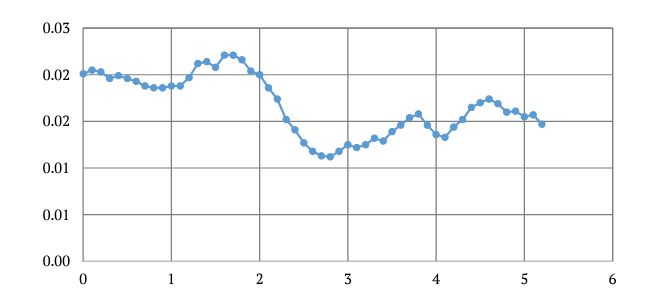
Note: the y-axis shows total fertility rates, and the x-axis shows years (1970 is the zero reference point, 1971 is 0.1, etc. up to 5.2 — 2022).
The general mathematical model for calculating derivatives of the polynomial degree function obtained as a result of data approximation within the period 1970—2022 is as follows:
dy / dx = 0,0582x5 – 0,8755x4 + 4,7104x3 – 10,797x2 + 9,6584x – 2,393, (6)
where: dy/dx is the derivative for the argument x for the approximating function y (5); x is the ordinal number of the year in the 53-year period (0 corresponds to 1970, 5.2 to 2022).20
Table 2 shows changes in the TFR and the derivative of the fertility function in Latvia over the period 1970—2022, and also provides an empirical interpretation (in relation to fertility) of changes in the values of the derivative.
Year | Fertility rate, TFR | Change in TFR compared to the previous year | Derivative* of the approximating | Percentage change** in the derivative compared to the previous year | Empirical interpretation (in relation to fertility) of change |
1970 | 2.01 | — | – 2.3930 | — | Previous growth in fertility rates slowed down (in 1965 the TFR was 1.74) |
1971 | 2.05 | 0.04 | – 1.5305 | 36.0 | |
1972 | 2.03 | – 0.02 | – 0.8569 | 44.0 | |
1973 | 1.96 | – 0.07 | – 0.3470 | 59.5 | |
1974 | 1.99 | 0.03 | 0.0225 | 106.5 | The growth in fertility rates slowed down as much as possible and turned towards decline |
1975 | 1.96 | – 0.03 | 0.2729 | 1112.9 | |
1976 | 1.93 | – 0.03 | 0.4236 | 55.2 | Fertility rates continued to fall but at a slower rate |
1977 | 1.88 | – 0.05 | 0.4926 | 16.3 | |
1978 | 1.86 | – 0.02 | 0.4958 | 0.6 | The decline in fertility rates stopped and turned towards growth |
1979 | 1.86 | 0.00 | 0.4478 | – 9.7 | |
1980 | 1.88 | 0.02 | 0.3615 | – 19.3 | Fertility rates continued to rise but at a slower rate |
1981 | 1.88 | 0.00 | 0.2483 | – 31.3 | |
1982 | 1.97 | 0.09 | 0.1184 | – 52.3 | |
1983 | 2.12 | 0.15 | – 0.0197 | – 116.6 | Fertility growth stopped and a downward trend emerged |
1984 | 2.14 | 0.02 | – 0.1583 | – 703.6 | |
1985 | 2.08 | – 0.06 | – 0.2913 | – 84.0 | Fertility rates continued to fall but this decline was slowing down (the short-term rise in TFR in 1986—1987 did not change the general trend of declining fertility) |
1986 | 2.21 | 0.13 | – 0.4135 | – 41.9 | |
1987 | 2.21 | 0.00 | – 0.5208 | – 25.9 | |
1988 | 2.16 | – 0.05 | – 0.6100 | – 17.1 | |
1989 | 2.04 | – 0.12 | – 0.6791 | – 11.3 | |
1990 | 2.00 | – 0.04 | – 0.7266 | – 7.0 | |
1991 | 1.86 | – 0.14 | – 0.7520 | – 3.5 | |
1992 | 1.74 | – 0.12 | – 0.7554 | – 0.5 | |
1993 | 1.52 | – 0.22 | – 0.7375 | 2.4 | |
1994 | 1.41 | – 0.11 | – 0.6997 | 5.1 | |
1995 | 1.27 | – 0.14 | – 0.6439 | 8.0 | |
1996 | 1.18 | – 0.09 | – 0.5722 | 11.1 | |
1997 | 1.13 | – 0.05 | – 0.4872 | 14.9 | |
1998 | 1.12 | – 0.01 | – 0.3920 | 19.5 | |
1999 | 1.18 | 0.06 | – 0.2894 | 26.2 | |
2000 | 1.25 | 0.07 | – 0.1829 | 36.8 | |
2001 | 1.22 | – 0.03 | – 0.0757 | 58.6 | The decline in fertility rates stopped and there was a growing trend in fertility |
2002 | 1.25 | 0.03 | 0.0288 | 138.0 | |
2003 | 1.32 | 0.07 | 0.1274 | 342.4 | Fertility rates continued to rise But this growth was slowing down (the short-term decrease in the TFR in 2009—2010 did not change the general trend of growth in the fertility level) |
2004 | 1.29 | – 0.03 | 0.2170 | 70.3 | |
2005 | 1.39 | 0.10 | 0.2946 | 35.8 | |
2006 | 1.46 | 0.07 | 0.3575 | 21.4 | |
2007 | 1.54 | 0.08 | 0.4034 | 12.8 | |
2008 | 1.58 | 0.04 | 0.4305 | 6.7 | |
2009 | 1.46 | – 0.12 | 0.4373 | 1.6 | |
2010 | 1.36 | – 0.10 | 0.4230 | – 3.3 | |
2011 | 1.33 | – 0.03 | 0.3873 | – 8.4 | |
2012 | 1.44 | 0.11 | 0.3306 | – 14.6 | |
2013 | 1.52 | 0.08 | 0.2542 | – 23.1 | |
2014 | 1.65 | 0.13 | 0. 1602 | – 37.0 | |
2015 | 1.70 | 0.05 | 0.0514 | – 67.9 | |
2016 | 1.74 | 0.04 | – 0.0682 | – 232.7 | Growth stalled at 1965 levels and fertility rates began to decline |
2017 | 1.69 | – 0.05 | – 0.1937 | – 184.0 | The decline in fertility rates continued but at a slower rate |
2018 | 1.60 | – 0.09 | – 0.3189 | – 64.6 | |
2019 | 1.61 | 0.01 | – 0.4367 | – 36.9 | |
2020 | 1.55 | – 0.06 | – 0.5385 | – 23.3 | |
2021 | 1.57 | 0.02 | – 0.6145 | – 14.1 | |
2022 | 1.47 | – 0.10 | – 0.6535 | – 6.3 | |
| Source: calculated and compiled according to official Latvian statistics. | |||||
Note: * Derivatives were calculated in MS Excel strictly according to (5), taking into account three or four decimals, respectively.
** Calculation of the percentage change in the derivatives compared to the previous year is necessary to consider the relative differences between the derivatives and reduce the effect of a purely mathematical relationship between the values of the approximating function and its derivatives caused by a change in the variable x [11].
The data in Table 2 (as well as the graph in Figure 1) show the cyclical nature of the medium-term fertility trend in Latvia, which, however, has a generally decreasing slope: from a TFR equal to 2.01 children on average per woman in 1970 to 1.47 in 2022. Furthermore, during the medium-term analysis of fertility trends in Latvia, there were frequent periods of apparent contradiction. For instance, there were times when the Total Fertility Rate (TFR) increased while the derivative of the approximating function (indicating the rate of change) was negative, such as in 1970—1971 and 1983—1984. Conversely, there were periods when the TFR decreased while the derivative of the function was positive, as observed in 2003—2004 and 2009—2010.
Such situations serve as a compelling example of the importance of not only examining the primary indicators under study, such as the Total Fertility Rate (TFR), but also considering the derivatives of the approximating function. This approach provides a more comprehensive understanding of fertility changes within the broader trend framework (Fig. 2). For example, the negative derivative of the approximating function in 1970—1971 with a simultaneous actual increase in the TFR, indicated that the previous growth was slowing down (in 1965, the TFR was 1.7421), and the negative derivative observed during 1983—1984, alongside an increase in the TFR, indicated that growth had halted and a downward trend in fertility rates had begun. The positive derivative of the approximating function in 2003—2004, along with an actual decrease in the Total Fertility Rate (TFR), indicated that while fertility was declining, the rate of decline was slowing down. Additionally, the temporary dip in TFR during 2009—2010, likely influenced by the shock from the 2008 global financial crisis, did not change the overall trend of fertility growth observed from 2003 to 2015.
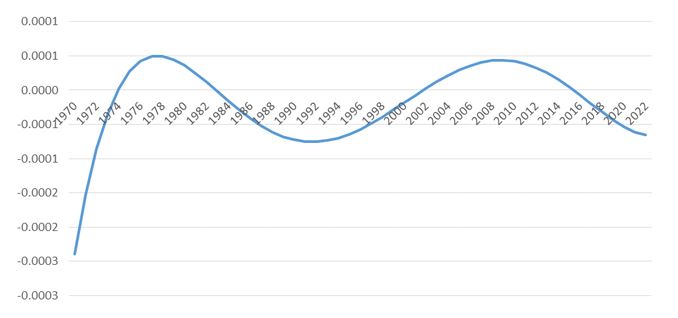
The curve of the derivative of the approximating function of the TFR in Latvia, shown in Figure 2, confirms a fairly uniform cyclical nature of the fertility trend, with periodic slowdowns and accelerations in the growth and decline of the fertility level, at least since 1973, that is, relatively long before the change in socioeconomic formation and political status of Latvia in the early 1990s.
In Table 3, the authors delineated different phases of demographic cycles in Latvia, drawing an analogy with economic cycles: growth (expansion), peak or boom, decline (recession), and bottom (depression). This framework was used to predict the trajectory of the fertility trend in Latvia in the near future, addressing the central research question posed in the article’s introduction: can Latvia increase its fertility levels as envisioned in the “Population Reproduction Strategy”?
Time | Empirical interpretation of changes in derivatives in the context of TFR | Duration of the phases of demographic cycles | Designation of phases of demographic cycles |
1970—1973 | Previous growth in fertility rates slowed down (TFR was 1.74 in 1965*, 1.96 in 1973) | 4 years that fell within the study period 1970—2022 | Growth (expansion) |
1974—1975 | The growth of the fertility level first slowed down and then turned began to decrease (TFR was 1.99—1.96) | 2 years | Peak or boom |
1976—1977 | The decline in fertility continued but at a slower rate (TFR was 1.93—1.88) | 2 years | Decline (recession) |
1978—1979 | The decline in fertility stopped and shifted towards growth (TFR was 1.86—1.86) | 2 years | Bottom (depression) |
Next demographic cycle | |||
1980—1982 | The increase in fertility continued but slowed down (TFR was 1.88—1.97) | 3 years | Growth (expansion) |
1983—1984 | Fertility growth stopped and there was a trend towards a decrease in the fertility rate (TFR was 2.12—2.14) | 2 years | Peak or boom |
1985—2000 | The decline in fertility continued but slowed down (TFR was 2.08—1.25); in 1986—1987 there was a short-term rise in the TFR as a result of M. Gorbachev’s anti-alcohol campaign (TFR was 2.21) | 16 years | Decline (recession) |
2001—2002 | The decline in fertility stopped and an upward trend emerged (TFR was 1.22—1.25) | 2 years | Bottom (depression) |
Next demographic cycle | |||
2003—2015 | The increase in fertility continued but at a slower rate (TFR was 1.32—1.70); in 2009-2010 there was a sharp short-term decline in the TFR as a result of the shock from the global financial crisis of 2008 (the TFR was 1.46—1.36) | 13 years | Growth (expansion) |
2016 | Growth plateaued at the 1965 fertility level (1.74) and there was a downward trend in fertility rates | 1 year | Peak or boom |
2017—2022 | The decline in fertility continued but at a slower pace (TFR was 1.69—1.47) | 6 years | Decline (recession) |
Source: compiled according to Table 2. | |||
Note: * The authors do not have data on the fertility rates in Latvia before 1965.
Discussion of the results
The main findings of the authors’ mathematical analysis of Latvia’s medium-term fertility trend spanning from 1970 to 2022 (53 years), as succinctly presented in Table 3, reveal empirically substantiated demographic cycles that bear striking resemblance to economic cycles. These cycles, well-established in macroeconomic theory [22] and even interrelated with them [23], depict a historical process in demography as a sequence of phases analogous to economic cycles. Moreover, these demographic cycles reflect cyclical fluctuations in per capita consumption, mirroring cycles of real wages or income.22
Based on the results of the mathematical analysis, it is projected that the decline in fertility levels in Latvia will persist for several more years until reaching the bottom of the next demographic cycle. This nadir is anticipated to be lower than the previous one, specifically below 1.22—1.25 children on average per woman. Subsequently, a reversal towards increasing fertility levels is expected as part of a long-term trend of declining fertility. However, this growth trajectory is forecasted to fall short of reaching the previous peak, which was around 1.74 children on average per woman. Therefore, the anticipated rise in fertility in Latvia to reach 1.77 children per woman by 2027, as envisioned by the authors of this study, is deemed unachievable under any realistically feasible socioeconomic and political conditions in the country.
The primary reason cited by the authors of this study for the impossibility of increasing the fertility level in Latvia in the near future is attributed to societal value changes. These shifts are extensively researched, documented, and discussed by sociologists and demographers not only in Latvia but also in Lithuania and other countries. In Soviet times, a couple with two children was considered the ideal family model: both having many children and being childless were rare [1]. This ensured the achievement of a fertility level close to 2.0. Currently, as shown by the data of comparative sociological “Study of factors contributing to marriage, fertility and positive child-parent relationships” conducted by the University of Latvia in 2004 (n = 1970 people) and in 2022 (n = 2297 people), “the family still has value (family safety, health of loved ones), but the child is no longer the only and necessary means of realizing one’s life ambitions, no longer at the center of the individual value system”23 (Table 4).
Value | Rank in the hierarchy of values | Value | |
2004 | 2022 | ||
Family safety (safety of loved ones) | 1 | 1 | Family safety (safety of loved ones) |
Health (no physical or mental illness) | 2 | 2 | Health (no physical or mental illness) |
Children and family (as an intrinsic value) | 3 | 3 | Peace in the whole world(without wars and conflicts) |
Inner harmony | 4 | 4 | Freedom (freedom of action and thought) |
Mature love | 5 | 5 | Inner harmony |
Self-esteem | 6 | 6 | Self-esteem |
Sincere friendship | 7 | 7 | Honesty |
Freedom (freedom of action and thought) | 8 | 8 | Intelligence |
Intelligence | 9 | 9 | Country safety (protecting my people from enemies) |
Honesty | 10 | 10 | Sincere friendship |
Peace in the whole world(without wars and conflicts) | 11 | 11 | Mature love |
… | |||
Country safety (protecting my people from enemies) | 24 | 22 | Children and family (as an intrinsic value) |
Source: Pirsko, L., Sebre, S., Upmane, A. 2022, Laulību, dzimstības un pozitīvu bērnu-vecāku attiecību veicinošo faktoru izpēte: 2022. gada un 2004. gada pētījumu rezultātu salīdzinājums, Pārskats par pētījumu, Valsts Pārresoru koordinācijas centrs, URL: https://pkc.gov.lv/sites/default/files/inline-files/Laulibu_dzimstibas_pozitivu_attiecibu_izpete_2022_1.pdf (accessed 20.09.2023). | |||
The authors reviewing the results of the aforementioned study commented on the significant decline in the perceived importance of children and family within the hierarchy of values in Latvian society. They stated, “This result suggests that as the perceived value of children and family diminishes, it is likely that individuals will exert less effort to pursue these values. Consequently, there may be reduced willingness among people to start a family and have children”.24 The current tendency among young people not to put in extra effort (in the next case — to work) is also evidenced by the results of an international survey conducted by the recruiting company Randstad Deutschland of 35,000 young people aged 18 to 24 years. 58 % of respondents said they would leave their job if it interfered with their enjoyment of life, and 38 % had already done this at least once. Many personnel managers in Western (and not only Western) companies complain that young people do not want to take responsibility, do not want to work a full 5 days a week and avoid ‘overtime’ in every possible way.25
In turn, for researchers of the phenomenon of female childlessness in Lithuania, the results of a comparative survey of women of two generations led to the conclusion that “the subjectively perceived reasons for not having children revealed different ways of experiencing childlessness among two generations of women. <...> The differences between women of two generations are especially noticeable in terms of voluntary childlessness. Older women do not openly say that they themselves decided to remain childless, although they admit that they never really wanted children. On the contrary, young women are not afraid to say that they have decided to remain childless and are enjoying it” [3, p. 19—20]. These results fully correspond with the results of sociological surveys in Latvia.
Thus, “value choice largely determines the pace and direction of the evolution of modern society” [24, p. 247], which is also true for its demographic development. “Previously, it was believed that it was achievements in the economy that were the decisive factor in improving people’s lives, achieving social dynamism and the success of countries in international cooperation” [25, p. 427]. Much later, the “programming role of culture” [24, p. 246] was recognized as “a way of transmitting accumulated sociohistorical experience (suprabiological programs of human life) in the organisation of social life, in its changes and the generation of various types of society... In order for the type of society to change and a new one to arise, there must be a change in the cultural code, mutation of ideological universals, and then technical and economic development and competition with other societies will determine the future fate of the new type of social organisation” [25, p. 428—429].
According to the authors, this understanding of changes in demographic development in modern society needs some adjustment. Latvian society belongs to an individualistic and ‘feminine’ type of culture (caring for others, law-abiding, striving for personal success) [26] with a dominant mentality of rural (peasant) conservatism, for which active adaptation to the realities of a market economy (behavioural attitudes towards profit, competition) is alien [27]. In the conditions of socioeconomic instability in the functioning of Latvian society, men of working age and women of fertile age, when making decisions about having children, pay the main attention to the level of personal and family well-being, state attention to their health and financial safety of the family and often recognize this attention as insufficient, accepting the decision to migrate to other EU countries. This is especially typical for the age cohort from 15 to 44 years [28, p. 92].
To solve the problems of population reproduction, the Latvian government needs to focus its main efforts on achieving sustainable well-being of the population of the country and its regions, taking care of people’s health, the innovative development of local agricultural, as well as medium- and high-tech industrial production [29], good neighbourly and mutually beneficial socioeconomic relations with countries bordering Latvia.
Conclusions
The results of this study showed that in Latvia there are empirically based demographic cycles that are similar to and related to economic cycles. But unlike economic cycles, which are well developed in macroeconomic theory, the concept of demographic cycles is practically not used either in Latvia or in English-language scientific publications in general. Nevertheless, in Russian-language publications, both demographic cycles and the relationship between cyclicality in economics and demography are quite actively studied.
Based on the results of a mathematical analysis of the medium-term fertility trend in Latvia obtained by the authors, it can be expected that the decline in fertility in the country will continue for several more years before the bottom of the next demographic cycle is reached. This bottom value will be lower than the previous one of less than 1.22—1. 25 children on average per woman. There is an anticipated turn towards increasing fertility levels within an overall declining trend. However, this projected increase is unlikely to surpass the previous peak. Specifically, the next maximum of the demographic cycle in terms of the Total Fertility Rate (TFR) is expected to be less than 1.74 children on average per woman. Consequently, the desired and even expected increase in the TFR in Latvia to 1.77 children per woman by 2027, as envisioned in the “FAMILY —
LATVIA — 2030 (2050) Population Reproduction Strategy,” is considered practically unattainable by the authors of this study.
The application of the mathematical analysis to the study of fertility trends showed that it is methodologically incorrect to conduct a superficial linear analysis of demographic data, as is often done in Latvia. At the same time, based on the concept of demographic cycles used by the authors of this study, it can be argued that the studied time period of 53 years is most likely part of a longer-term demographic cycle, which is not fully covered by this study and thereby limits the application of its results in the long-term perspective.
A demographically significant direction for further study of the topic for the safety of the state is the analysis of natural population growth/decline in the regions of Latvia, as well as the economic and non-economic factors that determine them: the gender and age structure of the population, birth and death rates, the development of the regional economy, sociocultural changes in society that contribute to the growth of fertility rates.
Reference
Zvidrins, P. 1979, The dynamics of fertility in Latvia, Population Studies, vol. 33, № 2, p. 277—282, https://doi.org/10.2307/2173532
Krišjāne, Z., Krūmiņš, J. (zin. red.). 2019, Tautas ataudze Latvijā un sabiedrības atjaunošanas izaicinājumi, Rīga, LU Akadēmiskais apgāds, 300 lpp., https://doi.org/10.22364/talsai
Tretjakova, V., Gedvilaitė-Kordušienė, M., Rapolienė, G. 2020, Women’s pathways to childlessness in Lithuania, Sociālo Zinātņu Vēstnesis [Social Sciences Bulletin], № 2, p. 7—21.
Pourreza, A., Sadeghi, A., Amini-Rarani, M., Khodayari-Zarnaq, R., Jafari, H. 2021, Contributing factors to the total fertility rate declining trend in the Middle East and North Africa: a systemic review, Journal of Health, Population and Nutrition, № 40, 11, https://doi.org/10.1186/s41043-021-00239-w
Skirbekk, V. 2022, Decline and Prosper: Changing Global Birth Rates and the Advantages of Fewer Children, First edition, Palgrave Macmillan Cham, 396 p., https://doi.org/10.1007/978-3-030-91611-4
Martynov, V. L., Sazonova, I. Ye. 2023, Population change and the settlement system transformation in Poland, as revealed by the 2021 census, Baltic Region, vol. 15, № 2, p. 41—61, https://doi.org/10.5922/2079-8555-2023-2-3
Adhia, N. 2018, Some demographic trends in the world’s most populous country-to-be, vol. 23, № 2, p. 5—8.
Ryazantsev, S. V. (ed.). 2021, Demographic development of post-Soviet countries (1991—2021): trends, demographic policy, prospects, Moscow, ITD “Perspektiva”, https://doi.org/10.19181/monogr.978-5-89697-379-9.2021
Deshpande, J. V. 2004, Mathematical Analysis and Applications: An Introduction, First edition, Alpha Science.
Brannan, D. A. 2006, A First Course in Mathematical Analysis, Cambridge, Cambridge University Press, https://doi.org/10.1017/CBO9780511803949
Volodko, I. 2007, Augstākā matemātika, I daļa, Rīga, Zvaigzne ABC.
Van de Kaa, D. J. 1987, Europe’s second demographic transition, Population Bulletin, vol. 42, № (1), p. 1—59.
Sobotka, T. 2008, Overview Chapter 6: The diverse faces of the second demographic transition in Europe, Demographic Research, vol. 19, p. 171—222, https://doi.org/10.4054/DemRes.2008.19.8
Krūmiņš, J., Krišjāne, Z. 2016, Demogrāfiskā attīstība Latvijā: problēmas un izaicinājumi, LZA Vēstis=Bulletin of the Latvia Academy of Sciences, A. dala, p. 40—50.
Lesthaeghe, R. 2020, The second demographic transition, 1986—2020: sub-replacement fertility and rising cohabitation — a global update, Genus, № 76, 10, https://doi.org/10.1186/s41118-020-00077-4
Coleman, D. 2006, Immigration and ethnic change in low-fertility countries: a Third Demographic Transition, Population and Development Review, vol. 32, № 3, p. 401—446.
May, J. F. 2012, World Population Policies. Their Origin, Evolution, and Impact, Springer Dordrecht, https://doi.org/10.1007/978-94-007-2837-0
Bērziņš, A. 2019, Dzimstības izmaiņas, In: Krišjāne, Z., Krūmiņš, J. (zin. red.), Tautas ataudze Latvijā un sabiedrības atjaunošanas izaicinājumi, Rīga, LU Akadēmiskais apgāds, p. 155—163, https://doi.org/10.22364/talsai
Sherry, C. J., Sherry, J. W. 2000, The Mathematics of Technical Analysis: Applying Statistics to Trading Stocks, Options and Futures, iUniverse.
Hilkevics, S., Pulkstene, A. 2019, The consideration of the methodology for the evaluation of the financial condition of Baltic stock companies, Proceedings of the International Scientific Conference “Social Sciences for Regional Development 2018”, Part III: Issues of Economics, Daugavpils: Daugavpils University Academic Publishing House “Saule”, p. 16—23.
Revina, I. 2002, Ekonometrija, Rīga, LU Akadēmiskais apgāds.
Korotaev, A. V., Tsirel, S. V. 2010, Kondratiev waves in world economic dynamics, In: Khalturina, D. A., Korotaev, A. V. (ed.), System monitoring, Global and regional development, M., Librocom/URSS, p. 189—229 (in Russ.).
Ovechkina, N. I., Shulgina, N. A. Cyclicity theory in economics and demography, Vestnik NSUEM, 2012, № 2, p. 105—110 (in Russ.).
Belov, A. A., Danilov, A. N., Rotman, D. G. 2023, Value factor of the countries uneven development, RUDN Journal of Sociology, vol. 23, № 2, p. 244—255, https://doi.org/10.22363/2313-2272-2023-23-2-244-255
Stepin, V. S. 2019, Man. Activity. Culture, St. Petersburg, SPbGUP (in Russ.).
Hofstede, G. 2001, Culture’s Consequences: Comparing Values, Behaviours, Institutions and Organizations Across Countries, CA, Sage, Thousand Oaks.
Mietule, I., Komarova, V., Ostrovska, I., Ignatyevs, S., Heimanis, B. 2022, Economic texts as a reflection of the social reality of the transition period in Latvia and Russia, RUDN Journal of Sociology, vol. 22, № 1, p. 168—185, https://doi.org/10.22363/2313-2272-2022-22-1-168-185
Voronov, V. V., Ruza, O. P. 2018, Youth unemployment in the Latgale region of Latvia: causes and consequences, Baltic Region, vol. 10, № 4, p. 88—102, https://doi.org/10.5922/2079-8555-2018-4-6
Voronov, V. V. 2022, Small towns of Latvia: disparities in regional and urban development, Baltic Region, vol. 14, № 4, p. 39—56, https://doi.org/10.5922/2079-8555-2022-4-3