Spatial and structural patterns in the distribution of R&D, innovation and production activities in Russia


Abstract
A modern innovative economy relies on the continual integration of knowledge and technologies into production, monitoring, and management processes. Therefore, territorial proximity and sectoral complementarity of the activities of scientific, technological and industrial organisations are crucial factors in fostering innovation. This article aims to assess the relationship between a region’s economic and scientific specialisation and the level of its innovative development. The object of the study is the industrial and research profile of Russian regions’ economies with a focus on the strength of connections between them. We identified and measured Russian regions’ industry-specific research, technological and economic specialisations. Additionally, we described the spatial and structural patterns of interregional distribution and concentration of research, technological and innovative activities. Methodologically, we compared data on the product output by industry, using the OKVED classification subgroups and information on the costs and implementation of R&D. To gather the latter data, we employed our methodology, which involved juxtaposing GRNTI and OKVED codes. Overall, we analysed data from 17.3 thousand research, development and technological projects conducted between 2017 and 2021 across 18 fields. Specialisation coefficients for both the supply and demand of R&D outcomes and production were computed for each region. The econometric analysis made it possible to distinguish four clusters of regions based on their research and industrial specialisation: agro-industrial regions, mechanical engineering regions, precision engineering regions and diversified regions. The study demonstrated a correlation between a region’s innovative product output and the structure of its innovative economy.
Introduction and statement of the question
At the present stage, new knowledge is the most important source of innovation and a necessary condition for long-term economic growth. Increasing investment in fundamental research contributes to the expansion of applied developments and an increase in the number of inventions, the introduction of which into production ensures innovative growth [1]. In the 1960s, the function of knowledge production was studied separately [2], but later it began to be considered as an element of economic activity. The ideas of the innovation environment [3], a new model for the functioning of universities as centres for the generation and commercialization of knowledge and technology [4], and wider involvement of representatives of business, government and society in the innovation process [5], [6] were developed.
The neoclassical model of exogenous economic growth, proposed by Solow, identified scientific and technological progress as the main factor-catalyst of economic activity. Scientists associated the free diffusion of knowledge and technologies with their general availability and the achievement of economic interregional convergence with higher growth rates of catching-up regions due to the law of diminishing marginal returns. This assumption was confirmed by empirical studies using the example of Western European countries and the USA [7].
The new theory of endogenous growth, put forward by Romer in the 1980s, made it possible to take into account the economic benefits of investment in research and development (R&D). The economic and geographical studies [8], [9] showed that advanced regions with high levels of R&D expenditure have better economic growth indicators. The presence of territorial patterns in the location of scientific and innovative activity was confirmed when assessing the geographical location of the authors of patent applications in high-tech industries [10].
In the era of digitalization, accelerated movement and simplified access to information in the knowledge production system formed the basis of the concept of open innovation [11]. Increasingly, the results obtained through the research activities of one organisation are applied in the form of innovations in the open market of another. This made it possible to develop the idea of nonlinearity of the innovation process put forward by Schumpeter [12] as well as to substantiate the role of new knowledge as a source of endogenous growth for territorial innovation systems.
The results of some studies [13], [14], [15] indicate the presence of ‘hotspots’ (innovation clusters) and ‘voids’ (innovation periphery) on the national innovation map. Scientists have substantiated the heterogeneity of scientific and innovative activity and its high territorial localization [16], [17] by using various theoretical and empirical approaches. By using the example of European countries, a positive correlation between the spatial distribution of innovation activity and labour productivity was noted as well as a close relationship between the sectoral specialisation of production and innovation activities [18], [19].
The impact of R&D on productivity and economic growth can vary significantly depending on the industry, the type of R&D, and the source of investment [1]. The efficiency of investment in research and development is believed to be higher in regions with a specialized economic structure than in those with a diversified one [20]. At the local level, intersectoral knowledge flows also become of great importance for innovation [21]. The key role of the circulation of new knowledge and the effectiveness of its implementation for the development of production was substantiated by the example of Germany [22].
The sectoral specificity of the economic effect of research costs manifests itself both at the international [23], [24] and the interregional [25] levels. The endogenous growth is ensured not only due to a higher concentration of innovations in high-tech segments of the economy but also as a result of their adaptation in other, less technological sectors. Moreover, in the case of such extended countries as Russia, the economic inequality of the regions is extremely high, and the diffusion of innovations primarily affects only the neighbouring territories of the largest cities and the areas of the largest agglomerations [26]. The geographical limitation of the effects of diffusion of knowledge and innovation necessitates the localization of the innovation process in the region.
At the same time, it is important to what extent the region itself can benefit from the knowledge generated in it, which also depends on the ability of local actors and institutions to perceive their economic value [27]. In Russian science, the problem of effective implementation of R&D results into production was noted as early as in the Soviet period (e. g. [28], [29]). An additional complexity is associated with the fact that innovative activity does not always involve the introduction of new scientific developments while the presence of high-tech industries in the region makes the development of science necessary [30].
In this regard, the effectiveness of the regional system for the production of new knowledge and technologies should be assessed along with its production potential. This article continues research in the field of geography of knowledge and is devoted to assessing the territorial and structural patterns of location and concentration of research and industrial activities. The purpose of the article is to assess the connection between the economic and scientific specialisation of a region and the level of its innovative development. The authors set out to determine the role of factors of territorial proximity and industrial diversity in relation to the co-location of R&D and production activities for the innovative development of Russian regions.
Research methods and methodology
The main source of data on civil research, development and technological work (R&D) carried out in Russia within this study was the open database of the Unified State Information System for Research, Development and Technological Work (EGISU R&D). The platform has been developed and is currently administered by the Center for Information Technologies and Systems of the Executive Bodies (FGANU CITiS); it contains information about scientific reports and dissertations published since the beginning of 2014.
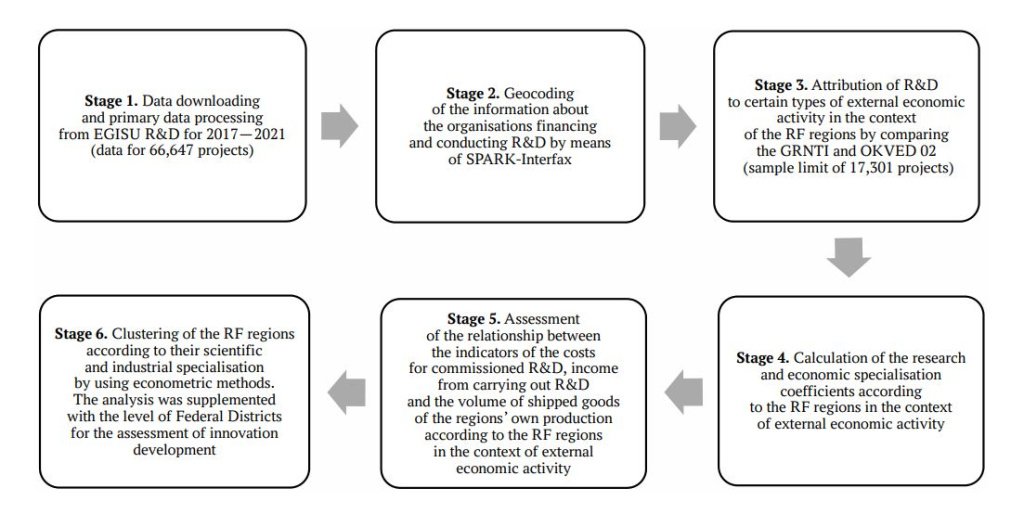
During the first stage, all information about starting research projects in json format for the period from January 2017 to April 2021 was downloaded from the EGISU R&D database (www.rosrid.ru). The initial set contained information about 66,647 projects, which were selected on the basis of the forms for sending information about the ongoing research, development and technological work for civilian purposes. The following was used from the available information: data on thematic and industry categories (keywords, branches of knowledge according to the GRNTI and OECD rubricator codes); customers and contractors (name and the OGRN code of the organisations); financing (volume and main sources) of each civil research project presented in the database that was underway in Russia during the period under study.
As a result of processing the primary open data of the EGISU R&D, several limitations were identified that acted as limiting factors in the analysis and interpretation of the results of the work. Firstly, the EGISU R&D database contains information only about civilian developments; some double-purpose projects that play an important role in the formation of the research potential of the regions of the Russian Federation were not included in the source data. Since private companies are not required to register their technical developments, a significant part of innovative activity in the non-state sector was also not included in the study. Secondly, some scientific institutions report on the internal research commissioned and carried out within the same organisation. As a result of ‘duplicate’ reporting in some regions, the amount of R&D financing may be overestimated. Therefore, ‘internal’ projects were excluded from the analysis. Thirdly, due to the manual filling of data submission forms, the problem of inaccuracies, errors and errata remains. In particular, the most acute problem was the indication of the incorrect amounts of financing for many developments (rubles were used as units of measurement instead of thousand rubles). Manual checks and adjustments of expenses for the largest projects were carried out to verify the data.
At the second stage, the information about organisations participating in R&D as a customer and/or contractor including their registration addresses was downloaded by using the primary state registration number (OGRN) from the SPARK-Interfax database. Based on it and by using geocoding (determining geographic coordinates from unstructured text data), all information was aggregated at the level of regions and municipalities. Spatial reference of R&D was carried out both for contractor organisations and for customers of developments, which made it possible to assess supply and demand in the field of scientific research. Geocoding was carried out by using the Yandex geocoder and the geo.ru library in the Python 3.7 programming language.
The third stage of the study included the attribution of R&D to certain types of economic activity in the context of the regions of the Russian Federation. It was carried out by comparing the codes of the GRNTI rubricator at the second level (for example, 68.47 “Forestry”) with the names of the subsections of the All-Russian Classifier of Economic Activities (OKVED 02. ‘Forestry and logging’). 255 thematic subgroups of more than 700 of the GRNTI that had an applied focus were assigned to 18 OKVED groups included in sections A-E, hereinafter referred to as the thematic areas. The determination of the economic specialisation of the regions of the Russian Federation was carried out by using data on the volume of shipped goods of one’s own production by subgroups of the OKVED for 2018.1
The identification of the industry affiliation of R&D was carried out for the applied research unambiguously identified within a particular group of industries: agriculture, mining and manufacturing industries, and electric power. It turned out to be impossible to connect the remaining areas of scientific knowledge directly with a specific branch of material production since they included predominantly fundamental research that was not directly aimed at practical application. Some projects were also not included in the study sample due to their classification into broader categories of the GRNTI rubricator and interdisciplinary focus. Thus, the final sample included 17,301 projects with a total financing of over 319.9 billion rubles (58.0 % of the total R&D costs for 2017—2021 included in the EGISU R&D). The applied industry research was carried out in all regions of the Russian Federation with the exception of the Nenets and Chukotka Autonomous Districts.
In the fourth stage, the interregional distribution of research and economic specialisations was traced. The research specialisation coefficients were calculated as the ratio of the share of costs for projects in each field of knowledge in the total amount of costs for applied R&D in the region to the share of costs for it in Russia as a whole. The assessment was carried out both for customer organisations (R&D demand) and for contractors (R&D offer). To calculate the economic specialisation coefficients of the regions of the Russian Federation, the volumes of shipped goods of their own production and indicators of gross domestic product (GDP) by type of activity were used. Those for which the values of the calculated coefficients were above 1 were considered to be key specialisations.
In the fifth stage, the statistical analysis methods were used to assess the relationship between the indicators of the costs for completed R&D, commissioned R&D and shipped goods of the regions’ own production in the context of 85 regions of the Russian Federation and 18 thematic areas. The analysis was carried out by using the software StatTech v. 3.1.6. Since the distribution of the quantitative indicators was different from normal, the direction and strength of pair correlations were assessed by using the Spearman rank correlation coefficient. For the study, only those cases were taken into account when the differences in the quantitative indicators were statistically significant (p < 0.05). The interpretation of the strength of the relationship was made according to the Chaddock scale: weak — from 0.1 to 0.3; moderate — from 0.3 to 0.5; significant — from 0.5 to 0.7; high — from 0.7 to 0.9; very high — from 0.9 to 0.99. Further analysis included indicators with a moderate or stronger relationship.
The sixth stage of the study included the interpretation of the results obtained in the previous stages, based on earlier studies that showed the relationship between industry structure and economic innovation. In particular, the work by Koo [31] substantiates that as the level of knowledge intensity of an industry increases, the influence of factors of diversity and specialisation decreases, and the diffusion of technologies is better ensured between a group of industries with similar knowledge bases. In the article by X. Li [32], based on data from China, it is noted that the occurrence of side technological effects during the clustering of companies is significantly limited if they do not have sustainable practices in conducting research activities. At the same time, the introduction of innovation is facilitated by the presence of local specialisation. Another study [33] showed that a region’s industry profile correlates with its domestic resources. The resource dependence of industries determines their concentration within certain geographic boundaries — the locations of these resources. This is also true for technological activities, the development of which is associated with the need for research and innovation resources. Thus, we expect that the level of innovative development of a region will be determined by the structural features of its economy.
At this stage, clustering of the regions of the Russian Federation was carried out by using the methods of econometric analysis according to scientific and industrial specialisation, thereby identifying four clusters. The study is supplemented by an assessment in terms of Federal Districts as units of government and macro-regional territorial communities. A comparison was made as regards the data on industry diversity with the share of innovatively active companies and the share of innovative products in the total volume of goods shipped, work performed, and services provided for the same period 2017—2021. The source of the data was the Rosstat database, ‘Science, Innovation, Technology’ (URL: https://rosstat.gov.ru/statistics/science). Based on the pair correlation coefficient, the relationship between innovation activity and economic specialisation is assessed to identify the degree of centralization of innovation activity.
The research algorithm is presented in the flow chart (Fig. 1).
Research results
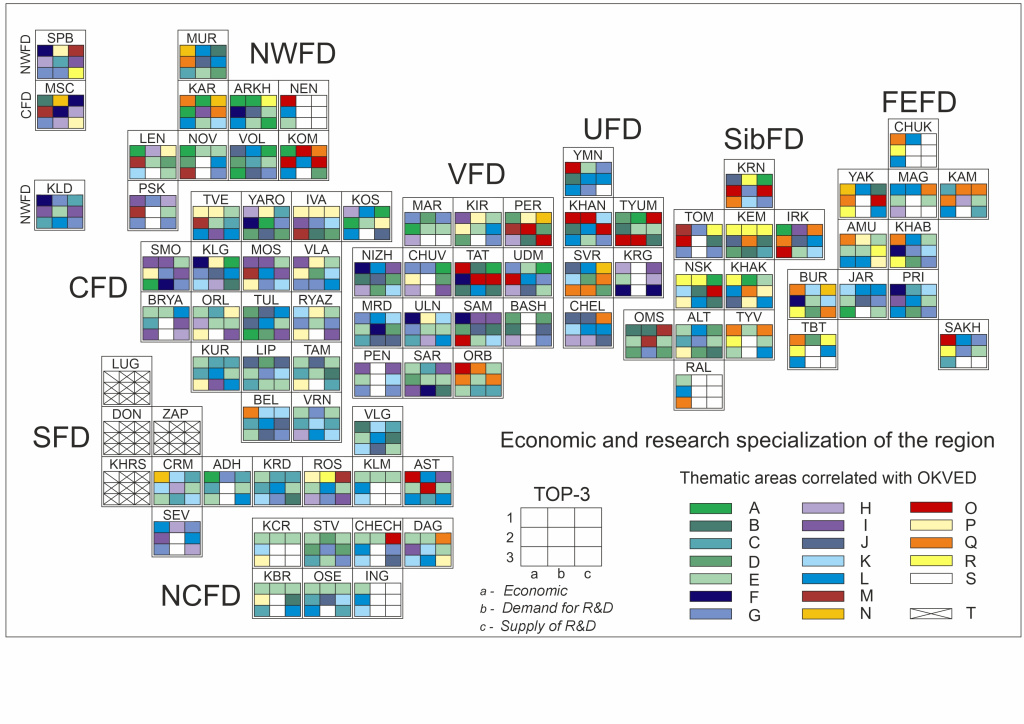
The results of calculating the coefficients of research and economic specialisations of Russian regions made it possible to assess the territorial distribution of the country’s scientific and industrial potential (Fig. 2). The geography of the location of organisations — R&D contractors and customers — is characterized by interregional heterogeneity and is also associated with the localisation of industrial production enterprises.
Note:
Index of Regions: ALT — Altai Territory; AMU — Amur Region; ARKH — Arkhangelsk Region; AST — Astrakhan Region; BEL — Belgorod Region; BRYA — Bryansk Region; VLA — Vladimir Region; VLG — Volgograd Region; VOL — Vologda Region; VRN — Voronezh Region; MSC — Moscow; SPB — St. Petersburg; SEV — Sevastopol; DON — Donetsk People’s Republic; JAR — Jewish Autonomous Region; TBT — Trans-Baikal Territory; ZAP — Zaporozhye Region; IVA — Ivanovo Region; IRK — Irkutsk Region; KBR — Kabardino-Balkarian Republic; KLD — Kaliningrad Region; KLG — Kaluga Region; KAM — Kamchatka Territory; KCR — Karachay-Cherkess Republic; KEM — Kemerovo Region; KIR — Kirov Region; KOS — Kostroma Region; KRD — Krasnodar Region; KRN — Krasnoyarsk Territory; KRG — Kurgan Region; KUR — Kursk Region; LEN — Leningrad Region; LIP — Lipetsk Region; LUG — Lugansk People’s Republic; MAG — Magadan Region; MOS — Moscow Region; MUR — Murmansk Region; NEN — Nenets Autonomous District; NIZH — Nizhny Novgorod Region; NOV — Novgorod Region; NSK — Novosibirsk Region; OMS — Omsk Region; ORB — Orenburg Region; ORL — Oryol Region; PEN — Penza Region; PER — Perm Region; PRI — Primorsky Territory; PSK — Pskov Region; ADH — Republic of Adygea; RAL — Republic of Altai; BASH — Republic of Bashkortostan; BUR — Republic of Buryatia; DAG — Republic of Dagestan; ING — Republic of Ingushetia; KLM — Republic of Kalmykia; KAR — Republic of Karelia; KOM — Komi Republic; CRM — Republic of Crimea; MAR — Republic of Mari El; MRD — Republic of Mordovia; YAK — Republic of Sakha (Yakutia); OSE — Republic of North Ossetia — Alania; TAT — Republic of Tatarstan; TYV — Republic of Tyva; KHAK — Republic of Khakassia; ROS — Rostov Region; RYAZ — Ryazan Region; SAM — Samara Region; SAR — Saratov Region; SAKH — Sakhalin Region; SVR — Sverdlovsk Region; SMO — Smolensk Region; STV — Stavropol Territory; TAM — Tambov Region; TVE — Tver Region; TOM — Tomsk Region; TUL — Tula Region; TYUM — Tyumen Region; UDM — Udmurt Republic; ULN — Ulyanovsk Region; KHAB — Khabarovsk Territory; KHAN — Khanty-Mansiysk Autonomous Okrug — Ugra; KHRS — Kherson Region; CHEL — Chelyabinsk Region; CHECH — Chechen Republic; CHUV — Chuvash Republic; CHUK — Chukotka Autonomous District; YMN — Yamalo-Nenets Autonomous District; YARO — Yaroslavl Region.
Thematic areas correlated with OKVED:
A — wood processing and production of wood and cork products, except furniture, production of straw products and weaving materials, production of paper and paper products; B — production of coke and petroleum products, production of rubber and plastic products; C — production of food products, drinks and tobacco products; D — production of chemicals and chemical products, production of medicines and materials used for medical purposes; E — agriculture; F — printing activities and copying of information media; G — extraction of other minerals; H — crude oil and natural gas production; I — production of textiles, clothing, production of leather and leather goods; J — production of motor vehicles, trailers and semi-trailers; production of other vehicles and equipment; K — production of computers, electronic and optical products; production of electrical equipment; L — production of machinery and equipment not included in other groups; M — furniture production; production of other finished products; N — metallurgical production; production of finished metal products, except machinery and equipment; O — production of other non-metallic mineral products; P — production, transmission and distribution of electricity; Q — mining of metal ores; R — coal mining; S — values of specialisation coefficients below 1; T — no data.
On a macro-regional scale, there are strong differences in the coverage of the thematic areas that occupy leading positions in the economic structure of the Russian Federation regions (Fig. 3). A broader spatial consideration of the Federal Districts made it possible to take into account the proximity of the regions in the assessment of the production processes and scientific and technological processes. The Volga Federal District, Siberian Federal District and Northwestern Federal District are leaders in the share of thematic areas for which higher values of all three calculated specialisation coefficients were obtained than in the Russian Federation. This indicates the concentration of production, research and investment resources within their borders, which favours the development of more knowledge-intensive sectors of the economy. The strongest sectoral focus was noted in the North Caucasus Federal District whose economy is largely represented by extractive activities.
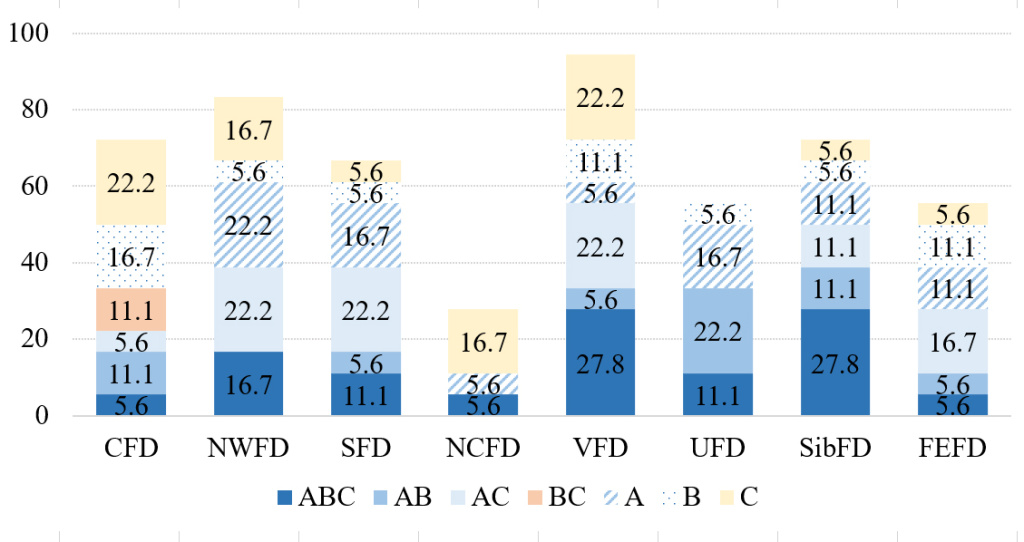
Note. A total of 18 thematic areas were assessed. Specialisations: A — research (R&D offer); B — research (R&D demand); C — economic (volume of output); ABC — values of all three coefficients are above 1; AB / AC / BC — values of two coefficients above 1; A / B / C — the value of only one coefficient is higher than 1.
The calculated indicator of thematic diversity for the Federal Districts of the Russian Federation reveals a high dependence on the indicator of innovative activity of companies (Fig. 4). The pair correlation coefficient is 0.860, which indicates that in the Federal Districts with a greater scientific and production potential there is also a higher concentration of enterprises and organisations engaged in innovative activities. A similar pattern can be noted in relation to the location of small innovative companies (the pair correlation coefficient is 0.798). In other words, the general level of innovation activity is closely related to the localization within geographic boundaries of both the research and industrial base for a wide range of activities.
The less thematic diversity is associated with lower rates of involvement of federal district companies in the innovation process. The Volga Federal District, as a leader among the districts, is characterized by the highest indicators of the complexity of the economic, scientific and technological profile of the regions represented at a high (above the Russian average) level of development of the vast majority of the considered OKVED. On the contrary, the North Caucasus Federal District, which has the lowest level of company innovation, is characterized by a focus on a limited list of specialisations, primarily agriculture.
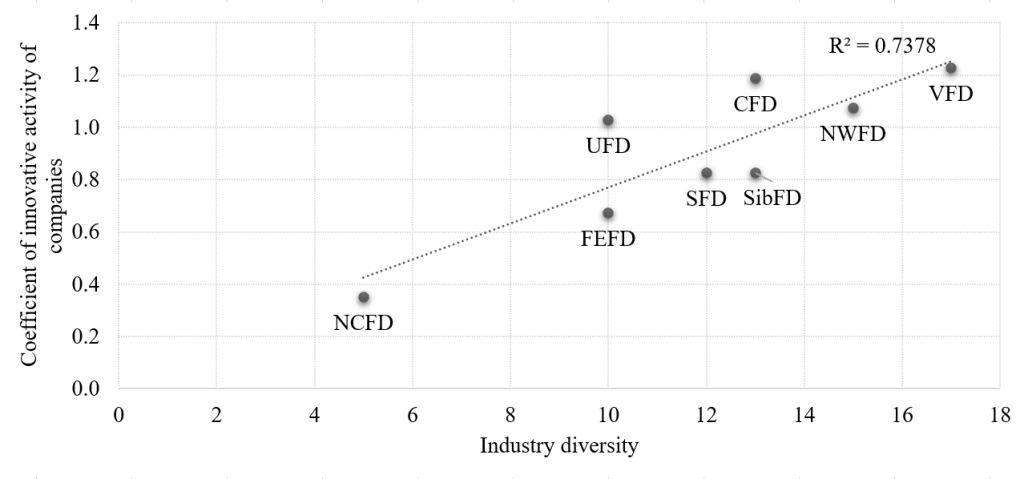
Note. The indicator of thematic diversity is the number of types of activities represented in a Federal District for which at least one of the three specialisation coefficients is above 1. The coefficient of innovative activity of companies in a Federal District is the ratio of the level of innovative activity of companies in the district in relation to the same in the Russian Federation (the average value for the period is calculated).
The relationship between industry diversity and the volume of innovative products (namely: the indicator of the share of innovative products in the total volume of goods shipped, work performed, and services provided for the same period of 2017—2021) is somewhat less strong. The correlation coefficient is 0.524. Despite the fact that the leading positions in terms of innovative product generation are retained by the Volga Federal District, Northwestern Federal District and Central Federal District, a high position is also observed in the North Caucasus Federal District whose economy is characterized by strong industrial centralization. Such a distribution suggests the importance of the composition and structure of the types of activities that form the basis of the economy (it is true for various economic models). To assess the importance of the co-location of the R&D contractor and customer organisations as well as industrial companies in the context of individual thematic areas, the correlation coefficients between indicators of product output, generation and financing of R&D were calculated according to the regions of the Russian Federation (Table 1, Fig. 5).
|
Indicators |
R&D offer — R&D demand |
Correlation strength |
||
|
Moderate |
Significant |
High |
||
|
I — A, B, E II — G* IV — R** |
I — D |
— |
||
|
Production volume — R&D offer |
I — A, C III — J |
I — B, D, E III — K, L, M, N, O, P |
— |
|
|
Production volume — R&D demand |
II — G IV — R |
I — A, B, C, D, E II — H |
II — F, I |
|
Note.
The letters indicate thematic areas correlated with OKVED. The legend is given in the note to Figure 2.
* the correlation is not statistically significant; ** the correlation is moderately negative.
I — the co-location of research, financing (and setting the thematic agenda) organisations and industrial enterprises is important;
II — industrial enterprises can be remote from research organisations, but co-located with financing organisations;
III — the co-location of industrial enterprises and research organisations is important;
IV — resource-based companies with distributed connections.
The strength of the correlation on the Chaddock scale: moderate — from 0.3 to 0.5; significant — from 0.5 to 0.7; high — from 0.7 to 0.9.
Table 1 and Figure 5 represent the final distribution of the thematic areas under study in four groups:
— first (I) — with the potential of key actors in the innovation process for clustering in the region, including manufacturing enterprises; organisations that create demand for scientific achievements by financing R&D; research and development organisations;
second (II) — with the potential for the formation of innovation networks, when production enterprises and organisations conducting R&D can be located in different regions, but the diffusion of new knowledge and innovation between them is ensured (in this case, the need for R&D (commission) comes from the region where industrial capacities are concentrated);
— third (III) — with the potential for the formation of localized scientific and production ties, including those with external financial support (the economic specialisation stimulating the development of research can be primary for the region and vice versa);
— fourth (IV) — with low innovative potential (in our study, these are dependent on natural resources).
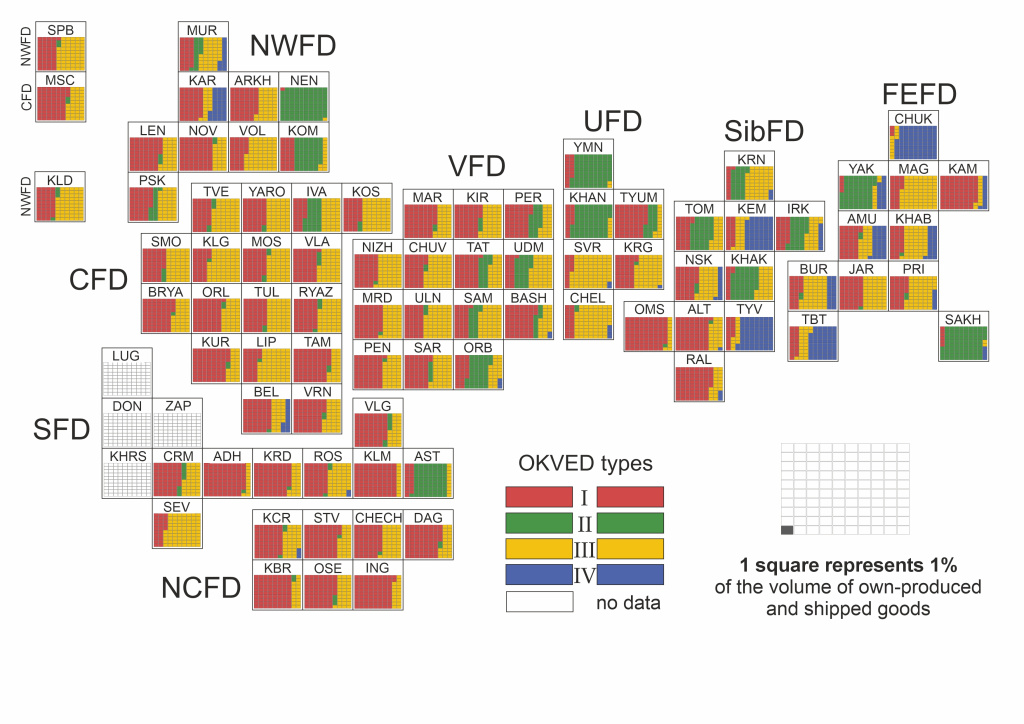
|
| 5 |
|
Groups of thematic areas by regions of Russia according to the volume of produced and shipped goods. One square represents 1 % of the volume of own-produced and shipped goods |
|
|
The first and third groups of the thematic areas (the second somewhat less) are focused on the localization of innovative activity or its individual processes. This was reflected in the calculated correlation coefficients (Table 2). We can assume that the prevalence of the thematic areas of the first and third groups in research and economic specialisations is positively related to the overall level of innovative development of the region while the high share of the fourth group of the thematic areas, on the contrary, does not contribute to the growth of innovation in the economy.
|
Share |
Groups |
Innovation indicators |
||
|
Share of innovatively active companies |
Share |
Diversity |
||
|
I |
0.799 |
0.579 |
0.899 |
|
|
II |
0.806 |
0.439 |
0.884 |
|
|
III |
0.903 |
0.581 |
0.958 |
|
|
IV |
– 0.449 |
– 0.398 |
– 0.115 |
|
Figure 6 demonstrates the differences in the structure of the economy of the Federal Districts of Russia in the context of selected groups. The example of the Far Eastern Federal District and Ural Federal District is illustrative. While having the same number of thematic areas, the Federal Districts are characterized by different innovative efficiency: the Far Eastern Federal District is inferior to the Ural Federal District in terms of the share of innovative goods and innovative activity of companies. This can be explained by qualitative differences in the structure of their economic systems: in the Ural Federal District there is a higher share of thematic areas of groups I and III while in the Far Eastern Federal District, a significant share falls on the less knowledge-intensive groups II and IV. In other words, for the innovation profile of a macroregion, not only the quantitative diversity of industries is important (the desire to expand specialisations and accumulate various knowledge bases), but also the level of their knowledge intensity. An imbalance towards a greater representation of low-tech activities, the development of which does not require the localization of the corresponding research base, does not contribute to strengthening the territorial innovation system and increasing the overall level of innovation in the economy.
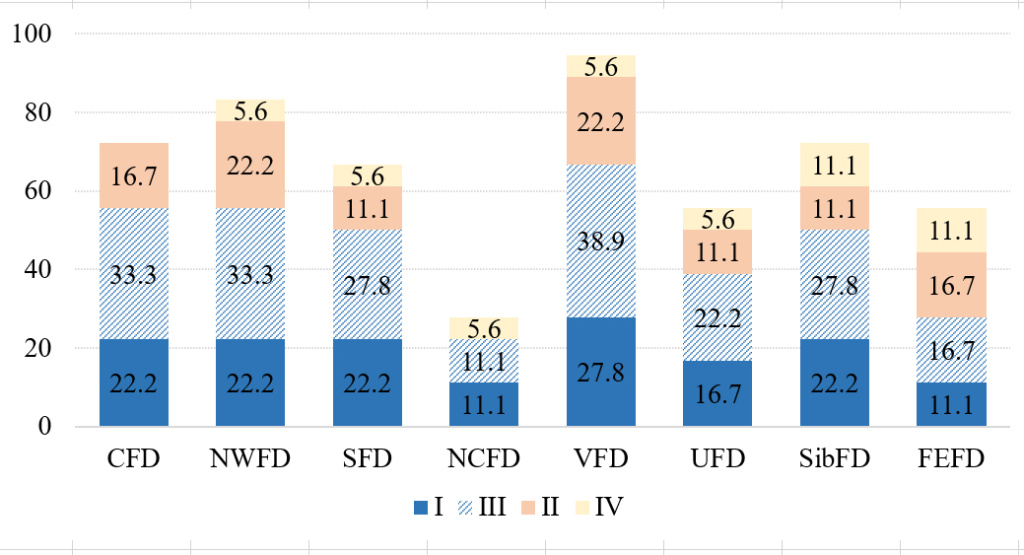
Note: The descriptions of groups I, II, III, and IV are given in Table 1.
Geographic diversity is more typical of innovative groups I and III of the thematic areas — there are several centres of economic growth within a Federal District (Fig. 7) while the prevalence of the thematic areas of groups II and IV in the structure of the economic system is associated with stronger geographic centralization. In terms of individual types of activities, the largest number of the regions of the Russian Federation are involved in the generation of knowledge and innovation in agriculture, and the smallest number is in the mining of coal and other minerals.
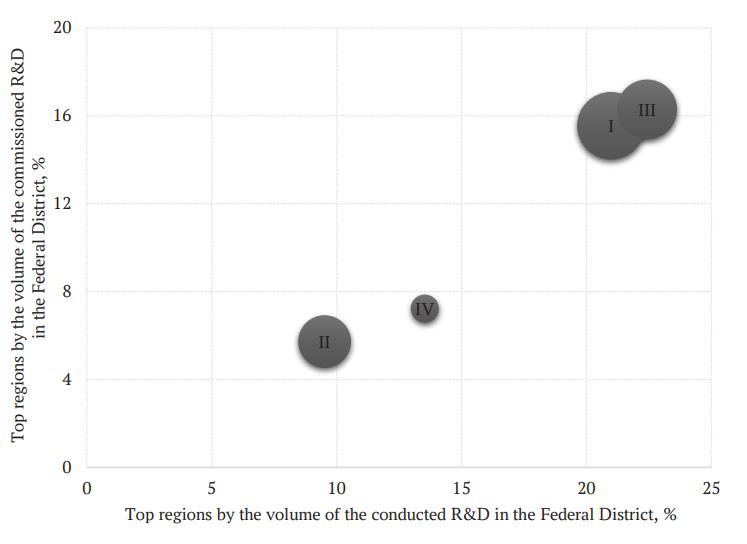
Note. The diameter of the punch indicates the share of regions leading in terms of product output in the Federal District (FD) of their total number in the FD. The leading regions for each indicator were defined as those whose share is at least 10 % of the values for the Federal District.
On average, for one customer region, there are 1.4 and 1.6 contractor regions for groups I and III of the thematic areas, while for groups II and IV of the thematic areas, this figure is higher — 2.5 and 1.8 contractor regions respectively. Thus, groups II and IV of the OKVED are characterized by a higher degree of geographic concentration of R&D financing. Similarly, when assessing the number of production regions per R&D contractor region, the leadership belongs to group II of the thematic areas (3.1) and the second place is occupied by the OKVED of groups I and III (1.7 and 1.3, respectively). As for the OKVED of group IV, the number of regions-generators of scientific knowledge and product manufacturers is almost equal (0.9).
The use of Federal Districts as units for description and analysis, despite their obvious internal economic and geographical heterogeneity, has its prerequisites. Aggregating data by Federal District simplifies the process of interpreting data within territorial communities. An alternative could be economic regions or additionally constructed territorial clusters, but a Federal District seems to be the most suitable territorial unit for the study. This is primarily due to the fact that Federal Districts are the units of government,2 which means that the findings obtained in the work can be adapted to support decision-making on the development of scientific and technological policy by the federal and regional authorities.
At the same time, a typology of regions based on their scientific specialisation was constructed during the work. This typology is an alternative to the analysis at the level of Federal Districts. It makes it possible to develop measures to support science and technology proceeding from the objective prerequisites for focal economic development and territorial irregularity of R&D demand and offer and to optimize the selections of regions for piloting measures to stimulate scientific activity. To form a typology of the Russian regions by research specialisation, a cluster analysis of the structure of research carried out in the region was conducted by using the k-means method. As a result, four clusters of regions were identified with similar parameters of specialisation of the R&D sector (Fig. 8, Table 3).
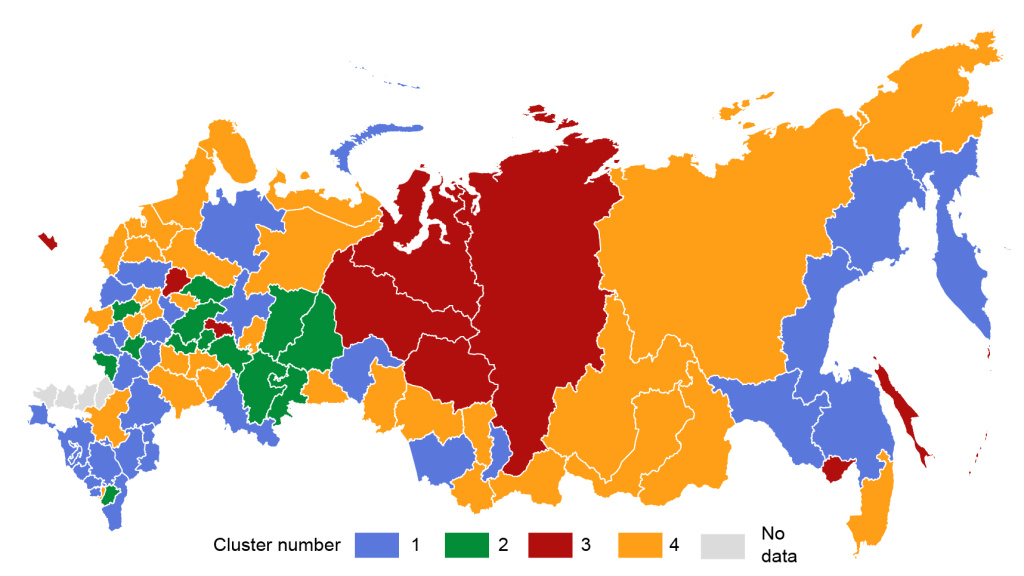
Table 3
Shares of the key industries in the structure of R&D implementation in cluster centres, %
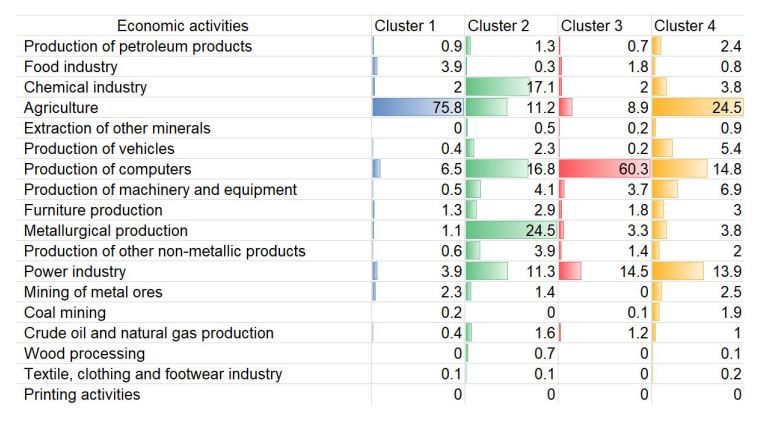
Cluster 1 (agro-industrial): It includes regions with a developed research infrastructure in agriculture and fisheries. Their predominance in the overall structure is largely due to the location of specialized institutes and research centres as well as large agricultural universities.
Cluster 2 (mechanical engineering): Large centres of metallurgy and mechanical engineering located in these regions serve their own needs for innovation on the basis of the existing network of higher education institutions and research centres.
Cluster 3 (precision engineering): It was identified on the basis of the predominance of computer technology developments aimed at federal customers. The developed research centres included in this cluster create demand from federal agencies and corporations. The key oil and gas-producing regions are primarily acceptors of innovation and do not have a self-sufficient infrastructure for conducting R&D.
Cluster 4 (diversified): This cluster includes both the innovative periphery and large centres with a diversified R&D structure. Regions of the innovation periphery do not have a pronounced specialisation. In addition to them, Cluster 4 includes several regions with centres of competence in two or more areas (the Vologda, Irkutsk, Moscow, Rostov Regions, etc.), which could not be included in other groups due to their diversity.
The discussion of the results
The study of spatial patterns of innovation activity is carried out in line with two main approaches. The Marshall-Arrow-Romer approach assumes that innovative effects on the economy are produced through the concentration of several main activities in the region. Such specialisation, subject to a common labour market and the use of internal resources, creates favourable conditions for the flow of knowledge and technology between industrial companies, which contributes to their innovation and economic growth. An alternative view draws primarily on the ideas of Jacobs and Porter and focuses on the importance of cross-industry diversity within geographically determined boundaries. This gives impetus to innovative activity through the development of the relationship of competition and cooperation between companies of different but often complementary activities.
The comparison of the performance indicators (for example, labour productivity, employment, output, etc.) with the implemented economic model in different spatiotemporal contexts does not provide a clear answer about the best approach to regional development. Such factors as the existing institutional environment [32]; the availability of resources in the region to diversify the production structure [34]; the level of development and maturity of specific types of activities; the degree of specialisation of the region [35]; the presence of specialized scientific and educational institutions that meet the needs of the economy and can strengthen innovative potential and act as drivers of innovative development of the region [36] and others are of great importance.
This study is limited by the use of generalized statistical data on economic, scientific and technological activities in the regions of the Russian Federation due to the lack of information on the actual interaction between scientific and industrial enterprises. The fact that a region has developed similar research and industrial specialisations only indicates the localization of certain competencies, knowledge and infrastructure in it, but does not prove the mutual integration of local business and science. A detailed consideration of various factors influencing industry and territorial proximity is possible only when using cases of individual regions with examples of enterprises.
Scientific and production ties can also be established between organisations with close geographical locations but with different administrative and territorial affiliations (for example, in the regions of the Russian Federation bordering each other). Such cooperation networks are of high importance in the interregional division of labour but are not the object of study in this work. This limitation is partially mitigated by additional consideration of the macro-regional context of scientific and industrial activity within the boundaries of the Federal Districts.
Another limiting factor in the study, which provides room for further scientific research, is the difficulty in considering the introduction of secondary innovations from other industries as the basis for the development of breakthrough innovations at the present stage. Methodologically, such ‘borrowings’ are difficult to predict since interactions are irregular and indirect in the form of a flow of new knowledge. In this context, the mapping of thematic and sectoral areas carried out in this work is a complex and non-trivial task. The authors are aware of the attempts to compare types of economic activity and scientific areas in other countries, but this experience cannot be fully applied to Russia which uses its own classifiers (GRNTI, OKVED).
Conclusion
The relationship between research activity, innovation activity and economic growth is non-linear. However, it is the ability to generate and commercialize new knowledge that is the key driver of regional development. The analysis of the geography of scientific research and industrial activity made it possible to assess the relationship between the economic and research specialisation of the Russian regions considering the structural differences of their economies. A positive relationship has been identified between the diversity of the thematic areas being developed in the region (in both research and economic terms) and the level of innovation activity. It is shown that in relation to the volume of output of innovative products, not only the number of leading types of activity plays a role but also the structure of the innovative economy that has developed in the region. The volume of output of innovative products is higher where a structure of an innovative economy exists. From this perspective, both a model of wide diversity and a model of a limited number of economic specialisations can be effective. Strengthening research and innovation activity, along with intensifying inter-organisational connections, creates conditions for sustainable industrial development.
The findings provide scope for further research in the field of the geography of knowledge and innovation. Below are just a few promising areas that, in our opinion, should be focused on in future work.
Firstly, it is necessary to continue work to determine the optimal criteria for the relationship between concentration and localization of research and production activities from the perspective of enhancing innovation in the region. Modern research on new industrial districts [37] supports the Marshall-Arrow-Romer approach to the importance of specialisation. At the same time, several other studies indicate the importance of ‘unrelated variety’ [38] and ‘cross-fertilization’ [39] for making breakthrough innovations, which proves the importance of cross-sectoral ties. It is important to develop a territorially adaptive approach to organizing new spatial forms of innovation activity taking into account local and industry-specific features of the innovation process.
Secondly, it is necessary to supplement current studies with an assessment of the dependence of the scientific, technological and innovation profile of a region on the level of its intellectual capital. Some earlier studies (for example, [36]) establish the relationship between the development of higher education, economic development and innovation: a higher educational institution attracts high-tech production and R&D thus creating the prerequisites for the development of a particular economy in the region, and the structure of economy determines the structure of training specialists for the corresponding profile. However, with modern advances in the information and communication sphere and transport, the distributed interregional network connections are also capable of ensuring a sufficient level of knowledge flow and diffusion of innovations through labour migration and the formation of informal business networks. It can be assumed that ‘temporary clusters [40] and organisational-cognitive proximity [41] can, under certain conditions, neutralize the factor of territorial remoteness of scientific, technological and industrial infrastructure, but this issue requires more careful study.
Thirdly, a more in-depth study of the processes of diffusion of knowledge and technology at the cross-sectoral level is required. The study shows that the economic specialisation of a region makes it possible to consolidate internal resources in just a few key activities. At the same time, the scientific sector ensures the development of primarily high-tech industries [42]. In this regard, the effects of co-development of high-tech and low-tech activities within the boundaries of the general innovation system of the region require additional study.
The research was carried out with the financial support of the Russian Science Foundation, grant № 23-27-00149 “The Eurasian vector of partnership in the mirror of interregional cooperation between Russia and India in the field of science, technology and innovation”.
Reference