Digital corporate reporting in the Baltic States: a comparative analysis in the context of the European Union


Abstract
This study provides a comparative analysis of digital corporate reporting in the Baltic States within the institutional and technological context of the European Union’s (EU) digital transformation. The research methodology is based on a comparative institutional approach and incorporates the analysis of international statistical data, as well as correlation and discriminant analyses. The institutional dimension of digital transformation is represented by the E-Government Development Index (EGDI), while the technological dimension is measured through the adoption of cloud computing technologies and Enterprise Resource Planning (ERP) systems at the enterprise level. The results indicate that, although the Baltic States benefit from relatively favourable institutional conditions for digitalisation, they exhibit substantial differences in the digitalisation of business processes and the development of digital corporate reporting. A statistically significant positive relationship was identified between EGDI scores and the use of structured forms of digital corporate reporting across EU countries (τ = 0.571; p < 0.001), as well as between the adoption of cloud computing technologies and the prevalence of such reporting forms (τ = 0.515; p = 0.002). The results of the discriminant analysis demonstrate the strong classification performance of the proposed model, which assigns EU countries to groups with relatively high and low levels of digital corporate reporting development, with an accuracy ranging from 85.2 to 88.9 %. The scientific novelty of the study lies in the development and empirical validation of an integrated model that conceptualises digital corporate reporting as an outcome of the interaction between the institutional and technological conditions of digital transformation. It also provides a comparative assessment of the Baltic States within the broader European context .
Introduction
The Baltic States occupy relatively high positions in the Global Digitalisation and Intelligence Index (GDII) for 2025. Among them, Estonia ranks highest (26th among 77 countries worldwide), being among the global leaders in digital transformation due to its advanced digital infrastructure, strong e-government indicators and broad adoption of digital technologies. Lithuania ranks 34th, while Latvia ranks 38th,1 which indicates that a certain gap in the level of digital development persists within the Baltic region. Thus, although the Baltic States all belong to the group of the most digitalised countries of Central and Eastern Europe, differences in their positions in the global ranking indicate the heterogeneity of national models of the digital transformation of the economy, which may be reflected in the digitalisation of business processes and in the development of digital corporate reporting.
According to Eurostat, in 2025 more than 52 % of enterprises in the European Union (EU) used cloud computing,2 and about 46 % used Enterprise Resource Planning (ERP) systems,3 which reflects the general trend towards the digitalisation of business processes. In the Baltic States, traditionally regarded as one of the most dynamic regions of digital development in the EU, these processes are also characterised by high intensity, but remain heterogeneous: while in Estonia in 2025 the share of enterprises using cloud technologies exceeded 60 %, in Latvia it was about 44 %, remaining below the EU average.4 This indicates substantial differences in the level of digitalisation of business processes within the region, which may also be reflected in the development of digital corporate reporting.
In the academic literature, the digitalisation of corporate reporting is considered in the context of broader processes of business digital transformation and the development of sustainable corporate governance. Several studies show that the use of digital technologies contributes to improving the quality of disclosure, increasing corporate transparency and strengthening companies’ interaction with stakeholders [1—3]. In studies devoted to the Baltic region, digitalisation is also considered an important factor in socio-economic development and the modernisation of regional economies. In particular, it is noted that the spread of digital technologies and the development of information and communication infrastructure create a basis for the transformation of economic and management processes in the region [4], while simultaneously affecting various aspects of territorial inequality towards both its reduction and increase [5; 6]. Digitalisation affects not only public administration and communication, but also the business processes of enterprises, including the preparation and dissemination of corporate information.
The Baltic States are of particular interest in this context. They share a common post-Soviet institutional heritage, function within a single European economic and regulatory space and, at the same time, form part of the broader Northern European region, which is characterised by a high level of digital development. Within the EU, the Baltic States are often regarded as one of the most dynamic and advanced regions of digital transformation, which is associated with the active introduction of e-government, the development of digital infrastructure and the widespread adoption of digital solutions in business [7—9]. At the same time, differences persist within the Baltic region in the level of digitalisation of business processes and in the practices of digital presentation of corporate information, reflecting the specific features of national models of the digital transformation of the economy. This makes the Baltic States a representative example for analysing the interaction of pan-European and national factors in the development of digital corporate reporting.
The aim of this study is to provide a comparative analysis of digital corporate reporting in the Baltic States in the EU context, with an emphasis on identifying cross-country differences within the region. The article uses a comparative institutional approach, which makes it possible to assess how the pan-European digital and regulatory environment is reflected in national practices of the digital presentation of corporate information. This approach also makes it possible to identify the specific features of the development of digital corporate reporting in the Baltic States by determining differences between them.
To achieve this aim, the study addresses the following tasks:
— to analyse theoretical approaches to the study of digital corporate reporting and the factors of its development;
— to develop a conceptual model of the relationship between the institutional and technological conditions of the digital transformation of the economy and the development of digital corporate reporting;
— to conduct a comparative analysis of the conditions of the digital transformation of the economy in the Baltic States in the EU context;
— to identify cross-country differences in the development of digital corporate reporting in the Baltic States;
— to determine the statistical relationship between the institutional and technological conditions of the digital transformation of the economy and the use of digital corporate reporting in EU countries;
— to formulate conclusions on the role of institutional and technological factors in the development of digital corporate reporting in the Baltic States.
Literature review and brief analysis
The development of digital technologies in recent decades has substantially transformed the processes of processing corporate information and preparing financial and non-financial reporting. The digitalisation of corporate reporting is considered in the academic literature as part of the broader digital transformation of business and the corporate governance system, within which traditional forms of presenting information are gradually being replaced by digital formats that provide automated data processing and more effective interaction between enterprises and stakeholders. One of the key directions of this transformation is the introduction of digital corporate reporting standards, such as XBRL, as well as the development of digital tools for the preparation and dissemination of financial and non-financial information [10; 11].
Contemporary studies emphasise that the digitalisation of corporate reporting is closely related to the general processes of business digital transformation. Digital technologies make it possible to automate the collection, processing and dissemination of corporate data, increasing the accuracy, comparability and analytical usability of disclosed information. For example, study [12] shows that the use of digital tools, including Sustainable Enterprise Resource Planning (S-ERP) systems and structured data formats, contributes to improving the quality of sustainability disclosure. The authors of [12] note that the digitalisation of reporting processes allows enterprises to generate more accurate and comparable Environmental, Social and Governance (ESG) data, which increases their usefulness for investors and other stakeholders. Similar conclusions are presented in study [13], where, based on a panel analysis of companies, it is established that a high level of digitalisation of business processes is associated with a higher quality of corporate disclosure, since digital technologies accelerate data processing and improve the accuracy of reporting indicators.
An important line of research is related to analysing the impact of digital corporate reporting on financial markets and investment decisions. In particular, the authors of study [11] examine the impact of XBRL adoption on the value relevance of accounting information in the United States and Japan. The results show that the transition to a digital format of financial reporting increases the informativeness of accounting indicators for investors and strengthens their relationship with the market value of companies. This is explained by the fact that the digital format facilitates access to data, increases their comparability and enables investors to use automated tools for information analysis. Thus, digital corporate reporting is considered an important element of the modern infrastructure of financial markets.
In addition to financial information, digitalisation also substantially affects the development of non-financial reporting, including sustainability reporting (ESG). Study [2] shows that the digitalisation of corporate processes contributes to the development of sustainability reporting practices and increases the competitiveness of enterprises. The use of digital tools allows companies to collect and analyse data related to the environmental, social and governance aspects of their activities more effectively, and also ensures more transparent interaction with stakeholders. A similar conclusion is contained in [14], where digital technologies, including artificial intelligence, blockchain and standardised data formats, are considered important tools for automating ESG reporting and increasing the transparency of corporate information.
From a theoretical point of view, digital corporate reporting is considered as the result of the interaction between technological innovations and institutional changes. The authors of study [10] note that the introduction of digital reporting standards is not only a technological innovation, but also an institutional transformation affecting the interaction between enterprises, investors, regulators and standard-setters. In particular, the digitalisation of corporate reporting requires the creation of new data standards, the development of taxonomies and changes in reporting preparation processes. This leads to a transition from traditional human-oriented documents to machine-readable data systems that can be analysed automatically by information systems [15].
An important direction of research is the analysis of the institutional conditions for the digitalisation of corporate reporting. Within institutional theory, the dissemination of digital reporting standards is explained by different forms of institutional pressure — regulatory, mimetic and normative. Empirical confirmation of this theoretical model is presented in study [16], where, based on cross-country analysis, it is shown that XBRL adoption depends on the level of technological development of the country, the degree of integration into the global system of accounting standards and the level of education. The authors of study [16] also note that regulatory pressure from international organisations is especially evident in developing countries, while in developed economies technological infrastructure and professional standards play a more significant role.
In addition to institutional factors at the macro level, the characteristics of enterprises themselves also play an important role. The results of study [17] show that the decision to introduce digital forms of corporate reporting depends on factors such as ownership structure and the level of financial leverage. Enterprises with a high debt burden and high ownership concentration demonstrate a lower propensity to use digital forms of presenting corporate information, which indicates the influence of internal incentives and corporate governance on the processes of reporting digitalisation. Similar conclusions are contained in study [18], which shows that the introduction of digital reporting standards is perceived ambiguously by enterprises in Poland: despite the advantages of digital formats, enterprises note high organisational and financial implementation costs.
The institutional environment of digitalisation of the economy and public administration plays a substantial role in the development of digital corporate reporting. In EU countries, the development of digital corporate reporting is closely related to the introduction of regulatory requirements such as the European Single Electronic Format (ESEF) and the use of XBRL for presenting financial information. Research results show that the integration of the Baltic States into the European digital ecosystem promotes the active introduction of digital technologies in public administration and business processes. For example, the analysis of values of the Digital Economy and Society Index (DESI) indicates a high level of digitalisation of infrastructure and e-government services in Estonia, Latvia and Lithuania [7; 9]. In addition, strategic digital development programmes implemented in the Baltic States are focused on integrating digital technologies into the economy, developing digital skills and introducing e-government services [8].
At the same time, digital corporate reporting does not exist in isolation from national accounting and financial reporting systems. Despite the unification of financial reporting requirements and EU regulatory initiatives, enterprises continue to function within national accounting systems that determine the procedure for forming primary information, the composition of reporting indicators and the mechanisms of interaction with public authorities [7—9]. In this regard, the digital transformation of corporate reporting affects not so much the content of accounting data as the forms of their presentation, transmission and processing. The use of standardised digital formats such as XBRL and iXBRL ensures the technological integration of different national financial reporting systems into a single digital information space, while preserving the specific features of national regulation of accounting and reporting.
The results of studies of regional digitalisation indicate that the level of diffusion of digital technologies can differ substantially between countries and regions. For example, study [4] shows that the development of digital infrastructure is an important factor in the economic modernisation of regions; however, differences in access to digital technologies form a so-called digital divide, which may limit the development of an innovative economy. Similar conclusions are contained in studies [5; 6], where it is noted that the spread of digital technologies depends on the level of economic development, the concentration of human capital and the development of infrastructure.
In post-Soviet European countries, including the Baltic region, the digital transformation of the economy is considered an important element of institutional modernisation and the formation of a modern digital environment for doing business [19—21]. The existing academic literature shows that digital corporate reporting is formed under the influence of a set of factors, including digital infrastructure, the institutional environment, regulatory requirements and the characteristics of enterprises themselves. However, most studies focus either on the technological aspects of the digitalisation of corporate reporting or on the institutional conditions of its implementation at the level of individual countries. At the same time, comparative studies devoted to analysing differences in the development of digital corporate reporting within individual EU regions, including the Baltic States, are practically absent.
This study aims to fill this gap through a comparative analysis of digital corporate reporting in the Baltic States in the EU context. The contribution of the study lies in identifying cross-country differences in the development of digital corporate reporting in the region and analysing their relationship with the institutional and technological conditions of the digital transformation of the economy. This approach makes it possible to clarify the role of the pan-European digital and regulatory environment in shaping national practices of digital presentation of corporate information and expands existing understandings of the regional specificity of the digitalisation of corporate reporting.
Conceptual framework and research methodology
This study provides a comparative analysis of the relationship between the institutional and technological conditions of the digital transformation of the economy and the development of digital corporate reporting in the Baltic States (Estonia, Latvia and Lithuania) in the EU context. Methodologically, the study combines several approaches: comparative analysis of countries using European and international indicators of the digitalisation of the economy, quantitative (in particular, correlation and discriminant) analysis of statistical data from international organisations, and expert analysis of the regulatory framework for the digitalisation of the economy and corporate reporting within the EU. The use of this set of methods makes it possible to consider digital corporate reporting as the result of the interaction between pan-European institutional conditions, the technological level of digitalisation of business processes and practices of digital presentation of information at the enterprise level.
The conceptual model of the study is based on the assumption that the development of digital corporate reporting in a particular country is determined by certain institutional and technological conditions. Within this study, these conditions of the digital transformation of the economy include two key components:
(1) digitalisation of public administration (institutional conditions of the digital transformation of the economy);
(2) digitalisation of business processes (technological conditions of the digital transformation of the economy).
These components form the institutional and technological basis for the functioning of the digital economy and create conditions for the use of digital forms of corporate reporting.
At the next stage of the analysis, practices of digital corporate reporting at the enterprise level are considered. These practices represent the result of the interaction between the institutional and technological conditions of the digital transformation of the economy and the organisational characteristics of enterprises themselves (Fig.).
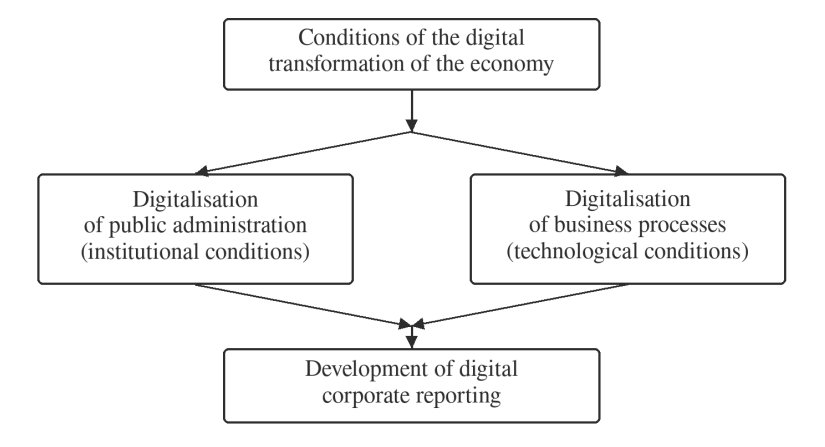
This model corresponds to the approach to analysing digital corporate reporting adopted in the academic literature, according to which the use of digital forms of presenting corporate information is determined by a combination of regulatory, technological and organisational factors [15; 16]. In particular, the development of e-government services forms the infrastructure for digital interaction between business and the state, while the digitalisation of enterprises’ business processes provides the technological basis for the automated preparation and processing of corporate information.
For the empirical interpretation of the proposed conceptual model of the study, the system of indicators presented in Table 1 is used.
Conceptual dimension | Empirical indicator | Data source |
Digitalisation of public administration | E-Government Development Index (EGDI) | UN E-Government Survey (Table 2) |
Digitalisation of business processes | Share of enterprises using cloud computing services Share of enterprises using Enterprise Resource Planning (ERP) systems | EU survey on ICT usage and e-commerce in enterprises (Eurostat) (Tables 3, 4) |
Digital corporate reporting | Use of structured forms for non-listed enterprises* Machine-readable data standards (XBRL / iXBRL) for non-listed enterprises | Authors’ expert assessments based on data from national business registers, tax authorities and digital reporting infrastructure (Table 5) |
Note: * Non-listed enterprises are enterprises without a stock-exchange listing, i. e. those not traded on a regulated market (for them, the use of digital forms of presenting corporate information is not a mandatory regulatory requirement at the EU level).
The first conceptual dimension is the digitalisation of public administration, understood as the institutional conditions of the digital transformation of the economy. To assess this aspect, the E-Government Development Index (EGDI), calculated by the United Nations, is used5. EGDI is a composite indicator that combines three key components of the development of public online services, telecommunications infrastructure and human capital.
The use of this index makes it possible to compare the level of digitalisation of public administration between countries and to assess the development of the infrastructure for electronic interaction between business and the state. For digital corporate reporting, the importance of this indicator lies in the fact that a developed e-government system provides the institutional infrastructure for using digital forms of presenting corporate information, digital business registers and online interaction between enterprises and public authorities.
The second conceptual dimension is the digitalisation of business processes, understood as a technological condition of the digital transformation of the economy. Within the study, this aspect is empirically interpreted through indicators of enterprises’ use of digital technologies, primarily:
(1) cloud computing services;
(2) ERP systems.
Cloud technologies allow enterprises to store and process corporate data in a digital environment, while ERP systems integrate the main business processes of an enterprise — accounting, resource management and financial operations — into a single information system. The use of such technologies ensures the automation of the preparation of financial and non-financial information and creates the technical basis for introducing digital forms of corporate reporting [15].
The third conceptual dimension is digital corporate reporting, which within the study is empirically interpreted as the use of digital forms of presenting enterprise information, including:
(1) structured forms for non-listed enterprises;
(2) machine-readable data standards (XBRL/iXBRL) for non-listed enterprises.
The use of structured forms of presenting corporate information for non-listed enterprises is a broader indicator, recording the presence of an institutionally established structured digital mechanism for preparing, submitting or receiving reporting for non-listed enterprises. In turn, machine-readable data standards for non-listed enterprises already refer to specific machine-readable formats — XBRL and iXBRL [10; 11]. As already mentioned above in the literature review and analysis, in EU countries digital corporate reporting is partly institutionalised through the mandatory use of XBRL (for listed enterprises under the ESEF standard.6
Expert binary coding of the above-mentioned indicators for non-listed enterprises in EU countries was carried out on the basis of the authors’ analysis of official sources — national business registers, tax authorities and digital reporting infrastructure.7 A value of 1 was assigned to a country when there was direct confirmation of a structured digital mechanism for filing reports or the use of XBRL/iXBRL in the annual reporting of non-listed enterprises; a value of 0 indicated the absence of such direct confirmation in the selected source base at the time of the analysis.
It should be noted that the indicators used refer to different observation years. This is due to differences in the periodicity of publication of international statistical data and the availability of information. In particular, EGDI data are available for 2024, indicators of the use of cloud technologies and ERP systems are for 2025, and expert assessments of digital corporate reporting were formed in 2026 on the basis of current regulatory and organisational mechanisms. Since the study is comparative and analyses relatively stable institutional and technological characteristics of countries, the time lag between individual indicators is not considered a factor that could substantially distort the results.
The proposed methodology makes it possible to analyse digital corporate reporting as a product of the interaction between the institutional and technological conditions shaping the economy’s digital transformation and enterprise practices in digitalising information systems. This approach provides the basis for a comparative analysis of digital corporate reporting in the Baltic States.
Empirical results of the study
Before presenting the empirical results of the study, it is important to emphasise that the analysis of the indicators of the Baltic States cannot be carried out in isolation, but must be considered in a broader pan-European context. This is due to the fact that Estonia, Latvia and Lithuania are part of the institutional and regulatory system of the EU, within which common standards for the digitalisation of public administration and the development of electronic services are formed. Accordingly, their digitalisation indicators, including the E-Government Development Index (EGDI), reflect not only national characteristics but also the results of integration into the pan-European digital ecosystem (Table 2).
Country | 2020, value from 0 to 1 | Rank among countries | 2022, value from 0 to 1 | Rank among countries | 2024, value from 0 to 1 | Rank among countries |
Denmark | 0.9758 | 1 | 0.9717 | 1 | 0.9847 | 1 |
Estonia | 0.9473 | 3 | 0.9393 | 8 | 0.9727 | 2 |
Finland | 0.9452 | 4 | 0.9533 | 2 | 0.9575 | 9 |
Netherlands | 0.9228 | 10 | 0.9384 | 9 | 0.9538 | 10 |
Germany | 0.8524 | 25 | 0.8770 | 22 | 0.9382 | 12 |
Sweden | 0.9365 | 6 | 0.9410 | 5 | 0.9326 | 14 |
Spain | 0.8801 | 17 | 0.8842 | 18 | 0.9206 | 17 |
Ireland | 0.8433 | 27 | 0.8567 | 30 | 0.9138 | 20 |
Lithuania | 0.8665 | 20 | 0.8745 | 24 | 0.9110 | 21 |
Austria | 0.8914 | 15 | 0.8801 | 20 | 0.9065 | 22 |
Malta | 0.8547 | 22 | 0.8943 | 15 | 0.8886 | 28 |
Latvia | 0.7798 | 49 | 0.8599 | 29 | 0.8852 | 29 |
Croatia | 0.7745 | 51 | 0.8106 | 44 | 0.8818 | 32 |
Slovenia | 0.8546 | 23 | 0.8781 | 21 | 0.8759 | 33 |
France | 0.8718 | 19 | 0.8832 | 19 | 0.8744 | 34 |
Greece | 0.8021 | 42 | 0.8455 | 33 | 0.8674 | 36 |
Poland | 0.8531 | 24 | 0.8437 | 34 | 0.8648 | 37 |
Cyprus | 0.8731 | 18 | 0.8660 | 27 | 0.8619 | 38 |
Luxembourg | 0.8272 | 33 | 0.8675 | 26 | 0.8466 | 45 |
Portugal | 0.8255 | 35 | 0.8273 | 38 | 0.8415 | 49 |
Italy | 0.8231 | 37 | 0.8375 | 37 | 0.8356 | 51 |
Czechia | 0.8135 | 39 | 0.8088 | 45 | 0.8239 | 54 |
Bulgaria | 0.7980 | 44 | 0.7766 | 52 | 0.8145 | 55 |
Belgium | 0.8047 | 41 | 0.8269 | 39 | 0.8121 | 56 |
Hungary | 0.7745 | 51 | 0.7827 | 51 | 0.8043 | 59 |
Slovakia | 0.7817 | 48 | 0.8008 | 47 | 0.8021 | 60 |
Romania | 0.7605 | 55 | 0.7619 | 57 | 0.7636 | 72 |
Compiled based on: United Nations, 2020, E-Government Survey 2020: Digital Government in the Decade of Action for Sustainable Development, New York, United Nations, URL: https://publicadministration.un.org/egovkb/en-us/Reports/UN-E-Government-Survey-2020 ; United Nations, 2022, E-Government Survey 2022: The Future of Digital Government, New York, United Nations, URL: https://publicadministration.un.org/egovkb/en-us/Reports/UN-E-Government-Survey-2022 ; United Nations, 2024, E-Government Survey 2024, New York, United Nations, URL: https://publicadministration.un.org/egovkb/en-us/Reports/UN-E-Government-Survey-2024 ; World Bank Data360, 2025, UN EGDI dataset [online], URL: https://data360.worldbank.org/en/dataset/UN_EGDI (accessed 25.03.2026).
The analysis of the data presented in Table 2 makes it possible to assess the level of digitalisation of public administration as a key institutional condition of the digital transformation of the economy. In accordance with the research methodology, this aspect is empirically interpreted through EGDI, which reflects the level of development of digital public services, telecommunications infrastructure and human capital. The results show that the Baltic States occupy relatively high positions in the global EGDI ranking, approaching EU leaders. In particular, Estonia demonstrates one of the highest levels of digitalisation of public administration, consistently ranking among the global leaders, and its indicators are comparable with those of Northern European countries such as Denmark, Finland and Sweden. Lithuania and Latvia are also characterised by substantial progress and are located in the upper part of the distribution of EU countries, although their indicators remain below the level of the most advanced Northern European countries. Thus, the Baltic States as a whole form a group of countries with particularly favourable institutional conditions for the digital transformation of the economy, while a certain differentiation by the level of development of e-government remains within the Baltic region.
For a more complete understanding of cross-country differences in digital corporate reporting, it is necessary to turn to the analysis of the technological conditions of the digital transformation of the economy, reflecting the actual use of digital technologies at the enterprise level. In accordance with the logic of the study, if Table 2 records the institutional conditions of the digital transformation of the economy, then Tables 3 and 4 present empirical indicators of technological conditions — above all the level of enterprises’ use of cloud computing and ERP systems.
Country | 2021, % | Rank among EU countries | 2023, % | Rank among EU countries | 2025, % | Rank among EU countries |
EU-27 | 40.97 | — | 45.21 | — | 52.74 | — |
Finland | 75.29 | 2 | 78.29 | 1 | 79.21 | 1 |
Italy | 60.47 | 5 | 61.39 | 6 | 75.60 | 2 |
Malta | 57.09 | 8 | 66.74 | 4 | 74.87 | 3 |
Ireland | 58.79 | 6 | 63.10 | 5 | 73.04 | 4 |
Sweden | 75.39 | 1 | 71.62 | 2 | 72.00 | 5 |
Denmark | 64.82 | 4 | 69.48 | 3 | 68.88 | 6 |
Netherlands | 64.94 | 3 | 61.19 | 7 | 68.49 | 7 |
Belgium | 52.96 | 9 | 51.69 | 11 | 61.62 | 8 |
Estonia | 57.54 | 7 | 58.57 | 8 | 60.66 | 9 |
Lithuania | 33.58 | 17 | 38.39 | 18 | 58.06 | 10 |
Czechia | 43.75 | 11 | 47.15 | 12 | 54.90 | 11 |
Poland | 28.70 | 22 | 55.67 | 9 | 54.71 | 12 |
Germany | 41.60 | 13 | 47.00 | 13 | 53.91 | 13 |
Austria | 40.40 | 14 | 46.48 | 14 | 52.08 | 14 |
Cyprus | 50.29 | 10 | 52.93 | 10 | 51.38 | 15 |
Slovenia | 42.69 | 12 | 40.21 | 17 | 48.04 | 16 |
Hungary | 26.41 | 24 | 44.94 | 16 | 47.96 | 17 |
Luxembourg | 33.48 | 18 | 37.04 | 20 | 47.70 | 18 |
Croatia | 39.15 | 15 | 45.08 | 15 | 46.61 | 19 |
Latvia | 28.55 | 23 | 35.76 | 21 | 44.08 | 20 |
Spain | 30.92 | 20 | 30.04 | 23 | 41.65 | 21 |
France | 29.35 | 21 | 26.76 | 24 | 40.41 | 22 |
Portugal | 33.37 | 19 | 37.50 | 19 | 38.71 | 23 |
Slovakia | 36.14 | 16 | 34.42 | 22 | 36.44 | 24 |
Romania | 14.14 | 26 | 18.40 | 26 | 24.94 | 25 |
Greece | 20.72 | 25 | 23.59 | 25 | 24.33 | 26 |
Bulgaria | 12.79 | 27 | 17.50 | 27 | 17.83 | 27 |
Compiled based on official statistics: European Commission (Eurostat), 2026, Digital economy and society statistics — enterprises [online data code: isoc_cicce_use], URL: https://ec.europa.eu/eurostat/statistics-explained/index.php?title = Digital_economy_and_society_statistics_-_enterprises (accessed 25.03.2026).
Country | 2021, % | Rank among EU countries | 2023, % | Rank among EU countries | 2025, % | Rank among EU countries |
EU-27 | 38.00 | — | 43.30 | — | 46.45 | — |
Denmark | 50.00 | 3 | 67.30 | 1 | 66.25 | 1 |
Belgium | 57.00 | 1 | 59.50 | 2 | 62.45 | 2 |
Spain | 49.00 | 4 | 54.60 | 5 | 60.38 | 3 |
Finland | 48.00 | 5 | 56.90 | 4 | 58.11 | 4 |
Greece | 35.00 | 16 | 45.30 | 10 | 54.84 | 5 |
France | 45.00 | 7 | 47.30 | 7 | 53.92 | 6 |
Netherlands | 43.00 | 9 | 49.90 | 6 | 52.56 | 7 |
Czechia | 38.00 | 13 | 29.00 | 23 | 49.70 | 8 |
Italy | 32.00 | 19 | 42.20 | 13 | 49.50 | 9 |
Luxembourg | 40.00 | 10 | 43.80 | 11 | 49.36 | 10 |
Portugal | 52.00 | 2 | 47.20 | 8 | 48.32 | 11 |
Malta | 39.00 | 12 | 46.50 | 9 | 46.34 | 12 |
Germany | 38.00 | 14 | 43.70 | 12 | 43.54 | 13 |
Lithuania | 45.00 | 8 | 41.90 | 14 | 41.29 | 14 |
Cyprus | 34.00 | 18 | 41.60 | 15 | 41.03 | 15 |
Poland | 32.00 | 20 | 36.00 | 18 | 39.10 | 16 |
Austria | 45.00 | 6 | 40.10 | 16 | 37.52 | 17 |
Slovenia | 36.00 | 15 | 37.00 | 17 | 35.49 | 18 |
Estonia | 23.00 | 24 | 31.10 | 21 | 35.10 | 19 |
Ireland | 24.00 | 23 | 30.20 | 22 | 33.83 | 20 |
Latvia | 39.00 | 11 | 34.00 | 20 | 32.12 | 21 |
Hungary | 21.00 | 26 | 35.20 | 19 | 30.85 | 22 |
Romania | 17.00 | 27 | 22.60 | 26 | 29.28 | 23 |
Sweden* | 35.00 | 17 | 58.60 | 3 | 28.07* | 24 |
Slovakia | 31.00 | 21 | 26.20 | 24 | 26.68 | 25 |
Bulgaria | 22.00 | 25 | 21.70 | 27 | 26.64 | 26 |
Croatia | 24.00 | 22 | 25.40 | 25 | 21.89 | 27 |
Note: * For Sweden, the indicator of ERP-system use in 2025 is not strictly comparable with the previous values of the series because of a break in the time series associated with the introduction of the statistical unit enterprise into national statistical practice. Therefore, the change in the value should not be interpreted as a direct actual decrease in the level of ERP-system use.
Compiled from official statistics: European Commission (Eurostat), 2026, Enterprises having ERP software package (isoc_eb_iip) [data set], URL: https://ec.europa.eu/eurostat/databrowser/view/isoc_eb_iip/default/table?lang = en (accessed 25.03.2026).
The data presented in Table 3 on the proportion of enterprises using cloud computing services provide a basis for assessing the digitalisation of business processes as a key technological condition for the digital transformation of the economy. EU countries show a steady positive dynamic in the spread of cloud technologies: the EU average increased from 40.97 % in 2021 to 52.74 % in 2025, indicating the systemic growth of business digitalisation.
A positive dynamic is also recorded in the Baltic States, but it is markedly heterogeneous. Estonia consistently belongs to the group of countries with a high level of use of cloud services (60.66 % in 2025), being located in the upper part of the distribution of EU countries and approaching the indicators of the most digitalised countries in Europe. Lithuania demonstrates the most substantial growth (from 33.58 % to 58.06 %), effectively reducing the gap with EU leaders. At the same time, Latvia, despite positive dynamics, remains below the EU average (44.08 % in 2025), indicating a slower pace of the digitalisation of business processes.
Thus, unlike the relatively high and more even level of institutional conditions for digitalisation recorded in Table 2, the level of technological conditions shows more pronounced differentiation between the Baltic States. This indicates that, even when operating in a single pan-European institutional space, the level of adoption of digital technologies by enterprises remains heterogeneous, which may be an important factor in differences in the development of digital corporate reporting in the Baltic region.
The data presented in Table 4, showing the proportion of enterprises using ERP systems, provide a basis for a further assessment of the digitalisation of business processes as a technological condition for the digital transformation of the economy. EU countries show moderate but stable growth in the use of ERP systems: the average indicator increased from 38.0 % in 2021 to 46.45 % in 2025, which indicates the gradual integration of digital solutions into the management of corporate resources and the internal business processes of enterprises.
In the Baltic States, the situation is also characterised by positive dynamics, but remains heterogeneous. Lithuania demonstrates the highest indicators among the countries of the region (41.29 % in 2025), approaching the EU average. At the same time, Estonia and Latvia remain below this level (35.10 % and 32.12 %, respectively), indicating a more limited spread of ERP systems compared with some other EU countries. At the same time, unlike the indicators for the use of cloud technologies (Table 3), where Estonia holds stronger positions, in the use of ERP systems it is not the undisputed leader of the region, which indicates differences in the structure of the digitalisation of business processes.
Thus, the results presented in Table 4 confirm that the technological conditions underpinning the digital transformation of the Baltic States vary not only across the countries of the region but also according to the types of digital technologies employed. This indicates the heterogeneity of the digitalisation of business processes at the enterprise level and emphasises that different components of digital transformation (cloud technologies and ERP systems) develop with different intensity, which may affect the formation of digital corporate reporting practices in different ways.
Moving from the analysis of the institutional and technological conditions of the digital transformation of the economy to the direct assessment of digital corporate reporting, it should be noted that Tables 3 and 4 reflect only the prerequisites for its development at the enterprise level. In this regard, Table 5 represents the next stage of the empirical analysis, recording not the conditions but the actual development of digital corporate reporting through the use of structured forms of presenting information and machine-readable data standards (XBRL/iXBRL) for non-listed enterprises.
Country | Structured forms for non-listed enterprises | Machine-readable data standards (XBRL/iXBRL) for non-listed enterprises |
Austria | 0 | 0 |
Belgium | 0 | 1 |
Bulgaria | 0 | 0 |
Hungary | 0 | 0 |
Germany | 1 | 1 |
Greece | 0 | 0 |
Denmark | 1 | 1 |
Ireland | 1 | 1 |
Spain | 1 | 1 |
Italy | 1 | 1 |
Cyprus | 0 | 0 |
Latvia | 0 | 0 |
Lithuania | 1 | 0 |
Luxembourg | 0 | 0 |
Malta | 0 | 0 |
Netherlands | 1 | 1 |
Poland | 1 | 0 |
Portugal | 0 | 0 |
Romania | 0 | 0 |
Slovakia | 0 | 0 |
Slovenia | 0 | 0 |
Finland | 1 | 0 |
France | 0 | 0 |
Croatia | 0 | 0 |
Czechia | 0 | 0 |
Sweden | 1 | 0 |
Estonia | 1 | 1 |
Note: * A value of 1 was assigned when there was direct confirmation in official sources; a value of 0 indicates the absence of such direct confirmation in the selected source base at the time of verification.
Source: authors’ expert assessments based on data from national business registers, tax authorities and digital reporting infrastructure.
The data presented in Table 5 allow for a direct assessment of the development of digital corporate reporting across EU countries, which this study regards as a key outcome of the digital transformation of the economy. The results indicate significant heterogeneity among EU countries: only a limited number of countries (for example, Estonia, Germany, Denmark, the Netherlands, Spain, Ireland and Italy) demonstrate the simultaneous use of both structured forms of presenting corporate information and machine-readable data standards (XBRL/iXBRL), while in most countries these practices are either implemented only partially or are absent.
A clearly expressed differentiation is observed in the Baltic States. Estonia demonstrates the highest level of development of digital corporate reporting, combining the use of structured forms and machine-readable data standards for non-listed enterprises. Lithuania is characterised by the partial introduction of digital mechanisms (the presence of structured forms in the absence of XBRL), whereas in Latvia no recorded systemic practices of digital presentation of corporate information for this category of enterprises are present.
Despite operating within a common European institutional and regulatory space, the Baltic States continue to differ considerably in the level of development of digital corporate reporting. A comparison of the results with the data in Tables 2—4 shows that the presence of favourable institutional conditions and a relatively high level of digitalisation of business processes does not automatically lead to the formation of developed practices of digital presentation of corporate information. This indicates the existence of a gap between the conditions of the digital transformation of the economy and their implementation at the level of corporate reporting, which is one of the key conclusions of this study.
To summarise the results obtained and to compare the Baltic States within a single analytical model, Table 6 presents a summary system of empirical indicators combining the institutional, technological and outcome characteristics of the digital transformation of the economy. This table makes it possible to integrate the results of the analysis in Tables 2—5 and to identify the relationship between the overall level of digitalisation of the economy and the development of digital corporate reporting in the Baltic States.
Empirical indicator | Estonia | Latvia | Lithuania |
Institutional conditions of the digital transformation of the economy | |||
E-Government Development Index (EGDI), from 0 to 1 | 0.9727 | 0.8852 | 0.9110 |
Technological conditions of the digital transformation of the economy | |||
Share of enterprises using cloud computing services, % | 60.66 | 44.08 | 58.06 |
Share of enterprises using ERP systems, % | 35.10 | 32.12 | 41.29 |
Development of digital corporate reporting | |||
Use of structured forms for non-listed enterprises, 0 or 1 | 1 | 0 | 1 |
Use of machine-readable data standards (XBRL/iXBRL) for non-listed enterprises, 0 or 1 | 1 | 0 | 0 |
Compiled based on data from Tables 2—5.
The analysis of the summary data presented in Table 6 makes it possible to comprehensively compare the institutional, technological and outcome aspects of the digital transformation of the economy in the Baltic States. The results show that, with a relatively similar level of institutional conditions for digitalisation (according to the EGDI indicator), substantial differences are observed between the countries of the region at the level of technological conditions and, especially, in the development of digital corporate reporting.
Estonia demonstrates the most balanced model of digital transformation, combining a high level of digitalisation of public administration, significant spread of cloud technologies and the presence of both structured forms and machine-readable standards of corporate reporting. Lithuania and Latvia are characterised by less balanced models: with rather high institutional indicators and the development of individual components of the digitalisation of business processes, the level of digital corporate reporting remains partial (in the case of Lithuania) or limited (in the case of Latvia).
The results of the summary analysis confirm that, even within a single pan-European institutional and regulatory space, the Baltic States demonstrate differences in the extent to which institutional and technological conditions of digitalisation are transformed into practices of digital presentation of corporate information. This indicates that the development of digital corporate reporting is determined not only by the level of digitalisation of the economy as a whole, but also by additional factors associated with national specificities in the introduction of digital solutions by enterprises and in the institutional environment of their use.
To test the identified relationships on a broader sample of EU countries and to quantitatively assess the influence of institutional and technological factors on the development of digital corporate reporting, Table 7 presents the results of the correlation analysis. This stage of the study makes it possible to move from descriptive comparison to statistical testing of hypotheses on the relationship between the conditions of the digital transformation of the economy and the practices of digital corporate reporting.
Condition of digitalisation of the economy | Use of structured forms | Use of machine-readable data standards (XBRL/iXBRL) for non-listed enterprises | ||
Kendall’s correlation coefficient | Statistical significance (two-tailed) | Kendall’s correlation coefficient | Statistical (two-tailed) | |
E-Government Development Index (EGDI) | 0.571** | < 0.001 | 0.346* | 0.034 |
Share of enterprises using cloud computing services | 0.515** | 0.002 | 0.364* | 0.026 |
Share of enterprises using ERP systems | 0.193 | 0.236 | 0.329* | 0.044 |
Note: * Correlation is significant at the 0.05 level (two-tailed). ** Correlation is significant at the 0.01 level (two-tailed).
Calculated using IBM SPSS Statistics based on data from Tables 2—5.
The results of the correlation analysis presented in Table 7 allow for a quantitative assessment of the relationship between the institutional and technological conditions shaping the digital transformation of the economy and the level of development of digital corporate reporting across EU countries. The obtained values of Kendall’s correlation coefficient indicate a statistically significant positive relationship between the level of digitalisation of public administration (EGDI) and the use of both structured forms (τ = 0.571, p < 0.001) and machine-readable data standards (τ = 0.346, p < 0.05). This indicates the important role of the institutional environment in shaping digital reporting practices. Similarly, the share of enterprises using cloud technologies also demonstrates a significant positive correlation with both indicators of digital corporate reporting (τ = 0.515, p < 0.01 and τ = 0.364, p < 0.05, respectively), which confirms the significance of the digitalisation of business processes as a technological factor. At the same time, the influence of ERP systems is less pronounced: a statistically significant relationship is observed only for machine-readable standards (τ = 0.329, p < 0.05), whereas it is absent for structured forms. Taken together, this makes it possible to conclude that the strongest influence on the development of digital corporate reporting is exerted by institutional conditions and the level of use of cloud technologies, while the role of ERP systems is more limited.
To further deepen the analysis and identify factors that statistically significantly determine whether countries belong to the group with developed or undeveloped digital corporate reporting, the study applies discriminant analysis. Unlike correlation analysis, which makes it possible to identify the presence of relationships between variables, this method allows their combined influence to be assessed and the “discriminating” factors that ensure the classification of countries by the level of development of digital corporate reporting to be determined.
The first two results of the discriminant analysis, presented in Tables 8 and 9, are test results and indicate the possibility of applying discriminant analysis in this form to the given sample of 27 countries. The classification results are then presented in Table 10.
Classification criterion | Function | Eigenvalue | % of variance | Cumulative % | Canonical correlation* |
Use of structured forms for non-listed enterprises | 1 | 1.208 | 100.0 | 100.0 | 0.740 |
Use of machine-readable data standards (XBRL/iXBRL) for non-listed enterprises | 1 | 0.444 | 100.0 | 100.0 | 0.554 |
Note: * Correlation coefficient between the values of the discriminant function and the actual membership of a case (i. e. country) in the group.
Calculated using IBM SPSS Statistics based on data from Tables 2—5.
The correlation coefficient between the calculated values of the discriminant function and actual group membership, equal to 0.740 for classification by the criterion of the use of structured forms for non-listed enterprises and 0.554 for classification by the criterion of the use of machine-readable data standards (XBRL/iXBRL) for non-listed enterprises (Table 8), is satisfactory.8
Classification criterion | Test of function(s) | Wilks’ Lambda | Chi-square | Degrees of freedom | Statistical significance, p |
Use of structured forms for non-listed enterprises | 1 | 0.453 | 18.615 | 3 | <0.001 |
Use of machine-readable data standards (XBRL/iXBRL) for non-listed enterprises | 1 | 0.693 | 8.633 | 3 | 0.035 |
Calculated using IBM SPSS Statistics based on data from Tables 2—5.
The test conducted using Wilks’ Lambda to determine whether the mean values of the discriminant function differ significantly in the two groups of countries — “with developed digital corporate reporting” and “without developed digital corporate reporting” — showed a statistically significant result (p < 0.001 according to the criterion of the use of structured forms for non-listed enterprises and p < 0.05 according to the criterion of the use of machine-readable data standards (XBRL/iXBRL) for non-listed enterprises) (Table 9).
The main result of discriminant analysis is the classification table showing the accuracy of the forecasts made (Table 10), i. e. the real “discriminant power” of all potential “discriminating” factors included in the analysis.
Classification criterion | Original group membership | Predicted group membership | Total | ||
Countries | Countries with developed digital corporate reporting | ||||
Use of structured forms for non-listed enterprises | Number | Countries without developed digital corporate reporting | 14 | 2 | 16 |
Countries with developed digital corporate reporting | 2 | 9 | 11 | ||
% | Countries without developed digital corporate reporting | 87.5 | 12.5 | 100.0 | |
Countries with developed digital corporate reporting | 18.2 | 81.8 | 100.0 | ||
Use of machine-readable data standards (XBRL/ iXBRL) for non-listed enterprises | Number | Countries without developed digital corporate reporting | 16 | 3 | 19 |
Countries with developed digital corporate reporting | 0 | 8 | 8 | ||
% | Countries without developed digital corporate reporting | 84.2 | 15.8 | 100.0 | |
Countries with developed digital corporate reporting | 0.0 | 100.0 | 100.0 | ||
Calculated using IBM SPSS Statistics based on data from Tables 2—5.
The classification results obtained in the discriminant analysis and presented in Table 10 show that, in the group of countries without developed digital corporate reporting, 14 out of 16 countries (i. e. in 87.5 % of cases) were correctly assigned to this group by the discriminant analysis model according to the criterion of the use of structured forms for non-listed enterprises, and 16 out of 19 countries (i. e. in 84.2 % of cases) according to the criterion of the use of machine-readable data standards (XBRL/iXBRL) for non-listed enterprises. Two cases out of 16 (12.5 %) according to the criterion of the use of structured forms for non-listed enterprises and three cases out of 19 (15.8 %) according to the criterion of the use of machine-readable data standards (XBRL/iXBRL) for non-listed enterprises were incorrectly assigned to the group of countries with developed digital corporate reporting. In turn, in the group of countries with developed digital corporate reporting, two cases out of 11 (18.2 %) according to the first criterion were incorrectly assigned to the “wrong” group, but in nine cases out of 11 (i. e. for 81.8 % of countries) according to the first criterion and in all eight cases (i. e. for 100.0 % of countries) according to the second criterion, it was correctly predicted that they would fall into the group with developed digital corporate reporting.
The final result of applying discriminant analysis is the average level of correct forecasts for each case falling into the corresponding group of countries: without developed digital corporate reporting or with developed digital corporate reporting. In this case, 85.2 % of the original observations according to the criterion of the use of structured forms for non-listed enterprises were classified correctly, and 88.9 % according to the criterion of the use of machine-readable data standards (XBRL/iXBRL) for non-listed enterprises. This is a high rate of correct forecasts9, indicating that in 85 % of cases according to the first criterion and in 89 % according to the second, it is possible to determine the level of development of digital corporate reporting in a country by knowing only the empirical indicators of the institutional and technological conditions of the digital transformation of the economy in that country.
Taken together, the results of the empirical analysis confirm the conceptual assumption that the development of digital corporate reporting is the result of the interaction between institutional and technological conditions of the digital transformation of the economy. The comparative analysis showed that, despite relatively similar levels of institutional digitalisation (as measured by the EGDI), the Baltic States demonstrate substantial differences in the level of digitalisation of business processes and, especially, in the spread of digital forms of corporate reporting. Correlation and discriminant analyses confirmed that the most significant factors in the formation of digital corporate reporting in EU countries are the development of e-government and the level of use of cloud technologies, whereas the influence of ERP systems is more limited. At the same time, the results obtained show that, even in the presence of favourable institutional and technological conditions, their transformation into practices of digital presentation of corporate information is heterogeneous, which is manifested in differences between the Baltic States and indicates the significance of additional factors determining the use of digital corporate reporting at the enterprise level.
Discussion of the results
The results of contemporary research confirm that the digitalisation of corporate reporting is accompanied by a transition from traditional documents to digital formats that ensure automated data processing and comparability [15]. Within institutional theory, this process is explained by the influence of regulatory, mimetic and normative pressure [22], which is also empirically confirmed in our study. In particular, the statistically significant relationship identified between the level of digitalisation of public administration and the development of digital corporate reporting points to the key role of institutional factors in stimulating the presentation of enterprise information in digital form.
Along with the institutional and technological conditions of the digital transformation of the economy, the characteristics of enterprises themselves play an important role. As the results of studies [17; 18] show, ownership structure, financial leverage and organisational costs can substantially influence the introduction of digital forms of presenting corporate information. Our results confirm these conclusions: despite the presence of a developed institutional environment, the comparatively low level of use of cloud technologies and ERP systems in Latvia limits the possibilities for the digitalisation of corporate reporting. This indicates that institutional conditions by themselves are not sufficient for the formation of digital reporting practices, while technological conditions play a key role; however, their influence is realised only when enterprises have the corresponding organisational readiness.
A substantial theoretical development of this problem is presented in study [21], which introduces the concept of ‘digitainability’, combining digitalisation and sustainable development. In this context, digital corporate reporting is considered as the result of synergy between digital technologies, data processing systems and sustainable business processes. An important role is assigned to iXBRL as the technological basis for structuring ESG data. The results of our study make it possible to complement this approach by showing that ‘digitainability’ is formed not only at the level of individual companies but also at the level of national institutional and technological systems.
At the same time, as the results of study [23] show, the introduction of digital standards does not automatically guarantee an improvement in the quality of reporting. The use of extensions, a lack of competences and dependence on external providers can reduce data comparability and increase the complexity of their interpretation. These conclusions are consistent with the results of our study, which found that even when digital mechanisms are present (for example, in individual EU countries), a high variability of practices of presenting corporate information remains. This indicates that the digitalisation of corporate reporting is not only a technological but also a socio-technical process requiring the coordination of standards, competences and organisational practices.
The results obtained suggest that the identified patterns are not exclusively a feature of the Baltic States. An analysis of the indicators of Central and Eastern European countries indicates that, even in the presence of relatively favourable institutional conditions for digitalisation, the level of development of digital corporate reporting may differ substantially. For example, Poland demonstrates a higher level of implementation of digital forms of corporate reporting, whereas some other post-socialist EU countries — such as Bulgaria, Hungary, Romania, Slovakia and Czechia — retain limited use of structured and machine-readable formats for presenting corporate information (Table 5). This conclusion is consistent with the results of studies of digital transformation in Central and Eastern European countries [24; 25], according to which the countries of the region are characterised by significant heterogeneity of institutional and technological development, and the influence of digitalisation on economic modernisation depends not only on the level of adoption of digital technologies, but also on the quality of the institutional environment and the specific features of national development models. Consequently, the relationship between the digitalisation of the economy and the development of digital corporate reporting is of a more general nature and is not limited exclusively to the Baltic region, reflecting broader processes of digital transformation characteristic of post-socialist EU countries.
Conclusion
The study was aimed at analysing digital corporate reporting in the Baltic States in the context of the institutional and technological conditions of the digital transformation of the European Union economy. The use of a comparative institutional approach, as well as a combination of quantitative (correlation and discriminant) and qualitative methods of analysis, made it possible to comprehensively assess the relationship between the level of digitalisation of public administration, the digitalisation of business processes and the development of digital forms of presenting corporate information.
The results showed that, with a relatively similar level of institutional conditions for digitalisation (using the E-Government Development Index as an example), the Baltic States demonstrate differences in technological conditions and, especially, in the development of digital corporate reporting. Estonia is characterised by the highest level of development of digital corporate reporting, whereas in Lithuania the relevant practices are introduced only partially, and in Latvia their spread remains limited. This confirms that, even within a single EU institutional space, the level of digitalisation of business processes and the introduction of digital forms of presenting information remain heterogeneous.
The results of the correlation analysis revealed a statistically significant positive relationship between the level of digitalisation of public administration, the use of cloud technologies and the development of digital corporate reporting, whereas the influence of ERP systems was less pronounced. Discriminant analysis confirmed the high explanatory power of the selected factors, ensuring an accuracy of country classification by level of development of digital corporate reporting of more than 85 %.
The scientific novelty of the study lies in the development and empirical testing of an integrated model that considers digital corporate reporting as the result of the interaction between the institutional and technological conditions of the digital transformation of the economy, as well as in the comparative analysis of the Baltic States within the pan-European space. An additional contribution is the testing of empirical indicators of digital corporate reporting for non-listed enterprises.
The practical significance of the results lies in substantiating the need for the coordinated development of the institutional environment and the technological base of digitalisation. The results show that the presence of a developed institutional environment alone does not guarantee the formation of digital corporate reporting without a sufficient level of digitalisation of business processes and organisational readiness of enterprises.
The limitations of the study include the use of expert assessments to measure digital corporate reporting and the limited sample of countries. In this regard, promising directions for further research include analysing the influence of organisational factors on the introduction of digital forms of reporting, studying the role of new digital technologies, and assessing the quality and comparability of data generated within digital standards.
Thus, the development of digital corporate reporting is a complex process that depends on the interaction between the institutional and technological conditions of the digital transformation of the economy, as well as on the ability of enterprises to integrate digital tools into the practice of presenting corporate information.
Reference