Integration in crisis: towards a new explicative model


Abstract
The goal of this study is to investigate the non-linear impact of crises on integrative structures through theoretical, empirical, and comparative analysis of four cases. This paper proposes a novel explanatory model of how integrative structures respond to various crisis junctures. The authors test the hypothesis that it is not the nature or intensity of the crisis, but rather the maturity and depth of integrative groupings’ institutional arrangements — along with the actual balance of power between governance levels—that ultimately determine whether the organization consolidates further or begins to disintegrate. Based on a survey of 409 specifically selected experts on integration, the study reveals that strongly integrated unions tend to strengthen during crises but often experience disintegrative backlash once the crisis subsides. Conversely, weakly integrated unions tend to loosen their ties during crises but regain their capacity for cooperation shortly thereafter. This model is explored through four case studies that consider how the 2022 and ongoing Ukraine conflict affected the EU (with a special focus on the energy crisis), NATO, BRICS and a quasi-integrated network of world-class universities. The findings show that policy responses to crises should be specifically calibrated to the integration model that the organisation follows.
Introduction
The French diplomat Jean Monnet, a staunch supporter of European integration whose ideas originally inspired the Schuman Plan to unite the French and German national production of coal and steel, is famous for his inspirational words on European integration. Although he predicted that Europe would be built through a chain of reactions to crises [1], he gave little consideration to the potential damage such crises could inflict on integrative structures. While historical analyses of integration processes in the literature suggest that, in some cases, crises may drive partners toward a more institutionalised framework of cooperation (‘an ever closer Union’), other cases indicate that crises can result in the rupture of the cooperative fabric. In studying this phenomenon, experts have pointed out that the reaction to a crisis may depend on the nature of the challenge, with Schimmelfennig [2] arguing that while ‘failures’ entail further capacity-building, ‘attacks’ only enable pre-existing coping mechanisms and are consequently more harmful to integration. The limit to this perspective is that a majority of crises are both failures and attacks, as these two types of crisis amplify one another.
In this paper, we test the hypothesis that the nature of the organisation and the level of integration are more relevant in the prediction of the impact of a crisis than the nature of the challenge itself or its intensity. Consideration is given both to the immediate response and to the medium to long-term consequences of crises. The paper proposes an original definition of integration — a phenomenon that is commonly described in the expert literature as the process whereby neighbouring countries deliberately transfer parts of their decision-making authority to a supranational entity through a combination of formal agreements and informal arrangements. From our viewpoint, integration does not necessarily require centralised (supranational or intergovernmental) governance, nor does it have to occur exclusively between neighbouring states. Still, some involvement by national governments may occur (so called “steering at a distance”) even when integration is primarily advanced by private actors or on a micro-level.
In line with our understanding integration can be defined as the development of common institutions and rules in different sectors by actors from various countries, which leads to a mutual dependence and preferentiality in mutual dealings. We hence consider the EU, NATO, BRICS and coordination among world-class universities in higher education to be integrative structures with varying levels of institutionalisation. The terms ‘integration in higher education’ and ‘world-class universities’ [6] are used interchangeably to refer to the fourth case, and designate the deep cooperation processes and implementation of common institutions that have created a mutual dependence between universities across the world.1 The study focuses on these four specific integrative structures, but the findings apply to other entities presenting similar characteristics.
We use a mixed-methods three-level research design, based on a theoretical, comparative and empirical investigation of crisis and integration. The data collection process, comprising 409 expert standardised survey responses and individualised comments, yields information on how organisations with different levels of integration react to crises over time. Respondents, hailing from 83 different countries, were selected based on their expertise on one of the four cases following strict criteria and are either reputable academics or professional diplomats. The findings show that strongly integrated unions gain in power in times of crisis but suffer from disintegrative backlash after the crisis has run its course. Conversely, weakly integrated unions experience a loosening of their ties in times of crises but recover rapidly thereafter their capacity to pursue cooperation. The novelty of this perspective lies in the medium to long-term analysis of the impact of crises, which can have a greater influence on the structure of an organisation than immediate reactions to a crisis. It also highlights the mechanisms at play behind the belated consequences of crises.
The remainder of this paper proceeds in four sections: a review of the expert literature on crises and integration is followed by an analysis of the research goals and design of the study. The findings, presented with illustrative quotes and graphs, precede a discussion section which includes policy recommendations.
Integration and crisis
Integration takes many different shapes and forms, leading to a variety of different definitions of the term. The scholarly emphasis on European integration has resulted in a constricted conceptual scope, often making it challenging to apply the term to broader or more flexible forms of integration.
A historical overview of the literature yields some theoretical insights: Ernst Haas’s 1958 definition of integration as “a process whereby political actors in several, distinct national settings are persuaded to shift their loyalties, expectations and political activities toward a new centre, whose institutions possess or demand jurisdiction over the pre-existing national states” [3] has the advantage of combining both the social and political dimensions of integration. Intergovernmentalism places a stronger focus on political aspects of integration and the creation of joint institutions, and this will be the primary focus of this paper. Although behavioural parameters are not overlooked, a definition that focuses on social aspects of integration is too restrictive and leaves out some interesting cases. Integration is best considered as a process that governments embark on, a voluntary and reversible delegation of decision-making power to a supranational entity. While both neofunctionalists and intergovernmentalists view integration as a process rather than as a political outcome, other authors, specifically specialists of the EU, have taken an interest in the ultimate political form the EU may come to take [4]. Experts concentrating on the EU integration offer very specific analytical insights on integration, which are not always applicable across the spectrum of different integration cases [5].
There is practical merit in studying different types of integration trends, and to analyse comparative integration as it helps to explain how different organisations are likely to evolve. The neofunctionalist spill-over described by Haas was later applied to other cases of integration elsewhere in the world, specifically to Latin America [7]. The question whether the economic integration of a group of countries will lead to greater political unity is answered negatively by Haas and Schmitter [8], who note that accelerated integration results from a rather rare combination of circumstances, referred to as a ‘creative crisis’, that make members realise they fare better as a group in mitigating the impact of a problem than alone or with a different set of partners. The deepening of integration appears as an exception rather than a rule and it was noted that integration is a process that shows little continuity, that it can flow backwards and that each region that undergoes integration processes follow an individual set of mechanisms, meaning that there is as such no ‘theory of integration’ that would be universally applicable [9]. The existing theoretical perspectives on integration were developed, however, in parallel with the unification of European countries: the optimism of the early years of the European Coal and Steel Community, which evolved into the European Economic Community, was a time of avid academic interest in how the integration would develop. However, the crisis of the 1960s characterised by the French resistance to qualified majority voting and the 1966 compromise that ensued in which the six members “agreed to disagree” marked the start of a standstill in the academic world with some authors theorising the stalling and even reversal of integration such as Lindberg and Scheingold with their work
Europe Would-Be Polity published in 1970. Haas himself expressed disappointment in the integration process in Europe, with a fundamental work on ‘the obsolescence of regional integration’ [10]. The disappointment in the stagnation of the European project was short-lived, and the resistance of General De Gaulle to the development of integration beyond intergovernmentalism came to an end as he left power. Some authors noted that the 1970s were not a time of stagnation but of preparation for the next stage of integration, which was misread at the time by many politicians and experts [11]. With the adoption of the Single European Act, then in 1991 the Maastricht Treaty, integration restarted in Europe and academic interest in the subject once again blossomed [5].
A number of new ideas emerged alongside the hypothesis that legal integration could represent the next stage beyond economic integration [7]. The theoretical development of integration theory was divided into three phases by Wiener [12]. The first phase, ‘explaining integration’, began in the 1960s and focused on understanding the underlying reasons for integration processes. The second phase, ‘analysing governance’, dates from the 1980s and aims to interpret the EU as a political entity by examining its internal political dynamics and the functioning of its regulatory frameworks [12]. The third phase, ‘constructing the EU’, started in the 1990s and addresses the consequences of integration as well as the potential generalisability of the integration phenomenon. The theory of integration has thus evolved from liberal and realist paradigms (depending on the author) toward approaches grounded in policy analysis, social constructivism, normative theory, and political economy [12]. Wiener underscores the absence of stagnation in the academic development of integration theory and characterises the post-1970s period as especially productive in terms of conceptual understanding of integration processes.
The earliest ideas on integration predate the European project only by a few years. Liberal approaches to IR criticised the realist approach to state sovereignty and noted that the world would be more peaceful if transnational organisations were capable of putting pressure on states [13]. The focus was more on developing global forms of cooperation than regional ones, although there were some developments in the study of federalism. The study of integration took off in the 1950s and especially 1960s with a focus on the potential of developing supranational institutions in different policy areas that would ‘spill-over’ to other areas, leading to a reinforcement of supranational commitments [14]. Functional spill-overs refer to the way in which policymaking in one sphere, as it naturally develops, comes to encompass other sectors. For example, a joint economic policy often leads to the development of joint legislation to regulate economic practices. Political spill-overs result from the shift in identities of actors that have started an integration process; in short, the more you integrate, the further you wish to deepen your commitments. Cultivated spill-overs were also identified and result from the desire of supranational institutions to increase their power and increase the number of issues subject to joint governance [15].
This period comprised attempts to theorise integration beyond Europe and to define the features underlying successful integration processes. The theory of transactionalism developed by Deutsch predicted the advent of a period of intense transnational communications that would create a greater solidarity between people beyond national borders [16]. Other scholars suggested that sovereignty was being temporarily pooled by governments rather than renounced, with some suggesting that integration could in the end reinforce the power of sovereign states rather than reduce it [17]. Moravcsik has a state-centric approach and underlines the importance of non-coercive interstate bargaining in integration processes [18]. He argues that European integration did not result from geopolitical or ideological factors but from the appeal of transactional gains. The perspective rejects the idea of path dependence linked to integration and the notion of neo-functionalist spill-over. A separate line of thought emphasised the state being challenged by supra- and sub-national entities, and slowly falling into decay. Rosenau described these changes as “turbulence in world politics” and writes about the “aggregation of parts and the disaggregation of wholes” [19]. Scholars also argued that integration processes could never be entirely controlled by the states participating in them, and that a return to the situation pre-integration was not possible [20]. Supranational institutions allow states to reduce uncertainty but create a level of dependence unrecognised by intergovernmentalists.
The second stage of theorisation of integration led to more interdisciplinarity and a better understanding of the functioning of the European entity. Academic research focused on dissecting the new institutions which appeared to have emerged out of nowhere. In ‘the anatomy of an institution’, the different levels of governance were explored and compared to a network with official and non-official vectors of influence [21]. Ruggie explained the appearance and development of the EU by the uptake of new norms and regimes which came to govern the international system as a whole but also facilitated the development of regional cooperation [22]. Different supranational institutions were seen as supporting each other, and the integrated Europe was described as a pillar of NATO. As the EU moved forward after 1992, attention was given to the maintenance of good governance within the organisation with the theorisation of the ‘democratic deficit’ and the need for transparency in the work of supranational entities, particularly the European Commission [23].
The advent of constructivism in the 1990s opened a new path of investigation into integration processes. The new focus on agency, identity, norms and social behaviour paved the way for a new analysis of the reasons behind the European construction [24]. The main debates amongst policymakers and governments about widening versus deepening commitments in the EU and about resource redistribution led to an increased academic attention to the future format of
Europe [ 25]. Studies on rule violations by EU member states have shown that such conflicts are often followed by the activation of ‘decompression mechanisms’, after which the Union implements policies allowing for differentiation among members [26]. The acceptance of diversity, along with the idea of multi-speed integration, has thus emerged as a pragmatic response to the resistance of certain member states. The politization of the EU in the 1990s led to a renewed analysis of spill-over processes, and the 2004 Constitution for Europe brought about a finer analysis of governance mechanisms within the EU. Critical theory has also been applied to the analysis of integration, with discourse analysis enabling the deconstruction of core concepts underpinning the European project, thereby revealing underlying biases and limitations [11].
The question of the legitimacy of supranational entities to govern and make decisions remains to this day a subject of scholarly interest [27]. The notion that the EU is constantly undergoing changes through spill-over mechanisms is now widely accepted by policymakers who often refer to the Union’s projects as ongoing and even incomplete [28]. Recent perspectives also criticise the idea of the EU’s exceptionalism, noting that sovereignty is ‘pooled’ but not renounced, and comparing the EU to a neo-medieval empire which has a complex, layered, and overlapping system of authority [29].
This overview of the literature shows that although early works presented some flexibility and provided different perspectives on integration, recent scholarship has focused on the development of the EU and this has led to a narrowing of definitions of what integration is, with ‘EU exceptionalism’ and perceptions the EU’s ‘normative power’ [30] crowding out other perspectives. The rise of constructivism, and particularly its vision that national governments do not necessarily initiate all changes in international politics, paves the way to a wider perspective on integration, which can be driven by sub-national actors with few geographical constraints. Thus, it is analytically productive to view integration as the development of common institutions and rules in different sectors by actors from various countries, which leads to a mutual dependence. We hence consider the EU, NATO, BRICS and higher education to be integration structures with different levels of institutionalisation.
Although the analysis of how crises affect integration is also highly EU-focused, the literature on crisis management in international organisations yields some valuable insights. A crisis can be defined as “an urgent threat to the basic structures or fundamental values [of an organisation], which harbours many ‘unknowns’ and appears to require a far-reaching response’ [31, p. 5]. Threat perception is inherently subjective, and for a challenge to be considered a crisis, it must be perceived as posing an existential threat to a given polity[31]. When considering a regional organisation, the primary threat can be formulated as a risk of disintegration, widely described as rolling back on common policies, a reduction in territorial scope or in the authority of the common institutions [32]. The depth of a crisis is often assessed based on the intensity of the response, which can range from minimal (minor policy reform) to extensive (major institutional changes, coalition-building to defeat challenging states) [33]. An organisation’s response to a crisis may depend on the nature of the crisis, with external challenges more frequently commanding conciliatory behaviour and a tightening in ties between members, and internal challenges more likely to lead to mutual blame.
The trigger of the crisis has also been analysed as impacting the outcomes of a crisis, with ‘failures’ entailing further capacity-building, while ‘attacks’ only enable pre-existing coping mechanisms and are assessed as being more harmful to integration [2]. Attacks are not linked to capacity deficits but to disagreement with the identity or values of an organisation and are deliberate actions to undermine the integrity of an organisation. While this distinction is analytically useful, most past crises have represented both failures and attacks, as a polity is most vulnerable — and thus most likely to be targeted — precisely when it is undergoing internal failure. This conceptual distinction does not, in some cases, allow observers to determine the potential impact of a crisis until it has come to a natural end. The nature of an attack or more specifically whether it has an internal or external origin may be a more significant factor in determining whether a polity reacts in a united way to a threat or runs the risk of disintegration, groups are more likely to unite to face off a common external challenger than an internal one. When dealing with the specific situation in which the challenge comes from a member state, the joint decision to adopt a conciliatory approach towards that state or to be assertive and attempt to isolate it plays a key role in the final outcome of the crisis and requires determining whether deep or wide participation is the priority for the organisation as a whole [33].
The distinction made in the constructivist literature between validity and applicatory contestation also shows that a crisis questioning the core values of an entity will have more dire consequences than challenges surrounding policy issues (or the ways the values are applied) [34]. The response to a crisis also depends on an organisation’s culture, the time the crisis is identified and whether it is framed as existential, with denial sometimes used as a coping strategy [35]. Perceptions can, however, change, and as the consequences of a challenge become apparent with time, the situation may be ‘upgraded’ to being considered a crisis, leading to late response mechanisms. In integrated entities, threats may be perceived at the level of member-states governments, at the level of the institution’s representative organs and bureaucracy or at both levels simultaneously. Common threat assessment is predictive of higher-level intensity threats, but also more effective and better coordinated crisis management. Joint recognition of a problem is a protective factor against validity contestation, but does not, however, guarantee less applicatory contestation [36].
Methodology and context of the case studies
Case study selection
Four different organisations were selected to investigate how crises affect integration, with a new definition of integration used by the authors as explained in section 1 of this paper. The EU is widely recognised as a highly integrated regional organisation and warrants no justification for its selection. NATO is also a tightly integrated regional organisation, although it lacks the traditional geographical and multi-sphere characteristics of the EU. There is, however, little contestation of the fact that its members have extensively interlinked their security and military policy. BRICS is not traditionally considered an integration structure as members do not delegate spans of their critical decision-making authority to the organisation. Nevertheless, its members have created common institutions and rules in different sectors, and a mutual dependence has appeared. Ties are characterised by mutual interaction before major foreign policy decisions and a common path taken to oppose US unipolarism. International higher integration, which we also qualify as the norm of ‘world-class universities’, is a micro-level and sector-specific form of integration which led members to participate in common institutions and regulatory bodies to develop competitive universities based on a common model. It fits with our definition of integration as integrated university systems are mutually dependent: from the struggle to be globally recognised, to attracting the best students, professors and sponsors, participating in global rankings, competing for the best business partnerships, universities follow common rules that regulate the form and content of higher education. A common crisis has affected all these structures, the 2022 and ongoing Ukraine crisis, although in the case of the EU, a special focus is put on the energy crisis that resulted from the Ukraine conflict.
These four cases were selected following the ‘most different’ research design, exploring two highly integrated structures that have little in common (EU and NATO: different scope, reach, sectoral specialisation) and two structures with low levels of integration that are radically different (BRICS and world-class universities: top down versus bottom-up integration, different levels of public awareness). The case selection shows that the level of integration is more important than the nature of the organisation. Selecting the same crisis for all cases allows for a more accurate comparison between the cases. In brief, we are testing whether we have similar outcomes when different organisations are confronted with the impact of the same crisis. Figure 1 illustrates where each case stands by the level of integration.

Data collection
This research is based on a mixed-methods data collection process, including four surveys of altogether 409 experts in integration. The goal of the study is to determine, based on perceptions of current and past events, how crisis events affect integration structures. Each case study was investigated through a separate survey, consisting of tailored questions targeting a specific integration phenomenon and its reaction to crisis. The survey on the EU and the 2022—2023 energy crisis had 102 respondents, the survey on NATO and the Ukraine crisis had 100 respondents, the survey on BRICS and the Ukraine crisis had 101 respondents, and the survey on world-class universities and the Ukraine crisis had 106 respondents. Each survey consists of nine questions: the first clarifies the sphere of work of the respondent, the following seven represent a progressive investigation into how crises affect integration mechanisms and the last offers space for respondent comments in free form. This semi-structured design enabled the authors to obtain responses to specific questions of interest while also incorporating participants’ insights on causal factors and their reflections on the survey itself.
Appendix 1 contains the full set of interview questions used for each survey. This paper examines the hypothesis that the effects of crisis events on integration structures vary according to the depth of integration. The questions move from confirming general trends to investigating the role of actors within organisations and the short and long-term consequences of crisis events. The surveys were conducted between April and August 2024 with experts on both EU integration (survey 1), NATO (survey 2), BRICS (survey 3) and world-class universities (survey 4). They come from various spheres: academia (123 respondents), the media (97 respondents), the energy industry (43 respondents), EU institutions (13 respondents) and local and national governments (133). Respondents were selected to meet at least one of the following criteria:
— no fewer than 3 academic articles published in Q1 journals (Scopus ranking) over the past five years (2020 to 2024) on topics related to the survey;
— no fewer than 15 articles on the topic of the survey published in national newspapers in 2023;
— a permanent position in government or a state institution / agency that plays a key role in interacting with the EU, BRICS, and NATO or coordinates higher education programmes.
Respondents were also selected to represent a wide range of nationalities (28) to minimise biased perception. This purposive sampling does not claim to be statistically representative of the entire population of these countries but aims to present a wide scope of perceptions. The survey results yielded significant insights regarding how crises influence different integration structures. Comments provided at the end of the survey in free form were highly informative as they revealed how governing organs reacted to the crisis, how populations perceived governance changes and the degree of doubt or certitude of the respondents when answering the survey questions. These qualitative insights are also presented in the findings section.
Context of the case studies
Case I. EU and the 2022—2023 energy crisis
The 2022 crisis in Ukraine and the sanctions the EU adopted against Russia set the stage for energy shortages in the EU. The organisation redefined its understanding of energy security by prioritising political considerations over economic ones. 2022 and 2023 represented a scramble to accelerate the energy transition to renewables and end dependence on fossil fuels, particularly those which were previously procured from Russia. Between July and September 2022, Russian gas exports to Europe declined by 74 % compared to the same months in 2021. While the focus had been during the COVID-19 pandemic and in previous years on increasing the use of natural gas as a cleaner alternative to oil, EU policymaking made a U-turn in 2022 to prevent shortages. The energy response included the reintroduction of dirtier fossil fuels such as coal, renewed emphasis on nuclear energy, costly LNG imports from ‘friendly countries’, and increased investment in renewable energy. The REPowerEU programme, launched in 2022 by the European Commission, prioritised the phasing out of Russian imports and provided funding for an acceleration in the development of renewables. Significant funding was also allocated to help the end consumer cope with the increase in energy prices.
While some argue that the Energy crisis has moved forward the energy transition and helped the EU reach its goals of clean, independent and participative energy, others underline the additional costs for the civilians and businesses of the EU, with numerous cases of ‘energy poverty’ being investigated across Europe. The economic slowdown resulting from high energy prices is tangible, as accessible energy has always been associated with economic growth and well-being. The accelerated energy transition has led to new fragilities in the EU’s energy mix, with an overreliance on novel but fragile technologies such as wind farms and solar energy, which are themselves vulnerable to changes brought about by climate change. The impact of the energy crisis on public sentiment and on attitudes to the EU within member countries remains underexplored in the expert literature; however, the hike in election results of nationalist parties in 2023 and 2024 shows that the technocratic energy management of the EU has fostered significant discontent across Europe.
Case 2. NATO and the Ukraine crisis
Created in 1949 by 12 countries from Europe and North America, NATO emerged from the ashes of World War II, during a period of significant tensions and ideological divisions that characterised the early years of the Cold War. The treaty established a collective defence system wherein an attack against one member would be considered an attack against all, enshrining the principle of collective defence. NATO fostered an integration of its countries’ military capacity and imposed upon its members a certain level of political cohesion. NATO has undergone several waves of enlargement and currently comprises 34 members. The challenge to NATO’s core identity came with the end of the Cold War. Following the dissolution of the Warsaw Pact and the collapse of the Soviet Union, NATO progressively evolved from a defensive alliance to an offensive one, embarking on poorly concealed efforts to promote the interests of its leader, the United States. From taking over peacekeeping operations and transforming them into regime change endeavours, to battling terrorism while frequently fostering it, NATO sought out for itself a new identity. Bolstering its presence in the Baltic states and Eastern Europe led to a confrontation with Russia as NATO started to threaten the country’s security interests and challenge its regional influence. NATO’s attempts to constantly redefine its role after WW2 have led to behaviour that has been seen as offensive by a large number of states in the international system. Its aggressive stance on the 2022 Ukraine conflict has led to a crisis within NATO itself rather than to its consolidation in the face of a newly framed enemy. Many NATO members aspire for peace and are against arming Ukraine, as this only draws out a destructive confrontation and risks an escalation to a full-fledged war between Russia and the West, with the possible use of nuclear weapons. This case shows that further forced-forward integration in cases of crises cannot lead to a consolidation of a regional organisation.
Case 3. BRICS and the Ukraine crisis
The BRICS started out as a disparate group of countries with the primary intention of contesting the Western-dominated world order. The term BRIC (originally excluding South Africa) was invented by Jim O’Neill in his 30th November 2001 working paper for Goldman Sachs and refers to the rising economic potential of Brazil, Russia, India and China. The first official BRIC meeting was organised in 2006 on the sidelines of the 61st UN General Assembly meeting, and the four countries began an official political dialogue through their foreign ministers. Meetings on a ministerial level became, from that date, a common occurrence and many topics were discussed, including healthcare, environmental protection, industry, and international politics. The organisation was joined in 2011 by South Africa, becoming BRICS. At the 7th BRICS summit, the countries created the New Development Bank to help finance infrastructure and development projects. The bank was designed with the purpose of counterbalancing institutions led by the United States, such as the World Bank and the International Monetary Fund. In 2024, BRICS admitted four new members: Egypt, Ethiopia, Iran and the United Arab Emirates. The underlying values of the organisation, such as the respect for sovereignty and the principle of non-intervention, have proved attractive, and the organisation has a large following in Africa, Asia and Latin America. Nevertheless, the organisation is facing an identity crisis linked to the Ukraine conflict as some members show different political positions and support opposing sides, with Brazil originally standing by Ukraine and the US, India and China largely sitting on the fence and Russia voicing its discontent at US aggression.
Case 4. World-class universities and the Ukraine crisis
The mechanisms that guided the global integration of higher education took several forms: the first is the informal spread of the norm of world-class universities with countries around the globe launching excellence in higher education programs to increase the attractiveness and visibility of their universities worldwide, the second forms a part of the first and consists of more formal and institutionalised mechanisms developed to promote integration such as the Bologna process. After the Second World War, the United States and the United Kingdom created a model of liberal universities competing with each other for the best students, professors and researchers. What started off as a national project spread with globalisation to other countries, first Western Europe, then China, Russia and other parts of the world. The majority of countries aspire and spend considerable government funds to join a process in which universities compete to be the highest ranked, to have the best business partnerships, the most prominent research and the most visible brand. This led to integration and to a loss of autonomy and sovereignty as states adopted international and mostly Western measures to govern their educational system. Launched in 1998, the Bologna process is a formalisation of the integration which aimed to ensure comparability in the standards and quality of higher-education qualifications in 49 countries through a harmonisation of the administration and content of education and creating a significant level of inter-dependence. The integration process is, however, experiencing a crisis as countries have come to realise that one university model is not suitable for all: discontent of academic staff at the commercialisation of education and the neglect of the humanities, was accompanied by a realisation that the system led to a brain drain of the best students and professors to the highest-ranked, mostly western, universities. The content of higher education is geared towards goals which did not develop the local economies of their countries. Many countries have realised that they have joined a system that favours the economic and cultural development of the West and particularly the Anglo-Saxon world. The ways in which this crisis will affect integration processes are explored in this thesis.
Findings
The surveys show that strongly integrated unions strengthen in times of crisis but are likely to suffer from a disintegrative backlash once the crisis has played out. Conversely, weakly integrated unions experience a loosening of their ties in times of crisis but recover rapidly thereafter their capacity to pursue cooperation. BRICS and international higher education are representative of structures with low levels of integration, while NATO and the EU are considered to be highly integrated. Respondents assess that while BRICS and international higher education responded to crises by rolling back and de facto ‘waiting out’ the difficult times by concentrating on national priorities, in the medium to long term they were able to pick up cooperation with their partners where they had left off. In these cases, integration was not considered to be compromised. The cases of highly integrated structures such as NATO and, particularly, the EU show reverse trends, with crisis events leading to a spill-over, empowering governing bodies and deepening integration. However, the effect was assessed by respondents as short-lived as the forced-forward integration was unpopular with the public and led to a loyalty crisis, which poses threats to the very survival of the organisations. A summary of the findings can be found in table. The remainder of this section presents the results of each of the surveys in greater detail.
Level of integration | Type of participation | Nature of the crisis | Intensity of the crisis | Main actor in the crisis | Short-term impact on integration | Long-term impact on integration | |
EU | High | Conscious | Energy | High | Integrated entity | Spill-over | Contestation |
NATO | High | Conscious | Political | Medium | Integrated entity | Spill-over | Contestation |
BRICS | Low | Conscious | Political | Low | States | Roll-back | Advancement |
International Higher Education | Medium | Unconscious | Functional | Medium | States | Roll-back | Advancement |
Case 1. EU and the 2022—2023 energy crisis
The findings demonstrate that the energy crisis has led to a hike in the importance of the Commission and EU organs in general, with states delegating formally and informally further powers to the EU to jointly address a common challenge. The respondents confirm the idea that the EU is ‘falling forward’, a phenomenon previously described in the literature as a motor of growth for the EU (see Jones et al. [37]). Further inquiry, however, suggests that this increase in the power of the EU suffers from a democratic deficit, and popular discontent with energy policymaking in the EU may lead to backlash against the organisation. Figure 2 provides an overview of respondents’ answers to the survey.
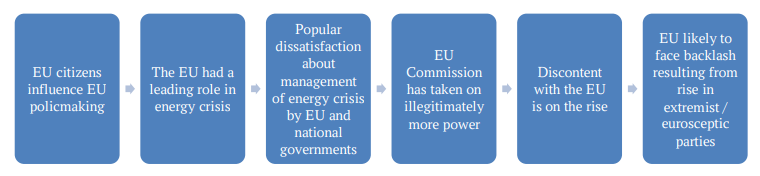
The first question reveals that EU citizens retain some influence on EU policymaking, as a small majority of respondents (53 %) believe that popular perceptions of EU integration still determine political outcomes. This point is important as, in the absence of popular influence on the EU, backlash as such would be unlikely. EU citizens impact policymaking through the EU Parliament, the Council and also through internal politics, by empowering Eurosceptic leaders. Answering the second question, respondents (59 %) confirmed the fact that the EU took a leadership role in energy decision-making during the 2022—2024 crisis and that this led to an increase in the power of the EU Commission. Article 194 of the Treaty on the Functioning of the European Union states that energy is a shared responsibility between EU Member States and the EU, with members states deciding the conditions for the extraction of their natural resources, selecting between types of energy and deciding on the structure of their energy supply and the EU controlling the functioning of the energy market, promoting energy security, energy efficiency and promoting renewables (EU Energy Policy 2024). However, the issues dealt with at the EU level have increased in importance, with the green transition away from fossil fuels being strongly promoted from above.
When asked how well the EU has managed recent energy challenges, 61 % of respondents expressed dissatisfaction at the increase in energy poverty and the management of the energy crisis by the EU. Some comments left in free form by respondents reveal the gap between the optimistic EU discourse and the reality of people on the ground, with an estimated 9.2 % of EU citizens experiencing some level of energy poverty.2 They also show that the decision to cut fossil fuels was made too fast to ensure energy security. Comments also target specifically the EU Commission, emphasising its distance from the people and the ‘ivory tower’ it governs from. Grass-root discontent is on the rise, both with the EU and with the governments of member states. When asked whether the energy crisis had led to more discontent with the EU and to an increase in nationalism in member states, 61 % of respondents answered ‘yes’ while only 23 % answered ‘no’ and 17 % were uncertain. The findings show that the energy crisis has reduced the general approval of the EU and has been a catalyst for an increase in nationalist sentiments. The EU is not the only source of popular discontent, as national governments are also being held responsible by the population for some of the repercussions of the 2022 energy crisis. This could lead to upheavals in national politics too.
The last closed question suggests that the EU is likely to face popular backlash resulting from the additional power it took to manage the energy crisis. 63 % of participants believe the EU will experience a roll-back of the power it acquired during the energy crisis, 21 % think the spill-over is long-lasting, while 17 % are undecided on the issue. One respondent commented that crises with external triggers, like the energy crisis, led to internal ones within the EU, with a delay ranging from several years to several decades. Brexit is mentioned by several respondents as the delayed consequence of the spill-over process resulting from the management of the migration crisis. The current energy crisis is seen as likely to entail a similar backlash. As the Commission increases its influence, dissatisfaction among the people empowers Eurosceptic parties, which may advocate for secession from the union.
Case 2. NATO and the Ukraine crisis
The findings reveal that in the 1990s NATO lacked a mission and a sense of unity, and the prospect of expansion was the only forward momentum experienced by the organisation. The 2014 Crimea crisis and the ongoing Ukraine conflict reinvigorated NATO, offering it a new sense of purpose and bringing its members together against a common perceived threat embodied by Russia. The organisation increased in power and expanded its military presence globally and especially in Eastern Europe, deploying, starting in 2022, new battlegroups in Bulgaria, Hungary, Romania and Slovakia. This expansion was not accompanied by an increase in public trust in NATO, and respondents point out growing levels of scepticism about the organisation and its capacity to promote peace. The first signs of backlash after the spill-over caused by the crisis are already noticeable. Figure 3 provides an overview of respondents’ answers to the survey.
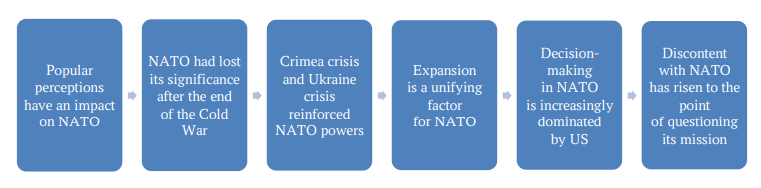
The first question helps to establish the fact that public opinion in NATO member states impacts the organisation’s decision-making and institutional structures, including country membership. 56 % of respondents believe popular perceptions have an impact on NATO. This is an important factor to establish, as it is a precondition for popular backlash having any impact on the organisation. Respondents also overwhelmingly agree that NATO in the 2000s had lost its significance. One respondent commented that NATO’s identity as a defensive alliance and a guarantor of security for Europe appeared at the time as redundant. NATO operations in the former Yugoslavia, Kosovo and Libya were marked by controversy surrounding the scope of the mandates and their implementation. Russia’s visible rise on the international stage and the 2014 Crimea situation led to a revival of NATO. 72 % of respondents noted that the events of 2014 brought together NATO members, while only 28 % think they divided them. Russia’s Special Military Operation led to a clear new mission statement for NATO: Adopted in 2022, NATO’s Strategic Concept2 states that Russia is the most significant and direct threat to Allies’ security and to peace and stability in the Euro-Atlantic area. Defining a clear enemy allowed NATO to expand its activities and temporarily increase its credibility. 44 % of respondents noted that NATO regained its mission and integrated further after the start of the Special Military Operation, 22 % noted that its mission remained unchanged since 2014, and 34 % noted that it created a division among its members. The consensus among respondents remains that NATO’s influence grew sometime between 2014 and 2022 to unprecedented levels since the end of the Cold War. Expansion is also considered to be a factor promoting unity in NATO (78 % of respondents), with Finland and Sweden revoking their longstanding policies of non-alliance.
The way NATO is managed has also evolved over the last decade, with an increasingly belligerent US playing a central role in the decision-making process of the organisation. When asked whether the decision-making centre in NATO had evolved since the 2010s, 47 % of respondents noted the US plays a more important role in the alliance, and 34 % noted few changes, saying the US had always dominated the organisation. Importantly, 68 % of respondents noted that discontent with NATO policy is on the increase compared to a decade ago. One comment underlined that the current steps taken by NATO are highly controversial and that there is ‘no widespread appetite for increasing the Alliance’s presence in Eastern Europe and even less support for Ukraine joining the alliance’. NATO’s involvement in Ukraine is seen as a step towards an expansion of its size and agenda by some political leaders, but public opinion does not believe that financing Ukraine should bring about larger changes in the security alliance. Support for NATO has started to dwindle as some side effects of its rise become apparent: the increase in incidents and military exercises, the heightened militarization of the Baltic and Black Sea regions, sharp increases in military expenditure, a progressive change from a defensive to an offensive doctrine, have all led to an increase in public concern about NATO. Low levels of support for NATO are confirmed by polls: In July 2023, trust in NATO dropped as low as 30 %.4 Donald Trump’s 2025 accession to the US Presidency represents an extra factor threatening to undermine NATO, which is already challenged by grassroot citizens. Similar to the case of the EU and the energy crisis, the expansion in power of NATO has caused popular discontent, and a backlash is predicted to arise as a result of the accelerated spill-over.
Case 3. BRICS and the Ukraine crisis
The findings for this case suggest that BRICS, being a weakly integrated organisation, suffered in the short term from the impact of the Ukraine crisis, with loyalties initially being divided between the countries supporting Russia and those preferring to align with the US hegemon. Notably, rather than cause vocal disagreements, the Ukraine conflict led each member (apart from Russia, which was directly involved) to take a step back and ‘wait out’ a time of heightened political tensions. This behaviour is in line with the previously established BRICS behaviour of avoiding controversial subject matters (see Crowley-Vigneau et al. [38], 2024). The crisis did not cause a spill-over, and BRICS did not double down on efforts to formulate common foreign policy statements. The development of economic cooperation, particularly between China, India and Russia, shows that US efforts to isolate Russia were unsuccessful. Brazil aligned with the West, voting in 2022 to condemn Russia at the UN General Assembly.5 Each country privileged its own interests, took a step back from political cooperation, and in 2023, political cooperation restarted within the organisation. Figure 4 provides an overview of how respondents’ answers to the survey help us answer the research question.
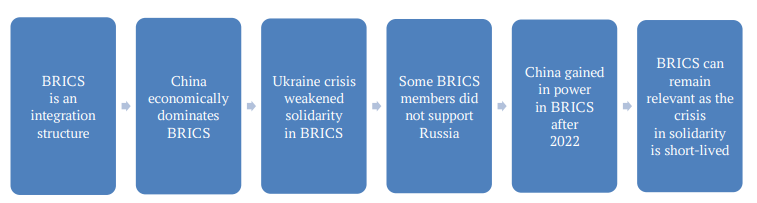
Responses to the first content question confirm that BRICS can be considered to be an integration structure (68 %), showing that a wider definition of integration is accepted among experts. Delegation of authority is not a sine qua non condition for integration. 53 % of respondents even note that BRICS also has the potential to become a regional integration bloc, reflecting the decreasing importance of geographical boundaries for cooperation between states. One respondent commented: ‘This is a mind-warping question in a way, we understand ‘regional’so loosely these days that it could include countries very far apart and potentially in different regions. We just don’t yet talk about international integration as such’. An investigation of China’s role in BRICS attempted to determine whether the country’s relative economic might poses threats to BRICS as an integration structure. 40 % of respondents note that China has more weight than other countries in decision-making in the organisation due to its economic clout. 34 % express concern that Chinese power intimidates its partners and could get in the way of BRICS integration. 24 % of respondents underline that China does not treat other states as equals. The main threat to BRICS is portrayed by respondents as the imbalance between its different members in economic and military might. One respondent, however, commented: ‘BRICS as a framework is based on respect and the equal power in negotiations of sovereign states, so size should not matter. When Russia enhanced cooperation with North Korea, changing China’s power balance with its ally, China accepted this situation and even remarked that it is not its business to comment on bilateral relations between two sovereign states.’
Expert assessments of the impact of the Ukraine conflict on BRICS show that the organisation was temporarily weakened by the crisis. 65 % of respondents suggested that solidarity within BRICS decreased with the crisis, 22 % that it didn’t affect it in any way and 13 % that it helped consolidate the group. Findings also reveal perceptions that some countries within BRICS sided with the West in condemning Russia at the start of the Special Military Operation. 25 % of respondents believe there was no unified reaction at all, and 17 % believe there was a general display of support for Russia. In this question, we analyse perceptions rather than facts as they impact future integration potential. While Brazil did express disagreement with Russian actions in the Security Council, other countries refrained from commenting. Even Brazil’s opposition was moderate: as noted in one comment: ‘Brazil condemned Russia but shortly after it also criticised the West for arming Ukraine and prolonging the conflict. It has also denied requests to sanction Russia. Experts emphasise in their responses a lack of unity and overall a reticence to take any steps against Russia. One respondent commented: ‘The West makes a lot of noise in the media, jumps at the opportunity to call it the end of BRICS, but the countries have just gone quiet on this and turned their attention to other issues, economic and social ones’.
Survey results show that there has, however, been a shift in power within BRICS, mostly in favour of China (57 % of respondents). Russia is perceived as having proved its military might, its resilience and its capacity to stand up to the West, but also as going through a challenging time in economic terms. Even though from some perspectives, China is presented as a potential threat to BRICS, 83 % of respondents still believe BRICS will remain relevant in the near future, because the world needs a credible organisation to counter US hegemony (36 %) and because there is potential for wider cooperation (48 %).
The survey shows that BRICS was negatively affected in the short term by the Ukraine crisis and that, in the short term, no spill-over took place. However, the organisation has preserved the capacity for future integration intact, and no backlash is expected in the medium to long term against BRICS, as popular and expert perceptions of the organisation remain positive.
Case 4. World-class universities and the Ukraine crisis
Universities around the world have developed common educational programs and administrative models in order to globally compete among themselves, with the development of world-class universities frequently being presented as an enabler for diversified and dynamic economic growth. The Bologna process is a regional integration mechanism that led to the standardisation of higher education systems in EU countries. Less formalised, the norm of world-class universities has integrated more universities from a larger array of countries aspiring to excel in rankings and attract the best students, professors and business partners. The survey assesses the impact of the Ukraine crisis on global integration mechanisms in higher education. The findings show that the ideological tensions and sanctions resulting from the crisis have put strains on some countries’ capacity and desire to globally integrate their universities. However, the potential for further integration remains promising, despite contestation mechanisms, as the economic benefits outweigh the political risks. Figure 5 offers an illustration of this case’s responses.
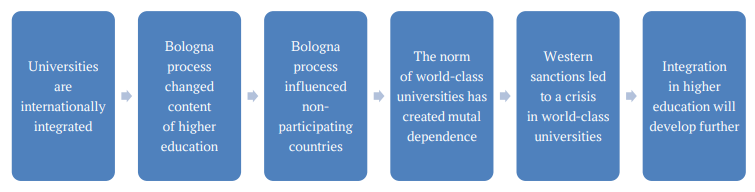
The first question aimed to collect expert perceptions on the level of integration between universities across the globe. 72 % of respondents noted that international cooperation between universities was either ‘deep’ with joint educational programs and research redefining the identity of these universities (46 %) or that universities were thoroughly integrated as their performance is evaluated by common entities and they compete for students and faculty across borders (26 %). One comment introduced a distinction: ‘Not all universities in a country are world-class, far from this, but the top universities strive for this status and the others often follow suit, even if they have few prospects of emerging as global leaders’. The Bologna process, which is the main formalised sub-norm governing the integration of higher education, is considered by respondents to have had a significant impact on participating countries and a trickle-down effect on other countries, whether they associated themselves formally in any way with the process or not. Respondents noted that the Bologna process changed primarily the administrative model of universities (26 %), the content of teaching (47 %), and the way research is performed (17 %), with only 23 % noting that none of the above were significantly impacted by the Bologna process. When asked about how it influenced non-participating countries, 26 % thought the process did not affect the rest of the world, while the rest of the respondents noted that it either affected perceptions of what makes a good university or directly led to changes in their organisational and teaching model.
The norm of world-class universities, in spite of being a much wider and less formalised process, has nonetheless led to very significant changes in higher educational systems around the globe, against the backdrop of globalisation and heightened economic competition. 48 % of respondents recognised some influence of the model of world-class universities, which was promoted by the World Bank as a solution to help developing countries become more economically competitive. 28 % noted that the model has a significant impact due to all universities globally striving to mimic leading universities. 24 % did not recognise any significant impact. A respondent summarised his/her viewpoint: ‘Higher education has become a competitive market where universities render a service. The question is not whether states want their universities to participate or not, there is little choice as isolation leads to loss of competence and in the end to a brain-drain abroad.’ When asked whether the norm of World-Class universities benefits primarily the West, 59 % answered negatively, 41 % positively, reflecting the fact that Western dominance in the internationalisation of higher education is an ongoing concern for over a third of respondents. One comment reflects the complexity of the issue: ‘World-class universities emerged in the West. The US did initially set the rules, and they are not all fair. But the sheer volume of countries integrated in the process has led to changes that the West is no longer in control of.’
The Ukraine crisis has affected the integration of universities significantly by revealing the reality of this informal integration process to the non-Western members involved. As Western sanctions against Russia were implemented, Russia’s higher educational system, which counted a dozen global leading universities, found itself isolated as partner universities and contractors broke off ties and implemented mobility restrictions that made it more difficult for foreign students from some parts of the world to come and study in Russia. Opinions were split concerning the reasons and circumstances that led to Russia withdrawal from the global higher education arena. 19 % of respondents noted that Russian universities had been forcefully excluded, 33 % that it had left of its own accord, 33 % said they left because it was in their best interest to leave the globalised education system after the crisis and 26 % noted that Russia has not truly left as disintegration is a much longer process and Russian universities remain largely defined by their international interactions over the past twenty years. Regardless of these differences of opinion between experts, a new trend was highlighted by several respondents: Russia’s experience of rejection has been a lesson for China, India and other countries which now have launched contestation of the Western-led model and aspire to develop World-Class universities on their own terms, prioritising national languages, traditions, values and culture. The short-term crisis in global higher education has led to a decrease in integration mechanisms. However, integration in higher education remains an integration process with promising prospects in the future. 67 % of respondents still believe that international cooperation is the key to the improvement of higher education and that integration is currently being redesigned to promote truly global, rather than Western values.
Discussion
This paper lays out a novel definition (and conceptualisation) of integration, which significantly expands the scope and enhances the predictive capacity of integration studies, putting this academic field more in touch with current realities. The focus we place on integration being a process that cultivates a sense of preferentiality and, hence, mutual dependence rather than a delegation of decision-making authority (erroneously referred to as ‘sovereignty’ in the expert literature) is significant. It allows us to view through the same comparative analytical lens different institutional arrangements which would have been traditionally considered as being of a completely different nature and thus incomparable (e. g. NATO and world-class universities). We also show that units of different levels of analysis (including subnational ones) can participate in and shape integration processes rather than just governments. Mutual dependence does not require a delegation of authority, and as such, a governmental stamp of approval is not always needed for collaborative integration. Additionally, integration does not require collaboration and the creation of mutual dependence in more than one sphere. Countries can integrate in restricted areas, potentially very narrow ones (e. g. higher education, sports, airport security). In short, integration unfolds in different forms, can originate from the grassroots or a government initiative, can include large or narrow groups of participants and can be multisectoral or sector-specific.
In addition, we introduce a novel analytical framework for understanding the impact of crisis events on integration dynamics, arguing that final outcomes depend more on the institutional architecture of integration than on the specific nature of the crisis itself. Figure 6 presents an overview of the theoretical contribution of this research, reflecting how entities with low levels of integration loosen their cooperation in times of crisis but then rapidly relaunch common policies; while entities with higher levels of integration deepen their cooperation and empower supranational institutions in times of crisis but subsequently face significant backlash challenges fraught with disintegration.
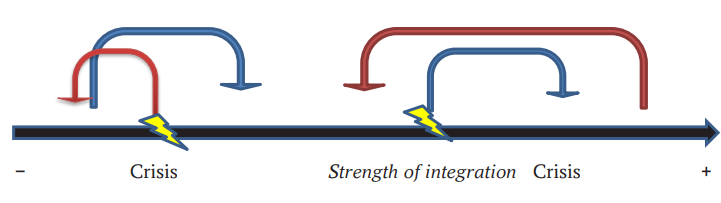
These findings call into question a sizeable segment of the literature on EU spill-over mechanisms, demonstrating that these mechanisms can be detrimental to integration processes and that their use to solve a crisis leads to a greater politicisation and backlash, resulting in new vital threats to the organisation (e. g. how Brexit resulted from EU empowerment on migration issues, the possible outcomes today of the EU’s energy management that goes against state interests). Future academic research should focus on the factors that determine the success of integration projects and the most productive coping mechanisms for integration structures in times of crisis. Each crisis encountered by the EU deserves to be analysed anew, with an investigation into the long-term consequences of the ‘spill-over’ or ‘falling over’ process. The root causes of major EU crises should be analysed in light of policy responses to past crisis events rather than focusing exclusively on external triggers. Assessments should be carried out on how far back the backlash process can take an entity that has integrated rapidly as a result of a crisis, and the factors that make backlash more likely.
Research should also focus on the dismantling of integrative structures, in an attempt to formulate adapted solutions for organisations which have outlived the reasons why they were created. Self-generating bureaucracy and fear of change can lead to integrative structures going rogue in an attempt to find a new mission statement. NATO’s role in putting down the premises of the Ukraine conflict is not negligible. Structures with lower levels of integration should be analysed from the angle of awareness: to what extent are governments and populations aware that integration is underway? While in BRICS, a top-down initiative, governments struggle to interest populations in grassroot cooperation and have to resort to public policy and soft power instruments to combat popular indifference; in higher education, in some cases, it is governments that struggle to understand and regulate these processes, often resorting post factum to mitigating measures.
These insights also allow for some policy recommendations:
First, attempts to accelerate integration can be damaging as they run the risk of reducing popular support for a regional organisation. Slow integration patterns allow for adjustment mechanisms to take place and avoid ‘buyer’s remorse’. The process through which an organisation recalibrates the distribution of power between the sub- and supranational entities is more balanced when it does not take place in times of crisis.
Second, integration models that are promising in the long term may specifically be those that allow countries to opt in and opt out consciously of every decision that is made. Flexibility stifles discontent, and voluntary participation helps to avoid internal conflicts, including the need to punish ‘bad pupils’. There is also no evidence to show that flexible approaches make countries less likely to deepen their commitments.
Third, government delegation of responsibilities to a supranational framework should develop in parallel with popular support for this endeavour to ensure a smooth and durable transition into integration.
Conclusion
The paper offers a novel account of how crises affect different integration structures and reveals, based on four case studies, the different coping mechanisms employed by each type of organisation. The authors formulate a broader conception of integration than is typically suggested in the existing literature, which allows for original and heuristic analytical insights. The study shows that the delegation of authority (quasi-sovereignty) is not always conscious (e. g. cases of BRICS or higher education) or consensual (e. g. EU spill-over mechanisms, NATO) but that states can always take back what is theirs and that they usually do so, during a crisis (for the least integrated entities) or after a crisis (for the more integrated entities). A qualitative inquiry based on a survey of 409 specifically selected experts on integration demonstrates that tightly integrated unions strengthen in times of crisis but suffer from a disintegrative backlash once the crisis has subsided. Conversely, weakly integrated unions experience a loosening of their ties in times of crisis but recover shortly thereafter their capacity to pursue further cooperation.
Reference