Evidence-based economic policy at the regional level


Abstract
This article revisits approaches to regional development by exploring both previously proposed and new policy opportunities for regions facing the greatest challenges in adapting to emerging geo-economic conditions. This revision is based on the methodology of comparative analysis of discrete structural (institutional) alternatives – an essential component for ensuring the necessary evidential level in selecting economic policy instruments, complementing other applied research tools. The Kaliningrad region is one of Russia’s most complex due to its geographical isolation and historical background. The most comprehensive and consistent review of development options, or structural alternatives, for this area is found in the works of Gennady Fedorov, a professor at the Immanuel Kant Baltic Federal University. This study elucidates the need to draw on the ideas of regional and spatial economic development of the Kaliningrad region reflected in the works of Prof. Fedorov and his colleagues from 1991 to 2023, when developing scenarios for Russia’s westernmost region. The main advantage of their findings is that they are presented through the lens of interdisciplinary discourse, utilising concepts from new institutional economic theory to provide an economic perspective. This study reveals the fundamental ideas behind the concept of the geo-demographic situation, the so-called ‘Fedorov matrix’ highlighting structural alternatives for the development of the Kaliningrad region and the spatially distributed clusters. The article examines the three main development strategies of the Kaliningrad region, as analysed by Fedorov, to trace the evolution of the region’s economic activity regulation regime. A conclusion is drawn regarding the demand for industrial policy instruments for the development of the region’s economy, while also emphasising their insufficient efficiency in application. The viability of Fedorov’s forecasts, as outlined in his works, is assessed through the example of planning a spatially distributed tourism and recreation cluster.
Introduction
Employing evidence-based practices in economic policy is an attempt to re-establish the role of economic science in public discourse. The problem of sceptical attitudes towards economic studies has been highlighted and discussed, for instance, by Abhijit Banerjee and Esther Duflo. In their work ‘Good Economics for Hard Times: Better Answers to Our Biggest Problems’ [1, p. 16— 17], they acknowledge the tough challenge of remedying this situation, which was partly due to the failure of many economic theories to align with the facts. Yet, this observation represents only a small part of a larger problem. Despite the simplicity of this principle, which dictates that decision-making in economic policy must be evidence-based, its implementation in practice is difficult. Indeed, this raises several questions: how decisions can be made when data and facts contradict them, on what basis we can predict the effects of applied economic policy measures, and what to do when assessments do not fully align with the chosen priorities.
These questions can also be posed in relation to research on current socio-economic development issues within interdisciplinary discourse at the supranational, national and regional levels. In this article, we offer a perspective on applying the principle of evidence-based economic policy within interdisciplinary discourse.
After exploring the context of the issue of concern, we will highlight one of the most important methodological principles in research and expert practice, as followed by Prof. Fedorov, which fits well within interdisciplinary discourse. This scholarly effort also explores the potential application of concepts from new institutional economic theory to discussions on defining the status, prospects and development mechanisms of the Kaliningrad region. Special attention will be given to the regulatory regimes that have governed economic activity in the region over the past 35 years.
Context
During the collapse of the Soviet Union and the transition to market relations in the early 1990s, questions about the development prospects of individual regions within the Russian Federation became increasingly urgent, with Kaliningrad being no exception. The complicated history of this area has made the study of the possibilities, limitations, and development scenarios of the Kaliningrad region particularly intriguing, especially for specialists in regional economics, whose interest extended to both the regional economy as a whole and its specific sectors. Discussions that began in the early 1990s continue to this day, driven not only by the historical context but also by a series of events that have occurred over the past nearly 35 years.
The discussion of regional development issues was not always based on a solid understanding of the actual circumstances. This problem was particularly acute in the case of Kaliningrad, as decisions on many important aspects of regional economic development were made at the federal level, where the necessary knowledge for these decisions was often scarce. This was partly due to the region’s special status during the Soviet period, when entry was restricted even for Soviet citizens. Furthermore, the dramatic change in the region’s demographic and geopolitical positioning, which occurred in the late 1940s and early 1950s, necessitated research at the intersection of geography, demography and socio-economic studies.
At the same time, there was a growing demand for comprehensive applied research and a thorough understanding of the region’s development challenges, as it became a semi-enclave for the EU and an exclave for Russia.1 The objective reasons for this were twofold: the urgent need to establish relations with the Baltic States, particularly those bordering the Kaliningrad region, and the limited financial resources the federal government could allocate through its industrial policy to a region for pursuing selected development priorities. Even the 1998—2005 federal target programme for the special economic zone (SEZ) in Kaliningrad was funded at only 3 %2 [2].
When assessing the impact of the special economic zone regime, the amount of resources spent is likely significant but not particularly indicative. ‘The region’s development is largely determined by factors that are international in nature: the conditions for cargo transit through foreign territories, the visa regimes of neighbouring countries, the state of the goods and services market in Central Europe, and the economic policies implemented in this part of Europe’ [3, p. 2]. For example, the Russian railways’ favourable tariff policy towards the Kaliningrad route between 2001 and 2003’, which significantly reduced additional transit costs through the territory of the Republic of Lithuania [4, p. 5]. However, an obstacle to the full utilisation of the SEZ regime before the adoption of the 2006 SEZ law was that neither the initial SEZ law’s preferential taxation of investments nor its guarantees for foreign investments, with the region’s property pledged as collateral, were realised [4].
In this context, it is worth recalling that industrial policy instruments, including special economic zones, involve not only the allocation of resources but also the creation of resource endowment effects [5], [6]. The latter is done through special economic conditions without the direct transfer of resources in the form of grants or subsidies. Some tools that do not require the transfer of state resources to private companies may be just as effective, or in some cases even more so. A notable example is the large-scale production of large-diameter pipes (LDPs) in Russia in the early 2000s. These pipelines, designed for the construction of trunk pipelines, were primarily intended for Gazprom’s infrastructure projects and international endeavours such as Nord Stream, Nord Stream 2 and Turkish Stream. This production effort required no funding from the state budget but relied solely on guarantees of future demand for pipes and temporary prioritisation over imported large-diameter pipes (LDPs) [7].
A comprehensive assessment of the current situation and development prospects for the Kaliningrad region was largely the result of a research group led by Fedorov actively participating in public discussions. The research to which Fedorov has contributed covers virtually the full spectrum of significant socio-economic issues in the region — from geographic and demographic aspects to the development of specific industries. Given the historical context, of particular importance was the choice of a methodological framework for the studies, at the core of which was Fedorov’s theory of geo-demographic situation (GDS). The recommendations derived from these findings held particular significance [8], [9].
A hallmark of Fedorov’s GDS concept is that it accounts for both systemic and situational factors. Systemic factors are internal and driven by demographic processes, as indicated by statistical data on the population (such as birth rates, mortality, and migration), whereas situational factors are external and primarily encompass socio-economic influences. Factors in the latter group may be a product of the territorial socio-economic system (TSES) where the study processes occur or from external TSESs through economic, settlement, social and ecodemographic links. The GDS has a dual nature: systemic and geosituational. As a geosituation, the GDS reveals the presence of external causes, while as a system, it embodies relative stability and self-development potential,’ Fedorov notes in the abstract of his doctoral dissertation.3
This concept is ideally suited for strategic planning in the region, where geopolitical, geo-economic and demographic factors have played a key role, as it provides for a ‘comprehensive study of the regional aspects of demographic processes and their dependence on both internal (demographic) and external (economic, settlement, social, ethnic, ecological and political) factors’ [10, p. 8].
Long before the term ‘sustainable development’ became common in the Russian scientific discourse, the theory of GDS largely aligned with the principles of sustainable development. It is not coincidental that, nearly 20 years after establishing the scientific foundations of the GDS concept, Fedorov observed: ‘What is termed sustainable development — a region’s dynamic and balanced development — is characterised not so much by economic or social indicators as by geo-demographic ones’ [10, p. 10].
Unfortunately, regional sustainable development strategies often neglect the geo-demographic component, focusing instead on economic indicators of growth. However, as the socio-economic development measures implemented in regions primarily aim to enhance living standards, as reflected in the quality of the population, this quality serves both as a result and as an indicator of the socio-economic transformations undertaken. It is not by chance that Fedorov emphasised the quality of the population as the most general category of the geo-demographic situation [9].
Discussing the various issues addressed in Fedorov’s studies reveals an important principle: in his research, the idealisation of desired outcomes is replaced by a pragmatic recognition of the imperfection of any realistic alternative, accompanied by a comparison of available options to select the most preferable one.
Adherence to this principle is essential within the framework of new institutional economic theory [11], [12], [13], whose systematic application in analysing the structure, opportunities and constraints of regional economic development is yet to be fully realised. In this article, we examine the development challenges characteristic of the Kaliningrad regional economy by applying elements of the research approach used in new institutional economic theory.
The most general question to consider is that of the region’s status, in which Fedorov has participated from the early 1990s [14], [15], [16], [17], [18]. Building on the corresponding discussion, we present our perspective on the applicability of institutional analysis methodology. The principles underpinning Fedorov’s research will be explained and described in greater detail, with this analysis contextualised within the evolution of the regulatory regime governing economic activity in the region.
Structural alternatives in defining the status of the Kaliningrad region
A hallmark of new institutional economic theory is its use of comparative analysis of discrete structural alternatives, setting it apart from marginal analysis, which aims to identify optimal conditions for resource deployment that maximise the profits and utility of exchanging agents [12], [19], [20]. The number of structural alternatives is not a continuum; rather, it is always finite and tangible, which is particularly important for applied research, whose findings can inform regulatory and business decisions.
Notable structural alternatives in institutional research include coordination mechanisms4 [19], [20], property rights regimes5 [21] and approaches to internalising externalities6 [22]. The merit of this methodology lies in recognising that the most appealing or potentially ideal state, one that promises ‘everything at once’, is ultimately unattainable. In an imperfect world, making an important choice often necessitates relinquishing a different option. Yet, the value of what is forgone need not necessarily exceed that of the chosen option; quite the opposite. To implement this principle, a comprehensive understanding of the details that make up the entire picture is essential. Consequently, recent socio-economic development strategies are moving away from traditional planning frameworks based on short-, medium- and long-term horizons, as well as from the classic optimistic, pessimistic and realistic scenarios. Instead, there is an increasing preference for planning within a framework of baseline, optimistic and target development scenarios. In practice, however, the target scenario, rather than focusing on specific objectives pertinent to an individual region, tends to align with broader goals outlined in national programmes.
The discussion of structural alternatives defining the status of the Kaliningrad region and the associated socio-economic development options involves highlighting characteristics of the regional politico-economic system whose combinations would appear mutually exclusive when compared. Fedorov presented a most comprehensive set of structural alternatives in a series of works, including co-authored contributions [3], [14], [18]. These alternatives, as seen in Russian and international publications of the 1990s and 2000s, are systematised in the Fedorov ‘matrix’, whose analytical framework helps explore the possibilities, prospects, and scenarios for the development of the Kaliningrad region through the lens of discrete structural alternatives. Each alternative is defined by two fundamental characteristics: the political and economic rules that form the institutional foundation for the functioning and development of the regional economy (Table). At its core, this is a politico-economic approach to examining regional development issues through a toolkit that, despite being labelled differently across various social science disciplines, reveals significant potential for interdisciplinary collaboration.
|
Politics |
Economics |
|||
|
1 dependent on federal subsidies |
2 economic regime for Russian regions |
3 economic zone |
4 the economic space of the Russian Federation |
|
|
A: Federal territory governed by the Centre |
A1 |
A2 |
A3 |
A4 |
|
B: Ordinary region, a constituent entity of the Russian Federation |
B1 |
B2 |
B3 |
B4* |
|
C: Territory with a special political statusс |
C1 |
C2* |
C3 |
C4 |
|
D: Independent state |
D1* |
D2* |
D3* |
D4 |
|
Source: [23, p. 11]. |
||||
*Technically impossible options.
Although constructing a structural alternatives matrix may seem a methodologically universal approach, applying it to a specific region requires a deep understanding of the territory under study. The ‘Fedorov matrix’ presents 16 options. Notably, from an applied perspective, some structural alternatives are considered unfeasible or non-viable due to incompatibility between the rules governing the region’s political status and the economic rules regulating relations within the region and with neighbouring areas, including foreign states. These are options D1—D3, B2, and B4. This matrix implements the principle of weak selection, a fundamental concept in the comparative analysis of discrete institutional alternatives [19], [20]. The principle states that normative conclusions can only be drawn from comparing achievable, feasible alternatives — of which there are 11 in the matrix. Including an unattainable alternative, which may be an ideal and thus desirable scenario, in the selection matrix can lead to decision-making errors with grave consequences.
At the time the matrix was developed, the status of the Kaliningrad region was defined by structural alternative B3: an ordinary region, a subject of the Russian Federation and a special economic zone. Currently, the matrix could be expanded with an additional component that creates new opportunities for the region’s socio-economic development, primarily by attracting international businesses and investments, including those of Russian origin but operating from foreign jurisdictions.7 This new component is the establishment of a special administrative region (SAR) on Oktyabrsky Island in Kaliningrad.8
The practice of establishing SARs was launched in Russia in 2018 as an alternative to foreign offshore zones. SAR residents benefit from tax incentives and a range of other preferences.9 SARs also constitute a reaction to changes in tax systems in foreign offshore areas, accounted for by the termination of double taxation agreements (DTAs) with Russia. The sanctions imposed on Russian companies operating abroad provided further incentives for their re-registration in the offshore zones established by the federal law on Oktyabrsky Island in the Kaliningrad region and Russky Island in Primorsky Krai. For example, from the beginning of 2024 to the time of writing this article, the number of residents on Oktyabrsky Island has increased by 23 %. In comparison, as of 31 May 2024, the registry for residents of the Kaliningrad special economic zone listed 315 active investment projects.
In December 2023, a group of Russian senators initiated the adoption of additional measures that grant the most beneficial business conditions in the SAR, alongside the previously mentioned registration requirements.10 Amendments to the Tax Code, established by Federal Law № 595 on 19 December 2023, allow companies in Russian offshore zones to contribute 300 million roubles directly to the budgets of the Kaliningrad region or Primorsky Krai, enabling the recipient regions to utilise these funds for infrastructure projects.11 This is especially pertinent given the development of priority industries for the region, as identified by regional authorities.12 Whether companies will opt to take advantage of these maximum benefits remains to be seen. However, the increase in the number of companies preceding the introduction of the law suggests that the primary incentive for registering in the SAR is the desire to avoid political risks and the associated organisational and economic complexities of conducting business abroad.
Certainly, each alternative entails gains, on the one hand, and losses, costs and risks, on the other. Moreover, these benefits, costs and risks are distributed among various interest groups, shaping their responses in terms of supporting, opposing or remaining neutral toward a given alternative. The expected, and even actual, distribution is not always evident, resembling the coexistence of various conflicting theories based on incomplete or incorrect information. This is why a crucial aspect of the comparative analysis of structural alternatives lies in research that seeks, on the one hand, to gain knowledge of actual circumstances and, on the other, to understand trends of change — not necessarily only those associated with development.
Even if a structural alternative has been identified, and it is maintained as the status quo, it requires an interpretation as an institutional choice. In this context, a central question pertains to the effects of implementing the special economic zone mechanism. The findings of this analysis will provide an answer to an even more sensitive question, whether the Kaliningrad region has been, or become, a region of economic growth, or the special economic zone is a mechanism merely camouflaging an unpromising periphery sustained by federal resources.
Fedorov’s research suggests that the Kaliningrad region’s economy has substantial development potential rooted in internal sources, including those specific to its location. However, realising this potential required establishing conditions adequate to overcome past constraints13 [24], [25].
The wide array of tools employed indicates that decision-makers at both federal and regional levels responsible for shaping the regulatory regime for economic activity align with this position. These tools include not only the mechanism of, at first, a free economic zone and, later, a special economic zone14 but also a special administrative region, region-specific national projects, industrial parks, technology parks and clusters, whose performance and effectiveness have been studied across various research institutes and academic schools. Notable works in the field include contributions by Nataliya Smorodinskaya (2011) [26], Olga Kuznetsova (2016) [27], Konstantin Nilov (2018) [28], Alexander Sebentsov and Maria Zotova (2018) [29], Alexey Streltstov and Gennady Yakovlev (2018) [30], Leonid Vardomsky (2022) [31] and others.
Research conducted over a relatively extended period and focusing on events significant to regional development has shown that Kaliningrad, while ‘middling’ nationwide in terms of the level and pace of development, also exhibits distinctive characteristics, including high volatility in economic dynamics. During economic downturns, the region’s economy shows results markedly below the Russian average, whereas recovery generally occurs at a faster pace. However, industry-specific structural effects have also played a role [32], [34].
In a recent work, Natalya Zubarevich emphasises the difficulty for regions to progress from underachievers to average performers, or from the latter to leaders, highlighting the developmental traps present at both low and mid-levels. Another finding requiring further elaboration is that, during the study period, polarisation occurred within the largest group of ‘middling’ regions, comprising nearly three-quarters of all regions [35]. Statistical data for the period in question [34, p. 25], [36], [37, p. 6, 8—9] place Kaliningrad within the mentioned category. Thus, despite various forms of support for the region’s economy, the measures and mechanisms aimed at mitigating its unstable geo-economic position appear to fall short of securing long-term levels of social and economic development and growth rates.
Mechanism for regulating the Kaliningrad region’s economy from 1991 to 2022
The structural alternatives discussed in the previous section possess a crucial temporal dimension, as a changing world inevitably impacts the matrix of discrete structural alternatives, including the current alternative with its inherent status quo features. Therefore, a special question to consider is how the regime regulating economic activity evolved over the study period. This evolution is traced in Fedorov’s work “Three Strategies for the Development of the Kaliningrad Region from 1991 to 2018”, which, while outlining principal strategies for the region’s development, shapes alternative regional visions of the future within the baseline variant B3 of the Fedorov matrix. These successive visions emerged between 1991 and 2018 in the following order:
— special (free) economic zone;
— region of cooperation;
— international development corridor [38];
— spatially distributed clusters operating within the region’s priority areas of specialisation [34].
The mechanisms of the special economic zone, first introduced in 1996 with the initial law on the Yantar free economic zone, remain relevant and continue to be central to the region’s development strategies, despite some changes over time (in 2006, the free economic zone law was replaced by a federal law on the special economic zone15). Despite some criticism of using these mechanisms as tools of economic policy [26], they are designed to fulfil the crucial role of offsetting the region’s exclave position. In this way, as Zubarevich emphasises, they ensure the current geopolitical priorities of regional policy [39], which is particularly relevant in today’s geopolitical and geo-economic conditions. In addition, centralisation has been supported and continues to be driven by federal target programmes up to 2013 and by state programmes thereafter. The ‘cooperation region’ strategy16 manifested in the visions of ‘an island of cooperation’ and a platform for Russia-EU collaboration, gained momentum in the late 1990s, following the 1997 Partnership and Cooperation Agreement between Russia and the EU. In 2003, it was formalised as the Strategy for the Development of the Kaliningrad Region as a Region of Cooperation, a document repealed in 2007. However, with the neighbouring countries joining NATO, this strategy became unrealistic.
Experts at IKBFU investigated the ‘Greater Eurasia’ concept even before the ‘cooperation region’ strategy was fully discontinued. This concept builds on the Belt and Road Initiative promoted by the governments of China and Russia. George Friedman’s ‘development corridor’ concept [40] was particularly suited to the geographical position of Kaliningrad — a territory positioned between core regions linked by sea routes. The region’s coastal location and the influence of the ‘maritime factor’ facilitated the materialisation of this concept [41]. Today, this strategy is unfolding as logistics companies provide Kaliningrad businesses with a new transport route to and from China’s port of Shanghai: via Arkhangelsk along the Northern Sea Route, then by rail to St. Petersburg, and finally by sea to Kaliningrad. Although this route takes between 40 and 45 days to traverse, a duration comparable to the existing option via India and the Suez Canal, it holds promise given the current geopolitical climate.17
A new concept for the formation of spatially distributed clusters, one that has not yet been formalised in a document, has been developed by Fedorov. This proposal encompasses economic entities from Saint Petersburg and the Leningrad and Kaliningrad regions. Drawing on insights from cluster studies [42], we concur with Fedorov et al. that the sectors with the highest potential for cluster formation include shipbuilding, fisheries, IT, automotive manufacturing (in collaboration with other Russian regions), education, healthcare, tourism and recreation [43]. In particular, clustering aligns with national tourism policy, which seeks to bolster the development of interregional tourism. Amid the geographical restructuring of Russia’s external ties, the Baltic coast is emerging as a key area for the development of domestic tourism. Moreover, clusters can and should form not only within neighbouring regions but also across maritime boundaries, with the Silver Necklace tourist route18 serving as a prime example of a spatially distributed tourism cluster. Despite its geographical separation from other areas in this cluster, Kaliningrad ranks second among the cities on the route in terms of tourist growth dynamics, following Saint Petersburg, with a 26 % increase in June 2024 compared to the same period in 2023.19 In addition, the North-West Federal District is a leader in terms of domestic and inbound tourism density [44]. The concept of the spatially distributed cluster fits well within the aforementioned ‘development corridor’ strategy and, to some extent, represents an advanced variant thereof. The establishment of regular transport connections is a significant step towards forming sustainable cluster structures.
In outlining a framework for the region’s economic development, Fedorov produced a master plan for the territory. It is now evident that the majority of his research, whether conducted independently or under his supervision, centres on strategic master planning for the region. A master plan functions as both a tool for planning territorial development and a vision for future development in view of the whole range of available economic and geographic, including cartographic, instruments.
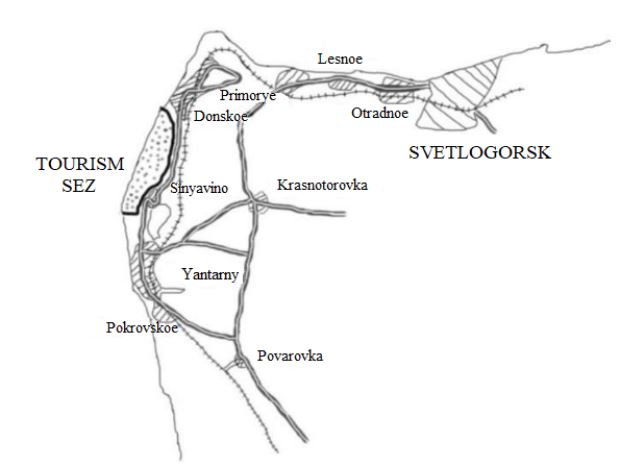
For example, several studies led by Fedorov, some of them involving the authors of this article, focus on the Kaliningrad region’s coastal tourism and recreation zone [45—47, etc.]. Over 20 years ago, his approach identified the area near the settlement of Yantarny as a prime location for the Coastal Functional Zone (see Fig.), an area that nearly aligns with the site designated in 2023 for the new ‘Belaya Dyuna’ [White Dune] resort.20 This recreation area is part of the Five Seas and Lake Baikal federal project launched at the request of President Vladimir Putin under the Tourism and Hospitality National Project.21
Notably, Fedorov proposed establishing a financial investment corporation (FIC) as a key mechanism to attract substantial new investments beyond those existing or planned as of 2006. Today, this role has been assumed by the Tourism.RF corporation, the Government of the Kaliningrad region, Gazprombank, and the Golfstrim specialised developer. These organisations signed an agreement at the 2024 St. Petersburg International Economic Forum, pledging to cooperate in the Belaya Dyuna year-round federal resort project in the Kaliningrad region.22
The authors share Zubarevich’s view that assessing the “corridor of opportunities” is a key task when developing a strategy capable of aligning goals and implementation mechanisms with the constraints posed by the persistence of entrenched spatial development trends [48, p. 51]. For the Kaliningrad region, tourism is undeniably a ‘corridor of opportunities’, enabling this average performer on other socio-economic indicators to maintain robust tourism appeal even amid a challenging geo-economic landscape. The region is positioned within the top ‘gold’ tier of the tourism attractiveness rating, known as the ‘Leaders’ group, ranking 17th with a score of 85.8 points. For comparison, Moscow ranks 1st with 110.2 points and the Leningrad region 18th with 84.5 points.23
It can therefore be concluded that a diverse array of industrial (structural) policy measures has been implemented within the Kaliningrad region’s economy over a relatively brief historical period. This underscores the region’s significance and the comparatively high demand for research in the area.
Conclusion
In summary, studies on regional development issues overseen or conducted by Fedorov are grounded in a methodology widely employed in new institutional economic theory. The approaches applied — comparative analysis of discrete structural development alternatives in a political-economic context, comprehensive regional studies using the concept of the geo-demographic environment, and assessments of prospective spatially distributed clusters in regional economic sectors — provide a solid foundation for an evidence-based policy, primarily industrial one. Additionally, it bolsters the development of the Kaliningrad region and encourages productive interdisciplinary research.
The article was prepared as part of the RANEPA state assignment research programme.
Reference