Inequality among residents and enterprises in the Latvian online market of digital marketing


Abstract
Despite the widespread adoption of digital technologies and their potential to break down traditional barriers in business and communication, many Latvian residents and enterprises still lack access to digital marketing tools and the advantages they offer. This article aims to analyze inequality among residents and enterprises in the Latvian online market of digital marketing. The conceptual basis of the study is the technology acceptance model (TAM), the theory of digital divide and the resource approach based on the theory of social fields. For dynamic analysis of statistical data, the con(di)vergence of indicators of the involvement of various socio-demographic and geographical groups of Latvian residents and enterprises in the online market of digital marketing is assessed. The empirical study is based on Latvian statistics for 2013—2022 (for some indicators — 2023). The results of the study show that the development of digital marketing in Latvia is happening very quickly, but the potential for development still remains very large, since with 90 % of Latvian residents regularly (at least once a week) using the internet, more than 30 % of Latvians have not yet made a purchase or order on the internet. The development of digital marketing in Latvia reduces socio-demographic and geographical inequalities among residents and enterprises in the online market in relation to the ‘digital inequality of input’ (access to the online market), but in relation to the ‘digital inequality of output’ (returns from this access) the equalizing opportunities of digital marketing in Latvia (especially in its regions) are limited by the specifics of the functioning of the economy based on social capital. In this economy, models and theories developed for the economy based on innovation practically do not work. The novelty of this study is a comprehensive analysis of the general background and dynamics of the development of the Latvian online market of digital marketing in the context of digital inequality among residents and enterprises.
Introduction
In Latvia, digital marketing has been actively utilized for over 15 years (globally, for more than 30 years [1]), and it essentially encompasses a range of strategies designed to promote and sell goods and services through electronic media. The lion’s share of this process is occupied by activities on the Internet (representing the technological basis for a separate segment of the market of marketing services),1 but digital marketing also covers activities on radio and television (not only overt advertising, but also the promotion of consumer ideas, and lifestyle — the so-called hidden agenda’).2
The global market of digital marketing is projected to reach a value of approximately USD 363.05 billion by 2023,3 driven by the growing number of users of digital channels. Owing to the rapid adoption of online advertising and increasing investments in ICT and digital platforms, the market of digital marketing is expected to further grow at a compound annual growth rate (CAGR) of 13.1 % during the forecast period 2024—2032.4 North America is the leading regional market of digital marketing and will continue to dominate in the coming years. The region is expected to account for 38 % to 42 % of the total digital marketing expenditure during the forecast period.5 The large target audience of the region is encouraging key players and brands in North America to promote their content, products and services online, which in turn is fueling the growth of the market of digital marketing. Asia Pacific is also expected to witness significant growth in the market of digital marketing in the coming years, owing to the high population density in the region, the spread of the Internet and the growing popularity of smartphones among the population.6
In turn, Latvia, according to the Digital Economy and Society Index (DESI) for 2021, has been doing well in terms of connectivity, use of Internet services and digitalization of public services, but the degree of business digitalization among small and medium-sized enterprises (SMEs) and e-commerce lags far behind the European Union (EU) average.7 This makes Latvia one of the least developed countries in the EU in this aspect, with the lowest level of web sales to enterprises and governments in the EU.8 SMEs in Latvia are undergoing a digital adaptation while lagging behind large enterprises in all areas of digitalization.
Even though currently there are tens of thousands of enterprises’ websites registered in Latvia, only a small part of them attract visitors from the world’s largest search engine Google. Insufficient content, incorrect technical settings or lack of popularity means that only their owners know about the existence of such websites.9 For a website to be successful and attract customers, potential customers need to know about it. Digital marketing tools can help with this if the right solutions are used and the website is adapted to best sales practices [2]. The so-called digital inequality10 or digital divide [3], [4], [5] among enterprises can be observed here, which is the disparity in technical, professional, cultural and other capabilities and abilities to successfully operate in the online market of digital marketing.
Regarding potential participants in the Latvian online market of digital marketing, in 2022, 10 % of the country’s population (and 16.3 % in Latgale, a traditionally lagging southeastern region [6]) did not use the Internet regularly (at least once a week),11 which means they are practically out of reach of digital marketing tools. In turn, in 2019 (before the COVID-19 pandemic, which was the impetus for increased digitalization of many spheres of activity in most countries of the world) the share of Latvians who did not use the Internet at least once a week was 16.3 % (in Latgale, 23.5 %).12
Scientific literature [7], [8] and business practices [9] recognize that the online market of digital marketing has the potential to reduce digital inequality among residents and enterprises. On the other hand, the results of some studies suggest that equalization of opportunities in the sense of access to the Internet leads to even greater technological inequality because individuals with initially higher socio-economic status are much more successful in using the opportunities offered by the Internet in general and by the online market of digital marketing in particular [10].
Thus, despite the widespread use of digital technologies and their potential to reduce traditional barriers in business and communication, there are significant inequalities in access to digital marketing tools and benefits from their use among Latvian residents and enterprises. This inequality is manifested both in differences in technical equipment and professional competencies, as well as in geographical and socio-economic divisions, which significantly affects the involvement of residents and enterprises in the online market of digital marketing.
This article aims to analyze the inequality among residents and enterprises in the Latvian online market of digital marketing. We hypothesize that the rapid development of digital marketing in Latvia is contributing to a reduction in digital inequality among residents and enterprises. The empirical basis of this study is the data of the Latvian Central Statistical Bureau (CSB) (Latvian: Centrālā statistikas pārvalde, CSP) for the last 10—11 years (from 2013 to 2022 (for some indicators — to 2023)) on the involvement of various groups of residents and enterprises in the online market of digital marketing.
Literature review and a brief analysis
The term ‘digital marketing’ appeared in the 1990s, during the period of rapid development of information and communication technologies (ICT) [11], [12]. Nowadays, digital marketing is considered one of the four components of comprehensive digitalization of an enterprise, and all four interrelated components (ICT development (infrastructure modernization), digitization of operations, digital marketing and digital business) “are stages in the digital journey of most enterprises” [9, p. 3]. The concept of the digital journey as a long process (and the thesis ‘transform or die’) is also used by the authors of the “SMEs Digital Journey Report Latvia 2021: Mechanism of the Digital Transformation” to analyze the digital transformation process of Latvian small and medium-sized enterprises (SMEs), which usually start their digital journey with digitization of general administration and marketing operations.13
The next step is the use of social media or participation in e-commerce. However, as more sophisticated technologies (such as big data and artificial intelligence) enter the market, the ability of SMEs to adopt them is significantly reduced compared to large enterprises.14 While some experts argue that digital marketing provides equal growth opportunities for every enterprise15 [8], the competence of enterprises in digital marketing often leaves much to be desired because “digital marketing is more than just technology adoption, it is also about strategies for integrating technology into business processes” [13, p. 4].
As for the behaviour of potential customers of enterprises in the online market of digital marketing, for example, the results of a study conducted in Lithuania show that Lithuanian customers prefer traditional shopping in stores rather than online shopping [2]. For instance, 44 % of shoppers visit physical stores more than three times a week. Despite the preference for traditional shopping, the authors of a Lithuanian study indicate that the online shopping market in Lithuania is still growing. The Lithuanian study also identified key characteristics of online stores that most influence online shopping behaviour. These factors include website design, informativeness, convenience, security, and the store’s popularity [2]. Overall, Lithuanian researchers emphasize the importance of adapting digital marketing and online sales strategies to the preferences and behaviour of local consumers, as well as the need for further research in this area, especially in other geographical regions with similar economic and cultural conditions [2] — for example, in Latvia.
The scientific literature identifies young people as the most promising target audience in the online digital marketing market [7], [14], [15]. For example, the results of a study conducted in Pakistan show that young Pakistanis prefer attractive and well-designed websites or social networks with many unique features to purchase goods and services. In particular, good website design and features increase shopping intention by 55.2 % [7]. The results of factor analysis show that overall social media marketing (SMM) determines the shopping behaviour of youth in Pakistan by 53.5 % and the remaining 46.5 % is due to other external and internal factors that are not related to SMM (such as personal, social, psychological, cultural differences or environmental factors) [7].
The rapidly growing online market of digital marketing worldwide has also created its own stratification, most often referred to in the scientific literature by the terms ‘digital inequality’ or ‘digital divide’. Researchers identify several levels of digital inequality, such as a first- and a second-order effect: a first-order effect is created by inequality in access to ICT, and a second-order effect is created by inequality in the use of ICT.16 Despite claims by some researchers that the digital divide will disappear over time due to increasing access to the Internet [4], the results of a six-month study of the online behaviour of 2,819 e-commerce users in the US show a different picture: even with comparable levels of Internet access, users with relatively high socio-economic status benefit more from e-commerce than those with relatively low socio-economic status.17 Specifically, higher-income users shop on more websites within a certain category of digital platforms; higher-income users are also more likely to shop on more digital platforms; a direct and statistically significant (p < 0.01) effect of income on the use of alternative e-commerce platforms was found; a direct relationship between income and the use of price comparison websites was also found; higher income users are more likely to shop on more digital platforms. Thus, a second-order effect describes that some individuals benefit less from digital opportunities not so much because of limited access to ICT, but because of limited ability to use it.
Some researchers distinguish three levels of the digital divide among residents [5], [14]: (1) access to the Internet — the difference in access to the latest ICT (presence or absence of material base) and include not only the possession of special devices (smartphones, computers, etc.) but also the availability of the Internet, as well as its qualitative characteristics (speed, cost, etc.); (2) use of the Internet — the difference in the skills necessary for the effective use of ICT (the presence of abilities not only to consume content but also to produce it, to be an active participant in interaction); (3) benefits from the use of the Internet — difference in life chances and opportunities resulting from the use of ICT (this level is the most difficult to measure and is based on information about the level of digitalization of the certain spheres of a society’s life). The results of a study conducted in Russia [14] allow its author to state the existence of differences in access to and use of the Internet between generations, both in terms of the possession of digital devices and in terms of the purpose of using the Internet. At the same time, there is a positive trend among representatives of all generations in Internet use. The assessment of the digital divide of the third level allows the author to conclude that there are benefits for all generations in Russia from the use of the Internet [14].
In Latvia, various aspects of the online market of digital marketing and digital inequality among residents, enterprises and also municipalities are actively studied at the Faculty of Business, Management and Economics of the University of Latvia, mainly under the leadership of Professor Sloka. The results of the research show that there is digital inequality among municipalities in Latvia.18 Out of 119 municipalities in Latvia, 13 do not use social networks at all. Some municipalities use up to 4 different social networks, while others limit themselves to one or two. In particular, 37 municipalities use four different social networks.19 These data indicate significant differences in the adoption and use of ICT among Latvian municipalities, which may exacerbate the digital divide between residents and enterprises at the third level, based on the level of digitalization of local administrative and public services [5], [14].
Furthermore, Latvian researchers study the problem of digital inequality among households depending on such characteristics as place of residence (region, city or rural area), income level and education level [16]. Using data from the Latvian CSB for 2019, Lase and Sloka identified differences between urban and rural Internet access, and socio-economic differences between residents with different income and education, which affects their opportunities as the result of Internet access and digital skills. The researchers concluded that Latvian society needs to strengthen motivation for lifelong learning, invest in ICT and raise awareness among residents about the importance of digitalization [16].
Despite a rather active study of the online market of digital marketing and digital inequality in Latvia, we have not been able to find any long-term dynamic analysis of the changes taking place in the Latvian online market of digital marketing in the context of digital inequality among residents and enterprises. Consequently, no attempt has yet been made to confirm or reject the hypothesis that the development of digital marketing in Latvia is very fast and reduces inequality among residents and enterprises in the online market. Furthermore, there are no studies analyzing the general background and dynamics of the Latvian online market of digital marketing and digital inequality among residents and enterprises.
Conceptual framework and the research methodology
Since the Internet market is based on technology, the conceptual understanding and description of the behaviour of its potential and actual participants can be based on the technology acceptance model (TAM) developed by Davis, which explains how users accept and use computerized information systems20 [17]. First, the perceived usefulness of a new technology is important — the degree to which an individual believes that using a particular computerized information system will improve his or her work (if a technology is perceived as useful, it is more likely to be accepted and used). Second, the perceived ease of use of the new technology is also important — the extent to which the individual believes that using the technology will not require excessive effort. If a technology is perceived as easy to use, the likelihood of its adoption by a potential user increases [17].
The perception of usefulness and ease of use of a new technology is likely to be strongly influenced by the socio-economic status of individuals.21 It can then be expected that Latvians with a relatively low socio-economic status will find online market activities difficult and risky and will be less motivated by the utilitarian benefits of these activities, which will lead to less effective use of digital marketing tools compared to their fellow citizens with a relatively high socio-economic status.
The conceptual basis of inequality in the online market of digital marketing is further explained using the theory of the digital divide developed by van Dijk [18], [19], used in those studies that distinguish several levels of digital inequality22 [3] or digital divide [5], [14]. Van Dijk identifies four types of access to ICT [19]:
(1) motivational access — interest, desire and need to use ICT; relates to potential users’ beliefs and attitudes towards technology, including their interest in ICTs and perceptions of their usefulness;
(2) material access — the physical presence of a computer, smartphone and Internet connection; also includes the availability and cost of equipment and services, which may be a significant barrier for some groups of potential users;
(3) access skills — abilities and skills necessary for the effective use of ICT (ability to use software and hardware, ability to search, find and process information);
(4) access use — the actual use and application of ICT in everyday life, work and learning; How often and how effectively individuals use technology to achieve their goals.
Van Dijk emphasizes that all these types of access to ICT are interconnected and important for understanding the digital divide — a lack of any of them can become an obstacle to full inclusion in the digital society [18; 19]. Thus, the main causes of digital inequality among Latvian residents and enterprises, located at different levels, are the following: inequality in ICT skills and competencies, inequality in access to infrastructure, socio-economic inequality (a first-order effect), inequality in the efficiency of using opportunities, opening up in the online market of digital marketing (a second-order effect).
Another paradigm for conceptual understanding and description of the behaviour of potential and actual participants in the online market of digital marketing is offered by the resource approach based on the theory of social fields developed by Bourdieu [20], actively used in research at Daugavpils University (Latvia) to study the volume and structure of the ‘resource portfolio’ and the total capital of various social strata [22], [23], [24]. The resource approach or the resource-asset-capital approach, developed by Tikhonova as a new theoretical paradigm in stratification studies [21], is based on the following methodological premise: the resources available to an individual/enterprise, as a result of their [resources] activation, can be converted into its assets, which, in turn, can bring socio-economic returns as a result of their [assets] capitalization, i. e. become the capital of an individual/enterprise. According to the methodology developed by Menshikov [22] and further modified [24], nine groups of resources — economic, cultural, professional, social, administrative, political, symbolic, physical and geographical — form the structure of a ‘resource portfolio’ characteristic of European society.23 In Latvia, using the example of two social strata, workers and the ‘middle class’ (identified based on three characteristics: income, education, self-identification), a statistically significant difference was discovered in the volume of the ‘resource portfolio’, and it was also found that workers are less successfully than representatives of the ‘middle class’ capitalize the resources at their disposal, i. e. less able to convert them into their capital [24]. Thus, social strata differ from each other not so much in the specificity of resources, but in the specificity of the capital obtained from them [24].
Overall, the technology acceptance model, the theory of digital divide and the resource approach based on the theory of social fields offer essentially a common conceptual understanding that digital inequality (like any other type of inequality) includes two main aspects: inequality of opportunity (input) and inequality of achievement (output). Each of the above-mentioned theoretical and methodological approaches used in this study explains the mechanism of digital inequality in different reference systems and terms, but they all recognize the fact that equality of access to ICT does not yet mean equality of results (I.e. the capabilities of a computer greatly depend on the abilities of the person who is sitting behind it). In application to the hypothesis of this study that the development of digital marketing in Latvia reduces inequality among residents and enterprises in the online market, this means the following: the hypothesis may be true in relation to the ‘digital inequality of input’ and not entirely true in relation to ‘digital inequality of output’.
In the framework of this study, the development of the online market of digital marketing is conceptually understood primarily in a quantitative aspect — as an increase in the share of Latvian residents and enterprises potentially and actually involved in the online market of digital marketing. Empirically, this is interpreted as the share of Latvian residents who regularly (at least once a week) use the Internet and make purchases or orders there, as well as the share of Latvian enterprises that have a website and use social media on the Internet. Based on available statistical data,24 the following figure shows the structure of Latvian residents and enterprises potentially and already involved in the online market of digital marketing.
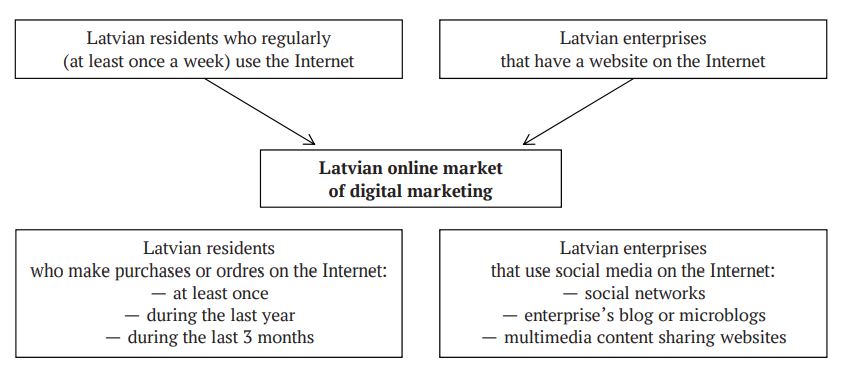
To study the dynamics of the share of Latvian residents and enterprises potentially and actually involved in the online market of digital marketing, i. e. the share of Latvian residents who regularly (at least once a week) use the Internet and make purchases or orders there, as well as the share of Latvian enterprises that have a website and use social media on the Internet, we use the method of assessing con(di)vergence [27], [28], [29] of indicators of the involvement of various groups of residents and enterprises in the Latvian online market of digital marketing for the period of time from 2013 to 2022 (2023) using comparative analysis of data and calculation of the coefficient of variation.25
The concept of con(di)vergence is quite applicable to describe the convergence or divergence of the indicators of involvement of various groups of Latvian residents and enterprises in the online market of digital marketing over a certain period since in economic and social contexts convergence refers to the process when the indicators of different groups or territories come closer together according to certain indicators [27]. To confirm the presence of convergence (decreasing the digital inequality) or divergence (increasing the digital inequality), we can use statistical data on the dynamics of indicators of the involvement of various groups of Latvian residents and enterprises in the online market of digital marketing to find out the degree of their [indicators] convergence or divergence.
In the scientific (mainly econometric) literature [27], [28], [29], there are two main types of con(di)vergence: β(beta)-con(di)vergence and σ(sigma)-con(di)vergence. These are two different concepts mainly used by economists to study interterritorial convergence or divergence by various indicators [30], [31], [32]. Thus, the concept of β-convergence is used to describe the process in which relatively poor economies grow at a faster rate than relatively rich ones, which over time leads to a decrease in the gap in measured indicators between them [31]. It can be called convergence over time and can be applied to any indicators and groups, including indicators of the involvement of various groups of residents and enterprises in the Latvian online market of digital marketing over the studied period. It is expected that lagging groups of residents and enterprises will increase their involvement in the online market at a faster pace.
In turn, the concept of σ-con(di)vergence describes a decrease or increase in the variability (scatter) of indicators among (in this study) various groups of residents and enterprises. It can be called con(di)vergence in space (not only physical but also socio-economic), leading to a decrease or increase in inequality between the groups studied. The conclusion about the presence or absence of σ-con(di)vergence of indicators is made based on a dynamic analysis of the coefficient of variation [31], which makes it possible to assess the variability (scatter) of an indicator within normalized boundaries [33]. The coefficient of variation is calculated as the ratio of the standard deviation to the arithmetic mean of the sample;26 if its value is less than 10 %, then the variability (scatter) of the indicator is considered weak, at 10—30 % — medium, 30—60 % — strong, 60—100 % — very strong [33]. The coefficient of variation can be used to analyze con(di)vergence, especially in the context of σ-con(di)vergence [31].
The empirical basis of this study is the data from the Latvian Central Statistical Bureau for the last 10—11 years (from 2013 to 2022 (2023)) on the involvement of various groups of Latvian residents and enterprises in the online market of digital marketing (Fig. 1) both for Latvia as a whole and depending on their socio-demographic and geographical characteristics: for residents — age (16—24 years, 25—34 years, 35—44 years, 45—54 years, 55—64 years, 65—74 years), education (ISCED 0—2 — no school education, education below primary, basic or primary education; ISCED 3 — general secondary education; ISCED 5—8 — higher education27), economic activity (employed, unemployed, schoolchildren or students, other economically inactive) and region of residence (Riga (the capital of Latvia), around Riga (the Pieriga region), Vidzeme region, Kurzeme region, Zemgale region, and the Latgale region); for enterprises — the number of employees (10—49 employees (small enterprises), 50—249 employees (medium-sized enterprises), 250 + employees (large enterprises)28) and industry (according to NACE 2 classification).
Results and discussion
In line with the research methodology, the statistical analysis of the development of Latvia’s online digital marketing market, in the context of digital inequality among residents and enterprises, involves examining the dynamics of potential and actual market participants. This includes analyzing the share of Latvian residents who regularly (at least once a week) use the Internet for purchases or orders, as well as the share of Latvian enterprises that maintain a website and utilize social media.
As the statistics indicate, the share of Latvian residents who regularly (at least once a week) use the Internet, i. e. potential participants in the Latvian online market of digital marketing, over the past 10 years has increased by 18.8 percentage points — from 71.2 % of the population in 2013 to 90.0 % in 2022 (hereinafter in the text — calculated according to the data of Latvian Central Statistical Bureau). At the same time, the smallest increase (16.8—17.2 percentage points) was observed in Riga and around Riga (the Pieriga region), which in the reference year of 2013 had the largest share of residents who regularly use the Internet (74.9 % and 75.0 %, respectively). In turn, the largest increase in potential participants in the online market of digital marketing was observed in the peripheral regions of Latvia, although it cannot be said that in the Latgale region, where at the time of the reference year 2013 there was the smallest share of residents who regularly use the Internet (64.9 %), the increase was the largest (which characterizes β-convergence, in which the indicators of more lagging groups grow faster).
As for σ-convergence, the variability (scatter) of the indicator of the regularity of Internet use across the regions of Latvia was weak both in 2013 (5.4 %) and in 2022 (3.2 %), while decreasing over 10 years by 2.2 percentage points. This suggests that in access to ICT, unlike most other socio-economic indicators, there is virtually no regional inequality in Latvia (furthermore, regional variability in access to ICT continues to decrease, with the largest decrease observed during the COVID-19 pandemic — from 4.2 % in 2020 to 2.8 % in 2021). This also supports the research hypothesis that geographic inequality among residents in the Latvian online market of digital marketing will decrease, at least in terms of access to this market.
In the framework of this study, we did not analyze the regularity of Internet use by Latvian residents depending on their age, education, and economic activity, but went straight to the analysis of the actual involvement of Latvian residents in the online market of digital marketing depending on all these indicators.
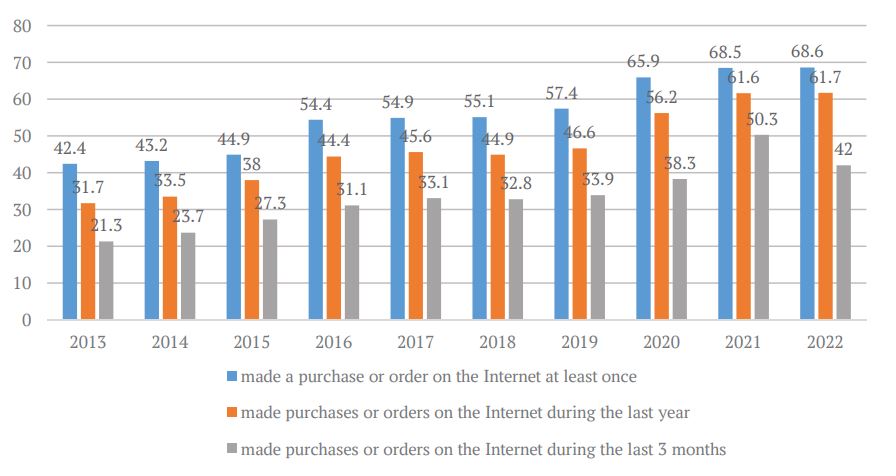
As the data in Figure 2 shows, the share of Latvian residents who make purchases or orders on the Internet, i. e. actual participants in the Latvian online market of digital marketing, over the past 10 years has increased by 20.7—30.0 percentage points. At the same time, the largest increase in digital buyers occurred in the group who made purchases or orders on the Internet during the last year, which indicates a very rapid pace of development of the Latvian online market of digital marketing. At the same time, the potential for development remains substantial. In 2022, despite 90 % of Latvian residents using the Internet regularly (at least once a week), over 30 % had not yet made any purchases or orders online.
The share of Latvian residents who make purchases or orders on the Internet is quickly converging geographically (regionally), both in terms of β-convergence and σ-convergence. Thus, in full accordance with the characteristic of β-convergence, in those regions of Latvia in which the least activity of digital buyers was observed in 2013, this indicator increased generally faster than in ‘advanced’ regions, greatly reducing the digital gap among Latvian residents by geographic attribute: for example, the share of Latgale region’s residents who made purchases or orders on the Internet during the last year increased from 16.3 % in 2013 to 49.8 % in 2022, i. e. by 33.5 percentage points, while in Riga this increase was the smallest among the regions of Latvia — by 27.1 percentage points (from 41.0 % in 2013 to 68.1 % in 2022). However, this is not the case for all indicators — for example, the share of residents who have made a purchase or order on the Internet at least once in the Latgale region (which lags behind in this indicator) is not growing at the fastest pace, being inferior in terms of the growth rate of the share of digital buyers to almost all other Latvian regions. Thus, according to this indicator, β-convergence does not occur.
As for σ-convergence, there are pronounced processes of convergence of indicators on a geographic (regional) basis (i. e. in geographic space). Thus, regional variability in the activity of Latvian residents making purchases or orders on the Internet has decreased by 10.5—17.2 percentage points over the past 10 years, but Riga remains the leader, and the Latgale region still lags behind, but with a smaller gap.
The share of Latvian residents who make purchases or orders on the Internet is converging by age just as quickly as by region, at least in terms of σ-convergence. Thus, the age variability in the activity of Latvian residents making purchases or orders on the Internet has decreased by 15.1—17.6 percentage points over the past 10 years, but the age group of 25—34 years old still remains the leader, and the age group of 55 + is still behind, although with a smaller gap.
In turn, β-convergence by age does not occur because lagging age groups do not increase their activity in the online market of digital marketing faster than ‘advanced’ age groups. Interestingly, the highest rate of increase in shopping activity in the online market is observed in the age group of 16—24 years (although in 2013, this group already occupied second place after the age group of 25—34 years). Indirectly, this may indicate that the youngest age group is not so much increasing their shopping activity in the online market, but rather helping their grandparents to do this — the age group 55 +, in which interest in the online market of digital marketing is also increasing, but there is a lack of knowledge and skills in handling it.
The share of Latvian residents who make purchases or orders on the Internet is converging faster by educational level than by age and region (in terms of σ-convergence). Thus, the educational variability of the shopping activity of Latvian residents making purchases or orders on the Internet has decreased by 18.9—25.2 percentage points over the past 10 years, but the group with higher education remains the leader, and the group with the lowest level of education still lags behind, although with a smaller gap (especially in terms of those who have made a purchase or order on the Internet at least once).
In turn, β-convergence by educational level, as well as by age, does not occur, since groups with a low level of education (ISCED 0—2 and ISCED 3) are increasing their activity in the online market of digital marketing faster than the group with higher education only in terms of testing shopping activity on the Internet (based on the share of those who have made a purchase or order on the Internet at least once or made purchases or orders on the Internet during the last year). In turn, the shopping activity in the online market in terms of making purchases or orders on the Internet during the last 3 months has been growing faster in the group with a higher education, which was already a leader in this aspect. Thus, it can be argued that Latvian residents with a low level of education are more actively trying to enter the online market of digital marketing, but most likely face greater challenges there than users with higher education.
The share of Latvian residents who make purchases or orders on the Internet is also quickly converging by economic activity in terms of σ-convergence but β-convergence does not occur, i. e. the shopping activity in the online market is growing faster in those groups that were already leading in this aspect (in particular, among employees and student youth), while the unemployed and other economically inactive groups of Latvian residents are increasing their shopping activity in the online market at a slower pace. At the same time, the variability of indicators of the shopping activity in the online market among groups with different economic activity over the past 10 years still decreased by 12.8—13.8 percentage points (i. e. σ-convergence occurred), although to a lesser extent than by age, education and geographic (regional) basis.
In 2013, the highest coefficient of variation (55.0—63.7 %) in the shopping activity of Latvian residents in the online market was observed by age, education (47.1—54.3 %) and economic activity (45.6—54.1 %); the coefficient of variation (19.5—32.9 %) was quite low by geographic (regional) basis. Over the past 10 years, the variability in the shopping activity of Latvian residents in the online market has decreased significantly. In 2022, the highest coefficient of variation (37.4—48.6 %) remained by age, followed (unlike in 2013) by economic activity (32.8—40.3 %), and then by education (22.2—35.4 %). The coefficient of variation based on geographic (regional) factors dropped to 9.0—17.1 %.
Such a significant decrease in digital inequality among Latvian residents in terms of their access to the online market of digital marketing and actual involvement in this market over the period from 2013 to 2022 was mainly due to the σ-convergence of indicators of the shopping activity of Latvian residents in the online market for almost all analyzed characteristics. In turn, β-convergence was observed only in some cases, which still did not prevent the decrease of digital inequality among Latvian residents (which [digital inequality], however, still exists). Overall, statistics indicate that the development of digital marketing in Latvia is very fast and reduces inequality among residents in the online market.
Next, we move on to analyzing the involvement of Latvian enterprises in the online market of digital marketing, starting with an analysis of the share of enterprises that have a website on the Internet. According to the research methodology, it is precisely such enterprises that are potential participants in the online market of digital marketing, since, as already indicated in the introduction of this article, a huge number of websites of Latvian enterprises, in reality, remain practically without the attention of the target audience, and only the owners themselves know about their existence.
Groups of enterprises | 2013 | 2014 | 2015 | 2016 | 2017 | 2018 | 2019 | 2020 | 2021 | 2023 | Difference 2023/2013, % points |
All enterprises | 55.7 | 55.9 | 59.0 | 63.5 | 62.9 | 63.0 | 64.8 | 62.6 | 67.8 | 67.3 | + 11.6 |
Incl. by the number of employees: | |||||||||||
10—49 employees (small enterprises) | 51.6 | 50.8 | 53.3 | 58.8 | 58.3 | 58.5 | 59.7 | 58.4 | 63.5 | 63.4 | + 11.8 |
50—249 employees (medium-sized enterprises) | 74.5 | 78.4 | 83.8 | 84.2 | 82.5 | 82.8 | 86.4 | 81.0 | 87.3 | 86.0 | + 11.5 |
250 + employees (large enterprises) | 92.1 | 94.8 | 94.6 | 96.3 | 96.2 | 95.0 | 95.0 | 94.1 | 95.5 | 98.1 | + 6.0 |
Coefficient of variation, % | 22.8 | 24.3 | 22.6 | 19.6 | 19.8 | 19.3 | 18.7 | 18.9 | 16.5 | 17.4 | – 5.4 |
Source: compiled based on the data of Latvian statistics.30 | |||||||||||
* The statistics contain data only for enterprises with 10 + employees.
** The statistics do not contain data for 2022.
As the data presented in Table 1 shows, the share of Latvian enterprises with a website on the Internet is constantly growing. A particularly large increase, more than 5 percentage points per year, occurred during the COVID-19 pandemic. There is β-convergence between SMEs and large enterprises, whereby SMEs are increasing their potential presence in the online market of digital marketing faster than large enterprises.
As for σ-convergence among Latvian enterprises by the number of employees, there is also a process of convergence of the indicator of a website presence on the Internet — from 22.8 % variability in 2013 to 17.4 % in 2022 (i. e. — 5.4 percentage points over 11 years) (Table 1).
In relation to the presence of a website on the Internet, there is no β-convergence of Latvian enterprises by industry, i. e. in industries with almost the same share of enterprises having a website on the Internet in 2013 (for example, in manufacturing (57.6 %) and electricity, gas supply, heating and air conditioning, water supply, wastewater, recycling and reclamation of waste (57.0 %)), the growth rates over the past 11 years could be completely different (in this case — 14.9 % and 25.0 %, respectively). In some sectors of the economy, which at the time of 2013 had relatively high indicators, there was even decrease over 11 years: hotels and accommodation (– 1.1 %), information and communication services (– 4.1 %), activities of administrative institutions and enterprises of services (– 3.9 %).
As for σ-convergence among Latvian enterprises by industry, there is a process of convergence in the indicators of the presence of a website on the Internet between groups of enterprises — from 28.7 % variability in 2013 to 19.7 % in 2023 (i. e. – 9.0 percentage points over 11 years). Thus, the digital inequality among Latvian enterprises by the number of employees and industry (at least in terms of potential access to the online market of digital marketing) is decreasing, and this decrease was especially pronounced during the COVID-19 pandemic: by 2.4 percentage points over one year of the pandemic by the number of employees and by 2.2 percentage points by industry.
Next, we move on to analyzing the use of social media on the Internet by Latvian enterprises, i. e. to the analysis of the actual involvement of enterprises in the online market of digital marketing. According to the classification adopted in Latvian statistics, social media on the Internet includes social networks, enterprise blogs or microblogs and multimedia content-sharing websites.
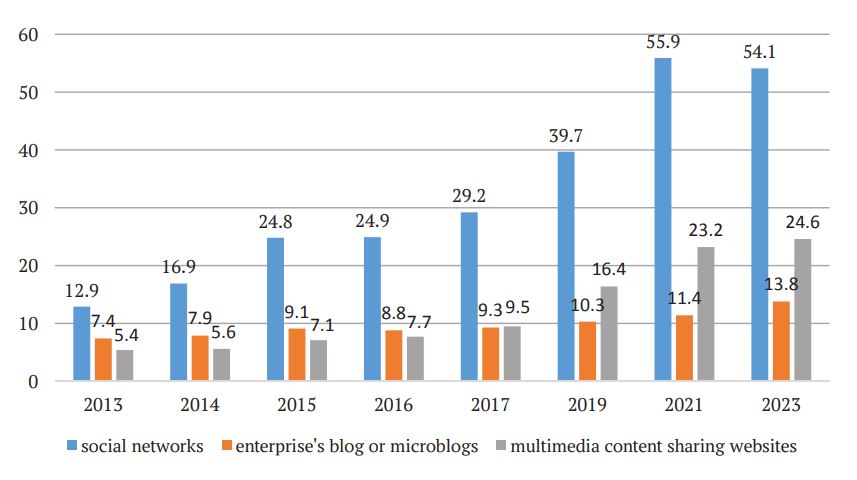
*The statistics contain data only for enterprises with 10 + employees.
** The statistics do not contain data for 2018, 2020, 2022.
As Figure 3 shows, among Latvian enterprises using social media on the Internet, the largest increase (41.2 percentage points) over the past 11 years has been observed in the use of social networks (which is quite consistent with the strategy “if a business is not present on a social network, it is not on the market”), and the smallest (6.4 percentage points) is in the use of enterprise’s blog or microblogs.
The share of small, medium-sized and large enterprises in Latvia using social media on the Internet (i. e. actual participants in the online market of digital marketing) is constantly growing, and this growth sometimes exceeds 50 percentage points over 11 years, as in the case of the use of social media by medium-sized and large enterprises (although they used social networks more often than small enterprises also in 2013). Overall, in terms of the use of social media (all analyzed types) on the Internet, the growth rate of large enterprises is faster than that of medium-sized and especially small enterprises, although initially large enterprises were in the lead in relation to medium-sized ones, and medium-sized enterprises — in relation to small ones (i. e. no β-convergence occurs here).
As for σ-convergence among Latvian enterprises by the number of employees, there is also a rather rapid process of convergence, i. e. decrease of the variability of indicators of the use of social media on the Internet: over 11 years — by 22.7 percentage points for social media, up 5.1 percentage points for enterprise’s blog or microblogs and 16.5 percentage points for multimedia content sharing websites. Despite this rather rapid process of convergence in terms of the use of social media on the Internet, large Latvian enterprises in this aspect are still far ahead of medium-sized and especially small enterprises — by tens of percentage points.
The variability of indicators of the use of social networks by Latvian enterprises across industries in 2013 was very strong (80.3 %), and over 11 years it decreased by 54.8 percentage points, falling to 25.5 %, i. e. there has been a rapid σ-convergence in the use of social networks among Latvian enterprises by industry (this is the largest decrease of digital inequality within the scope of this study).
As for β-convergence among Latvian enterprises by industry, we can say that lagging industries are growing faster (in full accordance with the β-convergence conception) — for example, wholesale and retail trade, car and motorcycle repairs with 12.7 % of the use of social networks in 2013 and an increase of 51.0 percentage points over 11 years.
The variability of indicators regarding the use of enterprise blogs or microblogs by Latvian enterprises across industries in 2013 was nearly as pronounced as that of social networks (78.3 % and 80.3 %, respectively). However, over the course of 11 years, this variability has decreased significantly less than in the case of social networks, declining by only 16.2 percentage points to 62.1 %. Thus, σ-convergence in the use of enterprise blogs or microblogs among Latvian enterprises is not as marked as in the case of social networks. As a result, the variability across industries in the use of enterprise blogs or microblogs, although decreased, still remains very strong (the leader with a big gap here is the information and communication services).
As for β-convergence among Latvian enterprises by industry, it does not occur with regard to the use of blogs or microblogs by enterprises, i. e. industries lagging behind in this regard do not grow faster, and sometimes (for example, in the case of wholesale, retail trade and repair of cars and motorcycles) even demonstrate a decrease. At the same time, the largest increase (14.6 % percentage points) in the use of enterprise blogs or microblogs was observed in the information and communication services, which was already the leader in 2013.
The variability of indicators of the use of multimedia content-sharing websites by Latvian enterprises across industries in 2013 was even greater (coefficient of variation — 83.6 %) than in the case of social networks and enterprise blogs or microblogs, and over 11 years this variability has decreased by almost a half, i. e. by 41.4 percentage points, falling to 42.2 %. Thus, σ-convergence in the use of multimedia content-sharing websites among Latvian enterprises was almost as significant as in the case of social networks, resulting in a significant decrease in the variability across industries.
As for β-convergence among Latvian enterprises by industry, it does not occur in relation to the use of multimedia content-sharing websites (as is in the case with enterprise’s blogs or microblogs), i. e. industries lagging behind (in 2013) in this regard can demonstrate both a rapid growth rate (for example, retail trade, except for trade in cars and motorcycles, with an increase of 23.4 percentage points), and quite moderate (for example, transportation and storage with an increase of 14.2 percentage points), and the leader in the use of multimedia content sharing websites in 2013, the information and communication services industry, demonstrates a relatively large increase of 23.8 percentage points.
Thus, at the time of 2013, the greatest digital inequality among Latvian enterprises was observed not so much in terms of access to the online market of digital marketing (in terms of a website presence on the Internet, the coefficient of variation was 22.8 % by the number of employees (Table 1) and 28.7 % by industry), but in terms of actual involvement in this market (for example, in terms of the use of social networks, the coefficient of variation was 47.5 % by the number of employees and 80.3 % by industry). Over 11 years the digital inequality among Latvian enterprises has decreased significantly, and by 2022 there is no longer such a significant difference between inequality among enterprises in terms of access to the online market of digital marketing and in terms of actual involvement in this market. Thus, in terms of the presence of a website on the Internet, the coefficient of variation in 2022 decreased to 17.4 % by the number of employees, i. e. by 5.4 % percentage points (Table. 1), and up to 19.7 % by industry, i. e. by 9.0 percentage points. In turn, in terms of the use of social networks, the coefficient of variation in 2022 decreased to 24.8 % by the number of employees, i. e. by 22.7 percentage points, and up to 25.5 % by industry, i. e. by 54.8 % percentage points.
Such a significant decrease in digital inequality among Latvian enterprises in terms of their access to the online market of digital marketing and actual involvement in this market over the period from 2013 to 2023 was mainly due to σ-convergence of indicators of the presence of a website and use of social media on the Internet. In turn, β-convergence was observed only in some cases, which still did not prevent the decrease of digital inequality among Latvian enterprises (which, however, remains quite strong).
The research hypothesis that the development of digital marketing in Latvia is very fast and reduces inequality among residents and enterprises in the online market can be considered proven, but in conclusion, it is necessary to include the reducing digital inequality in the context of more general inequality in the distribution of income among Latvian residents in the hope of seeing a decrease of inequality in terms of the Gini coefficient, simultaneously with the rapid development of digital marketing in Latvia. Statistics show that over 10 years the decrease in the Gini coefficient in Latvia was 1.5 percentage points. At the same time, at the start of the COVID-19 pandemic, the Gini coefficient was higher than in 2013, and over the two years of the pandemic, it decreased more than in all 10 years — by 1.7 percentage points (Fig. 4).
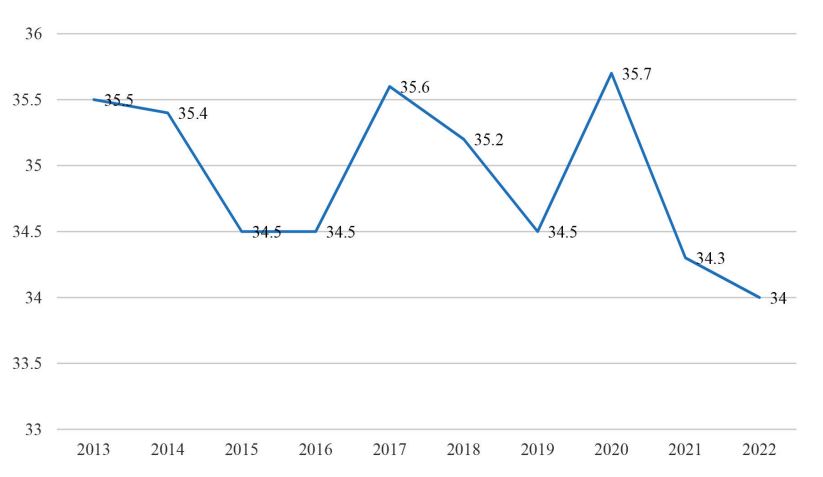
The accelerated decrease in inequality during the COVID-19 pandemic can be explained from the perspective of the theory of digital divide presented in the methodological section of this study [18], [19], namely, the fourth type of access to ICT (their actual use and application in everyday life, work and learning), which became an inevitable necessity only during the COVID-19 pandemic.
However, as the analyzed statistics reveal, digital inequality among Latvian residents and enterprises — along with broader socio-economic inequality—persists on a significant scale. We can begin to elucidate its possible causes through the case study presented in the following table.
Comparable indicators* | Online store BARBORA | Online store Vietējais top! |
Delivery territory | Products are delivered only in Riga region and around it (Pieriga region) | Products are delivered even in rural areas in the regions |
Competitors in the delivery territory | Yes | No |
Delivery time | The day and time of delivery is selected by the client during making order from the options offered on the website | There is no option on the website to select the day and time of delivery, but the delivery information states that it occurs on the same day if payment is received before 13.00—15.00 |
Website design | The website is beautifully designed | The website is beautifully designed |
Website informability | Good — products are grouped (which makes them easier to find), and there are all the necessary sections of information | Good — products are grouped (which makes them easier to find), and there are all the necessary sections of information |
Website usability | The website is quite easy to use: product sections open quickly (but the transition between them is not very convenient), the table for selecting delivery times appears twice, and the orders were always completed successfully | The website is very inconvenient to use: product sections take a long time to open, there are often unnecessary switches from one group of products to another, and the finished cart may ‘freeze’ during payment (in this case, I had to create a new profile and place the order again) |
Additional opportunities | The website features a section for recipes, allowing users to order ingredients directly in a basket. It also includes sections for new products and a ‘World of Wine.’ Additionally, users can create basket templates for typically repeated purchases | No |
Bonuses | Coupons and discounts are offered using a special code | Coupons and discounts are offered using a special code |
Support in case of problems | Three communication channels are offered: telephone, e-mail and Internet chat; respond and help through all channels (if they can’t answer the phone right away, they always call back) | Two communication channels are provided: telephone and email. However, phone calls often go unanswered, and emails receive no response. When contacting a specific physical store where the order is supposed to arrive, staff express understanding and sympathy but are unable to assist while the order remains in standby mode, citing that ‘the owner is on vacation |
Shopping experience | Multiple successful experiences, but only when visiting Riga and the Pieriga region, because this service is not available in the peripheral regions | Completely unsuccessful experience (the order was not completed): loss of time to place the order (at first it ‘froze’ during payment, and it took a long time to order again since groups of goods take a long time to open), at the time of writing the article, the completed and paid order was ‘hung’ in standby mode for almost week and has already lost the relevance for the buyer |
Business owners | Patrika Ltd. | MADARA 89 Ltd. |
Legal address of the enterprise | Maskavas street 257, Riga, LV-1019, Latvia | Baznicas laukums 2, Smiltene, Smiltene County, LV-4729, Latvia |
Source: compiled based on both personal experience and information from the enterprises’ websites. | ||
* Formulated partly based on [2].
The results of the case study of two enterprises operating in the Latvian online market for the delivery of food and essential goods, presented in Table 2, can be explained within the conceptual framework and methodology of this study, based on the technology acceptance model, the theory of digital divide and the resource approach.
Using the technology acceptance model, which works with the user’s subjectively perceived usefulness and ease of use of computerized information systems33 [17], it is possible to explain the user’s shopping experience in the online market of digital marketing as follows: the service of ordering and delivering food and essential goods is subjectively perceived by the user as useful and easy to use. However, the reasons for a successful shopping experience in the first case and a completely unsuccessful one in the second case cannot be explained using this model. The methodological assumption that differences in the socio-economic status of users determine their inequality in the use of digital marketing tools does not work here either,34 since both successful and completely unsuccessful shopping experiences belong to the same user.
The theory of digital divide and its four types of access to ICT (motivational access, material access, access skills and access use) [18], [19] can explain the results of the case study by shortcomings in the fourth type of access that have become an obstacle to successful experience in the online market of digital marketing in the case of the online store Vietējais top! (Table 2). In particular, in this case, one can state shortcomings in the access use, i. e. in the effectiveness of the actual use and application of ICT for the implementation of an order on the Internet. In the context of digital inequality on a geographical (regional) basis, addressed by this study, it is noteworthy that a successful shopping experience was stated in cooperation with a metropolitan digital seller, and an unsuccessful one — with a regional one. This illustrates that the capital region of Latvia, unlike the rest of the country, is at a higher—and, crucially, qualitatively different—stage of economic development, characterized by distinct driving forces and business culture. This fact has been deeply studied in the works of researchers from Daugavpils University [34; 35], but is usually not considered both in economic research and in economic policy.
Most likely, the results of this study can be explained in the conceptual paradigm of the resource approach based on the theory of social fields [20] or the resource-asset-capital approach [21], which assumes that resources (including technological ones, i. e. motivational and material access to the online market and even skills in handling it) available to the resident / enterprise can be turned into his / her / its assets, which, in turn, can become the capital of the resident / enterprise. Thus, technological (like any other) resources do not always become assets, much less capital (which is what happened in the second case, presented in Table 2). In an economy based on social capital (and this is precisely the economy of the peripheral regions of Latvia — as opposed to the capital region), a key role is given to social connections that promote cooperation between individuals and groups, and in such an economy the conversion of social and administrative capital into economic capital is most pronounced [22]. Considering the very low (about 2 %) level of participation of Latgale residents in public organizations and political parties, revealed by researchers at Daugavpils University [22], the peripheral regions of Latvia are characterized by a rather ‘closed] type of social capital (according to M. Olson), in which interests of closed groups may conflict with general public interest and lead to social and economic inefficiency [36].
In a practical sense, this means that for participants in the online market of digital marketing promoting a product or service, it is not enough to have a website of your enterprise on the Internet — you must also be able to use this website to completely fulfil the client’s order (for example, help him/her to figure out if the completed and paid order for food delivery ‘hangs’ in standby mode for almost a week). As for the target audience, it is not enough to have access to the website and the ability to use it — you also need to use existing social connections or try to establish new ones (if there is no administrative capital), calling physical participants in the supply chain and finding out when the owner will be back from vacation to deal with an order stuck on the website. In such conditions, models and theories developed for an economy at the innovation stage of development (in Latvia, only Riga is close to this stage [35]) practically do not work.
The results of this study are consistent with the results of other studies that digital marketing is a strong equalizer for residents and enterprises when used effectively to reach target audiences, attract customers and measure results.35
Conclusions
Based on the results of this study, the following conclusions can be drawn about the digital inequality among residents and enterprises and the development of the Latvian online market of digital marketing:
(1) The development of digital marketing in Latvia has progressed rapidly, with the COVID-19 pandemic serving as a major catalyst, forcing an increased use of ICT in everyday life, work, and education. However, the potential for further growth remains substantial, as, despite 90 % of Latvian residents regularly using the Internet (at least once a week), more than 30 % have never made a purchase or order online;
(2) Between 2013 and 2022, digital inequality among Latvian residents, in terms of access to and participation in the online market, saw a significant reduction. There was a rapid convergence of shopping activity indicators across nearly all key characteristics—age, education, economic activity, and region of residence;
(3) However, despite this notable progress, digital inequality remains widespread among Latvian residents and enterprises. Large enterprises, especially those in information and communication services, continue to lead by a considerable margin. Among residents, the most active participants are still economically engaged individuals from Riga, aged 25—34, with higher education.
Thus, digital marketing is a strong ‘equalizer’ for residents and enterprises, when it is used effectively and not just by providing equal physical access to ICT. Otherwise, the digital gap between residents and enterprises that are more successful (for various reasons) in capitalizing their technological and other resources in the online market of digital marketing, and those that are not, could become even larger than it was in the offline market. Today, the development of digital marketing in Latvia reduces inequality among various socio-demographic and geographical groups of residents and enterprises in the online market in relation to the ‘digital inequality of input’ (access to the online market), but in relation to the ‘digital inequality of output’ (return on this access) the equalizing opportunities of digital marketing in Latvia (especially in its regions) are limited by the specifics of the functioning of the economy, which is based on social capital.
The main limitation of this study is the non-exhaustive set of analyzed statistical indicators, which gives an idea of the general background and dynamics of the development of the Latvian online market of digital marketing in the context of digital inequality among residents and enterprises but does not cover many more detailed aspects related to the use of various digital marketing tools. Regarding future research directions on the development of Latvia’s online digital marketing market, a useful starting point could be our case analysis comparing two enterprises in the Latvian online market for food and essential goods delivery. From this foundation, we can conduct a comprehensive study of the technological, organizational, economic, and social aspects of the digital marketing market, as well as the barriers that prevent digital marketing from more effectively reducing digital—and consequently socio-economic—inequality in Latvia.
Reference
Weng, J. 2023, The evolution of digital marketing in the 21st century: three periods analysis, BCP Business & Management, № 38, p. 2041—2046, https://doi.org/10.54691/bcpbm.v38i.4029
Davidavičienė, V., Raudeliuniene, J., Jonyte-Zemlickiene, A., Tvaronaviciene, M. 2021, Factors affecting customer buying behavior in online shopping, Marketing and Management of Innovations, № 4, p. 11—19, http://doi.org/10.21272/mmi.2021.4-01
Arbeláez-Rendón, M., Giraldo, D. P., Lotero, L. 2023, Influence of digital divide in the entrepreneurial motor of a digital economy: a system dynamics approach, Journal of Open Innovation: Technology, Market, and Complexity, vol. 9, № 2, 100046, https://doi.org/10.1016/j.joitmc.2023.100046
Dobrinskaya, D. Y., Martynenko, T. S. 2019, Perspectives of the Russian information society: digital divide levels, RUDN Journal of Sociology, vol. 19, № 1, p. 108—120, https://doi.org/10.22363/2313-2272-2019-19-1-108-120 (in Russ.).
Voronov, V. V. 2022, Small towns of Latvia: disparities in regional and urban development, Baltic Region, vol. 14, № 4, p. 39—56, https://doi.org/10.5922/2079-8555-2022-4-3
Ali, R., Komarova, V., Aslam, T., Peleckis, K. 2022, The impact of social media marketing on youth buying behaviour in an emerging country, Entrepreneurship and Sustainability Issues, vol. 9, № 4, p. 125—138, http://doi.org/10.9770/jesi.2022.9.4(6)
Umit Kucuk, S. 2009, The evolution of market equalization on the Internet, Journal of Research for Consumers, № 16, p. 1—15.
Pellicelli, M. 2023, The Digital Transformation of Supply Chain Management, Elsevier,
https://doi.org/10.1016/C2020-0-02458-8
Larina, Y. 2017, Understanding algorithmic societies. Hybrid intelligence and its zombies, Free Thought, № 5, p. 5—26 (in Russ.).
Zhixian, Y. 2018, Introduction to marketing. In: Marketing Services and Resources in Information Organizations (A volume in Chandos Information Professional Series), Elsevier, p. 1—17, https://doi.org/10.1016/B978-0-08-100798-3.00001-5
Varlamova, Y. A. 2022, Intergenerational digital divide in Russia, Mir Rossii, vol. 31, № 2, p. 51—74, https://doi.org/10.17323/1811-038X-2022-31-2-51-74 (in Russ.).
Dunlop, S., Freeman, B., Jones, S. C. 2016, Marketing to youth in the digital age: the promotion of unhealthy products and health promoting behaviours on social media, Media and Communication, vol. 4, № 3, p. 35—49, https://doi.org/10.17645/mac.v4i3.522
Davis, F. D. 1989, Perceived usefulness, perceived ease of use, and user acceptance of information technology, MIS Quarterly, vol. 13, № 3, p. 319—340, https://doi.org/10.2307/249008
van Dijk, J. 2006, Digital divide research, achievements and shortcomings, Poetics, № 34, p. 4—5, https://doi.org/10.1016/j.poetic.2006.05.004
van Dijk, J. 2017, Digital divide: impact of access, in: Rössler, P., Hoffner, C. A., van Zoonen, L. (eds.), The International Encyclopedia of Media Effects, John Wiley & Sons, p. 24—49, https://doi.org/10.1002/9781118783764.wbieme0043
Tikhonova, N. 2006, Resource approach as a new theoretical paradigm in stratification research, Sociological Studies, № 9, p. 28—41. EDN: OYOAUH (in Russ.).
Meņšikovs, V. 2009, Kopkapitāls un jaunatnes dzīves stratēģijas: sociologiskais aspekts, Sociālo Zinātņu Vēstnesis, № 2, p. 7—37, https://du.lv/wp-content/uploads/2022/11/SZV_2009_2.pdf (in Latv.).
Mensikovs, V., Kokina, I., Komarova, V., Ruza, O., Danilevica, A. 2020, Measuring multidimensional poverty within the resource-based approach: a case study of Latgale region, Latvia, Entrepreneurship and Sustainability Issues, vol. 8, № 2, p. 1211—1227, https://doi.org/10.9770/jesi.2020.8.2(72)
Komarova, V., Mietule, I., Arbidane, I., Tumalavičius, V., Kokarevica, A. 2022, Resources and capital of different social classes in modern Latvia, Journal of Eastern European and Central Asian Research, vol. 9, № 3, p. 500—512, http://dx.doi.org/10.15549/jeecar.v9i3.861
Seda, F., Setyawati, L., Pera, Y., Damm, M., Nobel, K. 2020, Social exclusion, religious capital, and the quality of life: multiple case studies of Indonesia and Thailand, Economics and Sociology, vol. 13, № 4, p. 107—124, https://doi.org/10.14254/2071-789X.2020/13-4/7
Meņšikovs, V., Lavrinoviča, I. 2011, Sociālās diferenciācijas tendences mūsdienu Latvijā, Daugavpils Universitātes 53. starptautiskās zinātniskās konferences rakstu krājums, Daugavpils, Daugavpils Universitātes Akadēmiskais apgāds “Saule”, p. 121—134 (in Latv.).
Barro, R. J., Sala-i-Martin, X. 1991, Convergence across states and regions, Brooking Papers on Economic Activity, № 1, p. 107—182.
Barro, R. J., Sala-i-Martin, X. 1992, Convergence, Journal of Political Economy, vol. 100, № 2, p. 223—251.
Barro, R. J., Sala-i-Martin, X. 1997, Technological diffusion, convergence, and growth, Journal of Economic Growth, vol. 2, № 1, p. 1—26.
Boronenko, V., Mensikovs, V., Lavrinenko, O. 2014, The impact of EU accession on the economic performance of the countries’ internal (NUTS 3) regions, Proceedings of Rijeka Faculty of Economics, vol. 32, № 2, p. 313—341.
Lavrinenko, O. 2015, Living Standard of Central and Eastern Europe, Germany, GlobeEdit, 116 p.
Lavrinenko, O., Lavrinovica, I., Jefimovs, N. 2012, Sustainable development, economic growth and differentiation of incomes of Latvian population, Journal of Security and Sustainability Issues, vol. 2, № 1, p. 33—39, https://doi.org/10.9770/jssi/2012.2.1(3)
Krastiņš, O., Ciemiņa, I. 2003, Statistika: mācību grāmata augstskolām, Rīga, Latvijas Republikas Centrālā statistikas pārvalde (in Latv.).
Boronenko, V. 2014, The Role of Clusters in Regional Competitiveness, LAMBERT Academic Publishing, 80 p.
Seļivanova-Fjodorova, N. 2020, Economic differentiation of Latvia’s regions at the beginning of the 21st century, Social Sciences Bulletin, № 1, p. 108—135, https://doi.org/10.9770/szv.2020.1
Olson, M. 1965, The Logic of Collective Action: Public Goods and the Theory of Groups, Harvard University Press, 319 p.