Moving towards technological sovereignty: a new global trend and the Russian specifics


Abstract
This paper investigates the global trend of the early 2020s, characterized by securitization of industrial strategies and the course towards technological self-sufficiency/sovereignty (the TS course) in both developed and developing countries, accompanied by geopolitical fragmentation of the world economy. We first identify typical features of the process of securitization of industrial policy in the context of its historical models’ evolution, then consider parameters of the TS course, including motives, objectives, tools, and risks, in Western nations (EU and USA) and in leading BRICS members (China, India, Brazil). It is shown that Western countries strive for product and technological independence from China while aiming for global leadership in the field of semiconductor (USA) or green (EU) technologies. Conversely, China aims for a central role in the global economy, prioritizing technological independence from the West. In India and Brazil, the TS course is shaped by structural economic challenges and the risks of growth slowdown. Against this background, we proceed to examine Russia’s TS course, analyzing its rationale, design of TS projects, as well as limitations and risks posed by sanctions. Then we highlight distinctions between Russia’s TS course and its foreign analogues, as well as reveal risks of Russia’s increasing technological dependence on China. The conclusion suggests that achieving TS, driven by security imperatives, may present a more formidable challenge than anticipated by governments across different types of countries.
Over the past three decades, globalisation, driven by open market policies and the expansion of multilateral cooperation, has markedly increased the interdependence of national economies. However, the advantages of participation in global value chains and deepening the division of labour are now undermined by new conflicts.
Firstly, the growing complexity of non-linear global networks has increased the fragility of the global economy. Local disruptions in supply chains — whether due to cyberattacks, natural disasters, or other events — can trigger waves of economic shocks that rapidly propagate on a global scale. In the wake of the 2020 pandemic, these ripple effects have sparked political frictions between countries, calls for de-globalization, and a rise in protectionist measures [1].
Secondly, the world faced weaponization of its economic connectivity: major suppliers such as China began to use interdependencies as a means of geopolitical pressure on trade partners, including dumping practices to displace competitors. This resulted in China’s trade conflicts, first with the US and then with the EU.
Thirdly, the ongoing armed conflicts and new sanction barriers have further restricted freedom of trade, breaking the previously established economic ties. The unprecedented volume of sanctions imposed on Russia in 2022 has effective- ly severed its direct contacts with the West, while numerous third-party countries have become exposed to the risk of secondary sanctions [2]. Finally, the intensifying technological rivalry between the US and China, especially for the semiconductor market, has created the threat of technological decoupling when global production may divide into two separate ecosystems.
Basically, the technological race and the decline in trust between the West and the East in recent years have led nations to perceive multilateral cooperation less as an advantage and more as a potential threat to national security [3], [4]. This shift has given rise to the ‘securitization’ of international economic relations, with countries increasingly forming geopolitical blocs based on ‘friendshoring’ — prioritizing trade and production partnerships with ideologically close, “friendly” nations [5]. The prevailing view in academic discourse is that a separation of the global economy into three segments — the United States-aligned West, the China-aligned East, and a group of non-aligned states manoeuvring between the first and the second — will have adverse implications for international trade, global economic growth, and the domestic development of nations due to increased costs [6].
A similar securitization can be observed in domestic economic policymaking. Since the early 2020s, more and more developed and developing countries have been refocusing their industrial strategies from their previous priority of enhancing efficiency to the task of ensuring security. This shift has entailed efforts to bolster technological self-sufficiency, particularly in strategic sectors. For Russia, which is facing unparalleled Western sanctions, the prospect of achieving technological sovereignty represents a unique conceptual and practical challenge.
This paper explores the extent to which Russia’s push for technological sovereignty aligns with global trends and how it differs from similar strategies implemented today by other nations. We first examine the very process of the securitization of industrial policy in the context of its historical models (Section 1). Next, we analyze the objectives, instruments, and challenges of the course towards technological self-sufficiency both in Western countries (the EU and the USA) and in the leading BRICS members (China, India, and Brazil) (Sections 2—3). Against this background, we describe Russia’s strategy for achieving technological sovereignty and assess the relevant measures that have been put forth by the Russian government (Section 4). Finally, we highlight how Russia’s approach differs from its foreign counterparts and discuss the challenges and risks to its success (Section 5). In conclusion, we evaluate the feasibility of achieving technological self-sufficiency under the ongoing geopolitical fragmentation of the world economy.
1. The evolution of industrial policy models and the shift towards securitization
The defining feature of the current historical moment is that the idea of enhancing economic and technological self-sufficiency, often termed “technological sovereignty” (TS), has simultaneously become a central objective for various groups of countries. The focus on achieving TS now plays a key role in shaping national industrial strategies across both developed and developing economies. However, such a shift in industrial policy challenges the logic of its traditional evolution in alignment with technological progress and the increasing complexity of production systems.
Indeed, for seven decades since the 1950s, the conceptual and practical changes in national industrial strategies have been driven primarily by the goal of modernizing the economy to improve its efficiency and ensure long-term sustainability. Historically, this evolution has involved a gradual shift from a predominantly vertical industrial policy (focused on specific sectors) to a more horizontal approach (emphasizing horizontal policies across all sectors). Eventually, these two models were synthesized into a systemic approach, designed to overcome the limitations of earlier models and capitalize on their strengths (Table 1).
|
Type of modernization |
Catching up industrialization (1950s—1980s) |
Internationalization and market transition (1980s—2000s) |
Innovation transition and adaptation to globalization (mid. 2000s—2010s) |
|
Industrial policy model and its conceptualization |
Vertical, or classic model (Asian developmentalism) |
Horizontal model (neoclassical Washington Consensus, neo-Schumpeterian growth theory) |
Systemic model (post-Washington Consensus, post-developmentalism, complexity theory) |
|
Main objectives |
Critical mass of new industries, import substitution and exports of finished goods |
Critical mass of market institutions, opening the economy and increasing its efficiency through deregulation |
Critical mass of network ecosystems for Industry 4.0 development and efficient participation in global value chains |
|
Typical examples |
Japan, South Korea, later — other “Asian Tigers” |
Developed and transition economies in Europe, other emerging markets |
Scandinavian countries, U.S., EU, and other developed and major developing economies |
|
Role and functions of the state |
Supreme manager and developer of industries and technologies (defines priorities for businesses and promotes their implementation) |
Supervisor of liberalized markets (supports competitive environment and creative destruction) |
Network partner to business and academia, network coordinator (supports networking and collaboration) |
|
Typical state interventions |
Vertical (selecting sectors for fiscal support, picking and nurturing business “winners”) |
Horizontal (ensuring the level playing field for all sectors, improving the market redistribution mechanisms) |
Horizontal with vertical projections (connecting “winners” picked by markets into joint cluster networks) |
|
Typical business links in the system |
Domination of vertical and hierarchical ties |
Vertical and horizontal ties |
Domination of horizontal networks and platform-based collaborations |
Source: compiled by authors after: [7—10]. | |||
By the mid-to-late 2010s, many OECD countries had incorporated the cluster and ecosystem approach — typical for the systemic model — into their industrial policies aimed at transitioning to a knowledge-based economy. These countries included the former Asian practitioners of classical industrial policy, European countries like France, the European Union (which had previously been committed to a horizontal model), and technologically advanced economies such as the USA, Canada, the UK, and the Netherlands, which had previously lacked formal industrial policies. Major developing countries have also followed suit, focusing on building Internet platforms, network institutions, and policies for the effective use of these instruments [7].
However, in 2020, this trend shifted dramatically. The COVID-19 pandemic crisis and the disruptions to global supply chains prompted many Western countries, especially in Europe, to adjust their industrial strategies to cope with the external shocks. This shift included pursuing greater self-sufficiency in vital consumer goods (e. g., medical supplies), reducing dependence on critical intermediate imports from Asia, and encouraging global firms to increase the resilience of their transborder supply chains by diversifying or reshoring their links [1].
Moreover, by the late2023, with tensions escalating between China and var¬ious nations, and the Russian-¬Ukrainian conflict persisting, the world witnessed not just a resurgence of proactive industrial policy, but its complete reloading [11]. Across continents, industrial strategies that once focused on enhancing national competitiveness began to incorporate political and geopolitical priorities centred on enhancing national economic security.1 Basically, such priorities have emerged as a cumulative reaction of countries to the risks and challenges of the previous five years, including the increased potential for information wars, armed conflicts, and internal social tensions. However, the key underlying motive behind this shift remains the growing threat to G7 countries, other national economies, and the whole world order posed by China’s widespread practice of trade weaponization [12]. To reduce dependence on China and protect themselves from potential losses, the US and the EU have begun to pursue a policy of “de-risking”, encouraging geographical reconfiguration of global value chains in line with the principles of “friendshoring.”
An expected fragmentation of the world economy into competing blocs of allies and adversaries has shaped the current aspiration of various countries to strengthen economic and technological self-sufficiency. Despite the multitude of national differences in such a course, as will be outlined below, we can identify several of its common features, including quite contradictory policy objectives.
Firstly, for the first time in history, national industrial strategies have begun to prioritize security over efficiency. These strategies now attempt to balance two conflicting goals: achieving self-sufficiency, which is aligned with practices of the past industrial era, and accelerating technological development, which is aligned with the modern era of distributed production. Since globalization has benefited all types of economies, enabling many developing nations, from China to Vietnam, to make a leap in development [13], governments are not seeking to entirely disengage from the existing global value chains but rather tend to retain the advantages of participating in them. However, the principle of friendshoring, which looks for a trade-off between security concerns and economic integration, may prove to become a serious obstacle to the natural, market-based evolution of globalized production [6]. The emergence of geopolitical blocs built on countries’ grouping around certain shared security preferences and close ideological values, along with nations’ deliberate curtailment of inter-bloc trade, is not identical to the business-led regionalization of the global value chains when their links have been increasingly concentrated within the major world macro-regions to form three interconnected production ecosystems in North America, Europe, and Asia-Pacific [1].
Secondly, in addition to the waning trust between Eastern and Western powers, there are internal factors that are pushing nations towards greater self-sufficiency. A growing number of governments are now questioning the sufficiency of market-based regulatory approaches to address the current challenges. Consequently, state intervention in the economy is increasing worldwide, even in regions that have historically relied on market forces for promoting economic activity, such as the United States and other in Europe, where the proactive industrial policy had previously been viewed with scepticism. Governments are now ready to make unprecedented budget investments into those industries and technologies that they consider strategically important for national security [14]. As a result, the role of budget stimulus and state-led redistribution mechanisms, which are the hallmarks of the classic industrial policy, is sharply rising in national strategies. Such an approach is particularly prevalent in China and other emerging markets, where the benefits of state intervention have long been a tenet of economic policy. At the same time, the largest economies seek to curtail the competitiveness of rival nations and secure exclusive advantages in advanced technology markets, which largely differs from the idea of developmentalism, typical for the classic model, where the developer state focuses on fostering national competitiveness [4].
Thirdly, both developed and developing countries are shifting the focus of industrial policy from narrow sector-specific targets to broader ‘mission-oriented’ initiatives. These large-scale projects — such as import substitution in high-tech sectors, achieving technological independence, accelerated green transition, or addressing social issues like eliminating inequality — are viewed as exceeding the capabilities of private business and requiring substantial state investment. On the one hand, the reorientation towards ambitious “missions” and technological breakthroughs is fueled by popular narratives about the “entrepreneurial state” as outlined in the research of Mariana Mazzucato [15]. On the other hand, in the context of security goals, governments have come to perceive technological modernization (mastering industries 4.0) as the result of large-scale budget programmes. Such perception is at odds with Schumpeterian and evolutionary theories that link technological advancements with the development of competitive markets able to generate gradual innovation, creative destruction, and feedback linkages [16]. As a result, the contemporary role of the state, until recently associated with the cultivation of horizontal partnerships and innovation ecosystems in accordance with the systemic model of industrial policy, is fading into obscurity. Instead of a parallel development of technological and institutional innovations, governments start to focus on just the technological component (digitalization, robotization, etc.), isolating it from the needed institutional measures. Meanwhile, this gap in the advancement of both components may lead to economic distortions, especially in emerging market economies, such as China or Russia.
It should be noted that modern economic science offers no conceptual or empirical justification for better development of advanced industries within the framework of friendshoring and technological sovereignty. On the contrary, the existing studies warn about high costs of such a policy course, indicating that the revival of import tariffs and non-tariff barriers to protect national markets may adversely affect global trade, world GDP and the innovation-led transition itself. The rising costs can ultimately lead to the opposite effect — a reduction in industrial exports and a slowdown in national economies [11], [17]. Nevertheless, governments are adopting protectionist measures as a macroeconomic trade-off, anticipating that these actions will mitigate more significant risks to sustainable growth. Under geopolitical pressures, the new model of industrial policy is gaining traction, which makes the fragmentation of the world economy into blocs almost inevitable.
The precise parameters of this fragmentation remain uncertain. However, prominent think tanks see its constitutive factor in the technological decoupling between the United States and China. This decoupling, they argue, may lead to the fragmentation of the global economy into three separate blocs: the Western bloc (embracing the US and its allies, including the EU), the unfriendly Eastern bloc (China and its allies, including Russia), and a group of neutral countries (Brazil, India, Turkey, etc.) seeking to maintain trade and business ties with both blocs [18; 19]. Other researchers draw attention to the mounting opposition to the developed world from the developing world. The latter is already responsible for generating half of the world’s GDP, increasing its share in trade and investment flows. Meanwhile, the BRICS countries, which have extended invitations to six new members to join their association, produce a total of about 30 % of the world’s GDP, thereby challenging the dominance of G7 countries in this regard [11]. Against this backdrop, official Russian economists tend to view geopolitical fragmentation as a natural process of regionalization. They believe that reconfiguration of global supply chains will enable the Global South to form new integration blocs and centres of influence. Furthermore, they hope that Russia is uniquely positioned to lead this new wave due to its focus on developing technological capabilities [20].
2. The technological self-sufficiency course in Western countries (the EU and USA)
The European Union
In the EU, three key events triggered the securitization of industrial policy: Brexit (2016—2020), widespread supply chain disruptions during the COVID-19 pandemic shock (2020), and mounting geopolitical risks after the outbreak of the Russian-Ukrainian conflict (2022) [21]. The current turn towards economic security, starting with energy security (marked by Europe’s accelerated exit from reliance on Russian hydrocarbons in 2022—2023), has been facilitated by already existing political and legal groundwork, laid in the late 2010s within the European concept of “strategic autonomy”.
The concept of technological sovereignty (hereinafter TS, also denoting technological self-sufficiency for other country cases) stems from this broader notion of strategic sovereignty, focusing on the EU’s ability to independently produce critical products and control key high-tech sectors [23]. The critical products span a wide range of sectors that rely on three groups of advanced technologies: green, digital (including semiconductors), and biotechnologies. The priority development of these technologies to achieve product and technological self-sufficiency in relevant sectors is aligned with core objectives of the European TS agenda (Table 2), which in turn are outlined in the EU Economic Security Strategy. This strategy, adopted in June 2023, also defines the main directions and tools of the EU’s renewed industrial policy, with the idea of TS integrated into all major pan-European programmes introduced in this area since 2022.3
|
Parameters |
European Union |
USA |
|
Main programmes and documents (year of adoption, amount of funding) |
— REPowerEU (2022, € 210 billion by 2027) — Green Deal Industrial Plan (2023, € 250 billion by 2050) — European Chips Act (2023, € 43 billion by 2030) — Strategic Technologies for Europe Platform (STEP, 2024) |
— The CHIPS and Science Act (2022, $53 billion by 2030) — Inflation Reduction Act (2022, $370 billion by 2030) — Presidential Executive Orders: on U.S. supply chains (2021); on critical technology investments in countries of concern (2024) |
|
Key objectives |
— reducing dependence on China and several Southeast Asian countries in three groups of technologies (de-risking) — energy reform — acceleration of digital and green transition — achieving global leadership in green technologies |
— decoupling with China on two groups of critical technologies (hard de-risking) — acceleration of green transition — reducing inequality and revitalizing old industrial areas — achieving global leadership in semiconductors |
|
Sectoral and technological priorities |
— green technologies — digital technologies (industries 4.0, semiconductors, etc.) — biotechnologies |
— green technologies — the current and next generation of semiconductors |
|
Main instruments and approaches |
— supply chains’ realignment (friendshoring and right-shoring) — stimulating investment and output in critical sectors (through budget subsidies) — diversification of the fossil fuel suppliers — anti-dumping duties — investments in specialized R&D and personnel training |
— supply chains’ realignment (friendshoring and right-shoring) — stimulating demand for domestic high-tech products (through tax incentives) — building innovation ecosystems and clusters in microelectronics — investments in the modernization of the industrial base — anti-dumping duties — investments in R&D and training |
Source: compiled by authors from the official EU and US documents. | ||
The largest allocations from the EU funds are directed to the REPowerEU energy security programme that supports Europe’s exit from hydrocarbon dependence, as well as to the associated Green Deal Industrial Plan that aims to position Europe as a global leader in the creation and use of green technologies needed to develop industries 4.0. Another priority concerns policy incentives for semiconductor manufacturing (European Chips Act) to accelerate inter alia the digital and green transition. To further support these efforts, the STEP Platform was launched in 2024, which acts as a one-stop shop for venture capital financing, targeting companies and start-ups with promising projects in the field of strategic technologies.
The European TS course is inextricably linked to the concept of de-risking.4 This refers to a policy of risk management in an interdependent world, which aims to combat trade weaponization and technology leakage, among other things. It envisages reducing imports from China in sectors that rely on the above-mentioned critical technologies, decreasing the EU’s dependence on semiconductors supplies from Southeast Asian countries, as well as creating resilient global supply chains with reliable suppliers in these sectors, even if such measures are accompanied by increased costs and reduced output [5]. The European Commission encourages businesses — via key budget programmes and subsidies — to rebuild supply chains according to the principles of friendshoring and to diversify their links according to principles of right-shoring. Right-shoring is not so much about the widespread return of capacity to Europe from outside its borders (reshoring), but rather about the strategic placement of links in those third countries where supply security is higher, and innovation potential is greater.
Despite these policy shifts, Europe maintains a multifaceted view of China. While regarding China as a systemic rival and a potentially adversarial force, it also perceives it as an advantageous trading partner, with whom further cooperation should be developed where possible, upon mitigating the potential for adversarial action [22]. At the same time, the EU intends to strengthen ties with the US, which have weakened over the past decade.
In governing technological development, the European Commission aims to find a balance between the American market-driven approach and Chinese state-centric model [22]. For the sake of security, it reinforces the centralized reallocation of resources in favour of priority sectors, while simultaneously requiring businesses to strictly differentiate their external ties. The prospect of strengthening the EU’s self-sufficiency will obviously be supported by joint efforts of the 27 member states. The potential of Europe as one of the three network ‘factories’ of the world will additionally work in this direction — due to the dense interdependence of European economies through intermediate supplies on a macro-regional scale [1]. At the same time, Europe faces significant competitive challenges. Currently, it suffers from getting into a mid-level technology trap, lagging noticeably behind the US and China in developing digital sectors and biotechnologies, in generating radical innovations, and overall, in business innovation activity [24].
The United States
In the US, the TS course is shaped by its geopolitical confrontation with China and by the increased economic dependence on it, which has reached a level of security concern for the national economy [25]. However, the catalyst for the US retreat from an ultra-liberal model of industrial policy was not solely the trade conflict with China during Trump’s presidency. Rather it was the acute shortage of medical masks and other multiple vulnerabilities in American supply chains, exposed during the COVID-19 pandemic [26]. In response, President Biden issued an executive order in the spring of 2021, aimed at making the US supply chains not just more resilient to shock disruptions but also less dependent on foreign intermediaries. One year later, the Biden administration unveiled the Modern American Industrial Strategy designed to bolster the country’s global competitiveness and national security.5 The renewed industrial policy, codified in legislation, has identified green technologies and semiconductors as two pivotal groups of technologies and related sectors for obtaining priority budget support and for reducing the country’s dependence on import supplies from China (Table 2).
One major legislative effort, the CHIPS and Science Act, allocates unprecedented funding to restore the US share in the global semiconductor market up to the previous 37 % instead of the current 12 %. The Act is also meant to advance next-generation chip manufacturing and to reconfigure American global value chains in this industry in line with the same principles of friendshoring and right-shoring as in the EU. The US seeks to become a global leader in semiconductors, which could ensure its global technological leadership in principle, leaving it in the future ahead of China. Besides, for the sake of comprehensive digital development, the Act stimulates partnerships among firms and leading universities to foster innovation and nurture regional innovation clusters [27].
Another significant piece of legislation, the Inflation Reduction Act, was passed in August 2022 to address the challenge of sharply increased consumer prices under the global energy shock caused by sanctions against Russia and the Russian countersanctions. However, while its title reflects inflation concerns, the Act is primarily about the acceleration of the green energy transition. It provides for multibillion-dollar subsidies and programmes to finance investments in building infrastructure for new energy, reducing industrial emissions and energy costs, decarbonizing transportation, and increasing domestic production of currently imported electric vehicles. Furthermore, the US plans vast allocations in cutting-edge education programmes to develop critical technologies and create high-paying jobs (including the problem of alleviating the increased inequality), as well as various fiscal incentives to modernize depressed industrial areas that had emerged during the years of offshoring.
On the external front, the US has adopted a version of the European de-risking strategy, but with its own approach to dealing with China, encapsulated in the principle of “small yard, high fence”.6 This principle implies that to achieve self-sufficiency and maintain global leadership, the US should be ready to decisively decouple from China, cutting off trade and investment ties with it in a certain, quite narrow range of critical sectors. In 2024, to prevent the leakage of its advanced technologies and the emergence of new Chinese competitors, the US administration imposed a total or partial ban on private investment in China and other “countries of concern” in relation to three advanced sectors, namely, semiconductors and microelectronics, quantum cryptography, and several artificial intelligence systems.
It should be noted that in the US, as in the EU, the implementation of the TS course is accompanied by numerous potential risks. Particularly, even unprecedented budget injections in the semiconductor industry may prove insufficient against this industry’s objective investment needs and in light of China’s incomparably greater spending in this area.
3. The technological self-sufficiency course in the leading BRICS countries (China, India, Brazil)
China
China has addressed the TS course after years of pursuing economic openness since the 1990s. The turn in this direction, structured in line with the country’s geopolitical stance vis-à-vis the US, can be traced back to the mid-2010s when the “Made in China 2025” strategy was adopted. However, the ultimate securitization of Chinese industrial policy has been spurred by several consequent events — the trade war with the US in 2018, the shock of the pandemic, and the sharpening of foreign policy discourse regarding Taiwan. The country’s most recent five-year economic development plan for 2021—2025 proclaimed the achievement of technological sovereignty as a strategic pillar of national development [28].
China’s approach to TS is inextricably linked to a broader idea of economic self-sufficiency. The respective policies and their budgets are informed by a couple of overarching conceptual frameworks — the Dual Circulation Strategy (hereinafter DC) and the previously adopted Belt and Road Initiative (Table 3). Their implementation pursues two goals: firstly, to ensure that China is not dependent on the West, thereby making any sanctions ineffective in deterring the country’s actions; and secondly, to make China a dominant player in the global economy by 2049 (the 100th anniversary of the founding of the People’s Republic of China), thus displacing the US from its dominant position in advanced markets, including those in microelectronics and green technologies [28].
Parameters | Substance |
Main strategies and documents (year of adoption, amount of funding) | — Double Circulation Strategy (2020, $ 248 billion minimum budget investment per year, or about 1.5 % of GDP) — Belt and Road Initiative (2013, $ 1 trillion cumulative investment by the end of 2023) — XIV Five-Year Economic Development Plan (2021—2025) |
Key goals and objectives | — take the central place in the world economy (by 2049) — decouple from the US in semiconductors — achieve input and technological independence from the West in critical industries — ensure deep digital transformation of manufacturing — eliminate technological gaps across the widest possible range of industries — gain product and technological dominance in the Global South markets |
Sectoral priorities (key core technologies) | — semiconductors — digital technologies — green technologies — aerospace sector — biotechnologies |
Main instruments and approaches | — massive fiscal promotion of digital transition (especially in the semiconductors industry) — stimulation of domestic demand — diversification of links in transborder supply chains and completion of domestic value chains — in a wide range of industries (maximum localization) — protection of promising high-tech companies from external competition (through import tariffs and subsidies)
— attracting foreign investment to sectors with the — dumping and other measures to oust Western companies from the global ICT and green technology markets |
| Source: ccompiled by authors from [28—30]. | |
The idea of DC combines self-sufficiency (internal resource cycle with China relying on indigenous technologies and growing domestic demand) with adjusted external openness (external cycle with China moving away from dependence on imported technologies and relying on alternative, non-Western markets). The main goal of the strategy is to ensure China’s resource and product self-sufficiency in “key core technologies” — any existing or emerging technologies that could provide the country with critical strategic advantages in case it controls the creation, dissemination, and use of these technologies.7 In practice, this goal implies not only accelerated development of industries 4.0 but also maximized localization of a wide range of industries with high-tech products that Chinese firms cannot yet produce or produce them using imported parts, be it components or know-how [28]. While there is no official list of Chinese priority sectors, the literature provides a list of 35 technologies, seven of which are related to the semiconductor industry [30]. The elimination of import dependence and the stimulation of domestic demand are considered in China as measures to safeguard against the potential loss of Western markets in the event of decoupling from the US or the imposition of tighter Western sanctions. It is noteworthy that the annual funding allocated to the strategy’s activities significantly exceeds (in semiconductors—several times) the combined multi-year budgets of TS programmes in the US and Europe.
The “Belt and Road” serves as the outer contour of the DC strategy. By linking the logistics networks of Europe, Asia, and Africa, this initiative is meant to guarantee China’s open access to alternative markets for raw materials imports and finished goods exports, as well as to ensure China’s product and technology dominance in the Global South countries. It is assumed that over time these countries will form a trade and economic bloc led by China, where logistics and trade links are governed by “the hub-and-spoke” principle: participants are expected to develop bilateral interactions with and through China to a much greater extent than direct horizontal linkages with each other [29].
To achieve these goals, the Chinese leadership has set forth plans to accelerate digitalization in manufacturing. Concurrently, the authorities are intensifying digital and centralized control over business operations, steering them in the intended direction with the help of a “carrot and stick” policy, i. e., through combining strict regulation with generous fiscal incentives (substantial subsidies, investment funds, etc.). China aims to diversify the raw material suppliers and the sales markets in its global value chains, integrating their links into national industrial networks. This implies localizing stages of these chains within China’s borders, and thereby, building more complete domestic supply chains across a wide range of industries. At the same time, China seeks to attract foreign investment to sectors experiencing the most significant technological gaps. In essence, China is trying to strike a balance between fostering its own technological advancements wherever possible, including through the protection of promising sectors from import competition, while at the same time remaining open to the inflow of foreign investment and technologies in areas that require serious modernization.
In recent years, China has managed to increase self-sufficiency in several key sectors, achieve impressive advancements in some scientific and technological domains, as well as to attain an unparalleled level of investment in R&D, both in terms of scale and dynamism, when compared to the US and the EU. However, empirical studies indicate that the production and macroeconomic returns on these huge public allocations remain relatively low. Indeed, the substitution of private market motivations with a large-scale fiscal stimulus does not necessarily make the economy more efficient. For instance, the enterprises involved in the “Made in China 2025” strategy have received considerable subsidies and even expanded their own investments in R&D, yet they have not reached any discernible increase in productivity levels [31]. Within the framework of the DC strategy, the rapid achievement of self-sufficiency through fiscal stimulus also appears to become an end in itself, taking precedence over the task of improving the quality of growth and the social parameters of economic development. Furthermore, the literature points to future risks that China may face in maintaining its previous competitive advantages in case of its decoupling from the West and moving away from the capacious markets of the US and the EU [29]. And China’s dominance in the Global South markets may not necessarily contribute to obtaining the desired global technological leadership.
India and Brazil
India and Brazil are two prominent developing countries where the TS course is shaped by strikingly similar structural challenges. The involvement in global value chains afforded both countries access to cutting-edge technologies, thus facilitating their significant economic advancements. However, due to the initial distortions in the economy—in terms of industrial structure, geography, employment, and so forth—the benefits of this economic breakthrough have been distributed unevenly across sectors, regions, and social groups. This has resulted in increased internal imbalances, income inequality, and, consequently, an elevated risk of growth deceleration. Nevertheless, governmental bodies have come to regard the problem of imbalances not so much in structural-institutional terms, but rather as an immediate adverse outcome of the preceding growth model that rested on the idea of economic openness and integration into the globalized environment. Therefore, upon taking an opposite course towards less openness and greater self-sufficiency, these countries aim to retain within the economy considerable incomes that have so far flowed out abroad as profits of Western multinationals. Governments believe that strengthening budget redistributive mechanisms will allow them to redirect the retained revenues into problematic areas and eliminate certain imbalances. Meanwhile, it is frequently overlooked that without the inflow of foreign investment and technology through global value chains, these additional incomes would simply never exist.
Particularly, India has followed the path of market reforms and foreign economic liberalization for 30 years (1991—2019), emulating the successful experience of Southeast Asia countries (import of intermediate goods for the sake of more profitable exports), which ensured high growth rates (up to 8 % in some years), development of infrastructure and human capital, and finally, the transformation of the country into the world’s 5th largest economy [32]. However, growing inequality in the development of industries and regions, coupled with a shrinking manufacturing industry (low-margin and labour-intensive one), has led to an expanding trade deficit with South Korea, Japan, and China (India was exporting raw materials while importing finished products). Together with the persistence of massive poverty and a decline in GDP growth rates, this complex of problems has disappointed the Indian authorities in the efficacy of liberalization and globalization.
By 2020, following a series of competitive setbacks in dynamic Southeast Asia markets, India withdrew from free trade agreements with these countries. Additionally, the shock of the pandemic, which caused a 7 % decline in GDP and vaccine shortages, compelled India to abandon its entry into the RCEP, despite eight years of negotiations [32]. In 2020, India unveiled an alternative strategy, “Atmanirbhar Bharat” (Self-Sufficient India), designed to reduce external dependence, increase self-sufficiency, and simultaneously preserve the advantages of a market economy without resorting to protectionism and autarky. An additional trigger for the TS course was the risk of losing access to critical imports in case of a strict economic decoupling between the US and China. Given the context of ongoing political conflict with neighbouring countries, this risk poses a crucial challenge to India’s economic stability.
With the new course, India has set forth an ambitious plan to enhance its economic competitiveness and become a developed country running upper-middle-income by 2047 (the 100th anniversary of the country’s independence). To achieve this goal, the strategy “Atmanirbhar Bharat” proclaims inclusive and sustainable growth, with a particular focus on creating more profitable employment opportunities and reducing inequality. The following five major areas of the strategy should contribute to this outcome [32]:
1) Stimulating growth — targeting over 7 % annual growth through achieving economies of scale.
2) Public investment in infrastructure — focusing on green and digital transition to improve energy efficiency and create new jobs.
3) Modernization of economic system — through digitalization and introduction of advanced technologies (in cooperation with the US).
4) Leveraging active demography — capitalizing on the demographic dividend by enhancing skills (especially regarding youth) through public investments in health and education.
5) Boosting domestic demand and enhancing its sophistication — meeting industrial demand with domestic products while reducing manufacturing imports and exporting only surplus production, with an emphasis on innovation and building full-cycle internal value chains that capitalize on the vast capacity of the domestic market.
However, leading experts on the Indian economy [33] argue that India’s focus on self-sufficiency rests on three fundamental misconceptions: overestimating the capacity of its domestic market, overemphasizing the priority of domestic demand, and underestimating national export potential in a fragmented world economy. India still has enormous export opportunities in labour-intensive industries that are less affected by global fragmentation. But these opportunities could be realized only under a greater economic openness, rather than under orientation towards domestic demand and self-sufficiency.
Brazil, while following similar anti-globalization motives due to mounting structural imbalances, has also turned towards technological self-sufficiency. It strives for a “fairer” redistribution of resources and income, a reduced dependence on intermediate imports in the event of sudden shocks, and an increase in self-sufficiency to prepare for a possible technological decoupling between the US and China. Just like India, the Brazilian economy has undergone premature deindustrialization, with the share of its manufacturing sector in GDP steadily declining since the late 1980s to almost 10 %. This has been aggravated by high informal employment (over 40 % of the working-age population), which complicates the inter-sectoral flow of labour force [34].
The Brazilian TS course is outlined in its 10-year New Industrial Strategy (2023—2033), developed in collaboration with the economist Mariana Mazzucato. The strategy consists of six mission-oriented projects, all of which aim to strengthen self-sufficiency, particularly in digital and green technologies:8
1) Food security — modernizing the agro-industrial complex, with businesses required to source 95 % of equipment domestically.
2) Healthcare — reducing reliance on imported pharmaceuticals and medical equipment, with the goal of covering 70 % of demand with domestic products.
3) Urban well-being — upgrading housing and transport infrastructure using green technologies, with a target of increasing contribution of Brazilian supplier firms in global green transport chains by 25 %.
4) Digital transformation of the manufacturing industry — increasing the share of enterprises using digital technologies from 23.5 to 90 %.
5) Bioeconomy and green transition — boosting the share of biofuels in transportation by 50 %, reducing emissions by 30 %, and promoting green energy and production of green goods.
6) Defense — achieving full autonomy in the production of 50 % of critical technologies, including nuclear power, communications, and drones.
Although Brazil has a long-term experience in implementing extensive public programmes, most of them have failed to achieve their goals. This outcome is largely attributed to inherent shortcomings within the Brazilian institutional environment, including coordination failures, inappropriate selection of policy measures, or the presence of conflicting strategic priorities [35]. Such shortcomings call into question the successful realization of large-scale mission projects that require a much higher level of sophisticated public management skills.
Basically, for both India and Brazil, the key to addressing the problem of growing internal imbalances and increased inequality lies in improving national institutional systems, rather than in pursuing a path towards self-sufficiency. As evidenced by both literature and practice, this problem is generated not so much by globalization itself, but by changing realities brought in by the pace of scientific and technological progress. In the current era of increasing production complexity, a widening social gap can be witnessed even in rich developed countries like the US. Eric Maskin suggests that this gap, observed both within and between economies, is due to the growing disparity between high- and low-paid labour as professions evolve and change much faster than before [36].
4. The logic and specificity of Russia’s technological sovereignty course under sanctions
For countries that have fallen under large-scale international sanctions, and thereby, under serious isolation from global markets, the course towards technological self-sufficiency looks reasonable and arguably unavoidable. Governments, starting with the Iranian example, are actively developing such a course through industrial and/or scientific and technological policies, striving to maintain the economy at the current level of development and even even bring it to the technological frontiers. Russia has set the objective of achieving TS after the imposition of sanctions in 2014, a decision that preceded the emergence of a similar global trend. The present-day recognition of this course as the primary strategic direction until 2030—2035 entails pursuing the following three goals: mass import substitution, transition to domestic advanced technologies, and alignment of regional development through large investments [37], [38]. The parameters of strategic direction itself are outlined by means of three complementary documents adopted in the field of technological policy, namely, the Concept of Technological Development of Russia until 2030, the Strategy for Scientific and Technological Development of the Russian Federation, and the Federal law “On Technology Policy in the Russian Federation”.9 In total, these documents emphasize that Russian business should prioritize control over the domestic market, rather than simply replace Western imports with those from the East.
According to the Concept, the Russian TS course implies launching at least a dozen large-scale megaprojects, collectively termed “technological sovereignty projects” (TS-projects), that will be deployed within Russia’s borders or within the framework of international cooperation but under Russian control. Such projects are meant to develop domestic production lines, involving critical and cross-cutting technologies of the Russian origin, which is expected to advance the output of high-tech products, with the goal of replacing imports of interme- diate and final goods in priority manufacturing industries. In essence, TS projects should provide an organizational foundation and public funding for large businesses to build a multitude of completed, full-cycle industrial chains encompassing all stages of creating a certain product classified as high-tech, which is described in the Concept as “projects of the full innovation cycle”. The list of preferred technologies, types of products (goods and services) with a high-tech status, a range of priority sectors and, most importantly, the list of megaprojects with secured budget financing are determined and approved by the Russian government — as the principal agent responsible for implementing the national technological policy.10
Judging by the initial ten megaprojects, already adopted and covering 13 priority sectors (including engineering, chemistry, pharmaceuticals, electronics, and energy), in practice, the state support concerns the production of a diverse range of products utilizing the Russian technologies and equipment. They encompass a wide array of goods, from medicines, machine tools and diesel engines to liquefied natural gas, ships, and drones. To ensure the availability of guaranteed producers and buyers for these products, the system of governance in the field of Russia’s technological development will be restructured and put under a strict administrative vertical. As noted in the Strategy, after 2022, Russia is forced to move from the previous stage of building an innovation-oriented economy (2002—2021) to the stage of “mobilization development under the pressure of sanctions”, which requires the consolidation of economic entities and resources around priorities determined by the state. Thus, Russia turns to adopting attributes of a classic industrial policy. This option is confirmed by the statements of experts and government officials regarding Russia’s expected return to an investment-oriented economy. They assert that with the backing of the state, businesses will bolster their investments in fixed capital and in the modernization of production — the prospect supposed to launch mechanisms for sustainable economic growth [38].
The logic of implementing megaprojects is also more in line with the era of catching-up industrial development than with modern needs for innovation-led transition. According to the law “On Technology Policy in the Russian Federation”, the Government is expectedly at the head of the administrative hierarchy, executing the above-mentioned functions of selecting priorities across sectors, technologies, and products (Fig. 1). Each megaproject has a curator in the face of one or another deputy prime minister (depending on the group of industries), who performs supervisory functions and coordinates the activities of two central participants in the process — a complex of “qualified customers” (major state-owned companies and various state organizations) and a complex of “head contractors” (large companies or business groups, acting as industry leaders).
From the viewpoint of the curator’s tasks, the outcome of a TS project is the conclusion of a long-term agreement between qualified customers and head contractors: the former guarantee long-term demand and purchase of high-tech products, while the latter guarantee their production and supply upon building an industry-wide value chain. With such mutual guarantees, market competitiveness and export potential of manufactured products are secondary concerns, as the focus remains on self-sufficiency and state-driven demand.
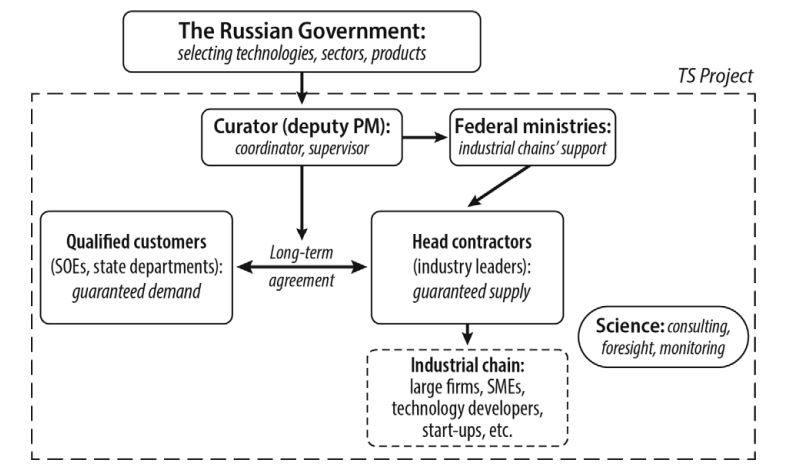
Industrial chains built by the head contractor may include small and medium-sized enterprises, universities and research organizations, including in the role of developers of their own technological solutions. It is assumed that chain participants create mutually beneficial partnerships [39]. However, judging by the documents, participants will most likely interact indirectly, through officials of federal agencies responsible for coordinating their activities and for managing fiscal support (through subsidies, tax benefits, and allocations). Priorities in receiving state support are given to incumbent, large companies in the industries, including state-owned ones, while new, fast-growing firms (start-ups) are expected to join supply chains as subcontractors of larger firms. Basic science institutions, such as the Russian Academy of Sciences, are relegated to a more passive, advisory role — offering support for TS projects by contributing to foresight development, refining sectoral priorities, or monitoring the effectiveness of policy implementation.
The Russian authorities expect that the “mobilization approach” in pursuing TS will provide a breakthrough in economic development. As follows from the Concept, in just six years, Russia should sharply (by 2.5 times) reduce its dependence on foreign technologies, no less sharply (by 2.3 times) increase the level of business innovation activity, raise the share of domestically produced high-tech products in total consumption up to 75 %, and nearly double the production of innovative goods upon relying on indigenous technologies. Besides, Russia plans to move away from its historical dependence on raw materials by boosting the volume of non-commodity, non-energy exports by 1.5 times.
Time will tell the extent to which these ambitious plans will be realized. However, when assessing their feasibility, it is crucial to consider the potential risks.
The initial unfavourable circumstance is that even prior to the 2022 sanctions, the Russian economy has experienced a prolonged period of underfunding of the R&D sector, a lack of innovative activity among businesses, and a sluggish pace of technological renewal. As reported by Rosstat, over the past decades, Russia’s total spending on R&D has not exceeded 1.1 % of GDP. In 2022, this figure fell to a historic minimum of 0.94 %. The contribution of private business to these expenditures has remained at the level of 30 % (against 70 % in developed economies), with the share of innovatively active firms in the total number of companies exhibiting little variation, staying steadily at a minimum of about 10 %.11
The further initial obstacle may be the compression of the accumulated knowledge base. As is known from contemporary innovation theory, a successful technological advance is largely the result of long-term, cumulative effects of knowledge accumulation, rather than an immediate outcome of huge budget incentives [40]. The departure of foreign companies and specialists from Russia, coupled with the relocation abroad of qualified domestic personnel, erodes this knowledge base, thereby causing long-term damage to the country’s technological capacity. This is a loss that is challenging to compensate for, unlike the replacement of high-tech imports.Another type of risk relates to the very design of TS projects. Both international experience and cluster theory reveal that the formation of vertical supply chains, where a network of subcontractors concentrates around orders and budgetary capacities of a single dominant “anchor” company, while horizontal cross-links remain weak, is not an effective organizational framework for technological and innovation development. This particularly applies to chains built through a top-down approach, with government officials selecting priorities and participants [7].
The most significant risks arise from the specific operating patterns of sanctioned economies. Sanctions frequently transform them into semi-closed systems with a vast shadow sector. In such environments, market self-regulatory mechanisms are distorted, business incentives are misaligned, and there is a resurgence of less efficient forms of economic governance, like those prevailing in the industrial era. To address market failures and resist sanctions pressure, governments tend to replace market redistribution mechanisms with budgetary and administrative ones, particularly considering the task of wide import substitution across industries. Such a policy can facilitate operations for selected groups of enterprises, yet simultaneously impose constraints on the broader advancement of technological and production capabilities. Relying solely on its own resources and those of friendly partners, the country may succeed in enhancing the development of some individual high-tech sectors (for example, in IT or the military-industrial complex). However, as Iran’s experience shows, the chance to advance technological competencies and raise technological level of the entire economy is small [41]. The failure of the Iranian “resistance economy” also demonstrates that even with the successful deployment of new manufacturing industries through fiscal incentives, it is not easy to effectively expand non-commodity exports. Economies usually adapt to sanctions by simplifying technology and reducing profitability, thus reinforcing their dependence on raw energy exports [42].
5. Differences of the Russian course from the global trend
Russia’s TS course is often portrayed as part of a broader global trend. However, despite surface similarities (e. g., large-scale budgetary projects, increased defense spending, and protectionist measures for domestic markets), significant internal differences arise from the unique challenges of operating under sanctions.
Firstly, across different countries worldwide, the TS course, despite being linked to specific projects and missions, remains confined to a limited range of sectors. In terms of scope, the US exemplifies the narrowest version of technological sovereignty, Europe represents a middle ground, while China is implementing the broadest version. Russia, in contrast, is deploying megaprojects for the purpose of import substitution and obtaining a self-sufficient set of technologies in the overwhelming number of industrial sectors. Such a task appears to be unfeasible even for a developed country, and in a sanctioned economy, an accelerated transition of industry to its own technological lines may be accompanied by a decrease, rather than an increase, in production standards. Russia’s long-standing trend of economic simplification is also proving to be a hindrance in this area. According to the Global Index of Economic Complexity, Russia has dropped from the third ten to the sixth ten (out of 133 countries in the world) in the 2000s, remaining at this level by 2022.12
Secondly, while Western countries are focused on national control over the latest cross-cutting technologies, Russia’s primary objective is to replace critical imported technologies with domestic ones (even if they are of previous generations), restructure logistics, and localize production [43]. Only at the second stage does Russia plan to rely on its own advanced technologies and ensure accelerated catching-up development by applying a technology leapfrogging approach [39]. Meanwhile, as the literature indicates, focusing on a technological leap represents a risky bet in the pursuit of self-sufficiency, even when adequately trained engineering personnel are available [44]. Moreover, it will be challenging for Russia to realize high-cost, cutting-edge technology projects due to their unprofitability under sanctions. One of the main obstacles to achieving a project recoupment is the lack of economies of scale: even under guaranteed government orders, the domestic demand for sophisticated, complex products is inherently limited in Russia, while the chance to introduce these products in foreign markets may be hindered by sanctions and insufficient competitiveness.
Thirdly, in developed and developing economies alike, energy security based on renewable sources constitutes an indispensable aspect of technological sovereignty. From 2023 onwards, the leading BRICS members have embarked upon a course of green transition. This approach is regarded as opening a promising avenue for a technological leap, both because green technologies (for instance, electric vehicles) necessitate significant advances in a range of industrial sectors, and because the country’s emphasis on attaining carbon neutrality results in a substantial surge in demand for green products [45]. Russia does not prioritize an accelerated green transition on its strategic agenda. Rather, it views China’s and other friendly countries’ investments in green technologies as a security risk, potentially leading to a loss of export and budget revenues. This, in turn, diminishes the Russian economy’s readiness for a possible technological leap, especially considering its limited access to global technology markets and the priority of mass import substitution.
Finally, in contrast to the Western geopolitical bloc, where the restructuring of global supply chains presupposes increased cooperation among developed countries, Russia’s partnership with the Eastern bloc countries is of little help to strengthen its position in cutting-edge technologies. The “full innovation cycle” value chains that Russia is now building domestically may not be aligned with the requirements of modern, complex production systems.
Likewise, the expectations of Russian experts and authorities that global fragmentation will open new opportunities for Russia’s mutually beneficial collaboration with friendly countries in Asia and the Global South [20] may also prove unfounded.
Particularly, it will be challenging for Russia to establish a balanced production cooperation with China, which would guarantee the preservation of its technological sovereignty. The trend of increasing Russia’s dependence on China was formed long before the 2022 sanctions, particularly in terms of intermediate imports. In contrast, the counter-dependence of Chinese industry on Russian supplies and sales markets has remained insignificant by the early 2020s (Fig. 2).
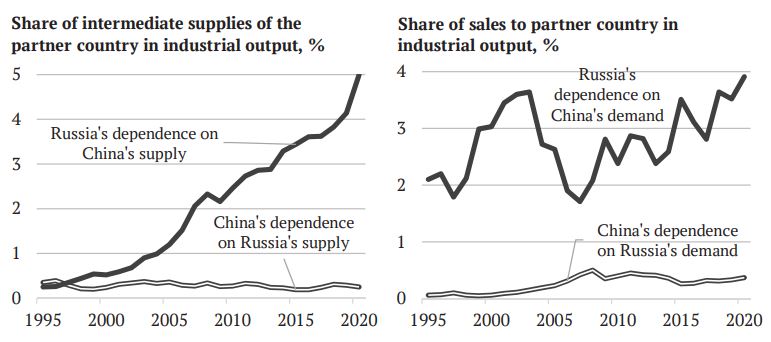
By switching its ties to the East, Russia has widely opened its market to the inflow of Chinese goods and capital. However, China has not yet demonstrated any willingness to make direct investments into the Russian economy or to permit the entry of Russian non-commodity exports into its own economy. Today’s Russia is of interest to China primarily as a supplier of inexpensive raw materials (not just hydrocarbons but also rare metals necessary for competing with the US in technology), as a market for cars and other finished products sold at increased prices, and as a convenient testing ground for the resistance to Western sanctions. In the past two years, China has significantly expanded its trade with Russia, primarily in pursuit of rent profits in a market where it can dictate prices as both a dominant supplier and a dominant consumer. In contrast, for Russia, robust trade relations with China are a key factor for supporting economic growth, which gives rise to several types of critical dependencies. Particularly, in Russia, industrial production depends on Chinese intermediate supplies (including dual-use goods), the federal budget, Chinese oil and gas demand, and foreign exchange reserves, on the state of the yuan and the passage of currency payments through Chinese banks under threat of secondary sanctions. Furthermore, Russia’s efforts to expand trade with the Global South are impeded by formidable competition from China that benefits from cost advantages in manufacturing exports due to economies of scale.
So, regardless of possible configuration of the Eastern bloc, it appears that Russia will retain asymmetrical reliance on China, which will compel it to largely adhere to Chinese technical and technological solutions — even while intensively developing its own.
* * *
Although the process of geopolitical fragmentation is frequently discussed today in the context of reducing nations’ dependence on supplies from unfriendly countries, the literature indicates that its main driver may be the intensifying rivalry between the US and China, and between the West and the East for global technological leadership [4]. In any case, the move towards technological self-sufficiency is becoming a common feature of industrial strategies across a wide range of very different economies. Each country has its own reasons for strengthening the domestic industrial and technological base, but the trend itself reflects the contradictory nature of the current historical moment. Оn the one hand, there is a push for digitalization and green transition to reduce costs and increase efficiency, on the other hand, — growing decoupling, securitization, and the intrusion of politically motivated factors into economic agenda, which raises potential costs.
The key costs are associated with the interruption of supplies of critical intermediate imports. As evidenced by global experience, such trade restrictions often result in the loss of value-added, leading to reduced industrial output and slower GDP growth. The Index of Geopolitical Fragmentation, developed by the IMF experts, reveals that the division of the global economy into competing blocs will negatively affect all countries in terms of output losses, with emerging market economies facing much greater losses than developed ones [47]. Put differently, the restructuring of global value chains on the principles of friendshoring may have painful macroeconomic consequences, while the task of achieving technological self-sufficiency, driven by security concerns or rivalry reasons, may prove more challenging than governments expect. The risks we have discussed above with respect to the EU, the US, the three major emerging economies, and Russia itself further raise doubts about the success of its solution.
Compared to other nations, Russia will likely suffer less direct losses from the ongoing global fragmentation, as it has already managed to weather the shocks of disengagement from the West back in 2022. Nevertheless, it remains unrealistic for Russia to challenge the technological dominance of either the US or China [48]. Over time, sanctions and efforts to adapt to them may place Russia in a vulnerable position, causing stagflation. In sanctioned economies, the risks of stagflation are predetermined by a long-term macroeconomic stress, high inflation costs, and an increasing reliance on fiscal stimulus to keep the economy afloat [42]. In this situation, the planned state support for industry within the framework of Russian TS projects may positively affect the GDP dynamics for some short-term period, but hardly ensure a long-term stimulating effect, since sanctions largely suppress traditional market-based growth drivers.
Moreover, while large-scale spending on megaprojects may offset sanctions-related losses for major Russian businesses, including state-owned enterprises, these investments will hardly help to achieve the outlined goals in the field of technological development. The problem extends far beyond the too broad range of sectoral priorities, involving numerous structural and institutional barriers. It is crucial for Russia to avoid a scenario where the interest of large businesses in receiving subsidies and maintaining industry leadership is restricting the growth opportunities of medium-sized technology companies, both private and mixed, who are central to innovation and to establishing collaboration with universities, research institutions, and small innovative firms [39]. Furthermore, the issue of technological sovereignty highlights the acute need for facilitating the transfer of technology, capital, and labour force from defense to civilian sectors, which has historically been a challenge for Russian industrial policy.
Despite the growing influence of developing countries in the global economy, a bloc association with geopolitically close partners may also prove ineffective in delivering the anticipated strategic benefits to Russia. These countries are objectively unable to compensate Russia for the loss of Western markets, especially in terms of attracting investment and the latest technologies, given their economic capabilities and the pattern of their attitude toward cooperation with Russia. In the context of a fragmented world, they will most likely remain the main beneficiaries of the Russian sanctioned stance, continuing to profit from price arbitrage mechanisms [3].
High oil revenues, which have so far allowed Russia to pay for increasingly expensive imports and cover increased transaction costs, may get insufficient if China’s economic slowdown persists or if India turns to alternative oil suppliers such as Saudi Arabia or Venezuela. In such a scenario, an influx of Chinese capital could provide relief, though this prospect depends not just on Russia’s efforts, but also on China’s future strategy for dealing with the West. Despite China’s pivot towards technological self-sufficiency, its businesses and banks still prioritize the American and European markets, often complying with the sanctions regime to avoid the risk of secondary sanctions. What does not depend for Russia on external circumstances is a possible determination of the Russian authorities to follow China’s example in increasing budget investments in science, especially basic science. Considering the sanctions, this approach should be regarded as an imperative: without a concerted effort to enhance the knowledge base, Russia will find it difficult to maintain its current technological standards.
In today’s historical context, Russia’s move towards technological sovereignty has seemingly no viable alternatives. However, even under an optimized implementation, such a course does not guarantee automatic progress in innovation or economic growth dynamism. A realistic approach is to admit that an economy’s self-adaptation to sanctions is usually accompanied by its shift to a lower technological trajectory, where the reduced level of complexity provides a new macro-equilibrium and “natural” self-sufficiency. Attempts by governments to realize a more positive adaptation scenario, thus making the economy more productive and profitable than the balancing market forces would allow, have not yet succeeded anywhere.
This research was carried out at the Centre for Innovation Economy and Industrial Policy of the Institute of Economics of the Russian Academy of Sciences under the state assignment “Structural modernization and ensuring Russia’s technological sovereignty”. The authors are grateful to two anonymous reviewers for helpful comments and remarks.
Reference