Dividing Lines in the EU’s Common Foreign Policy: Russia as a polarising factor


Abstract
Amid the ongoing confrontation between Russia and the West, the processes of consolidation and divergence among political elites are crucial for understanding the mechanisms that form dividing lines. This is particularly important when examining the elites of the European Union in their opposition to Russia. This article aims to develop a framework for analysing the dividing lines among EU elites in the context of relations with Russia. The analysis employs a multi-tier model establishing a relationship between the ‘depth’ of a dividing line and the degree of elite disunity. The model includes two levels of analysis of dividing lines within the EU: supranational and national. The research demonstrates that, depending on the degree of interest misalignment and the availability of communication channels, elite divergence can result in segmentation, fragmentation or polarisation. Each of the tiers of divergence increasingly reduces the likelihood of forming a common EU position on foreign policy issues. All three tendencies — segmentation, fragmentation and polarisation — are observed within the EU in relation to Russia at different levels of elite analysis. Crucial to the formation of a dividing line is the aspect of EU—Russia relations in question: the degree of distancing from the country or support for, and funding of, containment. Additional variables include factors such as the regional affiliation of the elite, their ideology and position within the power structure. Among all levels of analysis, polarisation is most evident in the efforts of supranational elites to promote ‘militant integration’, which conflicts with the interests of national elites and citizens of member states.
Introduction
One of the most significant phenomena in contemporary international relations is the confrontation between Russia and the West, which tends to escalate. In these circumstances, the research on the factors influencing Western countries’ foreign policy decision-making process and the dividing lines existing within Western elites regarding policy formulation towards Russia becomes particularly relevant. It is especially important given the fact that, as President Vladimir Putin noted, Russia is not opposed by unfriendly states but by unfriendly elites.1 These issues are also highly relevant to the European Union (EU), one of the key centres of the modern world and a significant counterbalance to Russia. In the EU, foreign policy decision-making processes at both national and supranational levels are closely interconnected, yet they also exhibit substantial distinctive features.
While maintaining an official anti-Russian stance, EU member states are increasingly confronted with internal and external divisions across various levels of society, driven by socio-economic, political, ideological, and other factors. In the current situation of open confrontation with Russia, the articulation and implementation of a common foreign policy course towards Russia have become an impetus for the formation of dividing lines within European countries. Here, the EU’s political elites play a central role, differentiating in their degree of support for anti-Russian initiatives based on political or national affiliation.
Scientific research on this phenomenon is of great value for determining the current political line concerning the EU and individual European countries. For this reason, the article’s authors propose their approach to analysing the dividing lines formation process among EU political groups, standardised within a unified model. The supranational segment of the EU elite, associated with the “multi-component European elite system” [1, p. 28], is considered as an example. At the same time, divergence is considered only within political circles as a specific manifestation of the EU elite’s multi-level and complex environment.
The article aims to develop a model for analysing dividing lines within Western elites, using the EU as a case study in contemporary relation to Russia. The model relies on the authors’ gradation of elite divergence degree, including stages such as segmentation, fragmentation, and polarization. The priority is to identify common mechanisms for the dividing line formation in the EU derived from the supranational environment. Consequently, the model presented in the article might be applied further to other Western countries.
The article is structurally composed of theoretical, methodological, and empirical parts. The first and second parts address the general scientific aspects of inter-elite dividing line creation. They draw on concepts of social divergence and the structure of the EU elites. These sections establish the general framework of the model for analysing dividing lines. The third section focuses on practical examples of elite divergence from EU practice, expressed in specific political cases.
In developing the model, the authors employ a structural and functional analysis, focusing on identifying the broader, supranational elite system and evaluating the functional connections and positions of Euro-elite segments concerning foreign policy decisions. The model is based on a comparative analysis of elite segments, assessing their stances on two key aspects of relations with Russia: the severance of ties and support for Ukraine. Accompanying factors (ideological, geopolitical, institutional, etc.) determined the resulting configuration of dividing lines.
The empirical basis of the work includes speeches and statements by EU politicians reflecting differences in the EU elite discourse. Statements are selected based on the representation of the three main segments of the EU elite, depending on the cases and forms of divergence under consideration. The examples are general and do not intend to delineate the full range of existing positions. Their purpose is to illustrate the broad contours of the presented analytical model.
Dividing lines within society and political elites: theoretical aspect
The emergence of dividing lines in modern political and national communities is a natural phenomenon with a significant range of causal prerequisites. The disunity of society and elites is not uniform or homogeneous. It includes gradation, which determines the “depths” of the dividing lines. In contemporary social sciences, a list of terms reflects various forms of social divergence. Among them, ‘segmentation’ used in economic market research, ‘fragmentation’ [2], which comes from the field of digital and computer systems analysis [3], [4], and ‘polarization’, which has gained popularity over the past decade against the backdrop of global populism growth, play a central role [5]. These categories are used in scientific research in conjunction or separately but rarely form a systematic or multi-level understanding of the process of social divergence.
Nevertheless, the gradation of divergence is a necessary basis for studying dividing lines, as it defines criteria for empirically significant cases of cleavage formation when analyzing inter-elite interaction. For this reason, the authors of the work carry out a general systematization of the concepts of segmentation, fragmentation, and polarization. The gradation of three forms of rejection of compromise existence among elites relies on the intensity of contacts between political groups and the degree of ideological differences. A potential transition from one stage to another features the reduction of ties, followed by a transformation in mutual perception.
Segmentation, as the initial stage of elite divergence, implies a split into separate parts while maintaining mutual contacts. The emergence of segmentation elements signifies the division of community members into groups based on distinctive characteristics, which is a prerequisite (but not necessarily a cause) for ideological cocoons and information barriers in communication [6, p. 58]. The basis of segmentation may lie in classic ideological boundaries, relying on old and updated ideological markers (‘left’, ‘right’, ‘liberals’, ‘conservatives’, ‘nationalists’, ‘fundamentalists’, ‘radicals’, etc.) [7, p. 179].
The next stage of elite divergence, fragmentation, forms a trend toward the reduction or disappearance of intergroup communications present during the segmentation stage. Fragmentation manifests in cutting dialogue in favour of direct separation and the rupture of mutual ties between already formed groups. It leads to decreasing social solidarity between emerging groups and increasing ideological disproportion while each group consolidates its interests and goals. However, unlike polarization, subgroups in the fragmentation process may have similar or overlapping interests, leading to mutual sporadic cooperation and coordination without stable connections.
Polarization only solidifies the breakdown of the social structure and leads to conflicting and non-overlapping positions. It is no longer just a communication breakdown. It creates a ‘counter-narrative’ and polar positions that provoke direct or indirect confrontations among elites. It is associated with the division into groups with different views, differing beliefs, and interests, as well as the fixation of dividing lines in conflicting narratives. In other words, consolidation of dividing lines and political group distancing form the basis of polarization. At present, polarization studies highlight two main foundations: preference-based polarization, or issue-oriented polarization, and so-called identity-based polarization, or affective (social) polarization [8—10, p. 922]. The latter is directly related to the ideological chasm between political groups and interpersonal confrontation among their representatives [11, p. 53]. At the same time, polarization can be, depending on the research agenda, a gradual process or a formed state of the elite and society [9]. All these characteristics clarify the polarization features and secure its status as a critical point in ties degradation between elites.
Any stage of social divergence can manifest as a result of the decline in the overall density of social contacts or the degradation of political consensus. There can also be causes stemming from other spheres of social life (e. g., economic stratification or intercultural confrontation). At the same time, dividing lines emerge at various levels of society, including disunity between social groups, marginalized groups and the mainstream of society, the masses, and elites, or the elites themselves.
It is necessary to emphasize the relevance of introducing a gradation of elite divergence in the context of foreign policy dynamics and the process of forming a collective position on specific aspects of international relations. Regarding this spectrum of issues, dividing line formation can occur due to internal and external causes. Internal causes depend on the relevance of the considered issue for society within the country and the structure of communication channels among political elites. External causes may be associated with direct and indirect external information influence, the position of the actor under consideration in the context of international ties of the state itself, its status within the international system, or various regions of a particular country. At the same time, external intervention has different importance depending on the phase of elite divergence. Artificial incitement of contradictions is a reason for consolidation, while the presence of real dividing lines facilitates the usage of the external factor in the context of elite conflict. All these variables create boundaries in the transition from one degree of inter-elite separation to the next.
Of all three categories of divergence—from segmentation to polarization—the most significant boundary is between polarization and fragmentation, as segmentation, to some extent, represents the natural state of a multiparty political environment. In contrast, fragmentation and polarization indicate the beginning of the degradation of social ties. However, within the framework of group dynamics, all three stages are possible only in the presence of a common phenomenon that triggers these processes. The absence of a common problem field does not create positive or negative connections for further inter-elite dynamics. It is also reflected in the subsequent securitization of key national priorities by the elite and the communication with the masses [12, p. 2], [13, p. 67].
The political space of European countries shows that complex political connections arise between political elites, varying in a spectrum from conditional unity to sharp confrontation. The structure of these relations depends on the specific topic or factor at the centre of attention. The demonstrated closeness, for example, on issues of relations with partners, may have a diametrically opposite character when discussing interaction with opponents. The most significant are those topics that can outweigh stable connections and create a rupture between elite groups. According to post-functional integration theory [14], [15], such topics include particularly sensitive issues affecting the elite’s or the country’s identity.
In the current situation, the political agenda concerning Russia is increasingly becoming such a topic for European countries. In some cases, this issue serves as a subject for elite fragmentation, maintaining an unstable balance, while in others, it becomes a real cause for polarization. It indicates the status of polarization as a process with active dynamics and the potential to transition from a problem-based to an affective form.
A clear definition of the ‘depth’ of dividing lines allows for an accurate characterization of the state of the elite in a particular country. It also aids in avoiding the simplification of the situation or an attempt to project an ideologically favourable state onto the actual circumstances. Such aspects are crucial in foreign policy planning. The state of fragmentation among elites preserves the possibility of consensus maintenance between fragments despite apparent disunity. In contrast, polarized ideological differences in narratives indicate a low likelihood of finding consensus (or its absence).
There is a vast number of sources for the emergence of social and inter-elite divergence, ranging from inequality, uncertainty [16], degradation of political culture, and populism [17], [18] to a set of individual prerequisites (cultural-religious, ethnic, and demographic differences). These factors lead to ideological and political differences in interests and positions. In other words, the social, political, and economic basis becomes the starting point for fragmentation, making subsequent polarization on key issues (including foreign policy formation) possible.
Thus, the theoretical understanding of dividing lines forming among elites points to differences and variability in the possible states of inter-elite balance. While polarization refers to the separation of elites with apparent distancing and rivalry with each other, fragmentation is associated only with the simpler divergence of elites into multiple separate groups or subgroups with minimal (but potentially maintained) communication. This gradation allows for a better understanding of the conditions under which it is appropriate to speak of politically significant divergence between elites and when it is an ideological split, not turning into a conflict of elites.
Levels and parameters for analyzing dividing lines within the EU supranational elites
A substantial component of studying the mechanism of dividing line formation remains the conditions to assess the elite divergence level. The model for analyzing the degree of divergence among EU elites in the face of confrontation with Russia, proposed by the authors, supplements the gradation of divergence with three key questions. Each of these forms the prerequisite for establishing fault lines. The figure depicts the general features and variables for analysis.
The following includes a critical assessment of which political groups should be considered the EU elite in foreign policy matters today (Variable 1). Equally important is to identify issues in relations with Russia that form dividing lines (Variable 2). The third aspect concerns the environmental factors determining the divergence conditions (Variable 3). The choice of subjects is determined by the functional relationship between the agent, context, and triggers [19]. The final part of the model records the overall degree of divergence. This model, as currently presented, is the author’s algorithm for analysis. It does not form a final matrix or coordinate system for determining the final conditions of each dividing line type. Its heuristic value lies in the distribution and systematization of observable prerequisites for dividing line creation within the EU elites. The model allows for the characterization of the dividing lines and specifies the state of divergence. By doing so, it avoids oversimplifying the nature of elite disunity by viewing it through the lens of only one component. Below is a clarification of why these variables are central to the model.
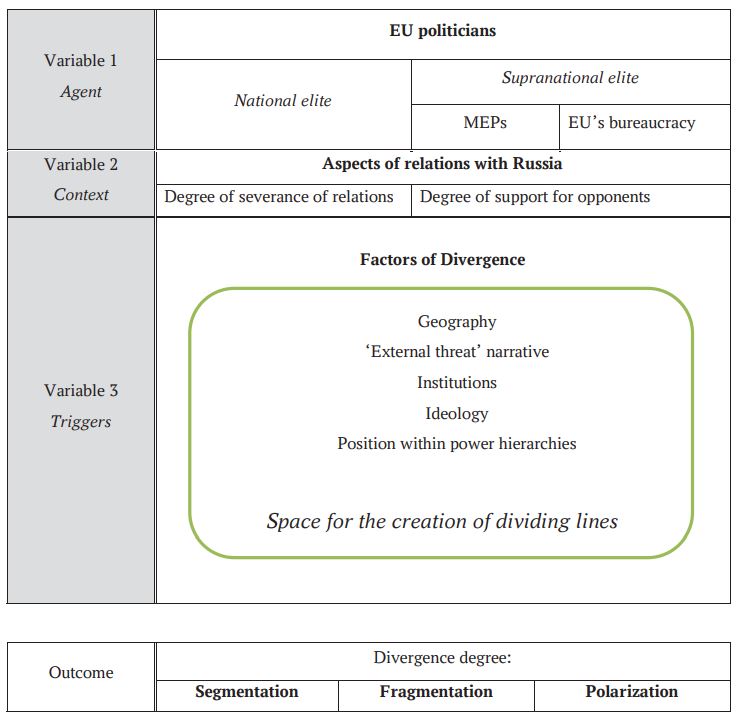
The issue of political circles (Variable 1) is of fundamental importance because it largely determines the structural complexity of the current foreign policy decision-making system in Europe. The primary assumption here is that the European space (and the space of the collective West within European borders) is associated with integration structures, primarily the EU. This assumption certainly does not account for the fact that not all European countries are part of EU institutions (e. g., the United Kingdom, Norway, Switzerland). However, to identify the patterns of polarization among elites in unfriendly countries, and given the EU’s role in coordinating anti-Russian measures, this assumption is considered acceptable.
From this assumption follows the key feature of the modern political systems of most European states, namely their multi-level structure, combining national and supranational elements [20], [21], [22], and thus national and supranational political elites [23], [24]. The former derives from traditional party ties and connections with central authorities. The latter, supranational, is associated with European institutions (e. g., the European Commission, the European Parliament, the European External Action Service (EEAS), etc.) and is represented by appointed ‘EU’s bureaucrats’ and elected MEPs. The existing institutional balance in the EU suggests that some institutions—the Council of Ministers and the European Council—ensure the status and functions of national elites. Other European institutions represent more of a union elite than a national one. However, supranational political groups have direct connections with nation-states, as there is often a transfer of national elites to the rank of supranational elites and vice versa.
Each elite has its own internal group identity [15]. National elites maintain an important role in determining political direction within the system. However, managing foreign policy issues is complicated by various priorities of the EU’s political elite (MEPs and EU’s bureaucrats) with a polycentric system of national forces. This trend has solidified since the EU gained international legal personality and established a permanent foreign policy institution (EEAS) [25], [26]. However, while national elites enjoy a high level of legitimacy, often due to their connection with the institution of elections, EU’s bureaucrats suffer from a legitimacy deficit, also referred to as a “democratic deficit” [27], [28]. The institutional procedures for appointing EU’s bureaucrats, even considering reforms undertaken in the 21st century, do not entirely depend on the choice of EU citizens.
In summary, the political space of the EU is a multi-component elite system, including national political elites, who can unite for activities at the European level, and the EU’s political elite. It is crucial to point out that business elites, civil society, and other political process participants are excluded from this system, as they have an indirect (albeit crucial) influence on the decision-making process and require separate consideration.
The second (contextual) part of the model (Variable 2) reflects those aspects of relations with Russia that create the basis for forming dividing lines in foreign policy issues. The foundation consists of two central contradictions: socio-economic issues and military-political confrontation. These have emerged since the onset of the sanctions confrontation and the information war between the EU and Russia in the mid-2010s [29], [30]. Both issues are logically connected but can contribute to elite divergence to varying degrees.
Under current conditions, the first includes the degree of severance of relations with Russia, and the second involves the degree of participation in the conflict in Ukraine. The severance of ties primarily includes varying sanctions measures and various forms of reduction in socio-economic and cultural contacts with Russia. Participation in the conflict in Ukraine signifies the EU and its elites’ shift from competitor status to that of unfriendly states and alliances. It is expressed in various forms, such as humanitarian aid or discussions about the possible deployment of a limited military contingent.
It is important to emphasize that dividing line creation, like divergence itself, is more of a process than a state, reflecting inter-elite dynamics. In the EU space, the factor of Russia as a thematic field for elite fragmentation simultaneously creates a basis for all three levels of divergence, directly dependent on factors that exacerbate tensions between elites (Variable 3). The foundation for analyzing such factors can be found within social variables [31], which include:
— Geographical proximity (border with Russia);
— Tone of the narrative about the “external threat”;
— Institutional framework;
— Internal and external ideological divergence;
— Position within power structures (ruling or opposition).
The list of variables is not exhaustive, but on a conceptual level, the essential element is the relationship between the factors and the level of divergence, which are systematically dependent on the elite level and the considered issues at a specific time. Depending on the empirical basis, certain factors will be more significant in determining elite divergence. For example, it can be assumed that the ideological divergence between right- and left-wing forces regarding material support for Ukraine will be crucial among MEPs but is hardly noticeable among the EU’s bureaucrats. At the same time, the nature of divergence (fragmentation, polarization, etc.) may be determined by the immediate position within the power structure—dominant or marginal. There is also evidence [32] of a geographical correlation that provokes the fragmentation of the national segment of the EU elite regarding reducing support for severing relations with Russia.
Thus, the presented analytical model includes a combination of theoretical concepts and practical variables, forming a unified problem field for determining the “depth” of dividing lines. The model requires further refinement by implementing quantitative assessment tools and tracking divergence dynamics. However, in its current form, it allows for the initial classification of dividing line formation cases among EU elites, thereby enabling its limited testing.
Russia as a dividing lines emergence factor
The gradual formation of a supranational Euro-elite, which preceded the modern confrontation between the West and Russia, created a context where the consolidation of contradictions in the inter-elite consensus accompanied the
Euro-elite’s search for its place within the EU’s political system. The multi-faceted nature of this process, with the dominant role of nation-states, simultaneously imposed limitations on national interests for the sake of consensus, forcing a balance of priorities at different system levels [29]. However, embedding limitations on elite and state interests through balancing (through sanctions and normative pressure) creates a basis for fragmentation. It derives from the lack of a dominant force, only partially filled by EU leaders in tandem with leading member states. In sum, it defines the conditions for elite divergence at the supranational level (with a projection onto the states) when forming a common foreign policy towards Russia.
Examples with varying degrees of separation help to identify the nature of EU elite divergence. Further case analysis illustrates each situation presented in the theoretical part, with subsequent reflection on the previously introduced variables.
Segmentation of EU elites
The EU elite system implies that political heterogeneity and segmentation in European countries is (even without external confrontation) a state of normalcy. For example, even before the start of the Special Military Operation (SMO) in February 2022, there were fault lines in the West at the transatlantic (in transnational and transgovernmental manifestations) [33], intra-regional (between Western and Eastern Europe), and intra-state levels [34]. Such conflicts cannot be fully perceived as interstate, as they reveal a component of confrontation between the conventionally liberal and conservative vectors of the multifaceted European elite.
Some examples of dividing lines became direct precursors to further fault lines in the context of the onset of the SMO. For example, the inconsistent course of German elites regarding Nord Stream 2 found a direct continuation in the form of a heterogeneous reaction to sanctions and the reduction of economic contacts with Russia after 2022. It indicates the presence of a whole layer of predominantly national prerequisites [35; 36] that served as the basis for an intra-elite split following the escalation of the confrontation in 2022.
The start of the SMO triggered a relatively homogeneous collective reaction from the majority of the EU elite, expressed in particular by the position of the European Council,2 echoed by the EEAS3 and the European Parliament.4 However, various segments of the EU elite subsequently differentiated their positions on building socio-economic ties with Russia, primarily on sanctions. Notably, the issue of the oil price cap demonstrated divergence.5 While there was broad support for the measure, Polish and Baltic politicians deviated from the consensus toward a lower price cap.6 In contrast, Hungary and several other countries retained the right not to participate in this mechanism.7 The price cap on Russian gas proved to be an even greater stumbling block, provoking a less uniform reaction across Europe. Greek Energy Minister Kostas Skrekas remarked that “Europe is engaging in futile debates”.8 Hungarian Foreign Minister Péter Szijjártó emphasized that in a trial vote among energy ministers, nine countries voiced critical opinions on the issue, opposing the price cap.9 Meanwhile, at the level of EU supranational leaders, including European Commission President Ursula von der Leyen, there was a strong push to promote restrictions in the energy sector.10 Consequently, a dynamic mechanism was established, which became a means of maintaining a state of segmentation without escalating into more acute dividing lines in the positions of countries and elites.
A key illustration of the overall segmentation of EU elites is their support for Ukraine during the conflict. Despite the dominant position that comprehensive assistance is necessary, an important indicator becomes the question of its degree and form. Elites express disproportionate support for various initiatives, ranging from political statements and basic humanitarian aid to points on EU membership and direct interference. The most pressing issue by the beginning of 2024 is the problem of financing military expenditures. Among the elites, there are opposing views on the possibility of creating joint EU bonds to finance arms supplies to Ukraine: the initiative is supported by politicians from France, Estonia, and Poland but not from Germany, the Netherlands, and Austria.11 Efforts to avoid deepening the dividing lines on this issue are being made at various levels. For this purpose, EU politicians consistently declare Russia’s intention for a “prolonged conflict with the West”12 and adopt general resolutions of the European Parliament13 on military support for Ukraine.
The examples lead to the conclusion that the factors of segmentation are economic beliefs (case of financing military expenses) or the geography of the elites (price cap situation). EU countries with a common border with Russia show a greater inclination towards active support for Ukraine, while in countries farther from Russia, the desire for support diminishes.14 This national division is aligned partially at the supranational level, where the EU’s bureaucracy expresses little divergence and MEPs rarely defend national geopolitical priorities. It reduces the divergence process to merely a segmentation status.
At the same time, considering the multifaceted nature of the elite, individual EU politicians have come to realize that the “available space for adopting new measures is becoming increasingly limited”.15 Further trends toward intensifying support for Ukraine will increase the degree of “militant integration” [37], [38], which, on the other hand, may potentially provoke a response from opponents of such an EU trajectory in the form of fragmentation or polarization. However, the visibility of increased divergence will depend on the scope of elites deviating from the thesis of the existential necessity for the EU to increase support for Ukraine.
Fragmentation of EU elites
The attempt to use external consolidation as a lever for rapprochement is associated with the desire to reduce the threat of divergence in the face of common challenges [10]. Representatives of the elite of the largest EU states undertake initiatives in this direction [38]. However, the intuitive connection between a collective external adversary and consolidation can be either dynamic [39] or even misleading. As a result, not only may unification not occur, but a directly opposite trend toward fragmentation may emerge.
In some cases, the degree of support for Ukraine, especially such confrontational measures as the supply of Taurus cruise missiles or statements about the possibility of sending a military contingent made by French President Emmanuel Macron,16 serve as grounds for fragmentation. On these issues, the positions of Olaf Scholz17 and Emmanuel Macron are directly opposed. Scholz openly stated that “there will be neither ground troops nor soldiers sent there by European countries or NATO states on Ukrainian soil”18 and spoke against the supply of Taurus missiles.19 In these matters, divergence shifts to a qualitatively new state as conflicting positions entrench fault lines in opinions. To adopt an opposing position is not considered acceptable, yet communication on these issues continues.
The fragmentation of opinions due to the situation with missiles and ground troops in Ukraine can be attributed, at least in part, to the absence of direct leadership among the national segment of the European elite. For this reason, the EU’s bureaucracy20 and MEPs are attempting to reduce fault lines by shifting the initiative towards further militarization to themselves. Consequently, in opposition to Scholz’s stance, MEPs are advocating for the deployment of Taurus missiles to Ukraine.21 However, the boundaries between sovereign and supranational initiatives and mutual pressure further fragment the elites within states and between levels of the EU elite system on matters of great sensitivity.
A similar trend is present in the European Parliament. Contrary to the expected consolidation of deputies, the opposite effect has occurred, revealing the ideological and regional fault lines that existed before the SMO [32]. Primarily, this refers to the dividing line between developed and developing EU countries and the growing isolation of eurosceptic MEP [40]. These trends may be identified by indirect indicators, namely the intensity of network connections within social media observed since the beginning of the SMO. Despite the initial general surge in network activity among all groups of MEPs at the start of the conflict, Eurosceptic circles have reduced their participation in verbal support and online discussion of issues related to the conflict in Ukraine [32]. It encompasses marginal and radical groups, as well as supporters of an alternative political agenda in general. Due to the weak propagation of their position through traditional media, social networks become an important platform for them, where fragmentation is captured.
This trend illustrates the shift to a more pronounced form of divergence and significantly reveals the fragmentation of the only EU institution directly elected by citizens. In comparison with the more homogeneous line of EU bureaucrats, this suggests that the degree of divergence in support for European initiatives and policies towards Russia can significantly vary when comparing the elected and appointed parts of the European elite. In turn, it contributes to the fragmentation of not only political groups within the European Parliament but also different parts of the supranational Euro-elite.
Polarization of EU elites
The most challenging aspect of the EU’s foreign policy is the ideological divergence intersecting with the issue of various elites’ connections to Russia. In academic and political discourse, there is a prevailing image of a direct link between European right-wing conservative circles and Russia, or at least a closeness to it [41], [42]. However, the reality is more complex. A review of 37 far-right parties [43] and an analysis of their activities in the European Parliament [44] show that fragmentation exists even among them. Some elites quickly distanced themselves from supporting Russia after the start of the SMO,22 while others, using cultural-civilizational arguments, justified their stance toward Russia’s policies.23
Even more significant is the inability of the shifts in European politics and the nominal consolidation of the European space to “delegitimize” right-wing ideological views. After a brief retreat, these views have, on the contrary, seen an increase in electoral support for right-wing forces. Some right-wing politicians have used pro-Russian rhetoric as a tool to criticize the worsening economic situation in Europe [43]. These observations are reproducible within both the national and supranational segments of the Euro-elite, forming the basis for political divergence to transition into a stage of polarization. At the same time, this trend occurs on the political periphery, frequently found in circles with strong cultural and economic ties to Russia.
The most striking manifestation of polarization is the mainstream political establishment’s direct effort to block the political agenda of pro-Russian right-wing circles. In the run-up to the 2024 European Parliament elections, the scandal surrounding the news website Voice of Europe reflected this effort,24 since the website promotes pro-Russian views on sanctions and the situation in Ukraine. This situation strongly affected far-right German politicians25 and extended to representatives of similar political circles26 in France, Italy, the Netherlands, and others. In a speech by Ursula von der Leyen, special concern was expressed about right-wing elite members opposing the EU.27
Ideological divergence combined with emerging polarization on issues related to interactions with Russia is observed not only in right-wing political circles. In some cases, it appears on the opposite, the left side of the political spectrum. A differentiated understanding of the left movement shows that one part is ideologically post-communist, while the other is socially democratic. The ideological disunity of left-wing forces is indicated by more pro-Russian views from the former (expressed, for example, in direct calls by these German leftist forces for a peaceful resolution28) and an anti-Russian stance from the latter [31]. However, as with the right-wing movement, this trend reflects more marginal rather than central political contradictions in Europe.
If polarization is considered not from the perspective of support for Russia but from the position of assessing actions to support Ukraine within the framework of the conflict, then dividing lines emerge between ruling elites and opposition forces [45]. It particularly affects questions of the effectiveness of sanctions.29 Opposition forces often use the conflict and its national costs to increase their electoral support, contrary to expectations of consolidation. At the same time, the pro-war policies of the current authorities are presented in terms of path dependence. In this context, the European Parliament elections also indicate a trend toward polarization, which is confirmed by growing concerns30 about the strengthening of opposition and radical forces in the new composition of the European Parliament.
Thus, the EU illustrates a multifactorial and complex environment in which the formation of dividing lines on foreign policy issues is coupled with varying degrees of divergence. Polarization between support for and opposition to Russia’s policies within the European elites is limited and marginal, while fragmentation and segmentation are more pronounced. In some cases, the existing political expectations of polarization in the public space do not align with the actual dividing lines. For this reason, applying a gradation of the degree of divergence allows for avoiding a false determination of the real European agenda. This approach offers a more precise understanding of the communication structure between EU elites, particularly between the bureaucracy and party elites.
Conclusion
The model formulated in this article for studying the dividing lines among EU elites on issues related to Russia has three fundamentally important variables for analysis. First, the basis is the gradation of the degree of elite divergence that forms the dividing lines. It includes the segmentation of elites, their fragmentation, and polarization. Second, the multifaceted nature of the EU elite requires the incorporation of European supranational elites (elected and appointed) in the analysis framework alongside traditional national elites. The role of state elite representatives is to articulate interests at the level of individual EU institutions. Third, the issue articulation in relations with Russia is of fundamental importance for the creation of the dividing lines. There is a notable difference among elites depending on whether the issue concerns the degree of severing relations with Russia (economic, cultural, etc.) or the degree of involvement in the conflict in Ukraine. Furthermore, geographic and ideological variables, combined with the status of a particular elite within power structures, play a significant role in determining the divisions and the degree of divergence. These factors most often determine the resulting degree of elite divergence.
The real polarization (with the highest degree of dividing lines) lies in the search by supranational elites for means of reputational growth and ways to intensify “militant integration.” It is perceived in ideologically and geographically divided political circles in a polarized manner, especially in conditions of supranational democracy deficit. The growth of polarization correlates with the transition of the discussed issues from the social and economic field to the military and political sphere. The divergence of demands from national or ideological groups on these issues within supranational bodies can potentially provoke elites to move to higher levels of divergence.
At the same time, as the multi-level analysis in the EU shows, hard polarization, and consequently the emergence of deep dividing lines, remains more of a hypothetical development scenario for the EU elites under current conditions. The actual situation is associated only with a trend toward the intensification of segmentation, which (in some cases) shifts to fragmentation along certain dividing lines. This phenomenon reduces the likelihood of maintaining a consolidated position among the elites and EU countries regarding Russia. The presence of certain political groups opposing increased confrontation, along with institutional complexity, creates conditions for deepening dividing lines.
The research was carried out with the support of a grant from the Russian Science Foundation №24-28-01280 “Dividing lines in Western policymaking elites with regard to development of policy towards Russia in circumstances of confrontation“.
Reference